Lauren Groff: The Monsters of Templeton (2008)


This is quite an unusual, hybrid book. There were passages I enjoyed a lot. The atmosphere and description of Templeton were something to savour. The idea of a monster living in the lake and the ghost in Willie’s bedroom appealed to me a great deal as well. But as much as I loved the beginning and many later parts I lost patience at times. My biggest problem was that I found it too exuberant and too artificial. It is full of great descriptions but totally lacks any psychological depth. The characters, Willie, her mother Vi, Cassandra and many others are charming but they are two-dimensional. Still I can understand that this book found his ardent fans.

At the beginning we see Willie depressed and sad. She is pregnant from her affair with her professor and comes back to Templeton where she grew up looking for refuge. She considers this to be a total failure. She has left Templeton for San Francisco a few years back. Templeton, as we read in the foreword, is actually Cooperstown, Groff’s hometown. It is also the hometown of James Fenimore Cooper. A small town with all the charm of a small town. While away in California Lauren Groff was so homesick that she decided to write about her town.

Apart from being pregnant and desperate, Willie hears from her mother,  that she is actually the daughter of someone from Templeton. After having thought she was the offspring of her mother’s casual encounters with different men during her hippie days, this comes as quite a shock. Willie being an archeologist and trained in research takes this bit of information as a challenge. She starts to investigate the story of her illustrious family, descendants of the great Marmaduke Temple (aka James Fenimore Cooper) in order to find out who her father is. She knows that one of the men in her genealogical tree is illegitimate and this information will lead her to her father.

The story of Willie is interspersed with journal entries, letters, diaries, stories of her ancestors. They are quite different in tone, some are like short stories in their own right and seem to have been written in another century, some were, for me, just tiresome diversions.

In the end, Willie knows the name of her father. She has learnt a great deal about her family and her town. The weak and depressed Willie of the beginning is strong again and able to go out into the world where a brilliant future is waiting for her.

This book deals with some heavy and important themes like illegitimacy / legitimacy / roots /origins /  parenthood/ history. In the beginning there are a lot of  signs of the insecurity of the times we live in but throughout the novel this is more and more abandoned. It is as if the author wanted to say: When you know your origins and where you belong you can never get lost and nothing can really harm you. I am not sure I agree with this.

Be it as it may, this is an original book and some parts are memorable. It’s just somewhat flawed as  a whole.

I would really like to do Lauren Groff justice so maybe I should let her speak for herself:

Taking the R.I.P.V Challenge

Thanks to Danielle from A Work in Progress, I found this challenge that is truly to my liking. Being a Goth at heart I am really looking forward to this. Participating and reading alike. It has started end of September and finishes on October 31st. Since I am maybe the only or one of a few non-native English speakers participating I tought it might be my own personal little challenge to find German examples.

And here goes:

My choice for a novel is going to be one of Gustav Meyrink’s. It will be either :

The Golem

The Green Face

The White Dominican or

The Angel of the West Window

The short story has already been chosen. It is going to be the following:

E.T.A. Hoffmann’s The Sandman

Last but not least., I chose a classic movie namely   M.F. Murnau’s Nosferatu.

Anyone who sees this and would like to join, please got to Stainless Steel Droppings for details.

Carson McCullers: The Ballad of the Sad Café (1951)

I remember reading The Heart is a Lonely Hunter years ago. What a special book but quite sad. All these people confessing to someone who is mute. I was very touched. Right after I also read The Ballad of the Sad Café which I have finally read again.
Carson McCullers was such a gifted writer. The way she tells this story of friendship, love and betrayal is so full of foreboding. Melancholic and gloomy at the same time. But also nostalgic. The narrator whose presence is very strong leaves no doubt as to the outcome of this story.  The title already gives away the tone, since ballads are not often joyful and one about a sad café is even less likely to be so.
Miss Amelia, the central character, is very unusual. She takes pride in things that are normally rather attributed to men like great physical strength. She can fight a man with her bare fists and often she will win. She is also a cunning  business woman and a healer. And an introvert who lives a lonely life on her own, although, as we are told, there was a ten-day marriage once. The setting, a small town in the rural South in the  forties of the last century, is described with a lot of detail. We are drawn into the story right away. We see, feel, hear and smell the place. We see the people sit together on the porch during the hot summer nights and sipping their drinks. I always idolized the South and the literature about it with its Gothic feel that can even be found in a lighthearted book like To Kill a Mockingbird. In this much gloomier tale the setting seems to have a life of its own.
If you walk along the main street on an August afternoon there is nothing whatsoever to do. The largest building, in the very centre of the town, is boarded up completely and leans so far to the right that it seems bound to collapse at any minute. The house is very old. There is about it a curious, cracked look that is very puzzling until you suddenly realize that at one time, and long ago, the right side of the front porch had been painted, and part of the wall—but the painting was left unfinished and one portion of the house is darker and dingier than the other. The building looks completely deserted. Nevertheless, on the second floor there is one window which is not boarded; sometimes in the late afternoon when the heat is at its worst a hand will slowly open the shutter and a face will look down on the town . . .However, here in this very town there was once a café. And this old boarded-up house was unlike any other place for many miles around. There were tables with cloths and paper napkins, coloured streamers from the electric fans, great gatherings on Saturday night. The owner of the place was Miss Amelia Evans. But the person most responsible for the success and gaiety of the place was a hunchback called Cousin Lymon. One other person had a part in the story of this café—he was the former husband of Miss Amelia, a terrible character who returned to the town after a long term in the penitentiary, caused ruin, and then went on his way again. The café has long since been closed, but it is still remembered.

The slow pace of the story changes when the hunchback arrives and pretends to be Amelia’s cousin Lymon. What unfolds is as incredible as touching. Amelia, who is no beauty,  falls in love with this being than seems to be even less fortunate than herself. With the influence of the chatty, lively cousin, her store turns into a café that soon becomes the center of this small town in lack of amusement.
We know from the beginning that the cheerfulness will end. When her ex-husband who was in the penitentiary for robbery reappears, he is announced like an evil spirit.
The cousin soon associates with this man whom he must have known before.
The ending is one of the saddest ever. I remember that I was really shaken by it the first time I read it.
I never knew much about Carson Mc Cullers but recently found out that apart from being a prodigy writer she led quite a sad life. She suffered from strokes, one of which left her paralyzed on the left side, since an early age. She had a tumultuous marriage, got divorced but married the same man again. She attempted suicide and he eventually committed suicide. As we know, she died at a relatively young age, leaving us her wonderful books that are so rich in unusual characters and  haunting intense atmosphere.
I know there is a Merchant Ivory film of this story. I would quite like to see it.

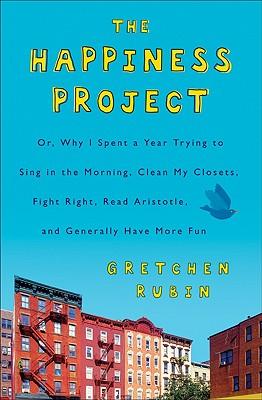
Gretchen Rubin: The Happiness Project: Or, Why I spent a Year Trying to Sing in the Morning, Clean my Closets, Fight Right, Read Aristotle and Generally Have More Fun (2009)

This is not going to be one of my better reviews as I am highly annoyed by this book and the live style it propagates. So instead of a review this is rather a rant. I do however still like Rubin’s blog as it is very colorful and many people tell little stories of their lives.

A word of caution at the beginning seems appropriate:  The Happiness Project is not about happiness, it is about having fun. And if you want to have fun the way Gretchen Rubin teaches it you will need money.

I felt a bit uneasy with her book early on. It is well written and entertaining to read but did not feel right. When I finally came to her view on Buddhism I realised what had bothered me subconsciously right away. There is a big difference between attachment and non-attachment. If you are influenced or attracted by Hinduism and Buddhism then this book will be a great disappointment  to you since it does equal  happiness to materialistic well-being. This is frankly infuriating. It takes a certain arrogance to show means how to improve your life through things and activities that will cost money. Gretchen Rubin’s way to happiness is not for free.

Just read the following quote taken from the chapter “Mindfulness” and you will see, what I mean regarding attachment/detachment:

I’d always been intrigued by Buddhism, so I was eager to learn more about both the religion and the life of the Buddha. But although I admired many of its teachings, I didn’t feel much deep connection to Buddhism, which at its heart, urges detachment as a way to alleviate suffering. Although there is a place for love and commitment, these bonds are considered fetters that bind us to lives of sorrow – which of course they do. Instead, I’m an adherent of the Western tradition of cultivating deep passions and profound attachments; I didn’t want to detach, I wanted to embrace; I didn’t want to loosen, I wanted to deepen. Also, the Western tradition emphasizes the expression and perfection of each unique, individual soul; not so in the Eastern tradition.”   (p. 235/236)

I think this about sums it up.

If however you want to improve your daily life, de-clutter your apartment, hear how to better your relationships with your husband, children, family and friends, then you might enjoy this book. It will show you how to spend and buy things, how to hoard your memories and so on and so fort.

I admit that if I had read the subtitle more carefully I wold have known what to expect. Still, leaving aside the detachment/attachment dichotomy, I believe there is no happiness without creativity and this is an aspect that is not covered at all. Apart from a little paragraph on scrapbooking there is no exploring creativity.

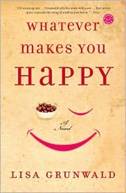
Lisa Grunwald: Whatever Makes You Happy (2005)

Whatever makes you happy is probably a book you either love or hate. It is a blend between fiction and  non-fiction  and very frankly this did not work for me. I found it highly artificial. But it is not boring, so that is one good thing.

Sally Faber, a 40-year-old writer, is trying to write a book about happiness. While struggling with writing she faces a lot of challenging moments in her life. Her little girls leave for the first time for two months to go to summer camp. Her mother leaves her with the challenging task to empty an appartement she owns whose inhabitant, a psychiatrist, has died without leaving any heirs.

Despite all of this Sally seems to have it all. A great live, cute girls, an understanding gentle and successful husband yet she endangers all of this by starting an affair with a megalomaniac self-centered artist who supposedly understands her better than her husband.

The idea to let us dive into Sally’s research was already quite artificial but to sort of test some of the theories by inventing this odd affair was even more so. It just did not make any sense. I did not understand what she did. In the end it felt less like a novel than like an experiment and playing around with the concept of happiness. Sure, there are quite a few insights, views and bits of information that are interesting, which is probably why many readers liked this, but it spoilt the novel for me to have it presented in this way.

Aspiring writers learn to show and not tell, and that is exactly what I would like to tell Lisa Grunwald.

I think it is disappointing because the idea of a novel about happiness appealed to me. The only bit I really liked was the way she described Sally´s feelings for her little girls. That was truly touching.

I should have known what to expect since this novel was recommended by Gretchen Rubin whose Happiness Project I found equally disappointing.  More of that in my next post

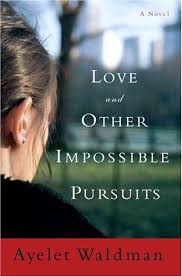
Ayelet Waldman: Love and Other Impossible Pursuits (2006)

I was so curious to read this. I had heard such a lot about Ayelet Waldman and most of it was fuelled by hate. I still do not understand this at all. Just because she questions motherhood? Because she admits, it is no picnic? Be it as it may, I really liked this book. It just swipes you away.

Emilia is married to the love of her life, Jack, but she is not his first wife. And there is also William, his son from his first marriage. A precocious and at times obnoxious child. Emilia cannot handle him and cannot handle her guilt either. Guilt that she was the reason Jack broke up with his wife Caroline, and guilt because she feels responsible for the death of her daughter Isabel who died on her first day home from the hospital just after she was born. This grief and her guilt overshadows everything. And the fact that her father left her mother for a young Russian prostitute.

A lot of heavy stuff but the prose is very light and funny enough this book is never depressing. I found it extremely interesting. It is also a portrait of the city of New York and a description of what it is like to be a mother in New York. Many things that probably only a New Yorker knows, like urbanbaby.com, the running moms of Central Park, A Walk to Remember. Movies and books about New York hold a special appeal for me. This one is no exception. I loved to read these insider descriptions of  walks and places that you would visit with a kid or on your own.

Love and Other Impossible Pursuits is a book that will engage you, make you think, make you wanna discuss it. It is courageous and tackles topics that are of great importance to everybody. Even to women like me who have no children.

It is really worth reading and I do also feel tempted to watch the movie.

Some questions that would be interesting to discuss:

How difficult is it to be a stepmother?

Can there ever be a conflict-free patchwork family?

How do you survive the death of your child?

Is it easier to lose a child when it is a bit older?

Is it better to share your feelings with people who have been through the same or should you see a counselor?

Would you want to replace your dead child?

Should you give him/her a name?

There are many, many more… A lot of food for thought as you can see.

Gerard Donovan: Julius Winsome (2007)

What a sad read and yet how true it felt.

If anyone has ever truly loved an animal, this book will get to him or her since the main character finds  his best friend, his dog, shot dead by some unknown person at the very beginning of this novel. Hardly ever have I been so moved by the description of someone´s mourning. But even before this tragic incident Julius Winsome has been grieving for a lot of other reasons.

He´s a loner living in a cabin deep in a forest in Maine, his only companions are the 3000 and some more books his father has left behind. They cover the cabin walls and Julius reads them one by one. He is still not over the loss of his father and is sad about having been left by the girlfriend he had for a few months who, all of a sudden, didn´t turn up any more. Apart from these two facts we hear nothing about his biography. It´s as if his memories were  solely composed of his grandfather´s stories of WWI and his father´s tales from WWII and some odd remembrances linked to his memorizing words found in Shakespeare´s plays and sonnets.

Julius has always been a defender of animals and to find his beloved dog senselessly shot dead triggers something  very dark in him.

In the chapters following the opening scenes we see him take revenge.

Gerard Donovan is also a poet so it is only natural his style should be very poetic and picturesque. You can almost hear the snow fall when it starts to cover  the dog´s grave. You can hear the gunshots from the hunters that so infuriate Julius and you feel the utter loneliness of this gentle man turning into an avenger.

Julius Winsome American edition amazon.com

Julius Winsome American edition barnes and noble

Julius Winsome (engl.) European Edition amazon.de

amazon.co. uk

Reviews

Review guardian co uk