Elizabeth Taylor: Blaming (1976)

When Amy’s husband dies on holiday in Istanbul, she is supported by the kindly but rather slovenly Martha, a young American novelist who lives in London. Upon their return to England, Amy is ungratefully reluctant to maintain their friendship, but the skeins of their existence seem inextricably linked as grief gives way to resilience and again to tragedy. Reversals of fortune and a compelling cast of characters, including Ernie, ex-sailor turned housekeeper, and Amy’s wonderfully precocious granddaughters, add spice to a novel that delights even as it unveils the most uncomfortable human emotions.

Blaming was my first Elizabeth Taylor novel. I read a recommendation on amazon a few months back and was very interested to read it. It is Elizabeth Taylor’s last novel. She wrote it while she was dying of cancer and it was published posthumously. This got me thinking quite a bit. To think that someone who knows his own death is approaching rapidly would write such a depressing novel makes me very sad. From a stylistic point of view this is a fascinating book. She is an accomplished writer and I truly admire her art. Her descriptions of places, actions and people ring true. There is an episode in which Martha and Amy are having dinner. Amy waits for Martha to eat but she keeps on talking and puts her fork down again and again. Such an exasperating habit that I have watched many times in people. The world Elizabeth Taylor creates is a very desolate one. There is hardly any person in this book that likes any of the others. Amy is by far the worst. She seems very judgmental of people and most of the time she doesn’t even register them. Her grief is intense but more because she has lost comfort and company than because she seems to miss her husband. I got the impression that she uses everybody and found her very boring. Towards the end she seems to develop a certain consciousness of her failings. Hence the blaming. But she is not the only one who fails. They all fail each other one way or the other.

Elizabeth Taylor ‘s daughter wrote an afterword in which she said she liked this and other novels because of the sense of humour. Especially also in the depiction of the granddaughters. Now that is something that eludes me. I did not think it was funny in any way. Those two girls, especially Isobel, are the most obnoxious fictional children I have ever come across. Unfortunately they seem very realistic.

I don’t necessarily mind reading something sad but this seems such a restrained world and apart from the American Martha and the factotum Ernie, they are  uninteresting people.

Since I often read as a writer and not only as a reader I would probably read another one of her books some day.

Just a quote to illustrate why:

Back along the suburban streets with the admired privet hedges, the houses with their bowed and bayed windows, the skeleton laburnums which in spring would give such pleasure. Gardens were all in darkness now, but television lit up rooms, or shadows passed behind drawn curtains. Sometimes light sprang up in bedrooms.

Any suggestions for another of her novels? Did I pick the dreariest one?

Sjón: The Blue Fox (2008) aka Skugga-Baldur (2004) An Icelandic Novel

The year is 1883. The stark Icelandic winter landscape is the backdrop. We follow the priest, Skugga-Baldur, on his hunt for the enigmatic blue fox. From there we’re then transported to the world of the naturalist Friðrik B. Friðriksson and his charge, Abba, who suffers from Down’s syndrome, and who came to his rescue when he was on the verge of disaster. Then to a shipwreck off the Icelandic coast in the spring of 1868.

The fates of Friðrik, Abba and Baldur are intrinsically bound and unravelled in this spellbinding book that is part thriller, part fairy tale.

Winner of the Nordic Literary Prize and nominated for the Icelandic Literature Prize

Different. Very different. Mysterious. I don’t always feel like finding out more about a book but this time I did. The Blue Fox is a haunting story full of ice and snow and darkness. Historical fiction and fairytale. It takes place at the time when Iceland has finally gained independence from Denmark. Fridrik, one of the protagonists, studied in Copenhagen. He is a naturalist and a herbalist. He returns to Iceland to burn down his late parents farm and erase all of his old life. But then he finds Abba, a young woman with Down’s Syndrome, who is kept in captivity. He decides to stay for her sake until the day she dies an early death. The book tells also the story of the priest Baldur Skuggason and the little blue vixen he is hunting. This is a very short novel but it is rich and multi-layered. Compellingly atmospherical and descriptive. What we don’t know unless we do a little bit of research is the fact that Skugga-Baldur, the Icelandic title, refers to a ghost being, part fox, part cat. A mysterious mythological creature. The English translator decided to name one of the forms of Skugga-Baldur. The German opted for the title Schattenfuchs, meaning shadow fox. Even though it has fairytale elements The Blue Fox is also very realistic. The writing is sparse, the information is well-chosen, we get a good impression of life in Iceland at the end of the 19th century. One thing that I found very interesting is the fact that Down’s Syndrome never existed in Iceland. Sjón deliberately chose to write about it as he was shocked when he found out that children showing signs of it in the womb are immediately aborted.

Sjón writes the lyrics for  Björk and also wrote the lyrics for the movie Dancer in the Dark. He is a well-known Icelandic poet. His affinity to poetry is very obvious.

I don’t think that I have read a lot of Icelandic literature so far apart from bits from the Edda and I have books by Halldor Laxness on my TBR pile.

Does anyone have recommendations? Any Icelandic writers you like or know of?

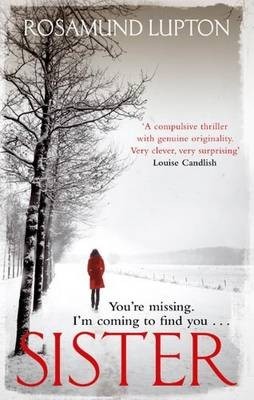
Rosamund Lupton: Sister (2010) A Great New British Thriller Writer

Nothing can break the bond between sisters …When Beatrice gets a frantic call in the middle of Sunday lunch to say that her younger sister, Tess, is missing, she boards the first flight home to London. But as she learns about the circumstances surrounding her sister’s disappearance, she is stunned to discover how little she actually knows of her sister’s life – and unprepared for the terrifying truths she must now face. The police, Beatrice’s fiance and even their mother accept they have lost Tess but Beatrice refuses to give up on her. So she embarks on a dangerous journey to discover the truth, no matter the cost.

That was a fast read. Even though this was a busy week and the novel had some 370 pages I read it in a few days. That certainly says something. I liked it a lot. The writing reminded me of Maggie O’Farrell. Should she ever choose to write a thriller, that’s what it could look like.

Sister is the story of  Tess and Beatrice, two sisters who are extremely close, even though the older one, Beatrice, lives in New York, while the younger, Tess, is still in London where she goes to an art school. When Beatrice gets the phone call from her mother saying her sister is missing she is highly alarmed and flies back to London immediately. When the sister is found dead and declared to be a suicide Bee – as her sister used to call her – is the only one who does not believe it was suicide. She is certain it was murder. And she won’t change her mind. No matter what the police, her mother or Tess’ psychiatrist say.

The story is told in part as if Beatrice was writing  a letter to her dead sister, telling her the whole story after the murderer has been found and arrested. In part she writes the letter, in part she tells the whole story to a lawyer. Consecutive flash backs. The story is also interspersed with dialogue between the sisters.  There are many red herrings as so many men who were in Tess’ life seem suspicious. The ending is quite a twist. That’s the only flaw I could find in this book. It seems a little bit artificial but then again it is not an improbable ending.

There are  many colorful characters in this novel. Art students, immigrants, doctors, scientists, policemen. The bond between those sisters is certainly the most important relationship in the book and it is very deep and moving. The story of their childhood is not an easy one which is another reason why they were so close. All through the novel Beatrice finds other people to relate to and some relationships like the one with her mother are completely transformed. Bee herself is also changed considerably. When the novel starts she is afraid of life, at the end she is ready to embrace and enjoy it.

Sister is Rosamund Lupton’s first book. The next should come out in 2011. I am already looking forward to reading it.

Kelley Armstrong: Bitten (2001) A Werewolf Thriller

Elena, heroine of Kelley Armstrong’s impressive debut thriller Bitten, never planned that a casual sexual encounter would transform her into a werewolf. Neither did Clay, her lover and one of the leaders of the exclusive werewolf clique known as the Pack; women do not generally change or survive if they do. Elena’s considerable reservations about her new life come to a head and she walks out on the Pack to return to something like normality, finding herself a boyfriend who turns a blind eye to her occasional disappearances in the middle of the night. She may have done with the infighting of werewolves, but they have not done with her; her former family call her back when they find themselves under threat from those they have excluded and dominated. Kelley Armstrong is very good on the sheer exhilaration of shape-changing, of running on four feet through forests, suburban greenery and urban back alleys; if there is a weakness here, it is that Elena’s relationship with the taciturn, untrustworthy Clay is sometimes a little too conventionally romantic–but the dark poetry of the best of the book overcomes this entirely.

I must admit if it hadn’t been for Kailana I would never have read Kelley Armstrong’s Bitten but some of her reviews of the Women of the Otherworld series were so enthusiastic, I simply had to try it.  And to be honest “A werewolf thriller” sounded somewhat intriguing. I was not disappointed. Besides, my late grandmother being from Brittany, I grew up with werewolf tales and did belive them until my late teens. But this is not the reason why I liked it. I liked it because I could identify with the heroine. She is such a realistically drawn person. A strong woman who grew up in foster homes, looking for a family, a home, security but never seems to get it. The years alone have hardened her. But then she meets Clay. Beautiful, intelligent, mysterious Clay who offers her everything she never had. Who even goes to a lot of pain to offer her her first proper Christmas and who takes her to Stonehaven, the home of his family, Jeremy, Antony, Nick, Logan and the others. And then the unthinkable happens. He bites her. The only secret he has kept from her, that he is a werewolf, is a fatal one. Normally no one survives a werewolf bite. Only the strongest do. And there was never a female werewolf. Elena is the first.

At the beginning of the novel, Elena lives in Toronto with Philipp. She has left Stonehaven and the pack. She doesnt’ want to be an outsider of society, she wants to fit in, lead a normal live. One day however she gets a call from Jeremy, the Alpha male of the pack. Someone is threatening the pack, wants their territory and has started killing innocent people. She is reluctant to go back at first but finally  gives in. Once she is there she realises how much she missed them. Especially Clay. The novel is action packed and fast paced. There is not only one other werewolf who wants to harm them, there are many. And they eventuallly start to kill the men from the pack. If they want to survive, they have to stick together and fight as one.

Elena fights alongside her men. As said before, she is a strong person. I would wish her as a role model for young women. Powerful and determined. What really surprised me is the writing. Did you ever want to know what it would feel like to be a werewolf? The writing is so detailed, and descriptive that you might very well have the feeling you know what it is like to smell with the nose of a wolf, to tread and run with the paws of a wolf, to hunt and to race through the forest at night. The character development of Elena is interesting too. At times I totally forgot I was reading Fantasy. The core theme is “being true to yourself” and that is certainly a theme anyone can relate to.

As you see, it is very entertaining. A werewolf thriller with a touching love story and a strong heroine. Bitten is the first in the series of Women of the Otherworld. I am not very keen on series but I might read the next one sooner or later.

Any series you like or would suggest?

Thierry Dancourt: Hôtel de Lausanne (2008) French Prize For First Novel

Au cimetière du Trocadéro, un homme et une femme s’assoient sur un banc. Le vent souffle, elle n’arrive pas à allumer sa cigarette, ils entament la conversation. Elle s’appelle Christine, vit un peu hors du temps, entre un père obsédé par les mappemondes et un fiancé qui semble ne pas beaucoup compter. Lui, Daniel, parcourt le monde à la recherche d’objets anciens. Entre eux se noue une relation à part, clandestine, dans un Paris enneigé et brumeux. Du XVIe arrondissement à Casablanca, une galerie de portraits se dessine, mais une figure domine, entre ombre et lumière, celle, singulière et attachante, de Christine Stretter.

A man and a woman meet at the cemetery du Trocadéro in Paris. She tries to light a cigarette but the wind and the rain are too strong. They start to talk as if they had known each other forever. Christine lives outside of our daily world between a father obsessed with maps and  a fiancé who is never there. Daniel is an antiquarian and travels the world. They will start to meet in hotels all over Paris and in the province.

Dancourt won the French prize for first novel and I am pretty sure he will be translated. This little book is far too wonderful and will be highly appreciated by people everywhere as it is also an homage to the city of Paris. Without knowing it ( I looked it up later) I knew that Dancourt is not a Parisian. Parisians do not render their city so lovingly. Only people from abroad and the homesick ones who live in other countries would describe it with such great detail.

Reading this filled me with a terrible longing. Missing a city is not much better than missing a person. On the other hand, the Paris of this book has an otherworldly quality and charm that the struggle of daily life, commuting etc. destroys sooner or later. This is the Paris we love to dream about, the town we would love to live in if we did not have to go to work every day.

Hôtel de Lausanne tells also a very lovely story in the typical French manner of not revealing too much. The people in this novel keep their mystery until the very end. We can only assume why they do this or that, it is never explained or analyzed.

Christine is engaged when she meets Daniel and even though their relationship is very profound and magical she still gets married to her fiancé as she always wanted to get married very young (she is only 21). The funny thing, even though this feels wrong on a logical level, it feels right emotionally. One has never the feeling of reading a book about an adulterous woman. And one never questions her choice. I never even wondered why she wasn’t getting married to Daniel if they were so close.

I liked this aura of mystery that encloses the people and the many descriptions of Paris, its little cafés and bars. Those typical little cafés no tourist would ever go to but where the people living close by, the so-called  “habitués” will come every day, drink and eat and chat. Village-like coziness of big cities where you end up staying in your quartier unless you go to work. Christine and Daniel have their favourite places, where people know them and treat them like a couple and where they occasionally also meet someone who knew Christine’s mother. A haunting figure of whom we try to catch a glimpse as hard as Christine tries herself.

Hôtel de Lausanne is a very enchanting novel and I will certainly read more of Dancourt (his second novel Jardin d’hiver has just been published). As stated before I am pretty confident this will be translated. It simply has to.

Susan Hill: The Woman in Black (1983)

Proud and solitary, Eel Marsh House surveys the windswept reaches of the salt marshes beyond Nine Lives Causeway. Arthur Kipps, a junior solicitor, is summoned to attend the funeral Mrs Alice Drablow, the house’s sole inhabitant, unaware of the tragic secrets which lie hidden behind the shuttered windows. It is not until he glimpses a wasted young woman, dressed all in black, at the funeral, that a creeping sense of unease begins to take hold, a feeling deepened by the reluctance of the locals to talk of the woman in black – and her terrible purpose.

The Woman in Black is the second ghost story by Susan Hill I have read in a very short time. But since we are nearing the end of the R.I.P. Challenge this was the time or never.

I feel tempted to compare them as there are a lot of similarities but The Woman in Black is the creepier of the two. The settings are similar as well, although in this novel most of the horrifying events take place inside of a grand old mansion and only a few in the foggy marshes. The nature of the ghost in The Woman in Black is much more evil. It does really mean to harm those who see it.

Susan Hills writing is again very traditional, old-fashioned. This novel could have been written in the 19th century. This includes the narrative style as well as the themes and motives. Even so or maybe because of this it is beautifully written. The descriptions are detailed and atmospherical.

The story begins some thirty years after the main events. It is Christmas Eve and Arthur, our protagonist, is enjoying the company of his extended family on his beautiful estate Monks’ Piece. The family is gathered in the drawing room telling ghost stories when Arthur comes back from a short refreshing walk outside. They urge him to contribute to the fun and tell a ghost story of his own. He is not willing to do this as he is reminded of horrible events he hasexperienced as a very young man. Instead of telling what happened he decides to write it down.

As a young solicitor he was sent to Crythin Gifford. Mrs. Drablow an elderly client of the firm he is working for has died and his boss wants him to attend the funeral and spend some time sorting out the papers the old woman has left behind. It gets creepy early on as no one in the little town wants to talk about the deceased or her property. At the funeral Arthur sees a woman in black who looks very wasted as well as a group of children that no one else sees.

Later, at Eel Marsh House, the stately home of Mrs. Drablow, he sees the woman in black again. The estate is located on Nine Lives Causeway and is completely cut off from the mainland at high tide, surrounded only by the sea and marshes. The setting alone would creep out many but Arthur also  hears terrible noises, the cries of a child,  noises as if someone had an accident in the marshes. It is also spooky inside of the house. He feels he is not alone. There is one room he doesn’t have access to but there are distinct noises coming from  inside and when the door stands ajar all of a sudden he almost freaks out.

After his first stay at the house he goes back despite his fears and it gets worse. The incidents culminate.

Like in The Small Hand the story is resolved in the end. We get to hear who is the ghost and why he haunts people. The spite- and vengeful being will not stop to haunt Arthur after his departure. It strikes again.

The Woman in Black is a dark tale, darker than The Small Hand. As a whole I think I liked The Small Hand better. But the beginning of The Woman in Black, the chapter titled “Christmas Eve” is one of the most pleasant initial chapters I have ever read and stands in striking contrast to the events that are narrated later.

Apparently the novel has been adapted for the stage and been made into a TV movie.

Has anyone read both? Which one did you prefer?


Nymeth’s review


Daniel Glattauer: Love Virtually (2011) aka Gut gegen Nordwind (2006) A German Novel in E-Mails

Love Virtually

“Write to me, Emmi. Writing is like kissing, but without lips. Writing is kissing with the mind.’

It begins by chance: Leo receives emails in error from an unknown woman called Emmi. Being polite he replies, and Emmi writes back. A few brief exchanges are all it takes to spark a mutual interest in each other, and soon Emmi and Leo are sharing their innermost secrets and longings. The erotic tension simmers, and it seems only a matter of time before they will meet in person. But they keep putting off the moment – the prospect both excites and unsettles them. And after all, Emmi is happily married. Will their feelings for each other survive the test of a real-life encounter?

And if so, what then?

Love Virtually is a funny, fast-paced and utterly absorbing novel, with plenty of twists and turns, about a love affair conducted entirely by email.

I have already read Love Virtually because the original came out in Germany in 2006. I even read it in hardback, a rare thing, as I was so curious to find out what the hype was all about. I must say, I have not often been this engrossed. You start it, you read and you do not stop before the end. After, let’s say, two –  three pages you will have forgotten that this is a novel, you will be sure that you are reading a real e-mail exchange between two people. That is quite an achievement. I am really  pleased to see that Glattauer’s book will be published in English in 2011.

Emmi writes accidentally to Leo and they keep on writing to each other because each one likes the tone of the other’s e-mails. And because they both imagine each other. Without knowing each other they develop crushes. There is only one little complication. Emmi is happily married. It seems only natural she does not want to meet Leo. What if he was anything like the man she imagines? Still she can’t stop writing. They tease and flirt and exchange their hidden dreams and wishes and get to know each other better and better. They also arrange a date without really meeting each other. They just both know that they are at the same restaurant at the same time. Later they compare their impressions and try to find out if they  did recognize each other.

Leo and Emmi are both  intellectuals. This is important to know, as that determines the nature of their exchange. Even though they tease and flirt, they philosophize and analyze a great deal too.

If you want to find out if they really meet you have to read the novel. Daniel Glattauer wrote a sequel (Alle sieben Wellen 2009) that has been published a while back. It is also very good but I would have preferred if he had stopped after Gut gegen Nordwind. The ending of Love Virtually is very special. The sequel spoils it.

I think the idea of having a crush on someone you only know by e-mail (I know the movie with Meg Ryan, but Love Virtually is very different) is interesting and Glattauer provides an in-depth analysis of this premiss. Love Virtually is highly entertaining but still deep. Personally I like epistolary novels a great deal. This is just a variation on the same theme.

A word on the English marketing of this book. Just have a look at the German cover. Don’t you think it looks much nicer? I can understand that the title was problematic. Gut gegen Nordwind would have to be translated as “Good against the North wind”. This is far more poetical than Love Virtually but does this mean anything outside of Germany? The North wind is a bit like the Californian Santa Ana winds, but cold, very cold. He does also carry a nervous energy and is a bit depressing. I must admit, I am not sure I would have bought the book with the title Love Virtually and such a cover. What do you think about the covers and the titles?