
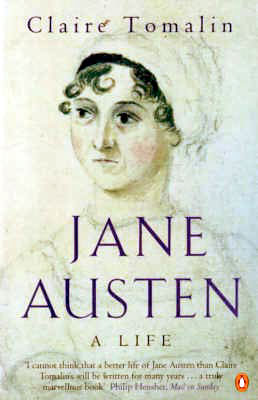
Last year I was in a Jane Austen mood for several months. I read the last of her novels I hadn’t read, watched movie adaptations, and even picked up the one or the other book inspired by her. Finally I also read Claire Tomalin’s Jane Austen biography, which I’ve finished a while ago.
Jane Austen – A Life isn’t only an excellent biography, it’s very moving as well. There isn’t all that much we know about Jane Austen but Tomalin wrote about what little we know with so much empathy and compassion that, at times, I couldn’t help but feel deeply for Jane Austen. When you read a biography you’re never sure what you will get. Some biographers are too present in the book or, what is even worse, some seem not to like their chosen subject at all. I’m glad none of this was the case here. I felt Tomalin approached Jane Austen with a lot of admiration and sympathy.
It’s hard to review a biography and do it justice, especially when it’s so carefully done, including every aspect of an author’s life. There were chapters I devoured, others, like those on the Austen neighbours, were a bit dragging. Overall however this is a wonderful biography and I could feel on every page how much passion and dedication Tomalin put into the book.
Since the book is so comprehensive, I’d like to pick just a few elements and write about those.
Tomalin, as I just wrote, is a very compassionate biographer, which made her detect things that are never explicitly stated in the testimonies or letters. She writes that seen from outside one might think that Jane Austen had a happy childhood and an unproblematic life, but when you look more closely, it becomes apparent, that there was a lot of heartache and sorrow. Tomalin mentions for example that all the Austen children were given away for up to 18 months when they were just a few months old. They grew up in the village with a wet-nurse. This means that by the age of three, they had experienced two traumatic events. First they had to leave the mother and later they were ripped from the family they hade come to see as their own.
The movie Becoming Jane, gives the wrong impression with regard to Jane Austen’s siblings. She had only one sister, but more than one brother, and because the parents had a school for boys, she and her sister grew up among many other boys. Unfortunately, because it was a boy’s school, the two sisters had to leave the family again and go to boarding school. This, it seems, was another traumatic event as the school was quite terrible.
When I watched Becoming Jane, I wondered, like so many others, how much of the love story was true. Why did Jane Austen never get married? Was she too heartbroken and could never get over Tom Lefroy? After reading Tomalin, I have the impression that the love story which is told in the movie, is quite close to reality. There was no elopement and, as I already mentioned, Jane had more than one brother, but the depiction of the unhappy love story between her and the Irishman Tom Lefroy is pretty accurate. She had more opportunities later in life but she turned all her suitors down. She didn’t have any feelings for them.
Jane and her sister Cassandra were very close and spent their whole lives together. Seeing how many of the women around them were either constantly pregnant or died in childbed, staying single must have been some consolation to them.
I wasn’t aware that Jane Austen stopped writing for almost ten years. The chapters on this silence are by far the most tragic and interesting. One could think that the cause for her silence was small, but for Jane Austen it was a catastrophe. She loved the house in the country in which she grew up and when her parents decided to sell it – without telling Jane or her sister anything about the decision, until it was executed – she was devastated. She didn’t want to move to Bath. She didn’t like it and the house would be much smaller. There would be no garden, and no possibility to be close to nature. The impact of this move was so intense that she became depressed, shut down and didn’t write anymore. I guess it was more than just the loss of the garden though. She had a certain routine, and lack of space would prevent that she could withdraw herself from company as easily as before.
Jane Austen died quite young and, according to Tomalin, it’s not entirely clear what illness she had. Some attempts at a retrospective diagnosis have been made. She might have died from Addison’s disease, Hodgkin’s Lymphoma or bovine tuberculosis. In any case, the deterioration was slow and she suffered for more than a year before she died.
The biography contains a lot more, of course. I focussed on the tragedies of her life, but Tomalin writes extensively about the books and the influence Jane Austen’s reading had on her writing. Dr Johnson is mentioned for example and that many of Austen’s famous sentences have been inspired by him.
At the end of her biography Tomalin writes about Jane Austen:
“She is as elusive as a cloud in the night sky.” (287)
That’s exactly how I felt when I closed the book. As if I’d been watching a shadow theater. It’s the first time, I close a biography and it leaves me this sad.

 Beauty is a Sleeping Cat