Lizzy and I are delighted to be making this announcement and we hope you’re happy to hear it. The tweets of others as early as January of this year looking forward to German Literature Month convinced us it just had to happen. And so your wishes have come true. This time, however, we are issuing a challenge.
GLM I and II were resounding successes and we want GLM III to follow suit. One thing has concerned us though. Why were the lady writers so grossly under-represented? Only 22% of the authors read in GLM I, reducing to 19% in GLM II, were female. We want to redress that balance. Now we’re not going all Orange prize on you. We don’t want to exclude the great male authors in German(-language) literature. But we are structuring the month so that there are times to focus in on the ladies.
We would, therefore, like the structure of German Literature Month III to look like this.
Week 1: 1-7.11 Ladies Week
Week 2: 8-14.11 Gents Week
Week 3: 15-21.11 Ladies Week
Week 4: 22-28.11 Gents Week
Weekend 29-30.11 Read as you please
Read anything you want: any format, any genre. As long as the works were originally written in German and are reviewed during November, they count for GLM III. The ideal female:male author ratio at the end of the month would be 50:50.
We will also have two readalongs:
7.11 Lizzy will lead a discussion of a title to be determined by public vote. A post will follow shortly with voting options. In the meantime if there’s a title you wish to suggest, written by a female (it will be ladies’ week after all), please leave a comment.
29.11 Caroline will lead a War and Literature discussion of Hans Keilson’s Death of the Adversary.
With just 5 weeks and 3 days to go it’s time to start planning. Check out those TBR’s and library catalogues. Find some female authors to read. Most of all get excited. This is the German Lit blogging event of the year. What’s not to get excited about?
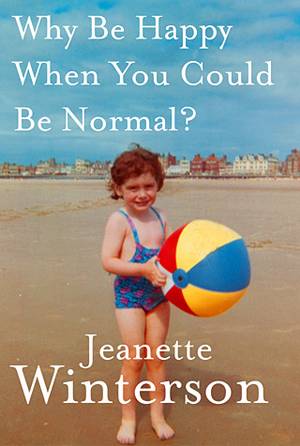
In 1985 Jeanette Winterson’s first novel, Oranges Are Not the Only Fruit, was published. It was Jeanette’s version of the story of a terraced house in Accrington, an adopted child, and the thwarted giantess Mrs Winterson. It was a cover story, a painful past written over and repainted. It was a story of survival.
This book is that story’s the silent twin. It is full of hurt and humour and a fierce love of life. It is about the pursuit of happiness, about lessons in love, the search for a mother and a journey into madness and out again. It is generous, honest and true.
Jeanette Winterson’s first novel Oranges Are Not the Only Fruit is largely inspired by her childhood. Her memoir Why Be Happy When You Could Be Normal? tells the other side of the story. That what was left out. It took me a long time to read this memoir. I started it four times, not because it’s not good, but because reading it was painful. The first part, until Jeanette leaves home at 16 and her mother asks her the question that has become the title of the book, is painful and disturbing for many reasons. The wit and the humor she uses to describe her awful childhood made me shudder. Shudder because I didn’t get it. I didn’t understand how you could live through so much pain and not go crazy, to write a book at 21 and become famous and leave it all behind. I was glad she proved to be so resilient, but it made me uneasy. I kept on thinking: When is it going to happen? When will she break down? Is that still in the future? I don’t think that you can survive a childhood like Winterson’s and not break down eventually. It’s just a matter of time.The second part of the book deals with what came much later. Jeanette Winterson’s descent into madness (her terms), her breakdown and attempted suicide in 2008. Reading that felt like entering a freshly aired room. I know this may sound weird, but the beginning made me choke. I couldn’t believe that she’d left it all behind and only when I read about the descent into madness, did I finally feel glad for her. Now she can move on.
Jeanette Winterson was adopted by the Wintersons when she was 6 months old. She was never told who her real parents were and her mother always said that the devil led them to the wrong crib, meaning she would have liked another child, a nicer child. This is such a typical statement from a woman like Mrs Winterson who is a depressed zealot and always utters half-truths in bible-inspired metaphor. Jeanette Winterson says that all of her books start with individual meaningful sentences and we see where that comes from. Her mother often only says one dark ominous sentence over and over again. Sometimes without any apparent connection to what just happens or what was just said. “Ask not for whom the bell tolls . . .”, “It’s a fault to heaven, a fault against the dead and a fault to nature . . . ” Uttered without any context or referring to very mundane things like the gas oven blowing up, these sentences are either creepy or hilarious.
Winterson grew up in the North of England, near Manchester and she loves this part of the country, lovingly tells us about its history, which is quite interesting. The Wintersons are not only religious fanatics but working class and her mother is so suspicious of books that she confiscates and burns all of those Jeanette has been hiding.
Punishment is frequent and comes in different forms. Either Jeanette is beaten or left outside all night and day, on the door step, even in winter.
When she falls in love with a girl, and Mrs W finds out, they perform an exorcism. Jeannette finally leaves at 16. She only returns once, when she’s studying in Oxford and things go very wrong. That’s the last time she sees her mother.
As you may have guessed, this isn’t an easy book to write about. I marked so many passages and sentences that hardly any page is left white. Jeanette Winterson has a way with words that is amazing. Although I don’t always agree, I find the sentences, many of which are used in her novels, arresting.
In her novel Oranges Are Not the Only Fruit, Jeanette Winterson paints her mother like a giantess and in her memoir she says she was too large for her circumstances. I was puzzled that there was no explanation whatsoever why Mrs W was the way she was. Mean, fanatic, abusive, depressed and just plain crazy. She had her dreams and her wishes, but smothered them. She lived as if she was wearing a very tight corset. The Wintersons were Pentecostals and the religion was like a mental corset.
If you like memoir, then you should read this. It’s disturbing, but it’s so amazingly well written and the first part has hilarious moments. Mrs Winterson is crazy, but she really is larger than life. She reminded me of some of Picasso’s paintings of grotesquely deformed women. We read about her with horror, but at the same time we almost wishes we had been there. I even felt compassion, there were small details that could almost make her endearing. At the end of the book, when Jeanette Winterson has found her birth mother and looks back on her childhood, she says she’s glad Mrs Winterson was her mother. Although she was crazy and abusive, she made her who she is, maybe without such an adoptive mother, there wouldn’t be a writer like Jeanette Winterson. I can understand that thinking very well.
After having read Mansfield Park and liking it so much (as you can see here) I decided to read Persuasion, which has been mentioned by so many in the comments as their favorite Jane Austen novel. The two books couldn’t be more different. I found Persuasion much more mature, more subtle, less witty, more elegant and a bit melancholic. It’s a perfect novel, there is nothing superfluous in it; the story and the characters are rounded and the way their emotions are shown is believable and very touching. There is a lot of sadness and heartache in this novel, but, since it’s an Austen novel, the good characters are rewarded. Despite of all of this, I’m not sure I prefer it to Pride and Prejudice or Mansfield Park. The earlier novels have some imperfections, but they also show an exuberance and wit, which I enjoy. From the point of view of the love story, I think Persuasion is my favourite and I like Anne Elliot and Captain Wentworth as much or even more as Elizabeth Bennet and Mr Darcy, but I missed some of the irony and playfulness of the earlier novels. On the other hand Persuasion is very subtle and I love the more urban settings, Lyme Regis and Bath, which add to its appeal.
Anne Elliot is one of three sisters who lost their mother at an early age and grew up with a silly and vain father who, on top of that, is a spendthrift. The most important things to him and his eldest daughter, Elizabeth, who is his female counterpart, are looks and titles. Being a baronet is of the utmost importance to him. The gentle and sensible Anne suffers a great deal through their coldness and superficiality and if it wasn’t for her mother’s old friend Lady Russell, who has become her mentor, she’d be bad off in a family of self-centred, pompous fools. Her younger sister Mary is not much better and at that a hypochondriac. When the novel starts the Elliots are forced to leave Kellynch Hall and find cheaper lodgings in Bath because Sir Elliot and Elizabeth have been spending far too much. The estate will be let to Admiral Croft and his wife. Mrs Croft is the sister of Captain Wentworth, the man Anne Elliot once loved and – persuaded by Lady Russell – refused to marry because he had no money and no status yet.
Eight years later Captain Wentworth is still as handsome and likable as he used to be, but he’s also very rich. Anne who has refused every suitor, soon regrets bitterly that she refused him. Captain Wentworth on his side is still hurt and resentful. He hasn’t forgotten Anne but cannot forgive her.
Persuasion is often called a “novel of second chances”, and that’s what the love story is all about, but Austen novels are always about much more than just love and marriage. Money and the criticism of a superficial society which attached too much worth to it are central themes. In Persuasion we find a similar situation as in Pride and Prejudice: a rich man with no male heir. The way this is handled is central to the society and the times in which Jane Austen lived but, thankfully, so different from now. Should Sir Elliot die, the estate would go to a distant male relative and not to one of his daughters. It seems as if the property was tied to the name only and not so much to the family. Someone who may never even have seen a house, may be living in it, while those who spent there all their lives have to move out.This is so incomprehensible for us, feels so incredibly unjust that whole series, like Downton Abbey, illustrating this practice, are sure to generate our interest.
A large part of the second story line in Persuasion focusses on this aspect. There is an heir, but he is proud and arrogant, and it is very painful for everyone to imagine he will be living in Kellynch Hall. However, since Sir Elliot is still a good-looking man, it’s not impossible that he remarries. If a younger wife would give birth to a son, the whole situation would look entirely different. While the love story is central the “hunt” for the estate and the ensuing complications are no less important.
I’ve read all of Jane Austen’s longer novels now and it’s quite fascinating to look back, to compare, find similarities, spot differences. I’m currently reading Claire Tomalin’s Jane Austen biography and it adds another layer. So much that is mentioned in Tomalin’s book can be found in the novels. I noticed that Jane Austen never describes London, but I didn’t know she’d never been there.
Nowadays I tend to jump from one author to the next, but it has a special appeal to read everything of one writer because the books are always linked and when you’ve read them all, you can see, that despite the differences, the individual books together form a whole. In Jane Austen’s case, reading all of her books, showed all of her novels are full of vivid portraits and character sketches, full of well-observed behaviour and show the many facets of romantic attachment. But while there are similarities in the themes, there is a huge difference in mood.
I always meant to return to Kelley Armstrong’s Women of the Otherworld series, but when I saw she has a new series out, which is a real departure from her dark fantasy series and much more of a thriller/crime series, I was very interested.
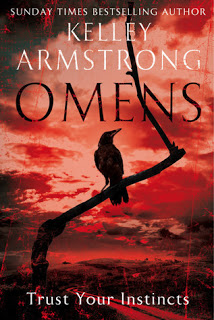
Omens is a terrific read and an unusual genre, one could call it a thriller with elements of magical realism. The only bad thing I can say about this book is that it’s not a standalone and that part II will only be out in 2014.
Olivia Talyor-Jones is a 24-year-old, rich society girl, just about to get married to her fiancé James when her world is turned upside down. Not only does she find out that she has been adopted, but her birth parents are serving a life sentence. They are serial killers who have committed four ritualistic murders.
Shocked by the discovery, haunted by the press and pushed away by her adoptive mother and her fiancé, she follows some signs and ends up in the small-town Cainsville, located not too far away from her hometown Chicago. Olivia decides to cut herself off from her former life for the time being, to look for an apartment and get a job.
Cainsville is a small town that seems to be stuck in another time and as soon as Olivia arrives, she encounters signs and omens which lead her to different interesting discoveries about the town and its people and her parents. Her birth parents hear that she has been found and want to get in contact with her. When Olivia meets dubious lawyer Gabriel Walsh, who was her birth mother’s lawyer during one of her appeals, she decides to visit Pamela, her mothe, and hire Walsh.
There were always doubts about her parents really being serial killers and after Olivia has met her mother and memories of her early childhood resurface, she starts to hope that they are innocent and, together with Gabriel, she wants to prove it. Their research puts them in great danger and the story we get to read is suspenseful and fast-paced.
The end of this book tells me that the supernatural elements which are toned down in this book, will become more important in the future. It seems that Olivia has been brought to Cainsville for a reason.
I enjoyed Omens a great deal and can hardly wait for the next book. This absorbing novel would appeal to people who do not like to read fantasy but enjoy a good thriller with a strong and likable heroine. There is potential for a love story here as well. I liked the description of the small town Cainsville a lot. It reminded me a bit of Louise Penny’s Three Pines, just with some magical realism thrown in.
This is my third contribution to Carl’s RIP VIII. At this pace I will have read four books before the second month starts. So far I have covered these genres”Haunted House”, “Urban Fantasy” and “Thriller”. Next up is, hopefully, – “Gaslamp Fantasy” (don’t tell me you are not intrigued).
If you’d like to see what others have reviewed so far, here’s the link to the RIP review site.
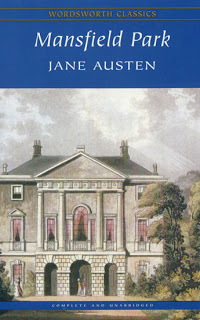
I’m nearing the end of my Austen journey. Now that I have read Mansfield Park, I’ve only got Persuasion and her short fiction left. I was surprised to like Mansfield Park so much as I know it’s not a favourite of many. The reason for this is to some extent its heroine Fanny Price. I wouldn’t go as far as saying I liked Mansfield Park better than Pride and Prejudice, but it may come in second, before Emma.
The story can be summarized briefly. Three women make three very different marriages. Mrs Price gets married to a poor man who likes his drink too much. She bears him some 12 children, one of them is Fanny. Lady Bertram marries a very rich man, owner of an impressive country estate, Mansfield Park. The third, Mrs Norris, lives near Mansfield Park with her husband in a small parsonage. The two ladies often speak about their unfortunate third sister who lives in Portsmouth in squalor and one day Mrs Norris urges the Bertrams to send for Fanny, who is about ten years old, and suggests they raise her at Mansfield Park, together with her four older cousins, Tom, Edmund, Maria and Julia.
Fanny is extremely timid but over the years she is doing well. She grows up to be an educated and very pretty young woman. She’s secretly in love with her cousin Edmund who was the only one who was nice to her. Edmund has decided to join the clergy as being the younger brother he will not have a lot of money to live on. A lot of the Bertram’s money comes from the colonies and when the plantations don’t do so well, Sir Bertram travels to Antigua with his older son.
Mrs Norris who is a widow by now had to vacate the cottage for the new pastor, Mr Grant, and while Sir Bertram travels to Antigua, Mary and Henry Crawford, the younger brother and sister of Mrs Grant, arrive and set in motion a series of dramatic events.
If you know Austen well, you know that all of her heroines are tested. Some more, some less, but in the end they are always rewarded and the reward is a happy marriage.
Fanny Price is a unusual heroine because she comes from a very poor family and the way she is treated by the Bertram’s is often quite shocking. Especially the unlikable Mrs Norris lets her feel daily that she is an inferior. Fanny reminded me much more of a Dickens character and when she is sent back to Portsmouth, as a form of punishment, towards the end of the book, it’s even more Dickensian. I don’t think we find such a close up of a poor family in any other of Austen’s novels. But Fanny Price is unusual for other reasons. She is so timid and fearful and very frail as well. I was surprised to find the portrait of a highly sensitive person who even shows some signs of what used to be called neurasthenia. She has to be careful at all times; she catches colds more easily than others, she’s more easily exhausted. Her symptoms are never as pertinent as when she stays in Portsmouth. She suffers from the noise, the dirt and the smells far more than anyone else would. I have seen her called passive by people but I would say she is quiet and withdrawn, she’s not so much a dreamer as a thinker. Sure, to some extent she is passive, but if you are told daily that you are nothing, that you have to be grateful, that you have to stay in the shadow, then it’s hard to be any other way. Even if she is passive, I don’t think she has a weak mind at all. When they want to force her to marry Henry, she opposes this strongly.
I think a lot of the dislike of Fanny Price stems from her opponent Mary Crawford. I saw people mention that they like her far better than Fanny. When the book was written, she was clearly one of the negative people but we, with our 21st Century mentalities, can’t help but like her and find a lot of what she says quite reasonable. I don’t think I spoil the novel if I mention that it is also about adultery. From our point of view Mary’s reaction to this event is understandable, but when the book was written it was quite shocking. I think small elements like this show very well why many people prefer a historical novel set in 1814 than the real thing because a writer of historical novels would take our mindset into consideration.
Mansfield Park has one of my favourite villains Mrs Norris. She’s a self-centered, selfish and cruel person and tries to exclude Fanny from every little bit of joy, denies her a fire in her room and reminds her constantly that she is an outsider. I loved to hate her and the end is so rewarding.
Mansfield Park has a minor flaw. It is Austen’s longest novel but it’s not long enough. I felt the end was rushed. Many of the most important scenes happen offstage and the final emotional developments happen too quickly. I wasn’t surprised when I watched the ITV production right after finishing the book to see, that those elements were shown in the film while the first parts were compressed. I can’t remember if Austen rushes all of her endings like this. I found it a bit disappointing, which doesn’t mean I preferred the movie version. Not at all. It’s OK but not great and it contains a lot of major changes.
I think that when people write unkindly about Fanny Price, they seem to forget that being adopted into a rich family, means that you are leaving your family behind. Being cut off from what you know, not seeing your beloved brother for years, must be a terrible shock, no matter how stately a home you get in exchange. The story of the little girl Fanny Price who became a delicate but strong heroine has moved me. It’s a rags to riches story that I wouldn’t have expected from Austen. Most of her heroines marry well and improve economically through their marriage, but they don’t start out being as destitute as Fanny.
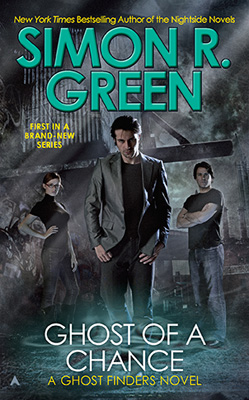
Well, well. Or rather – not well at all. As much as I enjoyed – in a guilty pleasure kind of way – the first of Simon R. Green’s Nightside novels (as you can read here), I can’t really find anything to like in this one, the first in a new series. I’d say he temporarily lost his writing mojo when he concocted this trashy, pulpy tale of five ghost hunters and their big adventure. Prologue and chapter 1 were promising enough but from there it went downhill rapidly. The characters are flat and clichéd, the story is pure humbug and the descriptions do a ton of telling instead of showing. There is something evil in the London underground system. It’s the most powerful and most unknown evil ever. What is it? Powerful, old and evil. Did I mention evil? And powerful? Ha! Now that’s descriptive. I can really see this old powerful evil thingy . . . In the end it gets a face but by that time it’s too late. The book has already been sacrificed on the altar of bad descriptions and abysmal storytelling. (I hate it when writers invent one coincidence after the other to save the plot and this happens on every page here.)
I had a look at the amazon reviews and there were many by die-hard Simon R. Green fans and with the exception of one or two everyone hated this novel big time.
Green is a prolific writer. He has a unique imagination, macabre, silly and naughty too. He displays this in this book as well, but other than that it was really bad.
It’s unfortunate that this sorry effort is my second contribution to Carl’s RIP VIII. I was debating whether or not I should write about it but I decided people deserved to be warned.
My verdict: there isn’t a ghost of a chance that anyone will like this.



 Beauty is a Sleeping Cat