
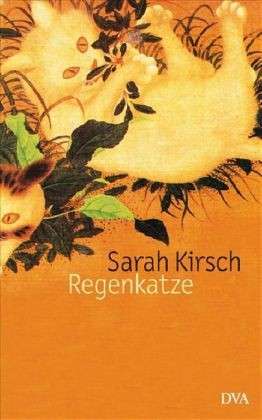
Sarah Kirsch, born Ingrid Bernstein, in 1935, in Prussian Saxony was a German poet and artist. She was widely known and appreciated in Germany and received numerous prestigious prices. Quite a lot of her books, like the poetry collection Catlives, have also been translated into English. Sarah Kirsch died in May this year. Taking the name Sarah was a deliberate choice to annoy her father who was an anti-Semite.
At first I wanted to join Danielle in her Christa Wolf project. She’s reading One Day a Year, Christa Wolf’s diary, for GLM. While looking for the book on my shelves, I came across Sarah Kirsch’s Regenkatze (Raincat), a diary of the years 2003/2004 and started reading it right away. Such a lovely book. But imagine how surprised I was when I found two diary entries dedicated to Christa Wolf’s One Day a Year, which came out in 2003. Obviously they knew each other as they were writers in the former Democratic Republic of Germany, a secluded space, in which everyone was monitored and spied on. According to those diary entries, Wolf wrote about Sarah Kirsch in her diary. Kirsch doesn’t say too much but she’s not keen on Wolf’s book and abandons it after a while saying that she distorted the truth.
Regenkatze is a wonderful book. It has been written by a woman who loved life and enjoyed every moment of it. But she could also be very critical and ironic. She hated anything fake and phony and loved nothing better than reading, writing, cats and nature.
Kirsch lived in the country, in a house on her own and occasionally with her son. Her days are quiet and filled with observations of the weather, the trees and plants, her cats. Highlights are book deliveries and plunging into the work of new authors. In 2003 she goes through a Murakami phase and re-reads Proust’s books. But she also enjoys Harry Potter, watches crime on TV and snuggles up with the cat.
I hadn’t read any of her poems before but the way she wrote this diary told me I should. She wrote Regenkatze in a very peculiar way, inventing new words, writing in metaphor’s, breaking up the structure of sentences, adding dialect and spoken language.
It’s a very engaging book. Her enthusiasm and joy is infectious and I will certainly read more of her.
I leave you with two of her poems from Catlives:
The Housing
It is dark in the house water curtains
Flow in front of the windows until Epiphany
We put up with the Christmas tree
Flames flicker on candle stubs
Wind presses the linenfold water
Close to the panes bulbous plants
Flower white blue and pink
Darkness tumbles from corners
Steels over sills creeps into
Itself and under the beds
Silence wells up from cupboards and coffers
And in the warm and tangible gloom
Through which I pass as it closes behind me
That hangs about like violet velvet
Rolls itself up and swells and sits in each pot
The one I love suddenly treats the piano
To pieces that move me to tears
The cat treads on her favourite chair
The drainpipes leak at the
Predetermined spots the carpenter’s
Drunken soul is clattering in the rafters
Snow
How before our practices eyes
Everything changes the village flies
Centuries back in the snow
All we need are a couple of crows
Pollard willows along the way oldfashioned dogs
Love and faithfulness count you pull me
Over ditches carry my stole little
Bundle of wood into the evening
Living smoke wraps up roofs.
 Beauty is a Sleeping Cat