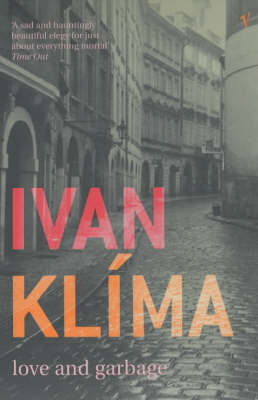
Ivan Klíma: Love and Garbage – Láska a smetí (1988)

Donning an orange vest, the narrator–a banned Czech writer–sweeps the Prague streets with a group of the society’s other outcasts–an old sailor given to drink, a sickly teenager, a foul-mouthed former beauty, a failed inventor, and an ex-pilot. As they go about their mindless job, the narrator learns of the dreams and sorrows of his coworkers and meditates on the life and work of Franz Kafka, the power of literature, and his relationship with his dying father. 

Love and Garbage is my first book by Czech writer Ivan Klíma. It’s said to be one of his best. Klíma had a difficult life. Born in Prague in 1931, he spent some years of his childhood in the concentration camp Theresienstadt.  Later he was an editor in his home town. He spent 1969/70 in the US where he taught Czech literature at a university but when he returned to Prague in 1970 he was forbidden to publish until 1989. Love and Garbage contains a lot of Klíma’s own story but it isn’t, as he says, autobiographical.

The narrator, a writer who isn’t allowed to publish, starts working as a street sweeper. The slow and contemplative work allows him to explore his city, to think about his life and an essay on Kafka he is writing and helps him forget his lover. Because he chose to work as a street sweeper and it isn’t necessity who forces him to do this job, he likes it. He likes his colleagues, most of them are outcasts too. The work he is doing doesn’t only allow him to think about his life but it turns into a philosophical meditation on what the society deems worthless. Garbage and human beings alike. As a child the writer who is Jewish lived in Theresienstadt and most of his relatives were killed. The Jews, he muses, were like garbage for the Germans, worthless and had to be discarded and burned. The novel is full of linked symbols and elements, of scenes that are mirrored and repeated.

After he was forbidden to publish, he was desperate, caught in a marriage that didn’t mean much anymore, to a wife who had started a new life. She was studying psychology and trying to help others while he spent his days locked inside, chasing thoughts, trying to write. During this time he meets the sculptor Daría and falls passionately in love with her. When the affair ends, he decides to sweep the streets. This is symbolical as well, he starts to clean the city around him, to make room inside for another, clean start.

The writer is working on an essay about Kafka and often returns to him. He is reminded of Kafka constantly. For him, Kafka was the purest possible writer, an outcast like himself, not really understood and unhappy in love.

When the novel begins, the narrator is heartbroken but that doesn’t explain the sadness in the book. The sadness comes from looking back, thinking about his childhood in the concentration camp and all the people he lost. The only person still alive from that period is his father but he is very old and ill. The saddest thing is that despite everything that happened in the past and that his country had to endure, instead of having a better life now, they live under a communist regime. The constant threats and lack of freedom make life unbearable. His affair with Daría is an attempt at finding happiness but it turns bitter eventually and when he tells his wife about it, it seems at first that he will end up losing both women.

Love and Garbage is a challenging read. It demands concentration as the story moves back and forth in time, breaking up the chronology, sometimes up to three times per page. It took a bit of getting used to but once I had read a few pages I liked it. This type of writing doesn’t allow you to fall into some sort of reader’s trance but wakes you up constantly. This may sound like a gimmick but that’s not what it is at all. It’s a cunning way to mirror the narrator’s interior life.  It’s not so much an interior monologue as a way to render how freely thoughts move, unlike the person who thinks them. We easily move back and forth in our minds, a childhood memory can be followed by some thoughts about the past day. In our minds we can go wherever we want, at any time we choose.

I have read a lot of Czech writers who wrote in German but only a very few who write in Czech. As I have found out, Love and Garbage was meant as an answer to Kundera’s Unbearable Lightness of Being which Klíma considered to be chauvinistic.

I liked Klíma’s writing. It’s unusual, complex, poetic and highly descriptive. There is hardly an aspect of human life that isn’t touched and that’s why the book is like a delicately woven tapestry. One pattern evokes another one, one angle mirrors the next, all is linked and intertwined. Poetical passages follow psychological insights, philosophical thoughts come after realistic descriptions. The book is sad but the way the writer fights for the tiniest bit of happiness and the richness of his interior life are so beautiful, they illuminate the book from within.

Have you read Klíma or other Czech writers?

Maureen Gibbon: Thief (2010)

Maureen Gibbon’s novel Thief is a powerful account of a young woman who has been raped as a teenager and now, in her thirties, is still trying to come to terms with this event. The life she is leading is like a walk on a tightrope. One dangerous boyfriend follows the next and even as a very young teenager she already led a promiscuous and risk-taking life.

At the beginning of the novel, she has left the Twin Cities and rented a lonely cabin near a lake. A bit too lonely maybe or she wouldn’t place an ad in the local newspaper looking for a “Great kisser, good listener”. One of the men who answers her ad, is Alpha Breville, an inmate in a state penitentiary. She writes and finds out that he was convicted because he raped a woman seven years ago.

What is it that makes her write back and go and visit this man week after week? She thinks it is because she is looking for closure and he will help her with this. Or is it once more her addiction to danger, sex and romance? It’s a little bit of everything, as we come to understand. But while Alpha sits behind bars, she still sees other men. One of them a cowboy who reveals to be as dysfunctional as all the others she has left before.

This is a highly disturbing book. Disturbing, honest and intriguing. I was very captivated and found it believable. I used to read a lot of psychology books and some of them were dedicated to addictions. The portrayal of a self-destructive, promiscuous woman who acts out via sex and romance was realistic for me. After I finished it, I noticed, how numbed Suzanne is, she is very self-destructive, seeks out men who have the potential to harm her, falls in love as soon as she had sex with a man, even a complete stranger, but she remains unemotional. The most important thing for her is, as soon as something is over, to find someone new.

The big question at the heart of the story is whether the rape victim and the rapist can heal each other and whether she brought the rape upon herself. This last question was particularly disturbing.

Maureen Gibbon has been raped as a young girl, just like Alice Sebold, the author of The Lovely Bones. The difference in their approach is interesting. I didn’t like The Lovely Bones but I liked Thief.

It’s a book that would be ideal for an open-minded discussion group or book club. Open minded because it asks uncomfortable questions about rapists and their victims and also because there is some very explicit sexual content. It’s not gratuitous as one of the topics is sexual addiction but I felt I needed to say it.

Irish Short Story Week March 12 – 22

Just like last year Mel u from The Reading Life is organizing an Irish Short Story Week.

He has already published his tentative plans and some resources for those who want to join. Some of the authors and topics he will review are James Joyce, Lord Dunsany, Elizabeth Bowen, Sheridan LeFanu, Oscar Wilde, Frank O’Connor, Irish fairy tales. I really like his plans, they manage to capture nicely how diverse the topic is. If you are interested in joining and want to know more about Mel u’s plans, you can find them here.

I’m not sure at all what I’m going to read. I have a few collections on my TBR pile and one anthology which looks promising. I know I will not be able to read more than one or two stories but that’s better than nothing, I guess.

Here are a few of the possibilities:

Frank O’ Connor’ s The Genius

James Joyce’s Araby 

Seán O Faoláin’s Innocence

Do you have a favourite Irish Short Story writer?

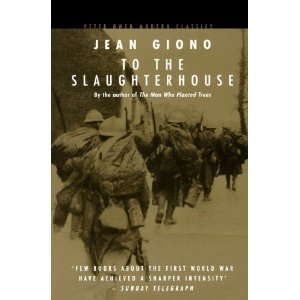
Literature and War Readalong March 30 2012: To the Slaughterhouse – Le grand troupeau by Jean Giono

Jean Giono’s To the Slaughterhouse – Le grand troupeau is the last WWI novel of this year’s readalong. Giono is one of the great French writers, famous for books like L’homme qui plantait des arbresThe Man Who Planted Trees, Joy of Man’s Desiring – Que ma joie demeure orLe hussard sur le toit – The Horseman on the Roof which has been made into a successful movie. His books are deeply rooted in the South of France and he is often compared to Pagnol.

I try not to be too enthusiastic this time, but, let me just say, cautiously, I think, this should be a good book. At least he is an author who has never disappointed me so far and I’m even planning on (re-)reading a few of his other books this year, like Colline, Un de Baumugnes and Regain, the so-called Pan trilogy. Giono is famous for the way he describes the joy of life and that’s why I’m particularly interested to see how he treated such a bleak subject.

Here are the first sentences

Last night they watched as all the men left. It was a thick August night smelling of corn and horse-sweat. The animals were harnessed in the station-yard. The big plough-haulers had been tied up to the shafts on the carts; their solid rumps held back the loads of women and children.

The train moved off quietly in the night, spattering the willow trees with embers as it took on speed. Then all the horses started moaning together.

*******

The discussion starts on Friday, 30 March 2012.

Further information on the Literature and War Readalong 2012, including all the book blurbs, can be found here.

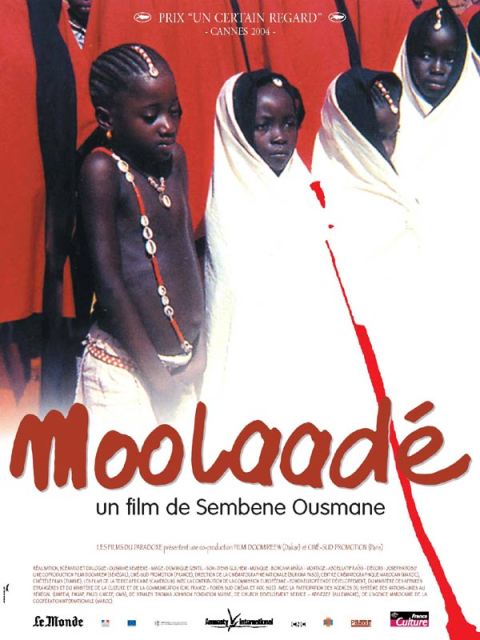
Moolaadé (2004) World Cinema Series – Senegal

I used to read a lot of African literature and watched a lot of documentaries as well but hardly any full-length movies at all. I had completely forgotten that Sembène Ousmane wasn’t only a great writer but also a highly acclaimed film director if Tom (Wuthering Expectations) hadn’t reminded me. I tried to find some of his movies and found the last film he made before his death.

Moolaadé is an exciting movie because it offers such an awesome combination of different elements. It is life-affirming, optimistic, critical, humanist and very esthetic at the same time.

Moolaadé is a movie about female circumcision, tradition, change and the status of women in a polygamous, patriarchal society. One cannot watch this movie without being profoundly disturbed but it’s thought-provoking and not depressing at all.

One day, four little girls, seek refuge in the compound of Collé. She is the favourite and second wife of her husband. It is known that her daughter is the only girl in the whole village who hasn’t been circumcised. Her daughter is the fiancé of the eldest son of the village chief who has studied in Paris and is soon to come home. Collé knows that there will be conflict if she shelters the girls. In order to protect them she pronounces Moolaadé, magical protection. As long as one person grants another one Moolaadé the person cannot be touched or the consequences would be fatal. In order to show that Moolaadé is at work, a coloured rope is tied over the entrance of the compound.

The uproar in the village is incredible. They threaten Collé but to no avail until her husband returns and they force him to whip her in public until she revokes the Moolaadé. She remains steadfast and is, at the end, helped by an outsider, a travelling salesman.

Moolaadé shows what a trap circumcision is. The girls know how painful it is, even lethal and that many will never be able to give birth without Cesarean section. Sex will always be agony for them. Still the men do not want to marry a woman who isn’t “purified”. The girls are afraid that they will never find a husband but even more afraid to be maimed for life.

The way the movie shows how horrible circumcision is, is well-done. We don’t see anything but what we see is enough to illustrate it. The most problematic figures in the film are the women who perform the circumcision. They are truly scary.

The strength of the movie however isn’t only to show all the aspects, beliefs, traditions and conflicting interests related to circumcision but to show a way, a solution. The women decide to not accept the horrors done to their bodies anymore. In the movie it’s the act of one courageous woman, who decides to break with tradition, who triggers a wave of change.

It’s a disturbing movie but it’s optimistic as well. There are not only  frustrating but a lot of comical moments too.

Western cinema, with a few exceptions seems to have forgotten that film making can be a means to trigger change, that there could be more to art than entertainment, that being engaged is an important value. Moolaadé reminded me of all this and much more.

It’s precisely movies like Moolaadé that I had in mind when I started the World Cinema Series. Movies that open a door to a world we hardly know. I liked it a lot and am pretty sure it will be one of my favourite movies this year.

Moolaadé is also a contribution to Richard’s Foreign Film Festival.

Madeleine St.John: The Women in Black (1993)

With the lightest touch and the most tender of comic instincts, Madeleine St John conjures a vanished summer of innocence. The Women In Black is a great novel, a lost Australian classic.

Madeleine St. John wasn’t on my initial list of authors for the Aussie Author Challenge but after one of Litlove’s (Tales From the Reading Room) comments I thought I’d like to read one of her books and picked The Women in Black. Coincidentally Litlove reviewed it recently as well as you can see here.

The Women in Black is Madeleine St. John’s first novel. She wrote it at the age of 52. It was followed by three other novels which, unlike the first, were not set in St. John’s native Sidney but in London where the author had been living since the 60s. The book is set in the 50s in Sidney and takes place to a large extent in a famous department store, just before the Christmas rush, on the floor of Cocktail Frocks and Model Gowns. It centers on a little group of interestingly different women, Patty, married to Frank (the brute), Mrs. Jacob, the mysterious, Fay, the thirtysomething single woman, Lisa aka Lesley the assistant (temporary) and Magda, the glamorous European refugee who has more elegance and style than all of them together.

Magda and Lisa are the characters where most of the other stories converge and are the indicators that this novel, as lovely, bubbly and playful as it seems, still is a satirical comedy of manners, depicting a society undergoing great change. One of those changes concerns the status of women. No longer only dependent housewives, this decade sees the first female university students who want more than just a husband and children.

When you have a confined environment like an office, a hotel, a shop or anything like this, a newcomer like Lisa, is sure to stir things up, no matter how kind and nice the person is. Lisa is a new type of Australian woman, one that has only recently emerged, more interested in books and studying than attracting a husband.

“A clever girl is the most wonderful thing in all creation you know: you must never forget that. People expect men to be clever. They expect girls to be stupid or at least silly, which very few girls really are, but most girls oblige them by acting like it. So you just go away and be as clever as ever you can: put their noses out of joint for them. It’s the best thing you could possibly do, you and all the clever girls in this city and the world.”

The World depicted in The Women in Black is gone. The importance for a woman to attract a man has considerably diminished, it isn’t exotic for a woman to study and the composite post-war society, mixing European refugees and born Australians, has certainly become more homogenous. At the time however it seems, Europe is as far as the moon and the ways of its people quite exotic which is a source of comedy for St. John.

“Do Russians count as Continentals?” she asked Myra. “Who are you thinking of?” asked Myra. “Oh, no one in particular,” said Fay. “I just wondered.” “Well, I suppose they do, ” said Myra. “But you know they’re not allowed out, Russians. You never really see any Russians, do you? They are all in Russia.” “I suppose you’re right, ” said Fay. “Still, if they were allowed out, they’d be Continentals, don’t you think?” “Oh yes, I reckon so, ” said Myra. “All them peoples are Continentals.”

This is a witty and cheerful novel in which each chapter is like a vignette and tells episodes of the one or the other woman’s story. As much as it depicts a change of values it shows that some things will always be of importance to women and much of this is reflected by the clothes and gowns sold at the department store. The power of dresses and fashion cannot be underestimated. A beautiful dress, sexy lingerie can become more than just a piece of garment, it can tie you down or free you.

Lisa stood gazing her fill. She was experiencing for the first time that particular species of love-at-first-sight which usually comes to a woman much earlier in her life, but which sooner or later comes to all: the sudden recognition that a particular frock is not merely pretty, would not merely suit one, but answers beyond these necessary attributes to ne’s deepest notions of oneself. It was her frock: it had been made, however unwittingly for her.

I enjoyed this a lot, and was reminded of my grand-mother who supplied Haute Couture dressmakers with haberdashery. I still have some of her elegant gloves and scarves, even some of her handbags and a black evening coat. It made me very nostalgic to read about the changes linked to clothes. Lisa’s mother sows a lot of her daughter’s clothes, alters them, mends them. Nowadays we just throw them away, buy something new. Only the most expensive Haute Couture dresses are still handmade.

As I said, it’s a cheerful novel that captures a changing society and a vanished world. It’s not free of social criticism but it manages to show that even this long-gone era with its antiquated beliefs had its charm. There are infuriating moments and people in the book, mostly men who repress women and the women who support them, but each negative character gets a chance to develop. The positive habits of one character are passed on to another one and all of them win something in the end. Lisa, for example is a reader and when she passes on her copy of Anna Karenina to Fay this isn’t only a symbol – shortly afterwards, she meets a nice Hungarian man – but reading literature is a new habit. There are many instances like this in the novel. Maybe at some other time I would have found this to be overly optimistic but it was exactly what I needed after my last readalong title.

If you want to spend a few moments with a cheerful and intelligent book, this is one you shouldn’t miss.

The Women in Black is my first contribution to the Aussie Author Challenge 2012.