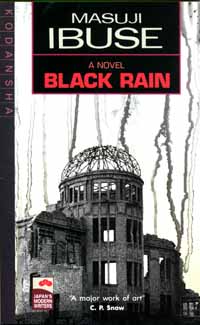
Literature and War Readalong July 30 2012: Black Rain – Kuroi Ame by Masuji Ibuse

When I saw Black Rain mentioned by Gary (The Parrish Lantern) on Rise’s blog (in lieu of a field guide) last year, I knew I wanted to include this book in this year’s readalong. Last year we read Marguerite Duras’ Hiroshima Mon Amour and I’m really curious to find out how this horrible event will be treated by a Japanese author. John Hersey’s Hiroshima and Ibuse’s Black Rain are said to be the most important novels on the horror of Hiroshima.

Here are the first sentences

For several years past, Shigematsu Shizuma, of the village of Kobatake, had been aware of his niece Yasuko as a weight on his mind. What was worse, he had a presentiment that the weight was going to remain with him, unspeakably oppressive, for still more years to come.

*******

The discussion starts on Monday, 30 July 2012.

Further information on the Literature and War Readalong 2012, including all the book blurbs, can be found here.

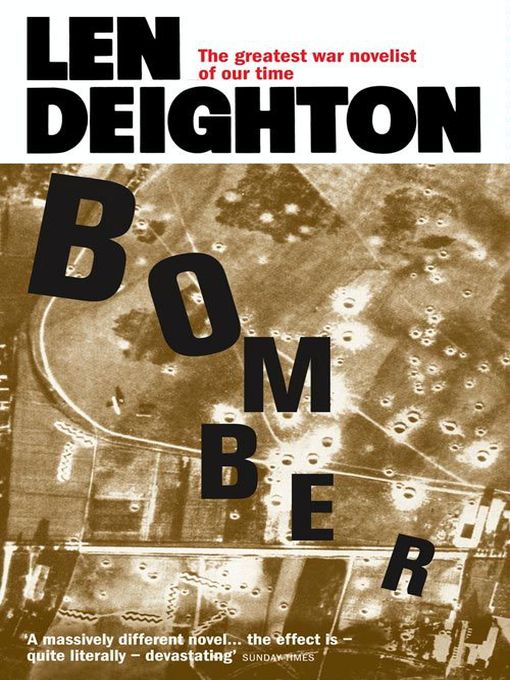
Literature and War Readalong June 29 2012: Bomber by Len Deighton

The last two titles in the readalong were both about the Blitz and the bombings of the British cities seen from the perspective of civilians. Bomber shows another point of view. Set in summer 1943 it tells the story of an Allied air raid from the point of view of all of the participants, in the air and on the ground, covering 24 hours. It has been praised for its detailed descriptions and documentary style and from what I read so far, it seems very well done. I have to thank Kevin (The War Movie Buff) for pointing it out.

Here are the first sentences

It was a bomber’s sky: dry air, wind enough to clear the smoke, cloud broken enough to recognize a few stars. The bedroom was so dark that it took Ruth Lambert a moment or so to see her husband standing at the window. “Are you alright, Sam?”

“Praying to Mother Moon.”

She laughed sleepily. “What are you talking about?”

“Don’t you think I need all the witchcraft I can get?”

“Oh, Sam. How can you say that when you…” She stopped.

“He supplied the words: “Have come back safe from forty-five raids?”

Should you want to join you will have to start early. With 527 pages it is by far the longest book of this readalong.

*******

The discussion starts on Friday, 29 June 2012.

Further information on the Literature and War Readalong 2012, including all the book blurbs, can be found here.

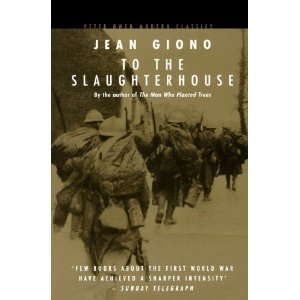
Jean Giono: To the Slaughterhouse – Le grand troupeau (1931) Literature and War Readalong March 2012

There are so many different ways to write about war. Some novels focus on the experience of the soldier, some will focus on what the civilians go through, some move back and forth between the front lines and the home front. While Jean Giono’s Le grand troupeau – To the Slaughterhouse does move back and forth, the book is still completely different from anything else that I have read so far.

Giono’s technique does need some getting used to. What he describes is equally beautiful and horrifying. The result may very well be one of the most radical anti-war books that I have read.

If you are looking for an action-driven novel, this isn’t one to turn to, Giono’s novel is far more like the description of paintings. I was reminded of Otto Dix’ WWI paintings more than once. Some of the very visual descriptions in this novel are as graphic and gruesome as Dix’ work.

The war has come to a little village in the French Provence region. All the men are drafted and go to war, leaving the women, old men, children and animals behind. Some of the men are shepherds. They have to abandon their herds. Left on their own,  the animals are endangered, they have accidents, get wounded. One day a massive herd enters the village. It’s an awful sight. So much suffering, so much pain.

Julia’s husband Joseph has gone to war, as has her sister-in-law’s young lover, Olivier. The story moves back and froth between life in the village and the men. It’s more a series of pictures than a real story. Very powerful and graphic pictures.

Giono chose to show us how war affects the body. It’s not the fighting he is interested in but what happens when someone is wounded. How the wounds fester, how the juices flow out the dead bodies. The rats which are always mentioned in WWI novels are present here as well but we see how they eat the faces of the dead men.

I had a faint feeling in my stomach for most of the time while reading but I saw what he wanted to achieve and I thought the idea was amazing. He didn’t stop at describing the horrors of the war and what it did to the bodies of the men, he described the beauty as well. The scents in the air, the taste of food, the beauty of the landscape.

There are hunting scenes and scenes of slaughter and the bodies of the dead animals resemble those of the dead and wounded men.

Human beings and animals both suffer pain, their bodies are vulnerable and frail, they can be killed and harmed and wounded and the result will be the same. At one point he goes one step farther, describing how the earth suffers too, when her body is ripped open by explosives. Giono includes the entirety of creation in his novel and shows that every being existing in this world, wants beauty, love and tenderness, shelter and food and when this is not provided, when aggression is let loose, the body is harmed, wounded and the being ultimately dies.

It’s a highly symbolical novel, with a profound message of peace. It was hard to read but I am glad I did. It really would be hard to find a more eloquent anti-war statement and a book which manages like this one, to show, that since we all, animals and human beings alike, suffer pain, we are equal. This profound message makes To the Slaughterhouse not only a plea for human rights but for animal rights as well.

Other reviews

Danielle (A Work in Progress)

To the Slaughterhouse is my fourth contribution to the War Through the Generations Challenge hosted by Anna and Serena.

*******

To the Slaughterhouse was the third book in the Literature and War Readalong 2012. The next one will be Helen Humphreys’ Coventry. Discussion starts on Monday April 30, 2012.

Jacqueline Winspear: Maisie Dobbs (2003) The First Maisie Dobbs Mystery

I’m not sure who mentioned Maisie Dobbs first. Either Danielle on A Work in Progress or Kailana on The Written World. Whoever it was I’m glad she did as Maisie is an amazing heroine. I really like her and the way she goes about her job. The period details are captured in a very descriptive way, reading often felt like watching a movie.

The story begins in London, 1929. Maisie Dobbs has opened her first office. She is a private investigator and psychologist who has been trained by a master of the art, Maurice Blanche, a friend of Lady Rowan, on whose estate Maisie used to be a maid.

Her first investigation leads her to follow the wife of Christopher Davenham. He suspects her to have a lover. What Maisie finds out is quite different from what Davenham and the reader think and will lead Maisie to investigate a crime and confront her with her own past.

The second part of the novel rewinds to 1910-1917. In 1910 Maisie is just a girl who lives alone with her father after her mother has died. She is unusually intelligent and her parents wanted to send her to college later but the mother’s illness has swallowed up all of their money and Maisie is sent to Lady Rowan as a maid. They soon find out about Maisie’s fondness for reading and learning and give her a private tutor, Maurice Blanche. Blanche is a special fellow with an eye for people and an unusual capability of seeing behind the masks.

Maisie finally goes to university and is about to embark on a splendid academic career when WWI breaks out. Like so many other young women she volunteers as a nurse and is sent to France where the man she has recently fallen in love with is serving as a doctor.

Maisie’s life story, the crime and its solution are all rooted in WWI. While I didn’t think the crime was gripping I thought the way the book revealed what happened to Maisie during the war was suspenseful. I truly admired the way it managed to convey an idea of WWI. Maisie and many other characters still suffer from various ailments or traumas. This, for example, is Maisie at the beginning of the novel.

Lucky, thought Maisie. Except for the war, I’ve had a lucky life so far. She sat down on the dubious oak chair, slipped off her shoes and rubbed her feet. Feet that still felt the cold and wet and filth and blood of France. Feet that hadn’t felt warm in twelve years, since 1917.

Facial wounds play and important role. The wounds and how society and the wounded handle them. But the horror of the trenches, the constant rain, mud and cold are rendered as well.

It’s certainly a novel that appeals to many people. To those who like cozy mysteries, to those who are interested in WWI. Fans of the upstairs-downstairs theme will love the middle section. Maisie Dobbs is a likable and clever character and to get to know the way how she reads people is fascinating. Her way of working is a mix of psychological analysis and psychic abilities that I enjoyed a great deal.

There are by now 9 books in the series and the fans and followers are numerous.

Because of its lovely design and a lot of information it is worth to visit Jacqueline Winspear’s Website.

If you are interested, March is Maisie Month on Facebook.

Maisie Dobbs is my third contribution to Anna and Serena’s War Through the Generations challenge.

Literature and War Readalong March 30 2012: To the Slaughterhouse – Le grand troupeau by Jean Giono

Jean Giono’s To the Slaughterhouse – Le grand troupeau is the last WWI novel of this year’s readalong. Giono is one of the great French writers, famous for books like L’homme qui plantait des arbresThe Man Who Planted Trees, Joy of Man’s Desiring – Que ma joie demeure orLe hussard sur le toit – The Horseman on the Roof which has been made into a successful movie. His books are deeply rooted in the South of France and he is often compared to Pagnol.

I try not to be too enthusiastic this time, but, let me just say, cautiously, I think, this should be a good book. At least he is an author who has never disappointed me so far and I’m even planning on (re-)reading a few of his other books this year, like Colline, Un de Baumugnes and Regain, the so-called Pan trilogy. Giono is famous for the way he describes the joy of life and that’s why I’m particularly interested to see how he treated such a bleak subject.

Here are the first sentences

Last night they watched as all the men left. It was a thick August night smelling of corn and horse-sweat. The animals were harnessed in the station-yard. The big plough-haulers had been tied up to the shafts on the carts; their solid rumps held back the loads of women and children.

The train moved off quietly in the night, spattering the willow trees with embers as it took on speed. Then all the horses started moaning together.

*******

The discussion starts on Friday, 30 March 2012.

Further information on the Literature and War Readalong 2012, including all the book blurbs, can be found here.

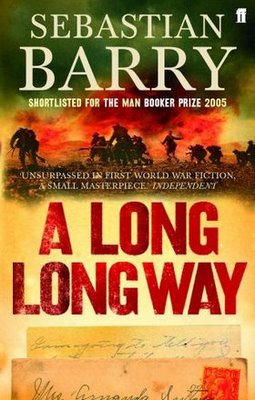
Sebastian Barry: A Long Long Way (2005) Literature and War Readalong February 2012

Sebastian Barry’s A Long Long Way is one of a few WWI novels told from an Irish perspective. Unlike How Many Miles to Babylon or many other WWI novels, its main theme isn’t class which was something I was glad for. Not that I think it wasn’t important but it has become one of the clichés of WWI literature. That and so many other elements. Luckily there aren’t all that many clichés in Barry’s novel.

Nineteen year-old Willie Dunne from Dublin volunteers in the early days of WWI. Like so many before or after him, he has no real reason, or they are at best quite vague and mostly personal. Maybe little Willie wants to prove himself and prove his father that he is worthy despite of his size. His father, a tall and imposing fellow, is a policeman. Something little Willie could never have become because he is barely taller than a midget. The army doesn’t care. They are in such great need of volunteers that they accept almost anyone.

We follow naive little Willie to Belgium where he spends his first months in the relative comfort of the rear camp, hardly seeing any fighting at all. Nothing really bad happens to little Willie and his company until one day, the soldiers see a yellow cloud hovering slowly over no-man’s-land. It takes them far too long to realize what that yellow cloud means, and only much too late, when many of them are already dying a cruel death or maimed for life, do they flee in horror. After this moment the novel takes a turn and becomes graphic and tragic and Willie loses his naivety at a breathtaking speed.

Although he sees many horrible things, it is only after his first leave to Ireland, that Willie is really affected. Not because he doesn’t fit in anymore – Barry doesn’t use this cliché either – but because Ireland is on the brink of the War of Independence and Willie, a compassionate man, is saddened to see the death of a young rebel and to realize that for the first time in his life, he doesn’t see things like his father.

Back in the trenches he tells the other Irish lads what he has seen at home. The newspapers write about it too and the British officers are aggressive and see them even more as cannon fodder than before. The longer the war lasts, the more intense the fighting in Ireland gets, the less the efforts and losses of the Irish are appreciated. In the end there are finally no more volunteers from Ireland. They do not want to fight for the enemy anymore and some would even gladly join the Germans. When Willie takes his second leave to Dublin, the aggression in the streets against his British uniform is open.

It is rare that I resent an author for his narrative technique but I do resent the way Barry wrote this novel. Furthermore I had a hard time with his style, I think it’s far from fluent and the overuse of adjectives at times was annoying. Just one example:

Now they rose up in the violent moonlight and entered bizarrely a huge field of high corn, the frail stems brushing gently against their faces, and because Willie was a small man, he had to grip the coat of the Sergeant-Major Moran in front or he would be lost, set adrift to wander for ever in this unexpected crop. The absurd bombs followed them religiously into the field, smashing all about the darkness, the stench of cordite and other chemicals obliterating the old dry smell of the corn.

As if the violent moonlight wasn’t enough, they have to enter the field bizarrely, followed religiously by absurd bombs? Admittedly, this was one of the worst passages but there were others, equally florid. This doesn’t explain why I resent him but it’s part of it. I felt tricked. This novel works like a trap door. You are lured into a devastated house which is bad enough but the moment you are inside, the carpet is pulled away from under you and the trap door opens. There is a building up of graphic scenes and an intensification of the tragedies that befall poor Willie that felt really mean. I was upset that the book had to end like it did, so absolutely depressing, without the tiniest little bit of hope or light. Don’t get me wrong, it’s not because the book describes graphic scenes, it’s because he intensifies them and accelerates it towards the end, when we do not see it coming anymore and, on top of that, has poor Willie experience one personal tragedy after the other.

With the exception of the dishonest structure, and an almost sadistic finishing off of the main character, the novel has a lot of elements that I thought well done. I haven’t read any WWI novel this eloquent on the use and the horrors of mustard gas. Nor any novel that showed the role of the priests so well. Father Buckley was my favourite character in this novel. A Catholic Priest with true compassion and a wide open heart. And I liked Barry’s choice of theme. His look at authority and its major representative, the father is very interesting. The father as a figure comes in many different forms, as the biological father, the King, the Priest. Coming to terms with authority and ultimately becoming a man and independent are important aspects. Little Willie isn’t a boy anymore at the end of the book, he is a man, with his own opinions, his own life. The book stays away from the usual criticism of high command but uncovers all sorts of hidden false authority.

A Long Long Way has been my second Sebastian Barry novel and I was also annoyed by the first. I just don’t like this type of artifice and manipulative writing that is so keen on effect.

I hope others have liked the book better. After all it has won many prizes. I’m looking forward to see what you thought.

Other reviews

Anna (Diary of an Eccentric)

Danielle (A Work in Progress)

Serena (Savvy Verse and Wit)

A Long Long Way is my second contribution to the War Through the Generations Challenge hosted by Anna and Serena.

*******

A Long Long Way was the second book in the Literature and War Readalong 2012. The next one will be Jean Giono’s Le grand troupeau – To the Slaughterhouse. Discussion starts on Friday March 30, 2012.

Literature and War Readalong February 27 2012: A Long Long Way by Sebastian Barry

In last year’s readalong we also read a WWI novel from the Irish perspective. It was one of my favourites and since I’m fond of Irish literature, I thought it would be great to add another one this year. I wanted to read Sebastian Barry’s novel A Long Long Way since Danielle (A Work in Progress) first mentioned it. WWI has a special meaning for the Irish. They were neutral during WWII, so, clearly, WWI has another importance. There were reasons why they remained neutral during the second World war which are tied to their own history. While some men, like the character Willie Dunne in this novel, fought for the Allies, other forces in the home country were about to erupt and would lead to the Easter Rising. WWI, the Irish War of Independence, followed by the Irish Civil War, cost the Irish too many lives for them to risk being dragged into WWII as well. I’m certainly simplifying but in a nutshell this was one of the reasons.

Some of what I just mentioned is the topic of Barry’s novel.

Here are the first sentences

He was born in the dying days.

It was the withering end of 1896. He was called William after the long-dead Orange King, because his father took an interest in such distant matters. On top of that, an old great-uncle, William Cullen, was yet living in Wicklow, across the mountains as they used to say, where his father himself had been reared.

I have read Sebastian Barry’s award-winning The Secret Scripture three years ago and I was one of a very few who didn’t like it. It had nothing to do with the writing as such which is great and one of the reasons why A Long Long Way was shortlisted for the Man Booker Prize in 2005. The reasons why I didn’t like it were timing and implausibility. I had just read The Vanishing Act of Esme Lennox before and the theme is the same, only I liked O’Farrell’s novel much better as it didn’t rely on implausible coincidences. Despite this unfortunate encounter I’m really looking forward to A Long Long Way and hope that some of you will join me.

Have you read Sebastian Barry?

*******

The discussion starts on Monday, 27 February 2012.

Further information on the Literature and War Readalong 2012, including all the book blurbs, can be found here.