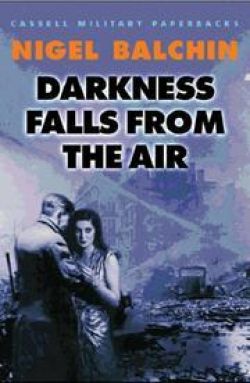
Nigel Balchin: Darkness Falls From the Air (1942) Literature and War Readalong May 2012

With ostentatious lack of concern, Bill Sarratt, his wife and her lover spend the war wining and dining expensively, occasionally sauntering out into the Blitz with cheerful remarks about the shattered night-life of London’s West End. But beneath the false insouciance lies the real strain of a war that has firmly wrapped them all in its embrace. Wit may crackle at the same pace as buildings burn, but personal tragedy lurks appallingly close at hand.

I have always wondered how people lived during the Blitz. How they coped with the fear, the chaos, the exhaustion and lack of sleep. I have seen a couple of movies set during WWII. Something that struck me more than once was the depiction of the Londoners during the Blitz. More than one movie showed them dancing or dining all through an air raid. Almost as if nothing was happening. I always wondered if this could have been the case. And what about the air raids that went on during the whole night? How would you cope with that? A lot of the questions I had have been answered by Darkness Falls From the Air. While I’m sure Blachin took some liberties and may have exaggerated, I think it still manges to give a good impression. It is one of the rare books that has been written during the Blitz which makes it especially interesting. Balchin worked as a psychologist for the British War Office and later as Deputy Scientific Advisor to the Army Council. Both occupations can be felt throughout the novel.

What I liked is how the main characters’ personal story, their marriage, work life and the war are interwoven.

In the beginning of the novel, the air raids aren’t as frequent at night and whenever a bomb falls down somewhere, Bill and his wife Marcia go and watch because it’s to a certain extent exciting. They do not feel threatened at all. They dine in underground restaurants and sleep in their own apartment. But the longer the war lasts, the more precarious the situation gets. People start to live in the tube and Marcia and Bill move to a hotel as their apartment house has no shelter. They still go out and dine underground and walk around the city to see the damage but it starts to become a bit less carefree. What gets to Stephen the most is the lack of sleep.

The day raids were dying down now. I suppose the pace was too hot to last. But to make up for it the nights were getting rougher than ever. The chief difficulty was to get enough sleep to keep going. Everybody was turning up at the office looking half asleep and sour as hell. I think it was this which led up to my row with Lennox. Lord knows there were enough reasons for quarreling with Lennox even if you were sleeping eight hours a night. When you got dow to an average of about three the thing was a certainty.

The narrator of Darkness Falls From the Air, Bill Sarrat, is a public servant. He must be one of the most cynical characters I’ve ever encountered in a novel. I didn’t expect this to be an amusing book but it was. Grim but funny. Passages like the one below illustrate what type a of person Sarrat is. He has an acute sense of the times he’s living in but at the same time he evades self-pity because he ultimately doesn’t take himself too seriously.

I’d decided that, what with work and Marcia and one thing and another, I was getting out of touch with the war. So I got out an atlas and Whitacker’s Almanack and so on and studied the war. That took about ten minutes. Then I tried forecasting the next bits. The last time Ted and I did that was at the beginning of the year. Ted put down that Germany would invade Switzerland, and that Japan would have a crack at Burma. I said that Germany would attack Hungary and Rumania and that Turkey would join up with us. The next morning Russia invaded Finland. An experience like that takes the heat out of you as a prophet.

The book follows three different narratives. The first is the marriage between Bill and Marcia which becomes more and more dysfunctional the longer the war goes on and the deeper Marcia entangles herself in her love affair with Stephen. The second story line centers on the depiction of life during the Blitz. The third narrative strand evolves around Bill’s occupation as a Civil Servant. The absurdity of the bureaucracy stands in stark contrast to the urgency of the matters they deal with. While “there is a war on”, they spend hours and days in useless meetings. Half of the staff is unprepared while others try to sabotage great projects out of sheer jealousy or incompetence. These parts reminded me so much of corporate life where people who have no clue will add tons of comments, questions and words of caution to a well prepared concepts just to pretend to be involved and competent. Additionally nobody wants to take a decision and those who work and think are the one’s seeing the useless people being promoted because they are in the way and no one knows how to deal with them otherwise. All this is captured by Balchin and these elements made this a very amusing book.

Blachin was, as I have mentioned, working as a psychologist and that shows in the parts dedicated to the love triangle. While I could have slapped Marcia and her vain lover Stephen, the discussions, the back and forth and Bill’s analysis of the whole story rang remarkably true.

While Darkness Falls From the Air has been called the novel of the Blitz, which it certainly is, it’s an amazing analysis of bureaucracy and a hopeless marriage. This was my first Balchin and I’m glad I discovered this author on Guy’s blog. It isn’t a flawless novel, it could have done with some editing but the voice and the tone are unique and the grim sense of  humour appealed to me a lot.

Other reviews

Danielle (A Work in Progress)

*******

Darkness Falls From the Air was the fifth book in the Literature and War Readalong 2012. The next one will be Bomber by Len Deighton. Discussion starts on Friday June 29, 2012.

Spanish Literature Month – July 2012

There have been requests last year and then a rumour started to spread and now it’s official: July is Spanish Literature Month. Stu (Winstonsdad’s Blog) and Richard (Caravana de recuerdos) who co-host this event have organized a watchalong (Carlos Saura) and two readalongs (Juan Carlos Onetti A Brief Life and Enrique Vila-Matas Bartleby and Co.) but if you cannot make them you are free to choose whatever you like. If you want to join, just leave a comment at one of the two blogs. Here’s Stu’s intro post and here the one by Richard.

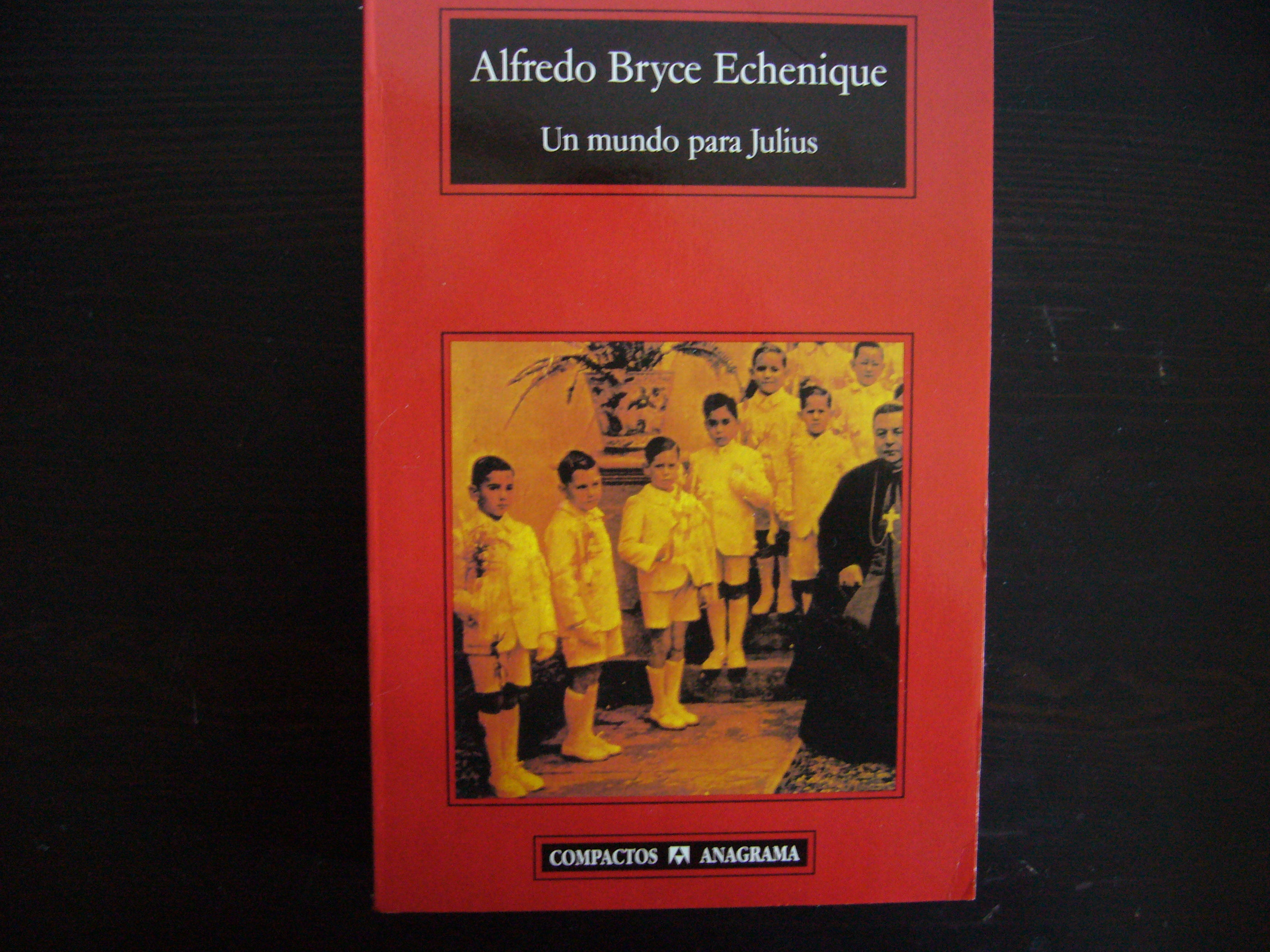
As you can see I have an idea what I would like to read. Since I may not be able to read a lot, I want at least to read one of the books I have in Spanish. A few years back I bought Un mundo para Julius by Peruvian writer Alfredo Bryce Echenique. I like books about the end of an era. They are usually lyrical, nostalgic and melancholic. This seems to be no exception.

It has been translated into English as A World for Julius.

Julius was born in a mansion on Salaverry Avenue, directly across from the old San Felipe Hippodrome.” Life-size Disney characters and cowboy movie heroes romp across the walls of his nursery. Out in the carriage house, his great-grandfather’s ornate, moldering carriage takes him on imaginary adventures. But Julius’s father is dead, and his beautiful young mother passes through her children’s lives like an ephemeral shooting star. Despite the soft shelter of family and money, hard realities overshadow Julius’s expanding world, just as the rugged Andes loom over his home in Lima. This lyrical, richly textured novel, first published in 1970 as Un mundo para Julius, opens new territory in Latin American literature with its focus on the social elite of Peru. A member of that elite, Bryce Echenique incisively charts the decline of an influential, centuries-old aristocratic family who becomes nouveaux riches with the invasion of foreign capital in the 1950s. A World for Julius, his first novel, marks the first appearance in English of this important Peruvian writer, whose Latin American postmodern fiction has won critical acclaim throughout the Spanish-speaking world.

I may end up reading something less challenging in terms of pages. Two authors I like a lot are Almudena Grandes from Spain and Maria Luisa Bombal from Chile. I still have some of their books I have not read.

Product Details

The crime novels by Teresa Solana A Not So Perfect Crime and A Shortcut to Paradise are possible choices as well.

Or another Peruvian author. I just recently got Vargas Llosa’s Death in the Andes – Lituma en los Andes.

Set in an isolated, run down community in the Peruvian Andes, Vargas Llosa’s riveting novel tells the story of a series of mysterious disappearances involving the Shining Path guerrillas and a local couple performing cannibalistic sacrifices with strange similarities to the Dionysian rituals of ancient Greece. Part-detective novel and part-political allegory, it offers a panoramic view of Peruvian society; not only of the current political violence and social upheaval, but also of the country’s past, and its connection to Indian culture and to pre-Hispanic mysticism.

I have read Juan Carlos Onetti before and liked him very much. To make sure that I really read at least something, I will join the readalong of A Brief Life. The details can be found on Richard’s and Stu’s blog.

I could suggest some other books but I think Stu and Richard are doing a great job at pointing out books you should discover.

Are you joining as well? What are you going to read? Do you have favourites of Latin American and Spanish literature?

Literature and War Readalong May 28 2012: Darkness Falls From the Air by Nigel Balchin

I had never heard of Nigel Balchin before reading a few intriguing reviews on Guy’s blog (herehere and here). When I looked him up and saw he wrote a novel – Darkness Falls From the Air – which is called the “classic novel of the London Blitz” and written during the Blitz in 1942, I was keen on including it this year. Balchin seems one of those authors hardly anyone knows anymore but those who rediscover him are usually enthusiastic. It even seems that he is Patrick McGrath’s favourite novelist.

After having read about the bombing of Coventry written by a contemporary writer it will be interesting to see how someone handles the Blitz who has actually experienced it.

Here are the first sentences

I stopped at about seven. There was too much stuff on my desk to have a chance of getting clear that night, and I was tired of it. I felt pretty guilty coming downstairs, and had to tell myself  that this was the first time this week that I had stopped before eight.

Two French officers were just coming in the front door as I went out, and I did the bowing and waving act that I always do to them. It struck me as odd that they should still be around – unless they had decided to stay on in England and fight with us.

*******

The discussion starts on Monday, 28 May 2012.

Further information on the Literature and War Readalong 2012, including all the book blurbs, can be found here.

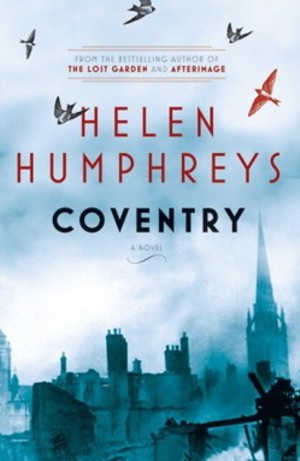
Helen Humphreys: Coventry (2008) Literature and War Readalong April 2012

Helen Humphrey’s novel Coventry starts with a woman and a young man standing on Coventry cathedral, on November 14, 1942. Harriet and Jeremy are fire fighters. It’s an eerie night, almost beautiful.

The moon is full and bright and the ground below the cathedral is white with frost. Harriet has never seen anything so beautiful. The ground glitters like the sea and smells of earthy cold.

This is the night in which Coventry cathedral will be bombed and most of the city destroyed. But when the bombs start falling and even after most of the destruction, Harriet still sees beauty.

The leaves have burnt black on the trees. The limbs are twisted and full of clothes, caught there like strange birds in the upper branches. The clothes must have blown up there from a bomb blast.

Harriet remembers the morning of November 14. How beautiful it was, all sun, and only a little wind to remind her of autumn. It was a thursday, early closing. She had gone round to the shops before lunch, and she had felt lucky because she was first in line at the butcher’s and got sausages.

Until this evening Harriet didn’t feel touched by the war. She is disappointed by it but not devastated. She will not, as she believes, suffer like she did in the last war when she lost the man she loved.

After the brief initial chapter, the novel moves back to 1914. A young Harriet sees her husband off to war. The very same morning, after returning from the train station, she meets Maeve, and lives a moment of intense friendship with the young woman. Harriet will not see her husband again. He goes missing in the trenches. And until the night of November 1940, she will not see Maeve again either.

Unbeknownst to all of them, the young man on the roof with Harriet, is Maeve’s son. The story of the two women’s lives will unfold during the novel, interwoven with the story of this tragic night in which the three fight in parallel and together, for their survival.

Harriet has never loved again and Maeve who left Coventry shortly after having met Harriet, gets pregnant. She doesn’t even know which one of the slodiers she was seeing is the father.

Most of the chapters focus on Harriet and Jeremy who flee from the burning cathedral, roam the streets, hide in shelters, run from the bombs and burning debris. They are looking for Maeve and their houses, anxious to discover how much they might have lost. The destruction is incredible, the sight of so many dead people is terrible but it’s even more harrowing to hear voices coming out from underneath demolished houses and not be able to help, to stand by and hear them suffocate. There are many descriptions of people whose life is snatched away within a second. One moment they are talking, shaving, walking, the next moment they are gone.

Coventry is a lyrical novel, written by a poet, telling the story of a poet who is trying to make sense. Since the tragic loss of her young husband, Harriet has written condensed descriptions. They shield her from emotion, give sense. That’s what she will do in the future as well. After the terrible night in which Coventry is destroyed, she will become a poet.

While Harriet paints with words, Maeve captures everything that has happened with her pencil. Already when they met in 1914 she was drawing constantly.

I’m in two minds about this book. It’s an intense description of what it meant to be in a city undergoing such massive destruction. This is well captured, at the same time, the addition of descriptions like the ones above, hold the horrors at arm’s length. I’m interested in the depiction and description of war. How do you put it into words, how do speak about the unspeakable? I think this was one of Helen Humphrey’s intentions, to show how a poet would write and feel about this horrible night. That’s why, more than a book about Coventry’s ordeal, this was for me a book about the birth of a poet. And that’s precisely what troubles me. I’ve read other books by Helen Humphreys and liked them, but in this case I feel the writing is too lyrical and esthetic for its topic. And there is the coincidence at the heart of the story, the fact that the young man Harriet spends the night with is Maeve’s son. Unfortunately I really don’t do well with this type of coincidence.

Coventry is a beautifully written book, the novel of a stylist but some rough edges would have given it a whole other dimension that would have been more appropriate for the subject. Still, and this may seem paradoxical, it is a book I would like to read again, if only for its language. Maybe I’m not doing it justice, maybe I’m just not used to someone describing war in such a lyrical way and depicting people who are so caught in their inner lives that they seem ultimately untouched by the collective experience of destruction.

I’m very curious to see what others thought.

Other reviews

Additionally to his review Tony has written an interesting post on his hometown Coventry and the Coventry Cathedral. It’s well worth reading.

Anna (Diary of an Eccentric)

Danielle (A Work in Progress)

TBM (50 Year Project)

Tony (Tony’s Reading List)

*******

Coventry was the fourth book in the Literature and War Readalong 2012. The next one will be Nigel Balchin’s Darkness Falls From the Air. Discussion starts on Monday May 28, 2012.

Literature and War Readalong April 30 2012: Coventry by Helen Humphreys

With last month’s book we have left WWI behind us and move on to WWII. The first of the WWII books is Helen Humphreys’ novel Coventry. I thought this would be my first novel by this author but I have read another one before, The Lost Garden, a wonderfully lyrical coming-of-age story which I liked a lot. With this in mind I’m keen on reading Coventry. Helen Humphreys is British but she lives in Ontario, Canada. Helen Humphreys has won several prizes, she is the author of 4 novels, one book of narrative non-fiction and four collections of poetry. I have a weakness for poets who write novels or novelists who write poetry because the writing is usually far above the average.

On the back cover of the novel it says that Coventry is “a memorial to the terrible losses of wartime, and a celebration of remembrance, determination and resilience.” The book tells the story of two women and moves back and forth between 1919 and the night of the 14 November 1940.

Here are the first sentences

The swallow arcs and dives above the cathedral. Harriet March watches it flicker through the darkness ahead of her as she walks along the cobblestones towards the church. The bird moves in the night air with all the swiftness of sudden feeling, and Harriet stops at the base of the ladder, tracking the flight of the lone swallow as it shivers up the length of the church spire.

*******

The discussion starts on Monday, 30 April 2012.

Further information on the Literature and War Readalong 2012, including all the book blurbs, can be found here.

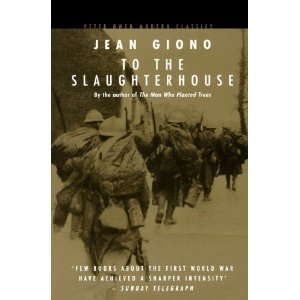
Jean Giono: To the Slaughterhouse – Le grand troupeau (1931) Literature and War Readalong March 2012

There are so many different ways to write about war. Some novels focus on the experience of the soldier, some will focus on what the civilians go through, some move back and forth between the front lines and the home front. While Jean Giono’s Le grand troupeau – To the Slaughterhouse does move back and forth, the book is still completely different from anything else that I have read so far.

Giono’s technique does need some getting used to. What he describes is equally beautiful and horrifying. The result may very well be one of the most radical anti-war books that I have read.

If you are looking for an action-driven novel, this isn’t one to turn to, Giono’s novel is far more like the description of paintings. I was reminded of Otto Dix’ WWI paintings more than once. Some of the very visual descriptions in this novel are as graphic and gruesome as Dix’ work.

The war has come to a little village in the French Provence region. All the men are drafted and go to war, leaving the women, old men, children and animals behind. Some of the men are shepherds. They have to abandon their herds. Left on their own,  the animals are endangered, they have accidents, get wounded. One day a massive herd enters the village. It’s an awful sight. So much suffering, so much pain.

Julia’s husband Joseph has gone to war, as has her sister-in-law’s young lover, Olivier. The story moves back and froth between life in the village and the men. It’s more a series of pictures than a real story. Very powerful and graphic pictures.

Giono chose to show us how war affects the body. It’s not the fighting he is interested in but what happens when someone is wounded. How the wounds fester, how the juices flow out the dead bodies. The rats which are always mentioned in WWI novels are present here as well but we see how they eat the faces of the dead men.

I had a faint feeling in my stomach for most of the time while reading but I saw what he wanted to achieve and I thought the idea was amazing. He didn’t stop at describing the horrors of the war and what it did to the bodies of the men, he described the beauty as well. The scents in the air, the taste of food, the beauty of the landscape.

There are hunting scenes and scenes of slaughter and the bodies of the dead animals resemble those of the dead and wounded men.

Human beings and animals both suffer pain, their bodies are vulnerable and frail, they can be killed and harmed and wounded and the result will be the same. At one point he goes one step farther, describing how the earth suffers too, when her body is ripped open by explosives. Giono includes the entirety of creation in his novel and shows that every being existing in this world, wants beauty, love and tenderness, shelter and food and when this is not provided, when aggression is let loose, the body is harmed, wounded and the being ultimately dies.

It’s a highly symbolical novel, with a profound message of peace. It was hard to read but I am glad I did. It really would be hard to find a more eloquent anti-war statement and a book which manages like this one, to show, that since we all, animals and human beings alike, suffer pain, we are equal. This profound message makes To the Slaughterhouse not only a plea for human rights but for animal rights as well.

Other reviews

Danielle (A Work in Progress)

To the Slaughterhouse is my fourth contribution to the War Through the Generations Challenge hosted by Anna and Serena.

*******

To the Slaughterhouse was the third book in the Literature and War Readalong 2012. The next one will be Helen Humphreys’ Coventry. Discussion starts on Monday April 30, 2012.

Literature and War Readalong March 30 2012: To the Slaughterhouse – Le grand troupeau by Jean Giono

Jean Giono’s To the Slaughterhouse – Le grand troupeau is the last WWI novel of this year’s readalong. Giono is one of the great French writers, famous for books like L’homme qui plantait des arbresThe Man Who Planted Trees, Joy of Man’s Desiring – Que ma joie demeure orLe hussard sur le toit – The Horseman on the Roof which has been made into a successful movie. His books are deeply rooted in the South of France and he is often compared to Pagnol.

I try not to be too enthusiastic this time, but, let me just say, cautiously, I think, this should be a good book. At least he is an author who has never disappointed me so far and I’m even planning on (re-)reading a few of his other books this year, like Colline, Un de Baumugnes and Regain, the so-called Pan trilogy. Giono is famous for the way he describes the joy of life and that’s why I’m particularly interested to see how he treated such a bleak subject.

Here are the first sentences

Last night they watched as all the men left. It was a thick August night smelling of corn and horse-sweat. The animals were harnessed in the station-yard. The big plough-haulers had been tied up to the shafts on the carts; their solid rumps held back the loads of women and children.

The train moved off quietly in the night, spattering the willow trees with embers as it took on speed. Then all the horses started moaning together.

*******

The discussion starts on Friday, 30 March 2012.

Further information on the Literature and War Readalong 2012, including all the book blurbs, can be found here.