Neil Gaiman – The Graveyard Book (2008) Readalong Part I

There was a hand in the darkness, and it held a knife.

The knife had a handle of polished black bone, and a blade finer and sharper than any razor. If it sliced you, you might not even know you had been cut, not immediately.

From the very first lines we are drawn into the story of the little boy Nobody Owens and the man Jack who kills his whole family at the beginning of Gaiman’s novel The Graveyard Book.  We don’t know why the man Jack kills the little boy’s family, all we know is that he isn’t happy he didn’t get the little boy as well. While he was killing Nobody’s parents and brother, the baby escapes through the door, down a hill and into the graveyard.

Mrs and Mr Owens see the little boy and Mrs Owens, although she is a ghost, feels an intense, until now unfulfilled longing  and wants to keep the baby for herself. At first there is debate. The other ghosts are not sure it is a good idea. How will she feed him? How will she take care of him? But when the man Jack arrives at the graveyard door and they become aware the baby is in great danger, they agree to protect him and keep him in the graveyard. Luckily Silas, who isn’t really a ghost but no real human either, can move between their and our world and is capable to provide food for the little boy.

In the subsequent chapters the boy who the ghosts have baptised Nobody Owens is introduced to the ways of the living and the dead. He learns to read and write, is taught history and other things, makes friends with a little girl, is abducted by ghouls.

The story as such, which is inspired by Kipling’s The Jungle Book, is not that special but the way it is told is fantastic. More than a writer Gaiman is a story-teller. He is a very musical writer with an ear for language and it’s not surprising his books work well as audio books. The sentences have a hypnotic quality, they draw you in, captivate you by their sound and their meaning alike.

What I thought was particularly great is that we know the man Jack will turn up again. We know his story isn’t over. And we don’t want it to be over. We want to find out why he killed Nobody’s family and what he will do to access the graveyard. The inhabitants of the cemetery may not be corporeal but they still have power. They were able to protect Nobody once, will they be capable to do it again?

I can’t tell you how much I like this novel. It’s wonderful, it feels as if Gaiman when he writes is connected to the very source of story telling itself. In an introduction to a short story collection Gaiman wrote that he thinks the only proof a story is well written is when the readers ask the question “What happened next?”. Gaiman certainly achieved this and much more.

I’ve bought The Graveyard Book a couple of years ago but never read it. I’m so glad it is part of this year’s R.I.P. hosted by Carl. 38 people have signed up to read along. If you want to read what other’s thought of the first 3 chapters, don’t miss visiting Carl’s blog for the other reviews.

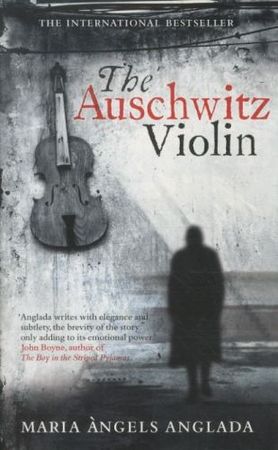
Literature and War Readalong October 2012: The Auschwitz Violin – El Violi` d`Auschwitz by Maria Àngels Anglada

Maria Àngels Anglada who died in 1999 was considered to be one of the most important Catalan writers of the 20th Century. She won many prizes and was widely read. The Auschwitz Violin – El Violi`d`Auschwitz was translated a year ago and when I saw it in a book shop I thought it’s a perfect choice. It’s slim, seems well written and tells the story of a musician and his struggle to stay human during his imprisonment in Auschwitz.

Here are the first sentences

December 1991

I always have trouble falling asleep after I perform at a concert. It keeps playing in my mind, like a tape going round and round. I was more keyed up than usual because this concert had been special: it marked the two hundredth anniversary of Mozart’s death. The recital was held in Krakow, a city of wonderful musicians, in a makeshift auditorium in the bellissima Casa Veneciana.

*******

The discussion starts on Monday, 29 October 2012.

Further information on the Literature and War Readalong 2012, including all the book blurbs, can be found here.

Richard Bausch: Peace (2008) Literature and War Readalong September 2012

Richard Bausch’s Peace (2008) is set in Italy during WWII. An American  recon squad comes upon a group of people and a cart. A German officer and a German prostitute are hiding on the wagon. When they turn it around, the German officer opens fire and kills two of the young American soldiers. Corporal Marson shoots him, while Sergeant Glick shoots the woman in the head.

It’s the end of WWII and German troops are retreating but not without trying to take down anyone they can with them. The mountains are hostile territory, it’s cold and it rains constantly. The little troop of men is demoralized. The life of a recon squad is usually very dangerous, they have to find out where the German line is and might accidentally already be behind the lines. After the shooting of the officer and the whore, three of the men are sent on recon again. Sgt Marson, Ash and Joyner. On their way they meet Angelo, a frail and very old Italian man and force him to guide them.

Marson, Ash and Joyner are as different as three people can be. Marson is the oldest, he’s 26, married and has a child. Joyner and Ash are 20. Ash seems to be deeply traumatized by something he experienced in Africa and which wakes him every night. He seems to be a good sort but starts to annoy Marson because he wants to denounce Glick. The murder of the prostitute has shocked him and he thinks Glick should be brought to justice. While Marson agrees with him, he feels it’s not the right time and he has problems of his own. They are on a very dangerous recon mission, it’s very cold and raining. They don’t know where they are and have to rely on a man he doesn’t completely trust. Many of the Italians have surrendered, many never really participated but there are still a lot of fascists who would gladly kill them. Plus he fights a battle with his conscience. Before shooting the German officer he had never killed anyone up close and the memory of it makes him sick. Tensions between the four people would be high anyway but Joyner is an aggressive bigot, anti-Jews, anti-Communists, anti-drinking. But swearing and abusing people constantly which is a huge contradiction.

Matters get even worse when it starts snowing and they hear shots. They find a dead German and later hear more shots coming from a village where, as the old man explains, Jews are being executed.

The three men are really tested and have to go to their limits. They fight the cold, are in enemy territory, traumatized by what they have seen so far and by their conscience.

I must honestly say I was not too impressed with this book. It’s told in chapters alternating between the past of the three men, what they had experienced in Palermo and their actual recon mission. The central conflict or theme, drawing the line between justified killing and murder, is shown but it didn’t move me. The book exemplifies how much it meant for soldiers to kill, it underlines that in WWII shooting someone from up close was in no way common and could cause a huge problem, triggering moral conflicts. Unfortunetly I never felt that conflict.

It’s hard to say why this book did so not work from me. I felt Bausch wanted to tell a story that wasn’t his and I suspect he watched a few movies in order to get a feel for what it was like but ultimately I felt he couldn’t make this story his and tell it in a moving way. In this it reminded me of Coventry but looking back I’d say, I liked that much more.

I’m aware this is a bit of an uninspired review but I’m really unfazed by this book.

I hope others did read along. I’m very interested to hear their thoughts.

Other reviews

Danielle (A Work in Progress)

Victoria (creativeshadows)

*******

Peace was the ninth book in the Literature and War Readalong 2012. The next one will be Maria Angels Anglada The Auschwitz Violin – El violí d’Auschwitz. Discussion starts on Monday 29 October, 2012.

Antonio Tabucchi Week – Wrap Up

Tabucchi Week is already over and I wanted to thank all of you who joined, read along, wrote reviews, commented and read other’s posts. I’m really happy that it was quite interactive and people visited each other’s blogs. There were quite a few very interesting discussions. I’m also happy that those who joined who didn’t know Tabucchi found an author whose work they want to continue exploring and those who knew him felt like returning to an old friend. I enjoyed the two books I chose a great deal and I’m also glad that I have discovered a few new blogs.

What I also loved was that many of the posts showed how wide Tabucchi’s range is and that everyone can find something else in his books. Quite a few people have read Pereira Maintains but every single post was completely different and highlighted other things, something I’ve rarely noticed when many people read the same novel.

Once more – Thank you so much for participating.

Below are all the participant reviews again (they are also in the intro post). In a few days I’ll set up a page which will allow to find the posts more easily. I’m pretty sure this isn’t the last author week I’ve hosted and knowing that I like a bit of a theme the next week will most probably also be dedicated to an Italian writer. No worries, though, not before next year.

It’s Getting Later All the Time – Brian (Babbling Books)

On Dreams of Dreams – Tom (Wuthering Expectations)

Pereira Declares – Judith (Reader in the Wilderness)

Pereira Maintains – TBM (50 Year Project)

Pereira Maintains – Vishy (Vishy’s Blog)

Pereira Maintains – Bettina (Liburuak)

Pereira Maintains – Andrew Blackman

Piazza d’Italia – Scott (seraillon)

Requiem – Caroline (Beauty is a Sleeping Cat)

The Edge of the Horizon – Caroline (Beauty is a Sleeping Cat)

The Flying Creatures of Fra Angelico – Stu (Winstons Dad’s Blog)

The Last Three Days of Fernando Pessoa with Bonus Lobster Recipe – Tom (Wuthering Expectations)

The Missing Head of Damasceno Monteiro – Richard (Caravana de Recuerdos)

Vanishing Point -1streading

Pereira Maintains (Book and Movie) and Requiem – Scribacchina (Parole/Words)

Antonio Tabucchi Week

Antonio Tabucchi Week is finally approaching. It’s starting tomorrow and this is really just a very quick introduction to the week and some info for those who participate. I’m going to post two reviews, one on Tuesday and one either Friday or Saturday and will wrap up on Monday in a week.

I spent the last week reading Tabucchi and was quite captivated by my choices. I wanted to read Pereira Maintains but then I dipped into another two of his books and one of them hooked me right away.

Tabucchi has written quite a few very short books, so if you haven’t started yet, there is still time until Sunday.

If you are participating and have reviewed something, please, leave a link in the comment section of this post.  I’ll add it to this post. Once the week is over you can still access the links either via this post or via the page I will set up.

Participant reviews

It’s Getting Later All the Time – Brian (Babbling Books)

On Dreams of Dreams – Tom (Wuthering Expectations)

Pereira Declares – Judith (Reader in the Wilderness)

Pereira Maintains – TBM (50 Year Project)

Pereira Maintains – Vishy (Vishy’s Blog)

Pereira Maintains – Bettina (Liburuak)

Pereira Maintains – Andrew Blackman

Piazza d’Italia – Scott (seraillon)

Requiem – Caroline (Beauty is a Sleeping Cat)

The Edge of the Horizon – Caroline (Beauty is a Sleeping Cat)

The Flying Creatures of Fra Angelico – Stu (Winstons Dad’s Blog)

The Last Three Days of Fernando Pessoa with Bonus Lobster Recipe – Tom (Wuthering Expectations)

The Missing Head of Damasceno Monteiro – Richard (Caravana de Recuerdos)

Vanishing Point -1streading

Pereira Maintains (Book and Movie) and Requiem – Scribacchina (Parole/Words)

Literature and War Readalong September 2012: Peace by Richard Bausch

This year’s readalong is a chance for me to read some of the great novelists and authors I hadn’t had an opportunity to read before. Since I’ve first read something about Richard Bausch he was on my list of authors I must read. He is quite famous as a short story writer, his work has appeared in numerous collections and magazines. Peace (2008) is set in Italy during WWII. This isn’t a tale of the home front but from the point of view of American soldiers. It is towards the end of the war, in 1944. Critics called it one of the best books they’ve ever read. A.L. Kennedy called it, lean, compact, layered, darkly humorous, unflinching and lyrical.

Here are the first sentences

They went on anyway, putting one foot in front of the other, holding their carbines barrel down to keep the water out, trying, in their misery and confusion – and their exhaustion – to remain watchful. This was the fourth straight day of rain – a windless, freezing downpour without any slight variation of itself.

*******

The discussion starts on Friday, 28 September 2012.

Further information on the Literature and War Readalong 2012, including all the book blurbs, can be found here.

Guy de Maupassant: Bel-Ami (1885)

When I used to think of Maupassant, I used to think of short stories. That was all I had read by him so far and because he is so excellent at it – probably one of the very best short story writers you can read – I thought that his novels might be pale in comparison. I was wrong. After having read Bel-Ami, I think that he might very well be one of the best writers in any genre. It’s one of the most perfect books I’ve ever read. I couldn’t name one single flaw. As much as I like Balzac there is always this and that, minor things, sure, but still, some imperfections. Not with Maupassant. What also surprised me is that this book could have been written nowadays. The society has changed, the world has changed but the way he writes about love, sex, power, money, careers… It’s outspoken and modern.

More than anything Bel-Ami is a character portrait paired with the portrait of a society, the Parisian high society. Georges Duroy, who receives the nick name Bel-Ami from the daughter of his lover Mme Marelle, is one of the most unlikable characters of French literature. An arriviste who has only one striking feature, his good looks, and one talent, the talent to know how to use people or, to be more precise, women.

At the beginning of the  novel he is working as a clerk and hardly knows how to pay his meals. He was a sergeant in the colonial army and served in Algeria. One evening, strolling down the boulevards of Paris and debating with himself how to use his last francs, he bumps into Forrestier, a former comrade. Forrestier has become a journalist in a new and not very respected newspaper which belongs to a Jewish man, Mr Walter. Forrestier is married to a beautiful and very intelligent woman and lives a cushy life. It wasn’t entirely clear to me why he chose to help Bel-Ami but he does and in doing so sets in motion the spectacular ascension of Georges Duroy. Forrestier opens the door to his house and helps him to a position as assistant journalist. Although, just like Forrrestier himself, he isn’t capable of writing one coherent piece, he will become a famous journalist. I’m not going to tell you how, you have to read it to find out.

One trait I found interesting in the novel is to see why people invite other people into their houses. Women invite Bel-Ami because they want him close, they are in love with him. Men on the other hand invite him because he doesn’t have a lot and they all love to display their riches. The women in this society are all easily seduced and the men become victims of their vanity.

While he is still somewhat naive but envious at the beginning of the novel, once he has understood how easily he gets access to the high society and can achieve almost anything through these two weaknesses, the easy seduction of women and the vanity of their men, he turns into a manipulative and calculating machine. Using one woman after the other, duping one husband after the other, he ascends the social ladder with dizzying speed.

While Bel-Ami is the central character, the women and their husbands are not less well-drawn. One perfect little scene after the other shows Bel-Ami “at work”. It’s amazing that he becomes a famous journalist although he isn’t capable of writing. And later he even becomes a politician despite the fact that he is clueless and knows nothing about politics. He is just clever enough to know who does and to get to their knowledge via the one or the other woman.

Bel-Ami is vain, he is self-centered and cares only about his own pleasure, power and money. He seduces people and uses them and when they are no longer of any value he discards them which leads to some fantastic scenes. While he is unlikable, one has to be fair, he doesn’t force women, he seduces them and it’s ultimately their weakness which leads him to success. Men like Bel-Ami still exist and things have not changed much in our society in that regard. I still see women falling for this type of guy who has nothing to offer but looks and sweet talk. And an erotic appeal. Let’s face it, without that erotic appeal not even Bel-Ami would have gotten that far. It’s obvious in the novel, and quite explicit too, that the women  do not fall for him because he is bright or because they want to spend hours gazing into his eyes. They want to go to bed with him. Even the very young ones like Mme Marelle’s daughter who invented the nickname Bel-Ami, cannot hold back and want physical contact.

Maupassant’s novel is one of those that should be read by people who think 19th Century literature is old-fashioned and has nothing to offer to contemporary readers. It could open a door to a whole new reading experience. 

Bel-Ami is an entirely captivating and well-told story, combining descriptions of opulent interiors and detailed character portraits with the analysis of a society addicted to power and fame and one man who knows how to exploit it all.