Literature and War Readalong 2013

The Yellow BirdsThe Flowers of WarThe WarsThe Heat of The Day

Children of The New WorldThere Is No TimeDeath of the AdversaryGrey SoulsEverything FlowsThe Sorrow of WarAll That I AMWinter in Wartime

It took a long time to compile the reading list for the Literature and War Readalong 2013 but I must say, I’m pleased with the result.

In 2013 we will be reading 12 books  from 12 different countries, written in 8 different languages and covering 6 different wars.

I think it’s the most diverse list so far. I also tried to take different events into account which should allow people to pick a book for the readalong which will also count towards other events. There is an Irish author for March, a Dutch author for June, German for November, and a Canadian and an Australian choice for the respective challenges.

And here goes the final list
The Yellow Birds

January, Monday 28

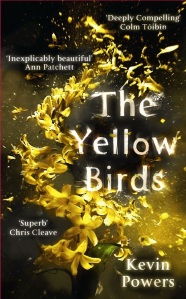
The Yellow Birds by Kevin Powers (2012), 240 pages – US – Iraq war

LONGLISTED FOR THE GUARDIAN FIRST BOOK AWARD 2012 NEW YORK TIMES BESTSELLER An unforgettable depiction of the psychological impact of war, by a young Iraq veteran and poet, THE YELLOW BIRDS is already being hailed as a modern classic. Everywhere John looks, he sees Murph. He flinches when cars drive past. His fingers clasp around the rifle he hasn’t held for months. Wide-eyed strangers praise him as a hero, but he can feel himself disappearing. Back home after a year in Iraq, memories swarm around him: bodies burning in the crisp morning air. Sunlight falling through branches; bullets kicking up dust; ripples on a pond wavering like plucked strings. The promise he made, to a young man’s mother, that her son would be brought home safely. With THE YELLOW BIRDS, poet and veteran Kevin Powers has composed an unforgettable account of friendship and loss. It vividly captures the desperation and brutality of war, and its terrible after-effects. But it is also a story of love, of great courage, and of extraordinary human survival. Written with profound emotional insight, especially into the effects of a hidden war on families at home, THE YELLOW BIRDS is one of the most haunting, true and powerful novels of our time. ‘THE YELLOW BIRDS is the All Quiet on the Western Front of America’s Arab Wars.’ (Tom Wolfe, author of The Bonfire of the Vanities ) ‘Kevin Powers has conjured a poetic and devastating account of war’s effect on the individual.’ (Damian Lewis, star of Homeland and Band of Brothers ) ‘Inexplicably beautiful’. (Ann Patchett, Orange Prize-winning author of Bel Canto and State of Wonder)
February, Thursday 28

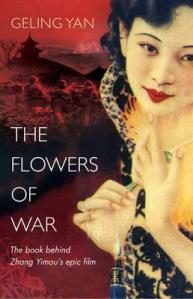
The Flowers of War aka Jingling Shisan Chai by Geling Yan (2006), 256 pages, ChinaChinese/Japanese war

December 1937. The Japanese have taken Nanking. A group of terrified schoolgirls hides in the compound of an American church. Among them is Shujuan, through whose thirteen-year-old eyes we witness the shocking events that follow. Run by Father Engelmann, an American priest who has been in China for many years, the church is supposedly neutral ground in the war between China and Japan. But it becomes clear the Japanese are not obeying international rules of engagement. As they pour through the streets of Nanking, raping and pillaging the civilian population, the girls are in increasing danger. And their safety is further compromised when prostitutes from the nearby brothel climb over the wall into the compound seeking refuge. Short, powerful, vivid, this beautiful novel transports the reader to 1930s China. Full of wonderful characters, from the austere priest to the irreverent prostitutes, it is a story about how war upsets all prejudices and how love can flourish amidst death.
March, Thursday 28

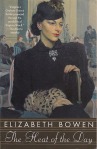
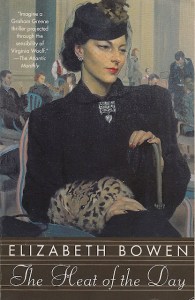
The Heat of the Day by Elizabeth Bowen (1949), 336 pages, IrelandWWII

It is wartime London, and the carelessness of people with no future flows through the evening air. Stella discovers that her lover Robert is suspected of selling information to the enemy. Harrison, the British intelligence agent on his trail, wants to bargain, the price for his silence being Stella herself. Caught between two men and unsure who she can trust, the flimsy structures of Stella’s life begin to crumble.
April, Monday 29

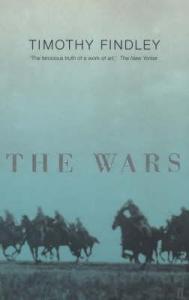
The Wars by Timothy Findley (1977), 240 pages, CanadaWWI

Robert Ross, a sensitive nineteen-year-old Canadian officer, went to war – the War to End All Wars. He found himself in the nightmare world of trench warfare; of mud and smoke, of chlorine gas and rotting corpses. In this world gone mad, Robert Ross performed a last desperate act to declare his commitment to life in the midst of death.The Wars is quite simply one of the best novels ever written about the First World War.
May, Friday 31

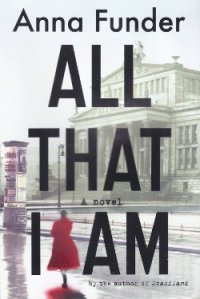
All That I Am by Anna Funder (2011), 384 pages, AustraliaWWII

Anna Funder, winner of the Samuel Johnson Prize and author of Stasiland, offers a thrilling tale and powerful love story that tells the heroic and tragic true story of the German resistance in World War II in All That I Am.

When Hitler comes to power in 1933, a tight-knit group of friends and lovers become hunted outlaws overnight. United in their resistance to the madness and tyranny of Nazism, they must flee the country. Dora, passionate and fearless, her lover, the great playwright Ernst Toller, her younger cousin Ruth and Ruth’s husband Hans find refuge in London. Here they take breath-taking risks in order to continue their work in secret. But England is not the safe-haven they think it to be, and a single, chilling act of betrayal will tear them apart…’The strengths of Funder’s writing are emotional and imaginative. In what she has to say about love, loss and betrayal there is profound truth’ The Times
June, Friday 28

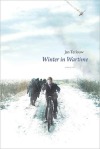
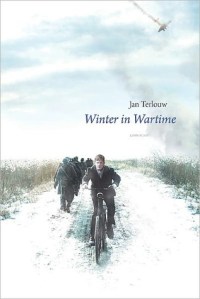
Winter in Wartime akak Oorlogswinter by Jan Terlouw (1972), 220 pages, NetherlandsWWII

Near the end of World War II, 14-year-old Michiel becomes involved with the Resistance after coming to the aid of a wounded British soldier. With the conflict coming to an end, Michiel comes of age and learns of the stark difference between adventure fantasy and the ugly realities of war.
July, Monday 29

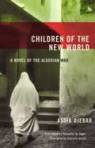
Children of the New World aka Les enfants du nouevau monde by Assia Djebar (1962), 233 AlgeriaFrench/Algerian war

Assia Djebar, the most distinguished woman writer to emerge from the Arab world – and a top candidate for the Nobel Prize in Literature – wrote “Children of the New World” following her own involvement in the Algerian resistance to colonial French rule. Djebar’s novel sheds light on current world conflicts as it reveals a determined Arab insurgency against foreign occupation, from the inside out. However, Djebar focuses on the experiences of women drawn into the politics of resistance. Her novel recounts the interlocking lives of women in a rural Algerian town who find themselves joined in solidarity and empower each other to engage in the fight for independence. Narrating the resistance movement from a variety of perspectives – from those of traditional wives to liberated students to political organisers – Djebar powerfully depicts the circumstances that drive oppressed communities to violence and at the same time movingly reveals the tragic costs of war.
August, Friday 30

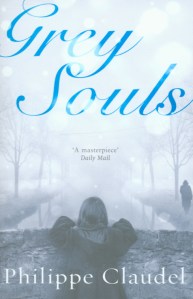
Grey Souls aka Les âmes grises by Philippe Claudel (2003), 208 pages, France  – WWI

This is ostensibly a detective story, about a crime that is committed in 1917, and solved 20 years later. The location is a small town in Northern France. The war is still being fought in the trenches, within sight and sound of the town, but the men of the town have been spared the slaughter because they are needed in the local factory. One freezing cold morning in the dead of winter, a beautiful ten-year old girl, one of three daughters of the local innkeeper, is found strangled and dumped in the canal. Suspicion falls on two deserters who are picked up near the town. Their interrogation and sentencing is brutal and swift. Twenty years later, the narrator, a local policeman, puts together what actually happened. On the night the deserters were arrested and interrogated, he was sitting by the bedside of his dying wife. He believes that justice was not done and wants to set the record straight. But the death of the child was not the only crime committed in the town during those weeks.

September, Monday 30

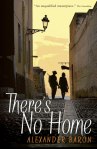
There’s No Home by Alexander Baron (1950), 288 pages,  UKWWII

‘An unqualified masterpiece … as acute a study of the psychology of war as fiction offers us’ Guardian It’s 1943. The allied invasion of Sicily. In a lull in the fighting, an exhausted British battalion marches into the searing summer heat of Catania, to be greeted by the women, children and old men emerging from the bomb shelters. Yearning for some semblance of domestic life, the men begin to fill the roles left by absent husbands and fathers. Unlikely relationships form, tender, exploitative even cruel, but all shaped by the exigencies of war. Centred around a love story, between Graziela, a young mother, and Sergeant Craddock, whose rough attempts at seduction are vindicated by his sympathy and the care he shows for her malnourished child, There’s No Home offers an unerringly humane and authentic portrayal of the emotional impact of war.
Everything Flows
October, Monday 28
Everything Flows by Vasily Grossman (1961), 320 pages, RussiaPost-War

Ivan Grigoryevich has been in the Gulag for thirty years. Released after Stalin’s death, he finds that the years of terror have imposed a collective moral slavery. He must struggle to find a place for himself in an unfamiliar world. Grossman tells the stories of those people entwined with Ivan’s fate: his cousin Nikolay, a scientist who never let his conscience interfere with his career, Pinegin, the informer who had Ivan sent to the camps and Anna Sergeyevna, Ivan’s lover, who tells of her involvement as an activist in the Terror famine of 1932-3.

Everything Flows is Vasily Grossman’s final testament, written after the Soviet authorities suppressed Life and Fate.
November, Friday 29

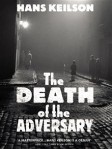
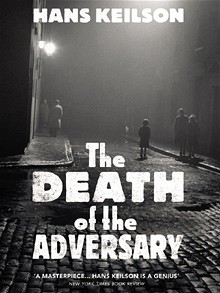
Death of the Adversary aka Der Tod des Widersachers by Hans Keilson (1942), 224 pages, GermanyWWII

My enemy – I shall refer to him as B. – entered my life about twenty years ago. At that time I had only a very vague idea of what it meant to be someone’s enemy; still less did I realise what it was to have an enemy. One has to mature gradually towards one’s enemy as towards one’s best friend.

1930s Germany; the shadow of Nazism looms. Pictures of the new dictator, ‘B.’, fill magazines and newspapers. Our hero is ten when his world begins to change dramatically. Suddenly, the other children won’t let him join in their games. Later, he is refused a job on a shop-floor. Later still, he hears youths boasting of an attack on a Jewish cemetery. Both hypnotised and horrified by his enemy, our hero chronicles the fear, anger and defiance of everyday life under tyranny.

Written while Hans Keilson was in hiding during World War II, this novel is a powerful account of what he outlived. Painful, trenchant and streaked with dark humour The Death of the Adversary is a rediscovered masterpiece.
December, Monday 30

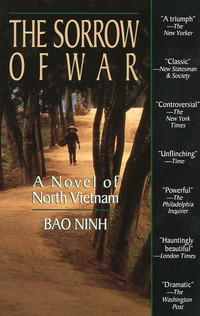
The Sorrow of War aka Thân phận của tình yêu by Bao Ninh (1991)  240 pages, VietnamVietnam war

Kien’s job is to search the Jungle of Screaming Souls for corpses. He knows the area well – this was where, in the dry season of 1969, his battalion was obliterated by American napalm and helicopter gunfire. Kien was one of only ten survivors. This book is his attempt to understand the eleven years of his life he gave to a senseless war.

Based on true experiences of Bao Ninh and banned by the communist party, this novel is revered as the ‘All Quiet on the Western Front for our era’.

Kevin suggested this book and I think after having read a few US novels on the war in Vietnam it’s about time to read one written by a Vietnamese writer.

The rules are still the same. At the beginning of the month, I will post a quick introduction to the book and who likes, can readalong, and either just join the discussion or post a review on his/her blog as well. I will, as usual link to all the reviews.
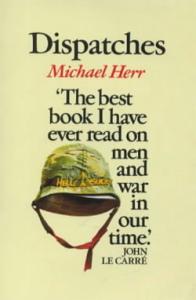
Literature and War Readalong December 28 2012: Dispatches by Michael Herr

https://beautyisasleepingcat.com/wp-content/uploads/2011/11/dispatches.jpg

Dispatches is a book I wanted to read  ever since it has been mentioned in the comments of other posts and after having read Tim O’Brien’s astonishing The Things They Carried. It’s the only book on the Vietnam war we are reading this year and I’m very keen on finding out how it will compare to O’Brien’s masterpiece.

Herr was a front-line reporter in the Vietnam war and has participated in the writing of movie scripts like Apocalypse Now and Platoon.

Here are the first sentences

There was a map of Vietnam on the wall of my apartment in Saigon and some nights, coming back late to the city, I’d lie out on my bed and look at it, too tired to do anything more than just get my boots off. That map was a marvel, especially now, that it wasn’t real anymore. For one thing it was very old. It had been left there years before by another tenant, probably a Fenchman, since the map had been made in Paris.

*******

The discussion starts on Friday, 28 December 2012.

Further information on the Literature and War Readalong 2012, including all the book blurbs, can be found here.

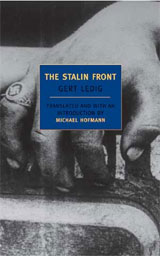
Literature and War Readalong November 30 2012 Meets German Literature Month: The Stalin Front – Die Stalinorgel by Gert Ledig

It is thanks to last’s year’s German Literature Month during which I read Sebald’s On the Natural History of Destruction that I discovered Gert Ledig’s The Stalin Front  –  Die Stalinorgel (1955).

In this novel Ledig depicts the atrocities of the Eastern Front. The fact that he is so explicit about the horrors and destruction is, according to Sebald, the reason why Ledig was forgotten and only rediscovered thanks to Sebald’s lectures and later book.

Here’s what is written about the book on the nyrb site

Gert Ledig (1921–1999) was born in Leipzig and grew up in Vienna. At the age of eighteen he volunteered for the army and was wounded at the battle of Leningrad in 1942. He reworked his experiences during the war in this novel Die Stalinorgel (1955). Sent back home, he trained as a naval engineer and was caught in several air raids. The experience never left him and led to the writing of Vergeltung (Payback) (1956). The novel’s reissue in Germany in 1999 heralded a much publicized rediscovery of the author’s work there.

Here are the first sentences

Prologue

The Lance-Coropral couldn’t turn in his grave because he didn’t have one. Some three versts from Podrova, forty versts south of Leningrad, he had been caught in a salvo of rockets, been thrown up in the air and with severed hands and head dangling, been impaled on the skeletal branches of what once had been a tree.

I hope that some of the participants of this year’s German Literature Month will join us. As you can deduce from the first lines –  this is a very graphic novel.

*******

The discussion starts on Friday, 30 November 2012.

Further information on the Literature and War Readalong 2012, including all the book blurbs, can be found here.

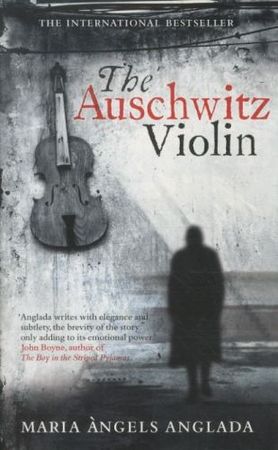
Maria Àngels Anglada: The Auschwitz Violin – El violi’ d’Auschwitz (1994) Literature and War Readalong October 2012

Is there anything that would make life in a concentration camp bearable? Anything that could make it worth living? Is it justified that talent will help you survive? And if you do, how can you go on living? Maria Àngels Anglada’s short and powerful novel The Auschwitz Violin – El violí d’Auschwitz asks precisely these questions.

When Climent, a famous violinist, is invited to Krakow in 1991 for a concert, he meets the elderly Polish violinist Regina who plays on an exquisite violin. He is intrigued, he thinks he should know the luthier but, as he is told, he doesn’t. He is curious and she is keen to share the story of the beautiful instrument. The violin has been made by Daniel, Regina’s uncle, a luthier who was sent to Auschwitz. Regina was only a small girl then. She had lost her parents in the ghetto but was saved and spent the war with a non-Jewish family who let her pass as their daughter.

Daniel who is still a young man, is only saved and not exterminated right away with many others because he pretends to be a carpenter. He helps to build a greenhouse for the sadistic and despotic camp Commander and later, when the commander finds out that he is a luthier, he is ordered to build a violin for him. Another captive, Bronislaw, will have to play on it during one of the dinners the Commander gives for other Nazis. Both their lives depend on Daniel’s success. If he wasn’t such a talented and passionate luthier, he wouldn’t stand a chance to make such a delicate instrument, with hands that are rough and split from the cold and material that is far from perfect.

Working on the violin changes everything for Daniel. It isn’t only a means to survive, like helping with the greenhouse was, but it gives sense to his days, makes a human being out of him again.

The way his workshop in Poland  is described and how he makes the new violin, with so much care and love, infuses this book with beauty, despite the horrors which are evoked as well.

Every chapter begins with a quote from a historical official document in which life in the camp is rendered in a statistical and factual manner. There are reports about shootings, about medical experiments and other atrocities. This adds another layer to the book, echoes the horrors Daniel has to endure and stands in stark contrast to the beauty he experiences while remembering his old life and crafting the violin.

When the instrument is finished, Bronislaw, the violinist, plays Corelli’s Sonata “La Folia” on it. Schindler, a passing figure in the novel, tells someone about Bronislaw and he is freed and brought to Sweden.

It’s a beautifully written book but a bit light at times. I don’t know if working on an instrument would really have transformed the days at the camp like this.

The idea that two people can better their lives, maybe even save it, because of their talents struck me as cruel but realistic. It’s certainly true that those with special talents had a higher chance to live longer or even survive. What does that say about us humans.? Do we always need a reason to help? Talent, looks, frailty, illness, as long as there is something different and special. The thought made me shudder because it’s at the core of so much injustice in this world, not only in the concentration camps.

Since Corelli’s Sonata “La Folia” is so important in the book, I attached a recording. It’s a very haunting piece.

The Auschwitz Violin manages to capture the horror’s of the concentration camps without being horrifying. I think Anglada wanted to tell us that there can be beauty in the most horrible places. I hope that’s true.

Other reviews

Anna (Diary of an Eccentric)

Danielle (A Work in Progress)


*******

The Auschwitz Violin was the tenth book in the Literature and War Readalong 2012. The next one will be Gert Ledig’s The Stalin FrontDie Stalinorgel. Discussion starts on Friday  30 November, 2012.

Some Background Information on Jakob Wassermann’s Newly Translated My First Wife

A recent excellent review of Jakob Wassermann’s novel My First Wife (just published by Penguin Classics) by Tom (A Common Reader) led me to hunt for the book in German. You know the feeling, you read a review and you think: “I want to read this now!” or rather not “now” but”NOW”. Only, I couldn’t find the German book. It took me quite a while to figure out which novel this was and only the review in the guardian which mentioned that My First Wife was “carved out” of another novel, solved the mystery.

I have inherited quite a lot of books of my late grandmother and a few of them are by Jakob Wassermann (1873 – 1934), an author widely read and admired until the 50s but then, I would say, slowly forgotten. I wouldn’t know of anyone, not even in Germany or Switzerland, who knows or even read him. What kept me from reading his books is the fact they are substantial. When I read Tom’s review I was pleased to see that there was one shorter novel to be discovered but I was wrong.

My first Wife doesn’t exist in German. The novel is a part of the much longer novel Joseph Kerkhoven’s Third Existence, which is part III of a 1600 pages long trilogy. Part I is The Case Maurizius, Part II Etzel Andergast. The Case Maurizius or Der Fall Maurizius which was published 1928 is considered to be his masterpiece and I hope it will be retranslated soon. It was a great success when it was published, Henry Miller was very fond of it.

According to the blog jakob wasserman, a blog which is entirely dedicated to the German author, many of his novels have been translated but are long out of print.

Judging from Tom’s review, The First Wife works very well as a standalone novel. I’m not going to discuss here whether I think it is legitimate or not to publish a part of a novel, which is part of a trilogy, as a standalone. I just thought I might be able to save other German reader’s the trouble to hunt for something that doesn’t exist in this form in German.

The best news for German readers however is that all of Jakob Wassermann’s novels are available free for the kindle. I’m very tempted to read the part which is called My First Wife in English and have already downloaded Joseph Kerkhovens dritte Existenz.

English readers who are still looking for something to read for German Literature Month may consider My First Wife, it seems a great choice.

Here’s the blurb but don’t hesitate to visit Tom’s blog and read his review.

It is the story of Alexander Herzog, a young writer, who goes to Vienna to escape his debts and a failed love affair. There he is pursued by book-loving Ganna: giddy, girlish, clumsy, eccentric and wild. Dazzled and unnerved by her devotion to him, and attracted to the large dowry offered by her wealthy father, he thinks he can mould Ganna into what he wants. But no-one can control her troubling passions. As their marriage starts to self-destruct, Herzog will discover that Ganna has resources and determination of which he had no idea – and that he can never escape her.

Posthumously published in 1934 and based on the author Jakob Wassermann’s own ruinous marriage, My First Wife bears the unmistakable aura of true and bitter experience. It is a tragic masterpiece that unfolds in shocking detail. Now this story of rare intensity and drama is brought to English readers in a powerful new translation by Michael Hofmann.

Reviews:

‘Like something out of Chekhov – it’s all there, the ennui, the preening etiquette, the intellectual posturing … painfully heartfelt … My First Wife is a devastating indictment of the choices we make out of convenience against our hearts and instincts, and the tragedies that ensue’ Independent

‘You won’t find a more agonising, fascinating literary account of a marriage hitting the rocks’ Mail Online


Neil Gaiman – The Graveyard Book (2008) Readalong Part III

Last week I wrote about chapters 4 – 6 of  Neil Gaiman’s The Graveyard Book, this week we have read the final chapters 7 and 8.

It was obvious that the man Jack would be back and also that he would be part of the final episodes. What wasn’t entirely clear but was revealed in the final chapters was why he was after Bod’s family. This is where The Graveyard Book turns almost into a Greek tragedy. In order to prevent something that is predicted, the man Jack commits a crime but, as is the case in the Greek tragedies, fails and the murder itself sets in motion his own undoing. Ironic really.

The final confrontation with the man Jack was something I expected and I wasn’t too surprised, still there are many surprises in the final chapters. I was wondering from the beginning how the book would end in terms of Bod’s development and future. Would he forever stay with his ghost family and friends? Would he start to follow Silas on his trips? Would Miss Lupescu show him how to become like her?All these were possibilities and I was keen on finding out which solution Gaiman had chosen. The end isn’t exactly like I expected it. I thought it was almost a bit sad. I know, I’m allowed to, as this is a readalong post, still, I don’t feel like spoiling the book, so I won’t say more.

There is something I like about Neil Gaiman’s books and stories and that is that he often provides a lot of information on how he his novels and stories came to be, what inspired him, where he wrote them.

As I said in my first post, The Graveyard Book is strongly influenced by The Jungle Book but one of the very first inspirations came, as he writes, from watching his then two year-old son riding his tricycle between the graves of a cemetery. He finally started the book with chapter four and if his daughter hadn’t wanted to know what would happen next, he would have stopped there.  Tori Amos is one of the people he mentions in the Acknowledgment section. He also adds some lines from her song Graveyard. I can only assume it inspired him too. It’s a very short piece. You can listen to it on YouTube.

I’m not sure which will be my next Gaiman. I guess either Coraline or American Gods.

I read The Graveyard Book for Carl’s readalong which is part of  R.I.P. VII.  If you want to read what other’s thought, don’t miss visiting Carl’s blog for the other reviews.

Neil Gaiman – The Graveyard Book (2008) Readalong Part II

Last week I wrote about chapters 1 -3 of  Neil Gaiman’s The Graveyard Book, this week we have read chapters 4 – 6.

I’m glad to report that I’m still enjoying the book a lot. The structure is less episodic now, some elements return and we already know that the man Jack who killed Bod’s whole family is still around and hasn’t given up.  Bod meets new people in these chapters and one of the most important is a witch. She may be one of my favourite characters and the relationship between the two is quite touching. But there is more. The story of the witch illustrates that there is a very interesting historical dimension to this book which could be overread but it’s present and very well done. The witch is in a part of the graveyard where people lie who have no gravestones, because they were suicides or otherwise cast out by the church. In a place in which gravestones play such a prominent role, to be without one, is like being bereft of your identity. The witch is very sad about this fact and Bod, who is a truly goodhearted little boy, tries to buy her a tombstone. Unfortunately this very nice thought brings not only a lot of trouble but at the end of the whole undertaking, the man Jack is informed that the little baby he couldn’t kill has turned into a boy and is still alive.

An element which didn’t strike me at first is how the many inhabitants of the graveyard are often presented. Gaiman gives us the inscriptions of their headstones like in this example “Majella Godspeed, Spinster of his Parish, 1791 – 1870, Lost to All but Memory”. When you’ve read half a dozen of these the effect is quite uncanny. It looks as if all that is left of us is our name, our dates, and -when we are lucky – an inscription that is poetical and wise and not one that is unintentionally funny.

In these chapters Bod gets into trouble more than once and what is sad is the fact that it is always when he tries to help others. But we do also discover another side of Bod. He has truly become a person who is able to move between the living and the dead and to use their respective talents. One of the scenes I enjoyed the most is when he uses his skills to haunt two particularly nasty children.

I’m looking forward to reading the rest now which will probably be this afternoon. It’s cool outside and rainy, the perfect weather for a book like this.

I’m reading The Graveyard Book for Carl’s readalong which is part of  R.I.P. VII.  If you want to read other’s thoughts, don’t miss visiting Carl’s blog for the other reviews.