Alexander Baron: There’s No Home (1950) Literature and War Readalong September 2013

There Is No Time

Alexander Baron was once known as the great British novelist of WWII, but since then he’s been somewhat forgotten. Three of his novels are “war novels”.  There’s No Home is one of them. For a novel about WWII it’s surprisingly peaceful and deals with a lesser known aspect of the war. When the allies invaded Sicily, and drove back the Germans to the Italian mainland, some of the troops were granted a few months of peace and quiet during which they lived among the Sicilian civilians.

There are different POV characters in the novel, but the main story focuses on Sgt Craddock. He’s the type of soldier liked by everyone, superiors and inferiors alike. He’s married with a little kid. Being away from home, first in combat and now in this eerie state of peace among the Sicilian civilians makes home seem like another world, a world far more foreign than Sicily. When he meets Graziella, falls in love with her and lives with her, almost as if they were husband and wife, only with far more openness and directness than he’s ever known with his wife, his own life in England moves farther and farther away.

The love story between Craddock and Graziella, is the only coherent story line, the rest is made of anecdotal episodes, either about civilian life or things that happen among the soldiers during the time in Sicily. The war and the fighting are far away, but eventually, they have to move on, go back to fighting and leave everything that has become dear to them.

It’s easy to see that Baron wrote from his own experience. Only someone who spent time in Italy, among Italians would be able to capture so many details, render such lifelike scenes. In the afterword we read that Baron was “adopted” by an Italian family while in Sicily, visited them often, ate with them. Most soldiers, not only those who had an Italian lover, formed close relationships with the population.

The book describes some of the absurdity of war, but it’s toned down. During this time of rest, the absurdity is felt the most in the treatment of deserters. It’s no coincidence that we have three deserters in this novel. A British, soldier, an Italian and a German one. Their treatment is very different.

I liked the way this book was written a great deal. It’s written in such a precise but effortless style, you barely notice you are reading, it felt much more like watching a movie. I appreciated that Baron chose a topic that may seem marginal to the war but that was interesting and rendered with great warmth. I suppose you could read his three war books like a trilogy, each showing another aspect of what Baron experienced during the war. After having read this novel on civilians and soldiers in repose, I’d like to read one of his other novels, From the City From the Plough, telling the story from the POV of an infantryman in combat.

Other reviews

You can find some quotes from the book on Danielle’s blog

Danielle (A Work in Progress)

*******

There’s No Home was the ninth book in the Literature and War Readalong 2013. The next is the post-war novel Everything Flows  by Russian writer Vasily Grossman. Discussion starts on Monday 28 October, 2013. Further information on the Literature and War Readalong, including the book blurbs can be found here.
Anne Rivers Siddons: The House Next Door (1978)

The House Next Door

This summer I was suddenly in the mood to read ghost stories and haunted house stories. Looking for books to read I came across Anne Rivers Siddons The House Next Door, which is mentioned in Stephen King’s Danse Macabre as one of the best of its kind. I saw it mentioned again, some time later, in American Nightmares: The Haunted House Formula in American Popular Fiction by Dale Bailey. I’m a huge fan of the so-called Southern Gothic, which was another reason why I wanted to read The House Next Door as it clearly falls under that sub genre.

I had some preconceived ideas of what a haunted house story had to look like and I must say none of those match The House Next Door. It’s a really unusual take on the theme and maybe because of that particularly successful.

Nobody would suspect horrific events in suburban Atlanta, in a world of affluence, in which people lazily discuss their equally rich neighbours over a cocktail, but, if we believe Colquitt, the narrator of The House Next Door, horror has come to haunt the quiet, elegant neighbourhood, in which she and her husband live. Right at the beginning she tells us that the house next door is haunted and then describes why she thinks so in eloquent and elaborate details.

Colquitt and her husband are not the richest in this leafy suburban neighbourhood but they own a house next to a big piece of land, which has proven to be too difficult to build on as a small stream runs right through it. Colquitt cherishes this woodsy piece of land and spends a lot of time looking out of the window into the trees. One day, to her utter shock, her friend and neighbour announces that the land has been bought by a very young couple and that soon the beautiful land will turn into a construction site.

Colquitt dreads the destruction, the noise and dirt, and she also dreads the loss of privacy. While she isn’t a big fan of the young couple, she becomes friends with the young architect and falls in love with the plans of the house, and eagerly watches how it takes form and rises out of the ground. The house is spectacular. It looks as if it was growing out of the earth; it’s a dream made of glass and walls and strikingly beautiful.

While the construction progresses, strange things start to happen. Dead animals are found, people have accidents. I can’t say more or the book will be spoilt.

The Haunted House is unique because it really captures what domestic horror is all about: the place where we feel safest, our home, can turn into the unsafest place imaginable. The book is also unique because it’s not set in a remote wild landscape but in an elegant Southern suburb. The evil breaks into the lives of affluent, sheltered people, and turns their world upside down.

I have never read anything by Anne River Siddons before and while I had some problems with the characters, I really admire her descriptive skills. She elaborates the scenes so well, you think you’re watching a movie. I loved the descriptions of the house and how evil started to spread slowly. I didn’t like the characters, I found them annoying. I’m not the type who wants to gossip over a cocktail every evening, which they happily did. There’s a lot of drinking going on between these pages; not one social encounter takes place without abundant intake of alcohol. Still, I could feel with Colquitt. The shock over the loss of that beautiful untouched piece of land was something I could relate to. I also identified with her enthusiasm once she knew the project for the house. I love all sorts of houses and while this would be a bit too modern for me (I’m not so keen on too much glass), I can see how a house like this would work surrounded by so many trees. I would be like a big tree house.

The House Next Door is a unusual, atmospherical and well written example of a haunted house story with strong images that will stay with you long after you’ve finished the book. I liked that for once the house in question was not an old decrepit mansion, but a brand new stylish house designed by an artistic architect.

This is my first contribution to Carl’s RIP VIII Challenge. Don’t miss visiting the review site.

Assia Djebar: Children of the New World – Les enfants du nouveau monde (1977) Literature and War Readalong July 2013

Children of The New World

Assia Djebar’s novel Children of the New World – Les enfants du nouveau monde is set during the Algerian War of Independence or Algerian Revolution which lasted from 1954 – 1962. If you are not familiar with this war wikipedia gives a short overview. It was a so-called decolonization war between France and Algeria. The war was fought in many different ways, guerrilla warfare, maquis fighting, terrorism and extensive use of torture on both sides.

The war in Algeria is still controversial in France. While it is meanwhile called “a war” and not only a “pacification intervention” – or whatever euphemism was chosen at the time – many of the aspects of the war are still not spoken about openly. One of them being the “interrogation techniques”.

It was a complex war that ripped apart the Algerian society. I think Assia Djebar showed this well in her novel. She chose to write Children of the New World as a series of vignettes, each with the name of a protagonist as title. Upon closer inspection we see that these are not individual stories but that each is a piece of a puzzle forming a kaleidoscopic canvas, which is apt and nails the Algerian society of the time. This was a society that resembles a broken pot, still held together at the seams, but the cracks showed and covered it like spiderwebs, ready to burst at any moment.

I have read the one or the other critique of this book stating it wasn’t really about the war, which puzzles me no end. The war is everywhere in this book, in every page. Every relationship is influenced or distorted by it. Neither love nor parenthood, nor friendship, nor anything else is free of the war’s influence.

We don’t see the fighting, that takes place outside of the city, in  the mountains, but the people see burning farms from afar, they see bombs fall and at the opening of the book, one falls on a house in the city, killing and old woman.

The book also shows how hostile this society was and how it was almost impossible to make a difference between enemies and allies. There were so many good and bad people on both sides. Not every Algerian was for the Algerian cause, not every French person was against it and many on both sides were against the use of torture and violence.

I have never read about any war in which torture was used this extensively. This becomes clear in the book too, although, mercifully, we find no descriptions, but we hear of people who don’t survive interrogations, of others who hear them scream in their own cells.

As said, the war is omnipresent in this book but Djebar transcends it and gives us more than just a society at war with itself and its oppressor. It shows a traditional society undergoing change and what this change means, notably for its women. I loved the many different descriptions of women’s lives. The diversity is amazing and in its best parts Djebar’s writing is as detailed as a documentary.

This was Assia Djebars third novel and it’s said that it’s not her best. I suppose that is correct as there are many structural problems. Djebar makes intense use of analepses , still I got the impression there were a lot of time-breaks that were not entirely wanted.

I’m curious and want to read another of her novels some day. She’s an interesting writer, with a raw unpolished force that I found quite refreshing.

For those of you interested in movies on the Algerian war – here’s a list that will also guide you to some of my reviews.

Other reviews

Danielle (A Work in Progress)


*******

Children of the New World – Les enfants du nouveau monde was the seventh book in the Literature and War Readalong 2013. The next is the WWI novel Grey Souls aka Les âmes grises by French writer Philippe Claudel . Discussion starts on Friday 30 August, 2013. Further information on the Literature and War Readalong, including the book blurbs can be found here.
Natalie Babbitt: Tuck Everlasting (1975) Exploring Books for Children and Young Adults

Tuck Everlasting

Doomed to – or blessed with – eternal life after drinking from a magic spring, the Tuck family wanders about trying to live as inconspicuously and comfortably as they can. When ten-year old Winnie Foster stumbles on their secret, the Tucks kidnap her and explain why living forever at one age is less than a blessing that it might seem.

Ever since I’ve read Tom’s Midnight Garden a few years ago, I felt like reading more children’s books. The beautiful novels of Meg Rosoff reminded me of this again and so I’ve decided to embark on a more systematic exploration of the genre. That doesn’t mean I’ll be reading only books for children but you might see the occasional review in the future.

Natalie Babbitt’s famous novel Tuck Everlasting was an ideal book to get re-aquainted with the genre.  The question that Tuck Everlasting explores is “What if you could choose to live forever?” This type of question is what I like about childrens’ books. They don’t shy away from exploring big themes: life, death, meaning of life, illness, friendship, moral choices.  Much more than many books for grownups do.

Winnie is a ten-year old girl who is growing up in a very strict family. Her mother and her grandmother monitor her every move, tell her constantly what is right and what is wrong. She is not allowed to leave the garden, let alone to go into the forest but one afternoon, tired of all those rules, she leaves and ventures into the forest. In the forest she meets a beautiful young man and sees him drink from a spring. Shocked that somebody finds out about the secret fountain of youth, he brings Winnie to his family and they kidnap her.

Unbeknownst to all of them, a man in a yellow suit is following them. He has been looking for the secret fountain since years and wants to make money with its water.

Winnie is confused and anxious at first but she likes the Tuck family. Unlike her own family they are warmhearted and affectionate. The father tells her how they discovered the spring and that whoever drinks from its water will live forever. While Winnie thinks at first that it would be wonderful not to die, she slowly comes to understand that it would mean she wouldn’t change anymore. She would stay the same young girl forever. One of the consequences if people found out and would drink from the water would be that soon there would be too many people in the world and they would all stagnate. She realizes that the beauty of life is linked to change and that she shouldn’t be afraid of death but of the unlived life.

It was interesting to watch the movie right after having finished the book and for once I must say, I preferred the film. I even liked it a great deal. It’s beautifully filmed and the cast was great. Alexis Bledel plays Winnie, William Hurt and Sissy Spacek are father and mother Tuck and the man in the yellow coat is played by Ben Kingsley. The Winnie in the film is a bit older, maybe 14 and a main part of the movie centers on the love story between her and the younger Tuck brother which is really lovely.

I liked the ideas, characters and the ending which was bitter-sweet but overall I found the tone of the book a bit annoying. I think it’s a great book for younger children but not exactly for older ones and grownups. The movie however is really charming. Ideal for a rainy Sunday afternoon. My DVD had an interview with the author in which she tells how she became a writer. She started to write together with her husband, or rather to illustrate his books. When he didn’t have enough time anymore, she had to do the writing as well and she became very famous. She has written and illustrated far over 15 books for children.

I’m not sure which will be my next children’s book. Maybe David Almond’s Skellig or Neil Gaiman’s Coraline.

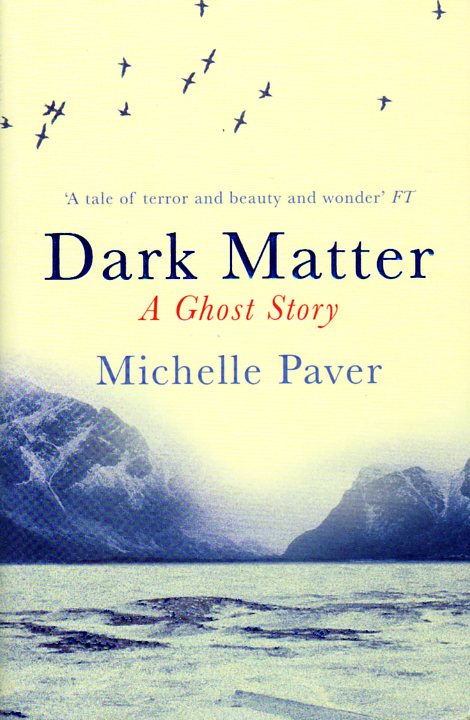
Michelle Paver: Dark Matter – A Ghost Story (2010)

Dark Matter

It’s been raining for weeks and very cold. It feels a bit like autumn, which could explain why, all of a sudden, I was in the mood to read a ghost story.

Dark Matter starts in London in 1937. Jack’s life isn’t going the way he was hoping it would. When he is offered the opportunity to accompany an expedition to the Arctic he accepts gladly. It sounds like the chance of a lifetime. Together with four other men he is to leave London just before summer. They will overwinter in Spitsbergen, or, to be more precise, on the fictional island of Gruhuken. When they arrive they are amazed how much life there is in the Arctic in summer. So many animals, so much light. By the time they have set up their camp, only three men and a pack of huskies are left.

When the nights get longer and the daylight is about to disappear for a couple of months, Gus, one of the remaining men, has appendicitis and needs surgery. His friend Algie leaves Gruhuken with him. Jack stays behind on his own, he wants to save the expedition. The two men promise to be back in a couple of weeks. Although the idea of eternal darkness frightens Jack, and the fact that he senses a malevolent presence near the camp doesn’t make it any better, he still wants to prove himself and please Gus.

The novel is told in form of a diary. In writing it, Jack tries to make sense and stay sane in the long dark Arctic night. Allusions by the captain and a trapper confirm what he felt early on: there is a dark presence lurking outside. When he discovers Gus’ diary he learns that he and Algie saw something too.

Most ghost stories are deeply rooted in their setting which is one reason why I like them so much. Haunted houses are my favourites but extreme weather conditions and wild landscapes are ideal too. I must say, to set this story during the cold and endless nights of the Arctic winter was a terrific idea. While the haunting as such wasn’t that creepy, to image what it would be like to spend days and days all alone in the darkness was scary. There is an instance in which Jack gets lost in the night and I could feel the dread. He couldn’t just wait until morning, as the morning would be as dark as the night, so he stumbled around blindly, got panicky and almost gave up. I found it equally unsettling to imagine living inside of an illuminated cabin located in the middle of nowhere and to never know whether someone was outside looking in or not.

Michelle Paver has spent a few times in the Arctic, in summer and in winter, which is certainly the reason why the location is rendered so well, everything was captured in such vivid details.

The story has another layer, which is even darker than the setting or the haunting. In a few scenes Paver manages to say more about cruelty than many other authors I’ve read before. There were two scenes in which cruelty against animals was described, both of which I found very unsettling. The history of the ghost was equally sordid. In some ways you could also say that the cruelty and injustice of society was another main topic. Those who are well-off have all the chances in the world, while people like Jack who come from a humble family or very poor people like the trapper, will always be taken advantage of.

It was interesting to read this novel just after having watched The Wall. While The Wall isn’t a ghost story, the dread and menace are very similar. Nature and loneliness are seen as hostile but ultimately what is to be feared the most are other human beings.

Dark Matter is a wonderful book, I really loved it. It is scary in more than just a supernatural way and works on many levels. Anyone who loves a good ghost story, has an interest in the Arctic or a love for dogs would like this book.

I’m still in the mood for ghost stories and would love to read some more. Has anyone a suggestion? Do you have a favourite ghost story?

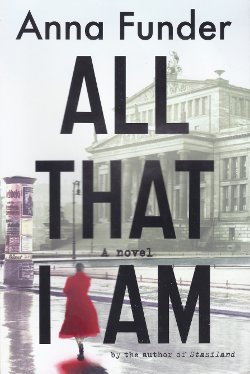
Anna Funder: All That I Am (2011) Literature and War Readalong May 2013

All That I AM

It’s not easy to write about this book and what is even worse – this is the very first time I almost forgot to write the review of one of my readalong titles. The book is not bad as such, I didn’t suffer while reading it or want to abandon it or anything like that. It just never reached me, if you know what I mean. It was like listening to the radio while talking to someone at the same time. You hear some individual words which briefly get your attention but overall it’s just background noise. This has certainly nothing to do with the topic as such but was entirely due to its execution. I was wondering before starting the novel why people called this “faction”. Now I know.

All That I Am tells the true story of four friends. Ruth Becker, her cousin Dora Fabian, the playwright Ernst Toller and Ruth’s husband Hans Wesemann. At a time when hardly anyone noticed, they knew that Hitler’s coming to power in 1933 was a very bad thing. Being part of the communist and socialist movement, they were not only in opposition to the National Socialist party but in grave danger from the beginning.

The chapters alternate between the point of view of Ruth Becker and Ernst Toller. They are both told in the present, just before their deaths, at different points in time. Ruth is living in Australia when she is looking back on her life, while Toller stays in the US in 1939 and tells Dora’s story from his point of view. Although they were both important, and, in Toller’s case, even more famous than Dora, their stories focus on Dora who was the center of their respective lives, their best friend and lover.

After a small act of rebellion – Ruth hangs a red flag out of the window, after Hitler comes to power – the four friends have to fear for their lives. People are being arrested and executed if they openly criticise the regime.

The four decide to leave for London and continue their work there. They fight in order to raise awareness of what is happening in Germany and still hope that Hitler will be overthrown.

At first they might have felt like they had escaped but Hitler’s agents were everywhere and even people living abroad were executed. They hear daily about people they know being killed. They must also fear that there is a traitor among them.

I’m not going to reveal more as the book works best, I think, when you don’t know too much in advance. That way it’s at least to some extent surprising. There are a few dramatic events and unexpected developments.

While I didn’t know these particular stories, wasn’t familiar with the four people, I knew enough about German history, so that this particular slice of it, had nothing new to offer. What was new were the stories of the four friends but the way this was told was not very interesting. It’s true, the book picks up speed in the second part but still, it read like Funder had tried to fill facts with life but didn’t really succeed. All we got was a half filled balloon hovering half a meter above the ground. It never managed to fly high up in the sky.

The best parts were the few moments telling Toller’s and Ruth’s final days.

Those who have read Stasiland, Anna Funder’s non-fiction book on Eastern Germany, were all very enthusiastic, which makes me think it would have been better if she had opted for the same approach here. Only, the facts are kind of meagre and maybe she thought turning something you could have told in 50 non-fiction pages would work better if turned into a full-length novel.

As for the topic – Yes, there were people who were aware as soon as 1933 that things were going wrong in Germany. Toller and his friends were not the only ones. There was a large number of writers and artists, communists and socialists who left Germany as early as that. What the book doesn’t explore is the fact that if  the communists and socialists would have been able to overthrow Hitler and his party, Germany might not have been much better off.

Sure, it’s an interesting story, sad and dramatic but told in a lifeless manner and very dry. It certainly didn’t work for me. Luckily it worked for others.

Other reviews

Lindsey (Little REader Library)

Lizzy’s Literary Life

Tony’s Reading List

The review is also a contribution to the Aussie Author Challenge.

*******

All That I Am was the fifth book in the Literature and War Readalong 2013. The next is the WWII novel Winter in Wartime by Dutch writer Jan Terlouw. Discussion starts on Friday 28 June, 2013. Further information on the Literature and War Readalong, including the book blurbs can be found here.

Fumiko Enchi: Masks – Onnamen inaudita (1958)

Masks

Mieko Togano, a highly cultivated, seemingly serene, but frustrated and bitter woman in her fifties, manipulates for her own bizarre purposes the relationship between her widowed daughter-in-law and that woman’s two suitors.

I just finished Fumiko Enchi’s Masks. Enchi was one of the most important Japanese women writers of the so-called Shōwa period (reign of Emperor Hirohito). The role of Japanese women was an important aspect of her work. Most of her figures are still old-fashioned, very obedient, even subservient figures. Nevertheless they try to fight their oppressors, sometimes, like in Masks, using rather unusual methods.

Masks is a mysterious novel. Looking at Masks superficially you could call it the tale of a vengeance. It’s a dark, mean, unfathomable story. The German edition I’ve read even calls it a crime story. A very unconventional crime story. Although nobody commits a murder, I was reminded of the work of Boileau-Narcejac, notably The Fiends – Diaboliques.

Mieko is a widow and a famous poet. She lives together with her equally widowed daughter-in-law, the beautiful, young Yasuko. Ibuki, one of Yasuko’s suitors, suspects the relationship to be sexual. The two women are very close. Yasuko pretends, she wants to break free but doesn’t make any attempts to change her situation.

Yasuko continues her late husbands studies of possession and necromancy. The two women, together with Ibuki and Mikame, form a literary and spiritualistic circle. Ibuki, a professor of literature, and Mikame, a doctor who dedicates his free time to anthropological research, are both specialized in the belief in ghosts and possessions.

Both men are attracted to Yasuko and feel as if they were under a spell. The mysterious thing however is that it’s not Yasuko who cast the spell but her mother-in-law Mieko.

Later in the book we learn a lot about Mieko’s tragic life and how badly she had been treated by her late husband. Her role as dependent wife who was at the mercy of a cruel man, turned her into a vindictive woman. The only man she really loved was her son Aiko, Yasuko’s late husband but he died on mount Fuji.

The story of her vengeance is pretty uncanny and the end is more than a little surprising. Both men are used like puppets and one of them pays a considerable prize for getting too close.

The novel bears great similarity with a black and white painting on which just a few, small details are highlighted in colour. The story and the people are black and white, with some shades of grey, while the descriptions of nature stand out in a most descriptive and colorful way.

What I loved about this book was the combination of many different aspects. It combines dark erotic elements, beautiful small descriptions of nature, a fascinating story and a complex symbolism. Many aspects of traditional Japanese culture like the No-Masks, the Tale of Prince Genji, the firefly festival and many more, build an interesting backdrop.

Masks is a haunting book, full of mystery, darkness, beauty and with an ending worthy of a psychological thriller. I’d recommend it to anyone who likes Boileau-Narcejac, as well as to the fans of Yoko Ogawa.