Susan Hill: The Woman in Black (1983)

Proud and solitary, Eel Marsh House surveys the windswept reaches of the salt marshes beyond Nine Lives Causeway. Arthur Kipps, a junior solicitor, is summoned to attend the funeral Mrs Alice Drablow, the house’s sole inhabitant, unaware of the tragic secrets which lie hidden behind the shuttered windows. It is not until he glimpses a wasted young woman, dressed all in black, at the funeral, that a creeping sense of unease begins to take hold, a feeling deepened by the reluctance of the locals to talk of the woman in black – and her terrible purpose.

The Woman in Black is the second ghost story by Susan Hill I have read in a very short time. But since we are nearing the end of the R.I.P. Challenge this was the time or never.

I feel tempted to compare them as there are a lot of similarities but The Woman in Black is the creepier of the two. The settings are similar as well, although in this novel most of the horrifying events take place inside of a grand old mansion and only a few in the foggy marshes. The nature of the ghost in The Woman in Black is much more evil. It does really mean to harm those who see it.

Susan Hills writing is again very traditional, old-fashioned. This novel could have been written in the 19th century. This includes the narrative style as well as the themes and motives. Even so or maybe because of this it is beautifully written. The descriptions are detailed and atmospherical.

The story begins some thirty years after the main events. It is Christmas Eve and Arthur, our protagonist, is enjoying the company of his extended family on his beautiful estate Monks’ Piece. The family is gathered in the drawing room telling ghost stories when Arthur comes back from a short refreshing walk outside. They urge him to contribute to the fun and tell a ghost story of his own. He is not willing to do this as he is reminded of horrible events he hasexperienced as a very young man. Instead of telling what happened he decides to write it down.

As a young solicitor he was sent to Crythin Gifford. Mrs. Drablow an elderly client of the firm he is working for has died and his boss wants him to attend the funeral and spend some time sorting out the papers the old woman has left behind. It gets creepy early on as no one in the little town wants to talk about the deceased or her property. At the funeral Arthur sees a woman in black who looks very wasted as well as a group of children that no one else sees.

Later, at Eel Marsh House, the stately home of Mrs. Drablow, he sees the woman in black again. The estate is located on Nine Lives Causeway and is completely cut off from the mainland at high tide, surrounded only by the sea and marshes. The setting alone would creep out many but Arthur also  hears terrible noises, the cries of a child,  noises as if someone had an accident in the marshes. It is also spooky inside of the house. He feels he is not alone. There is one room he doesn’t have access to but there are distinct noises coming from  inside and when the door stands ajar all of a sudden he almost freaks out.

After his first stay at the house he goes back despite his fears and it gets worse. The incidents culminate.

Like in The Small Hand the story is resolved in the end. We get to hear who is the ghost and why he haunts people. The spite- and vengeful being will not stop to haunt Arthur after his departure. It strikes again.

The Woman in Black is a dark tale, darker than The Small Hand. As a whole I think I liked The Small Hand better. But the beginning of The Woman in Black, the chapter titled “Christmas Eve” is one of the most pleasant initial chapters I have ever read and stands in striking contrast to the events that are narrated later.

Apparently the novel has been adapted for the stage and been made into a TV movie.

Has anyone read both? Which one did you prefer?


Nymeth’s review


Daniel Glattauer: Love Virtually (2011) aka Gut gegen Nordwind (2006) A German Novel in E-Mails

Love Virtually

“Write to me, Emmi. Writing is like kissing, but without lips. Writing is kissing with the mind.’

It begins by chance: Leo receives emails in error from an unknown woman called Emmi. Being polite he replies, and Emmi writes back. A few brief exchanges are all it takes to spark a mutual interest in each other, and soon Emmi and Leo are sharing their innermost secrets and longings. The erotic tension simmers, and it seems only a matter of time before they will meet in person. But they keep putting off the moment – the prospect both excites and unsettles them. And after all, Emmi is happily married. Will their feelings for each other survive the test of a real-life encounter?

And if so, what then?

Love Virtually is a funny, fast-paced and utterly absorbing novel, with plenty of twists and turns, about a love affair conducted entirely by email.

I have already read Love Virtually because the original came out in Germany in 2006. I even read it in hardback, a rare thing, as I was so curious to find out what the hype was all about. I must say, I have not often been this engrossed. You start it, you read and you do not stop before the end. After, let’s say, two –  three pages you will have forgotten that this is a novel, you will be sure that you are reading a real e-mail exchange between two people. That is quite an achievement. I am really  pleased to see that Glattauer’s book will be published in English in 2011.

Emmi writes accidentally to Leo and they keep on writing to each other because each one likes the tone of the other’s e-mails. And because they both imagine each other. Without knowing each other they develop crushes. There is only one little complication. Emmi is happily married. It seems only natural she does not want to meet Leo. What if he was anything like the man she imagines? Still she can’t stop writing. They tease and flirt and exchange their hidden dreams and wishes and get to know each other better and better. They also arrange a date without really meeting each other. They just both know that they are at the same restaurant at the same time. Later they compare their impressions and try to find out if they  did recognize each other.

Leo and Emmi are both  intellectuals. This is important to know, as that determines the nature of their exchange. Even though they tease and flirt, they philosophize and analyze a great deal too.

If you want to find out if they really meet you have to read the novel. Daniel Glattauer wrote a sequel (Alle sieben Wellen 2009) that has been published a while back. It is also very good but I would have preferred if he had stopped after Gut gegen Nordwind. The ending of Love Virtually is very special. The sequel spoils it.

I think the idea of having a crush on someone you only know by e-mail (I know the movie with Meg Ryan, but Love Virtually is very different) is interesting and Glattauer provides an in-depth analysis of this premiss. Love Virtually is highly entertaining but still deep. Personally I like epistolary novels a great deal. This is just a variation on the same theme.

A word on the English marketing of this book. Just have a look at the German cover. Don’t you think it looks much nicer? I can understand that the title was problematic. Gut gegen Nordwind would have to be translated as “Good against the North wind”. This is far more poetical than Love Virtually but does this mean anything outside of Germany? The North wind is a bit like the Californian Santa Ana winds, but cold, very cold. He does also carry a nervous energy and is a bit depressing. I must admit, I am not sure I would have bought the book with the title Love Virtually and such a cover. What do you think about the covers and the titles?

Susan Hill: The Small Hand (2010) A Ghost Story

Returning home from a visit to a client late one summer’s evening, antiquarian bookseller Adam Snow takes a wrong turning and stumbles across the derelict old White House. Compelled by curiosity, he approaches the door, and, standing before the entrance feels the unmistakable sensation of a small hand creeping into his own, ‘as if a child had taken hold of it’. Intrigued by the encounter, he determines to learn more, and discovers that the owner’s grandson had drowned tragically many years before. At first unperturbed by the odd experience, Snow begins to be plagued by haunting dreams, panic attacks, and more frequent visits from the small hand which become increasingly threatening and sinister …

I really bought The Small Hand with the R.I.P challenge in mind when I found it at a local bookstore. And because I love the cover and had wanted to read something  by Susan Hill anyway. I enjoyed it quite a lot. It is beautifully written but surprisingly old-fashioned in tone. It is quite an eerie and mysterious ghost story. What I appreciated is the fact that the mystery is solved in the end.

The Small Hand has quite a lot to offer. Adam Snow being a bookseller every book lover will feel a certain affinity right away. What sounds more enchanting than a job that involves travelling the world and looking for rare books? One of his trips brings Adam to the South of England. On his way back he gets lost and discovers an abandoned house with an overgrown garden. This is not exactly an original idea, especially not in a British novel as the British novel has a great tradition of descriptions of grand old  houses and mysterious gardens (from Great Expectations to The Secret Garden, Tom’s Midnight Garden to The Forgotten Garden and many more). The lack of originality did not disturb me one tiny bit as I love descriptions of old houses and descriptions of gardens that return to a state of wilderness. Susan Hill is very talented in describing nature with great detail. It is in this very garden that Adam feels for the first time the presence of the ghost of a little child.

Ghosts are normally bound to certain places but this one is not. It will haunt Adam all through the story and wherever he goes. Telling more would be a spoiler so I will stop here.

On one of his hunts for rare old books, a First Edition of Shakespeare in this case, Adam travels to a forlorn French monastery. This is another extremely well rendered description. And such an appealing one. I would love to spend a few weeks there myself.

I think this book could be quite scary for some readers especially if they have a history of recent panic attacks as this is the way Adam experiences the presence of the ghost or rather ghosts.

The Small Hand is a wonderfully old-fashioned and very British (a high compliment coming from a fervent Anglophile) Ghost Story creating a pleasant frisson. It is best read at this time of the year, preferably at night in bed.

I have already ordered The Woman in Black, another of Susan Hill’s Ghost Stories. What Susan Hill novels did you read and like?

Here’s another review of The Small Hand by Susan Hated Literature

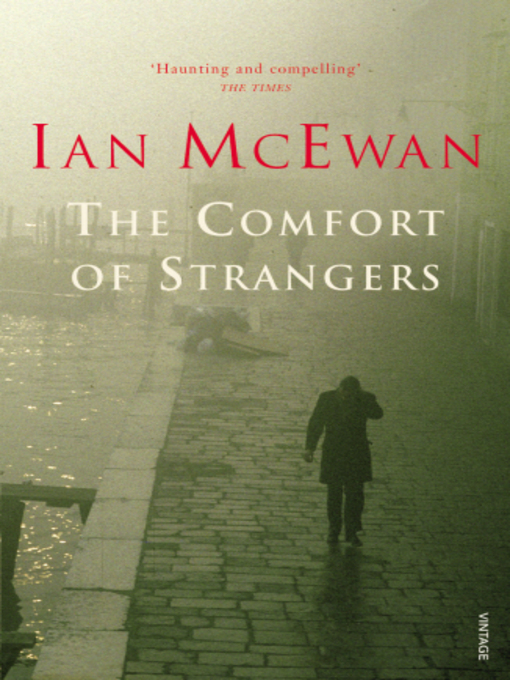
Ian McEwan: The Comfort of Strangers (1981)

As their holiday unfolds, Colin and Maria are locked into their own intimacy. They groom themselves meticulously, as though there waits someone who cares deeply about how they appear. Then, they meet a man with a disturbing story to tell and become drawn into a fantasy of violence and obsession.

I can’t forget The Comfort of Strangers. It keeps on haunting me.

This is not a novel, I liked. The world McEwan unleashes is too gloomy, too disgusting. Even though I didn’t like the novel  I am fascinated how obstinately  it stays in my mind, and even in my feelings.

I truly enjoyed Atonement. It did stay with me for a very long time as well. When you are engrossed in a novel that you enjoy you don’t pay so much attention to the skills of the author. You are just enchanted by the feelings he evokes in you. McEwan is one of the most renowned British writers and when reading a book like The Comfort of Strangers, that you do not even like but that still resonates in your mind, you know why he gets so much praise.

The Comfort of strangers narrates the stay of a young English couple in Venice. There is something sinister from the very beginning. The way McEwan describes the city gives the impression as if Venice was a lurking animal. The Venice he describes is neither idyllic nor romantic; on the very contrary. His description of those labyrinthine, narrow streets that make orientation difficult, of those alleys whose walls tower too high to permit an overwiew, is unsettling.  I was reminded of the movie Don’t Look Now. The young English couple is described as if they knew each other too well.  They don’t talk much, they drift and only barely escape deadly boredom. It is not exactly clear why but all of a sudden their  sexuality changes radically. They are suddenly drawn to more violent, sadomasochistic lovemaking.  On one of their nightly forays they meet a mysterious local man who takes them to his own restaurant where they drink far too much. On their way back to the hotel they get lost and wait on some doorstep till dawn approaches. As if out of nowhere the man reappears and takes them home where he introduces them to his wife. His wife seems to be an ailing invalid. They don’t know it, but from the moment they meet these two people they are doomed.

McEwan’s slim novel touches many topics: relationships, love, power, sadomasochism, people abroad, Venice,  disorientation, voyeurism. The list is almost endless. On top of that McEwan´s writing is scarce, concise, and very atmospherical and visual.

The Comfort of Strangers is not a pleasing novel, but one that shows you what good literature is capable of.

Are there any books that you did not like but still consider to be very fascinating?

Ruth Rendell: A Judgement in Stone (1977)

Four members of the Coverdale family – George, Jacqueline, Melinda and Giles – died in the space of fifteen minutes on the 14th February, St Valentine’s Day. Eunice Parchman, the housekeeper, shot them down on a Sunday evening while they were watching opera on television. Two weeks later she was arrested for the crime. But the tragedy neither began nor ended there.

I discovered this novel  thanks to a suggestion from Danielle from A Work in Progress. I have read a few books of Ruth Rendell before and liked them and  I also read one she wrote under the pen name Barbara Vine but didn’t know which to read next. It is always good with prolific writers if someone can make a suggestion. I really liked A Judgement in Stone and can see why it is considered to be one of her best. It takes a very good writer to be able to captivate a reader even though the victims and the murderer are known from the very beginning. The psychological insights are absolutely convincing. Each character is so different from the other and they are all quite fascinating. Rendell adds a lot about the British class system and her description of two completely deranged women is amazing.

Because we know from the start that the main characters will be killed the book has an eery quality. It reminded me of a Greek tragedy. There is nothing to stop the course of the action.

Eunice Parchman, a middle-aged, illiterate and not very intelligent woman starts her employment with the Coverdales in summer. On Valentine’s Day she kills them. The changing of the seasons that Rendell describes with great detail adds to the feeling of the inevitable. The narrator is very present in this story, he misses no occasion to remind us, that the people he describes will meet a certain death. This reminded me of Gabriel Garcia Marquez’ Chronicle of a Death Foretold.

Eunice is not only illiterate she also lacks feelings for others. There is not the tiniest bit of empathy in this woman. Since she can’t read and sees this as a great flaw she abhors the written word and those who like to read. The Coverdales, a typical British upper class family, love to read. There are books all over their house. Eunice tries to cover up her disability as best she can and gets herself in a lot of impossible situations. One day, when running errands, she meets Joan Smith, a former prostitute who has joined some obscure Christian sect. One woman is as deranged as the other. Eunice is a cold-hearted selfish sociopath and the other a fanatic psychopath. Their alliance can only bring misfortunes.

Rendell’s  book is gripping, psychologically convincing and utterly fascinating. I’m really in the mood to read more of her books.

A Judgement in Stone has twice been made into a movie. One of them is by Claude Chabrol, La Cérémonie, starring Sandrine Bonnaire as Eunice and Isabelle Huppert as Joan.


Boileau-Narcejac: The Fiends/The Woman Who Was No More aka Celle qui n’était plus/Les diaboliques (1952)

Boileau-Narcejac, the French writer duo, are for France what Simenon is for Belgium or Agatha Christie for the UK. They are not traditional crime writers though. Solving the mystery is not the main interest when reading them. What they are famous for is the twist in the stories. The combination of the spooky with the suspense. The density of the melancholic atmosphere. Their writing is a cinematographic one. Once you open one of Boileau-Narcejac’s psychological thrillers you feel as if you were in the middle of a movie. No wonder their books were made into movies. The most famous one is certainly Hitchcock’s Vertigo that was based on their D’entre les mort/Sueurs froides aka The living and the dead.  The second most famous one is Cluzot’s Les diaboliques that was later remade starring Sharon Stone and Isabelle Adjani. It will not be easy to find English translations of their work. They are out of print, I guess. This book is no exception but it is worth trying and libraries should have them, I am sure.

Sit back, open the book and let yourself be enchanted by this atmospheric, haunting tale in which there is a lot of dense fog along dark, sparely lit piers. The lanterns illuminate the quay only barely and inside the house you see a couple, Ravinel and his lover Lucienne, planning the murder of Ravinels’s wife. They are after her life insurance. Lucienne who is a doctor has planned it carefully. They will give Murielle an anesthetic and drown her in the bath. Ravinel is a salesman. He works in Nantes but lives near Paris.  They trick Murielle into coming to Nantes, kill her and drive with her body back to Paris where  they dump her in a river. But this is only the very beginning of the story. If Murielle is dead, how come she is writing letters to Ravinel? Ravinel knows the answer. She is a ghost. Isn’t she? The second part of the story takes place in  Paris which gives the writers the opportunity for detailed descriptions of little smoky bars and cafés, old, dark houses. The way they describe a Sunday morning in a house, with all the different noises, children screaming, radios blaring and the smells of coffee and breakfast is wonderfully evocative.

There will be much more confusion in this book and the end is quite astonishing.

Boileau-Narcejac are masters of their art. If you have ever seen one of those French movies, maybe Le quai des brumes with  Jean Gabin, then you know the feel. There is a certain visual simplicity that is highly atmospherical. A solitary lamppost on an empty street, its yellow halo penetrating the fog. A lonely person in a room smoking and thinking. The pictures are simple but the feelings are complex. Their writing is economical and highly efficient at the same time.

I would really like to encourage you to discover these great writers.

Since I am not sure if I finish my German book/books for R.I.P. I count this as Peril The Third.

Celle qui n’était plus amazon.fr

J. Courtney Sullivan: Commencement (2009)

A sparkling debut novel: a tender story of friendship, a witty take on liberal arts colleges, and a fascinating portrait of the first generation of women who have all the opportunities in the world, but no clear idea about what to choose.

Assigned to the same dorm their first year at Smith College, Celia, Bree, Sally, and April couldn’t have less in common. Celia, a lapsed Catholic, arrives with her grandmother’s rosary beads in hand and a bottle of vodka in her suitcase; beautiful Bree pines for the fiancé she left behind in Savannah; Sally, pristinely dressed in Lilly Pulitzer, is reeling from the loss of her mother; and April, a radical, redheaded feminist wearing a “Riot: Don’t Diet” T-shirt, wants a room transfer immediately.

Celia, Bree, Sally and April are best friends even though they couldn’t be more different. During their time at Smith’s College they are inseparable. They help each other through minor and bigger disasters. Four years after graduating they meet again at Sally’s wedding. A stupid dispute drives them apart and they avoid each other for almost a year when April disappears.

Commencement is a novel of ideas. I don’t know why it has been called chick-lit. Because four young women are the protagonists? Quite unfair. It is as if this label proves the point the book wants to make. Even years after women’s lib began, we are still nowhere. A large part of Commencement is dedicated to topics like sex-trafficking, rape and child abuse. Despite the serious topics it tackles, it is an entertaining book with a lighthearted quality. But it is definitely a feminist novel in the vein of Marilyn French’s The Women’s Room and not chick-lit. I needed some time to get into it as each chapter is told by someone else. We hear that person’s story and get to know the others through her eyes. That wouldn’t be confusing, but they sound similar and their names are similar. Sullivan let’s her characters explore all the possibilities women have today. Getting married, staying single, having kids, having no kids, become lesbians, have various sexual partners, be monogamous. She looks into the mechanics of family and friendship. One girl’s parents are still in love, another has lost her mother, the third grew up with a single hippie mom and the fourth has a career mom. Regarding their professional choices Sullivan goes a similar way. They all chose something quite different. Sullivan who is a feminist deliberately chose to show every possible combination/choice. This could have gone wrong but it is well done. From page to page I liked those girls more. I wouldn’t go as far as comparing it to Mary Mc Carthy’s The Group but it is very good.  Ronnie, April’s boss, a militant feminist and audacious filmmaker is a very interesting character. Her ideals are such that she is blinded by them and becomes a true fanatic. A selfish zealot who does not shy away from endangering others for the cause. Another interesting aspect is that even though one girl loves another girl, she never considers herself to be a lesbian. The depiction of a women’s college is probably very realistic as Sullivan went to Smith herself. The friendship of those girls is very touching. It’s cute how they cuddle up in bed together, watch movies or chat.

If you are looking for an interesting, thought-provoking but still entertaining read, go for it. Especially when you are a feminist, interested in women’s topics or just love stories about friendship among women.

I mentioned The Group and The Women’s Room before which I loved both. Which books about female friendships and developpment did you like?