Hiromi Kawakami: Manazuru (2006)

Manazuru is the first novel by Hiromi Kawakami that is available in English. She has been one of Japan’s most celebrated novelists since her first short story came out in 1994. I have read another one of her novels a couple of years ago. Many of her books are available in German and in French. (If you love literature in translation, especially Japanese literature, and you are able to read German and/or French, you have much more choice. I have for example read Hotel Iris by Yôko Ogawa, that came out last year in English, in a French translation almost ten years ago.).

The first novel by Hiromi Kawakami that I read is called Herr Nakano und die Frauen (Mr Nakano and the Women.) It’s a wonderful novel. A lot of what I liked in Herr Nakano is present in Manazuru too, still I wonder why they chose this novel to introduce Kawakami to English-speaking readers. Mr Nakano would have been a much better choice as it is much more typical for her writing. There are supernatural or dreamlike elements in Manazuru which are not present in her other books and which reminded me more of Murakami.

Manazuru is not easy to describe. It’s a mysterious book, filled with a dreamlike mood, shifting realities. Something very soft and gentle pervades it.  Still it’s very realistic. The story is told by Kei, a young woman who lives with her daughter and her mother in an apartment in Tokio. The three women live a very peaceful live, they share many intimate moments, cooking and eating together, stitching and knitting. They treat each other kindly but each of them leads her own life, of which the others know nothing. Kei thinks a lot about her relationship to her daughter and how unique it is. How she doesn’t love anyone like her with so much awkwardness. She thinks about what it means to have a child, physically. To feel her emotions because they once shared a body.

Kei’s husband Rei has disappeared ten years ago. Although she has been in a happy relationship with a married man, she has never forgotten her husband. She wonders always where he has gone, why he left or what has happened to him. At the beginning of the novel she decides to travel to Manazuru, a little seaside town where Rei has disappeared. When she arrives she feels a strange presence. A woman follows her, a woman who seems to be a ghost, whose density changes constantly. Sometimes the woman is just a shadow, sometimes Kei can touch her. She thinks this woman knows what happened to Rei.

Kei takes many trips to Manazuru all through the novel. Sometimes with Momo, her daughter, mostly on her own. Whenever she arrives there, she is in a dreamlike state that brings her very close to Rei. During her last trip she finds another village that is like a ghost village. Cranes are sitting on the dilapidated roofs (Manazuru means crane btw..) The houses have been abandoned. She thinks about the fact that an empty house is at first just empty but then, after several years, it gets a life of its own. Ivy will grow inside. Weeds  and many other plants will take over. It’s a bit like Kei herself after Rei abandoned  her. At first there was emptiness and loneliness and then she became someone else.

I liked Manazuru a lot because of its mood and because of the importance of moods. Kei doesn’t so much analyze her feelings or thoughts as describe her moods. They shift ever so lightly, just a little bit. They have the subtlety of scents, the same fleetingness.

What I love in Kawakami’s writing in general is her ability to capture those intimate moments in which hardly anything happens or is said, those moments during which people are sitting together, without talking and it still feels intimate and meaningful.

Hiromi Kawakami is one of the best authors  to start with for someone who isn’t familiar with Japanese writing because she is such a gentle writer. Her books are lovely and even tragic elements are toned down. We know her characters will make it in the end, move on, find meaning and all that stays from a tragic event is a feeling of bitter-sweet regret but no despair.

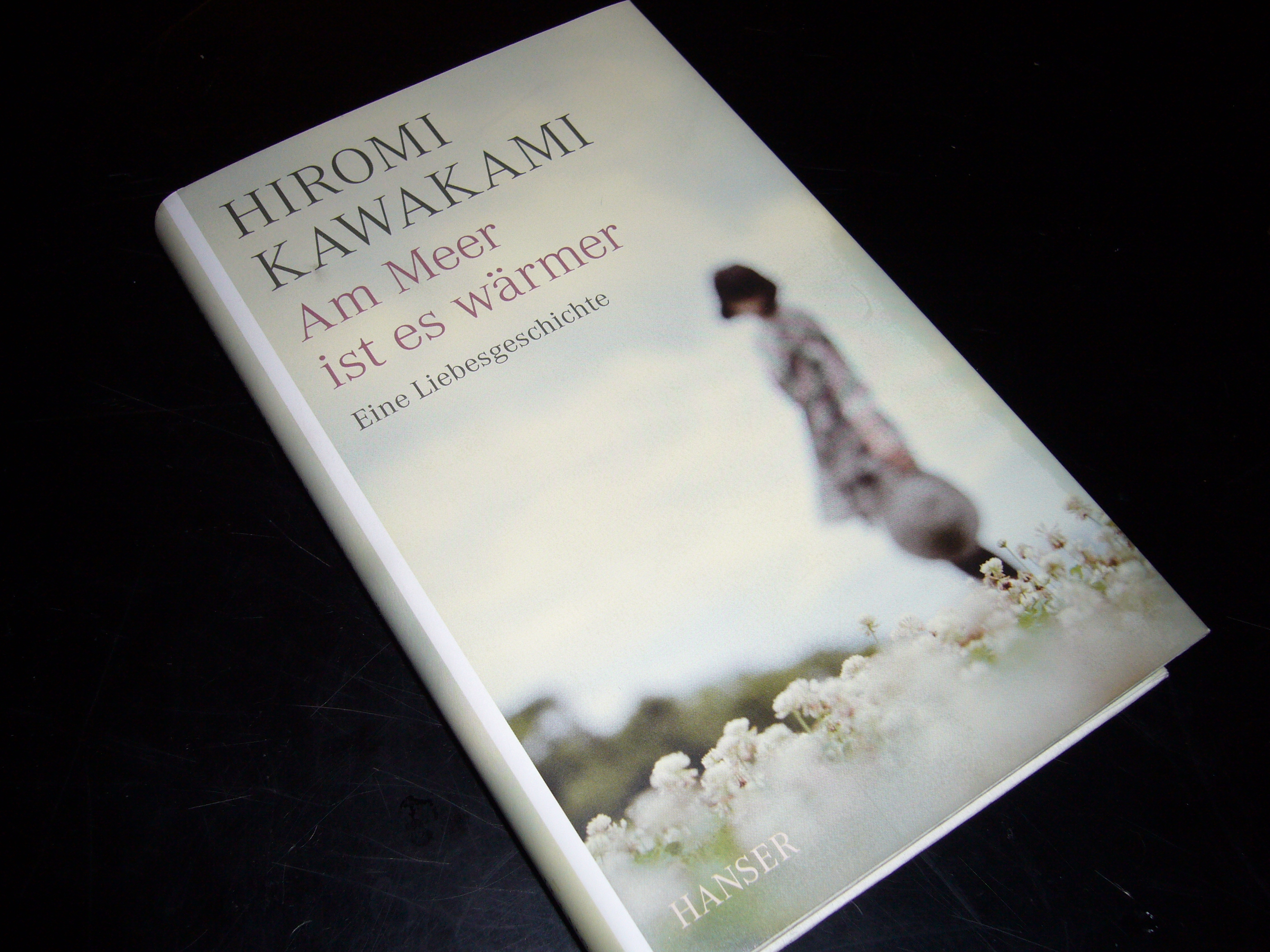
I read the book in German. I really love the cover. The woman is blurred, only the little flowers, (Immortelle, I think) at the bottom of the picture are in focus. It captures the mood of this novel much better than the English one in which the focus is on the woman.
Nina Bawden: The Birds on the Trees (1970)

The expulsion from school of their eldest son shatters the middle-class security of Maggie, a writer, and Charlie, a journalist. Since childhood, Toby has been diffident and self-absorbed, but the threat of drug taking and his refusal (or inability) to discuss his evident unhappiness, disturbs them sufficiently to seek professional help. Veering between private agony and public cheerfulness, Maggie and Charlie struggle to support their son and cope with the reactions- and advice- of friends and relatives. Noted for the acuity with which she reaches into the heart of relationships, Nina Bawden here excels in revealing the painful, intimate truths of a family in crisis. Toby’s situation is explored with great tenderness, while Maggie’s grief and self-recrimination are rigorously, if compassionately, observed. It is a novel that raises fundamental questions about parents and their children, and offers tentative hope but no tidy solutions.

Nina Bawden’s novel The Birds on the Trees was one of the so-called Lost Man Booker titles in 2010. These were books that would have been on the Man Booker short list in 1971 if the dates for the Prize hadn’t been moved. While reading about this, I encountered the expression Hampstead novel, a label I had never heard of before. It seems this label was used to describe a specific type of novel, not only set in Hampstead but focussing on leftist-liberal intellectuals of the middle-class. Margaret Dabble and Iris Murdoch were named as well. When I hear a description like that I have to fight the urge to yawn.  That does sound boring, doesn’t it? In any case, the fact that Bawden was nominated for the Lost Man Booker in 2010, with a novel that was, as critics wrote, so clearly a Hampstead novel, triggered a lot of more or less interesting response in the media and some referred to older articles. One article I read was particularly interesting because it looked at settings in British literature. If you are interested here is the link. The writer argues that to a certain extent you can deduce the themes and topics from the location of a book. It’s highly unlikely that you will find the same topics in a novel located in Peterborough as in a novel set in Wales. This may be very obvious for a British reader but for me it was highly enlightening.

Hampstead novel or not, The Birds on the Trees is the story of a family crisis. The family is an intellectual middle-class family. The mother is a writer, the father a journalist. The book opens in the past, when Toby, the oldest son, is barely five years old and runs away at Christmas. He is an odd little boy. Strangely quiet and polite for his age. The book then fast-forwards 13 years. Toby is 18 and has been expelled from school because of marijuana abuse. He has two younger siblings, 11-year-old Lucy and the 5-year-old Greg. The parents are shocked and horrified and have no clue what to do with their son. For Maggie, the mother, it’s clear, he has to go to Oxford, one way or another. Charlie, the father, would rather give him a break and let him figure out what he would like to do. But these are not the only two people with a strong opinion and some saying in the matter. Aunt Phoebe, the  domineering widowed sister of Charlie, meddles as well. And Maggie’s mother plays an important role too.

The structure and character portraits of this novel is what I liked best. It moves from one person to another, changing from first to third person narrative and gives the point of view and impressions of each character. The voices are very authentic, the dialogue rings true. Through all those inputs we see how much is really going on under the surface and how dysfunctional the family is.

Toby cannot stand it anymore at home after his expulsion and after having stayed at his grandparent’s home for a while, finally moves to London to live with an older friend. It seems he starts to use other drugs and when the parents go and get him, he is on the verge of a nervous breakdown and diagnosed with schizophrenic disorder. Electro shock is the chosen cure. I didn’t like this part of the story at all and had a problem to fully understand why Toby was called mentally ill. He seemed more aloof and detached than genuinely depressed or psychotic.

If Toby’s illness and the horrifying “cure” had been all this novel had to offer, I would have hated it, I’m sure, but there is so much more going on. It isn’t only well written but the different story lines and aspects are thought-provoking and captivating. Maggie, the mother, is by far the least appealing character. After a while she started to really get on my nerves. There is an instance in which she discusses with her husband whether it is OK to take the things that happen and turn them into a novel. This is a very important moment that could easily be missed. If I hadn’t done some research I wouldn’t have known that Nina Bawden told the story of her own family. Her son suffered from mental illness, abused drugs and finally killed himself in 1982. This may explain to some degree why the book is so flawed and at the same time so interesting. It seems as if she was in writing it, trying to answer the question of responsibility and at the same time imagining a positive outcome.

One of the core themes that I found to be extremely well executed is favouritism. Toby was the first child and remained, even after the others were born, very obviously the favourite. Although his little sister loves him, she and her younger brother start to believe that they might have been adopted. It seems the only explanation why Toby is always the center of attention.

While the end of the book and the description of the mental illness aren’t convincing, I still enjoyed this novel because it manages to capture insecurity and conflicting emotions at the heart of families so well. Some of the character portraits are great. With a few exceptions, there is hardly a conflict-free relationship in this family and the book illustrates them all. Depending on who talks to whom, the interaction triggers different aspects in the personality of the characters. One person who is quite insufferable in contact with someone may be quite charming the moment he or she speaks to someone else. Often people show only one part of their personality to someone and keep another part for someone else. Through the interior monologues and dialogues all the facets of the characters are wonderfully well shown. Maybe, as some journalists argued, the book didn’t deserve the Man Booker, being too flawed and too Hampsteadish, true enough, still I thought it was a great read.

Does anyone know Nina Bawden? Has she written other books that are worth reading?

Carrie Ryan: The Forest of Hands and Teeth (2010)

In Mary’s world there are simple truths. The Sisterhood always knows best. The Guardians will protect and serve. The Unconsecrated will never relent. And you must always mind the fence that surrounds the village; the fence that protects the village from the Forest of Hands and Teeth. 

I don’t think it is a coincidence that books like Carrie Ryan’s The Forest of Hands and Teeth are so popular. All around me people speak about their insecurities, how they have lost their confidence, their belief that all will stay the way it is, that they are safe. Many fear that the world as we know it may come to an end.

The Forest of Hands and Teeth is set in a time, long after the world as we know it has come to an end. A strange illness broke out, called The Return, and since then the world is divided in the people living in the village, guarded by the Sisterhood and the Guardians and those, behind the fences, who live in the forest, the so-called Unconsecrated. The Unconsecrated are living dead, zombies, who spread their disease through biting the living.

The story is told by Mary whose father has disappeared in the forest and possibly become one of the Unconsecrated and whose mother approaches the fence at the beginning of the book and turns. Her brother is a guardian. Mary will mostly probably get married to Harry, that’s the wish of the community and the Sisterhood who reign over this enclosed world. Harry and Mary have been friends forever, just like Cass and Mary have been friends. What nobody knows is that Mary is in love with Travis, Harry’s brother.

Until the day when the Unconsecrated breach the fence and kill almost all the villagers, it’s not clear whether Mary will join the Sisterhood or become a wife and mother. When their world collapses and they have to flee, it’s not that important anymore. Mary and a group of six people and a dog escape the village and reach a secret path that leads through the forest. The path is secured by a fence through which the moaning Unconsecrated try to reach them.

The path is like a maze. It’s mysterious and they do not know where they are going. There were tales of cities and an ocean somewhere beyond the forest. They don’t have a lot of food and are attacked constantly. When they arrive at an abandoned village they hope they may soon arrive at their destination and find safety.

The beginning of the story is unlike the stories in any zombie movie, I have ever seen. In the movies the zombies usually attack from the start and the people have to fight them. In this novel, for a long time, they are just a threatening presence and the book is all atmosphere but then, they close in on them and breach one gate after the other and the book turns into an action-packed novel that moves towards a climatic ending. Climatic and sad as some of the small group of survivors are bitten on the way.

I never felt like reading a zombie novel before and if it hadn’t been for Sarah’s intriguing review I wouldn’t have tried this book but I’m glad I did. It has a very special and haunting atmosphere, very captivating and oddly enthralling. The word zombies, is never used, by the way, but it’s clear from the descriptions. The Forest of Hands and Teeth is part I of a trilogy. I won’t rush to read part II and III right now but I feel like reading them some day.

Here’s another review by Fence (Susan Hated Literature).

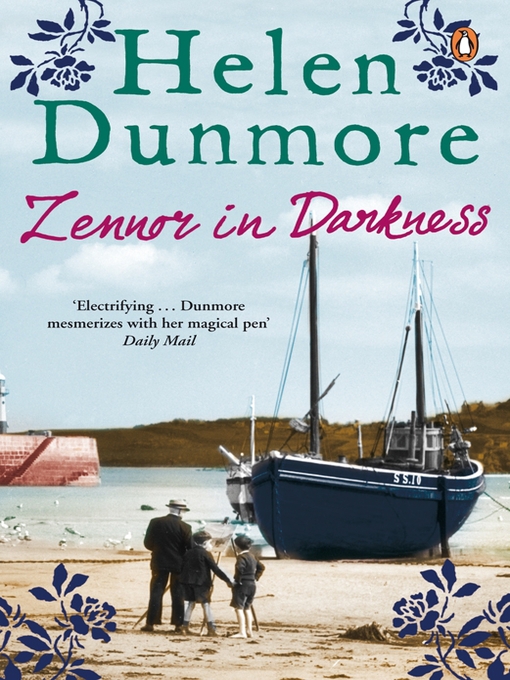
Helen Dunmore: Zennor in Darkness (1993) Literature and War Readalong January 2012

Helen Dunmore’s first novel Zennor in Darkness is set on the Cornish coast in 1917. The sound of war can be heard from afar. The first young men return from France, some of them are missing limbs, others are shell-shocked like Claire Coyne’s cousin John William. Although the war is present on every page, in the suspicions of the people, the fear that all the boys will be drafted, the noise the wind blows over from France, the scarcity of money and food, this is a novel of dreamlike beauty. Dunmore conveys the soft light of the Cornish coast, the beauty of the lovely landscape, the slow pace of life. This softness is mirrored in the way she changes the point of views, blurring the edges, softening the transitions, so that it feels as if one person’s consciousness and interior monologue, was flowing gently into that of another character. Reading it made me dreamy and I felt as if I was watching a water-color come to life. I read this book very slowly. I could have finished it in a few evenings but I put it aside frequently to make it last.

Zennor in Darkness interweaves the fictional story of Claire Coyne, and her cousin John William with the story of D.H.Lawrence and his wife. Claire lives alone with her father. Her mother who died while she was still very little was from Cornwall, while her father is an outsider, just like Lawrence. He comes from a rich Londoner family and was always seen as an intruder. Claire’s maternal grandparents, her aunts, uncles and cousins live close by. The children are a tight-knit community since they were little kids. They are so close that, although it seems logical for us, nobody suspects Claire and John William to be lovers.

The war has taken its toll, hundreds of thousands are dead and a lack in officers makes it possible for someone like John William who isn’t noble, to become an officer. He returns from France for a brief visit before he will join a training camp where he will stay a few months before being sent back to France.

Before his return Claire has befriended D.H. Lawrence. She is fascinated by him and even more so by his attractive German wife, Frieda. Not everyone is happy about their stay in Zennor. Germans are suspected to be spies and people would like to see them gone. Lawrence and his wife are happy in Cornwall. Their dream of a community of like-minded people has been shattered after Katherine Mansfield and her husband have left but still they love Cornwall and their simple life. Lawrence works in the garden, befriends the villagers. It’s not as easy for Frieda but she likes it as well. To the Lawrences Cornwall means more than just a place to stay, it is a refuge, a shelter and to watch their dream being crushed is painful.

Lawrence discovers that Claire is talented at drawing and encourages her to pursue a career. She introduces him to John William and Lawrence feels, more so than Claire, that John William hides something. One evening, when the two men walk alone in the balmy Cornish night, John William lets himself go in front of Lawrence, unable to hide the signs of shell-shock any longer.

Zennor in Darkness is a very beautiful novel and if anything it made me want to read more of Helen Dunmore. And it also made me want to return to D.H. Lawrence whose books I have abandoned for too long. I’ve always liked D.H.Lawrence, his novels, short stories, essays and letters and found that she captured him and his relationship with his wife very well. Frieda was a von Richthofen. A cousin of the famous Red Baron. Abandoning her marriage, her children and her privileges must have cost her a lot. I was always fascinated by this free spirit. The end of the book moved me. I knew the part related to the Lawrences, still it made me angry, while the fictitious story of Claire and John Williams made me sad.

What I found astonishing is the combination of beauty and horror. The descriptions of the Cornish coast, its air, light, flora and fauna alternate with passages like this one.

In Flanders the struggle for the Passchendaele Ridge continues. The poppy-blowing fields are ploughed by German and English guns, and sown with a litter of lost equipment, a seeding of blood and bone. Soon it will be autumn there too, and heavy northern rains will fall. Men will be listed missing, presumed drowned – a new classification for the lists in the newspaper. They are presumed drowned in the mud in which they live and often die. The men who came ‘right away to Blighty’ with John William will return to Flanders with their new commissions soon. Their training lasts only three months, and then they are wanted back at the Front. Hammond will die on a mission described to him by a senior officer as ‘rather a tricky bit of patrol-work’. His body will not be found. Simcox, a dozen feet to the left of him, will survive.

Ultimately however Zennor in Darkness is a novel about the difficulty to know another person. Either because you see them as strangers, or because they are too close for you and you lose all perspective. Like in real life, in many instances a stranger understands another character better than his own family, while at the same time, the community projects fear on the outsider.

In any case this was an excellent start to the Literature and War Readalong 2012.

Other reviews

Danielle (A Work in Progress)

Lizzy (Lizzy’s Literary Life)

Sarah (A Rat in the Book Pile)

Zennor in Darkness is also my first contribution to the War Through the Generations Challenge hosted by Anna and Serena.

*******

Zennor in Darkness was the first book in the Literature and War Readalong 2012. The next one will be Sebastian Barry’s A Long Long Way. Discussion starts on Monday February 27, 2012.

Henry Green: Party Going (1939)

Take a handful of idle bored rich people, put them in a confined space and see what happens. A minor writer may turn this tested recipe into a dull and boring exercise, a major writer will produce an amazing piece of writing which isn’t only brilliantly well written but a psychologically accurate comedy of manners.

Heavy fog has trapped the members of a party about to board a train for France in a London railway station. They were to leave for a couple of weeks. Max, their host, organizes these parties regularly and who is invited and who is not is of great importance.  Surely they cannot stay outside on the train platforms in the middle of those brutal and vulgar masses who will end up drinking and singing, now, can they? So they leave their porters and their luggage outside and move into the railway station hotel where Max has reserved some rooms for them.

This stay at the hotel may have been comfortable enough, boring, yes, but sipping tea, taking baths and slagging off others behind their back is amusing for a while. Unfortunately Claire’s aunt has committed the indecency of falling ill and becoming quite the nuisance for all of them. It’s particularly horrible for Claire as everybody knows she will board that train, no matter what, but, before she can do so, she must convince the partygoers that she isn’t heartless, no, on the very contrary, it’s her aunt’s fault entirely. Nobody should dare falling ill and spoil other people’s fun. Here’s Claire talking to Evelyn about her aunt.

(…) absolutely everyone else is dead and mother’s abroad as you know. It’s rather touching that’s why she came to see us off really it’s her only link. No, but it’s not touching actually because she goes and gets ill. Oh, Evelyn, it’s so unfair, isn’t it?

I’m sure you have realized by now that these characters are far from kind or pleasant. They are a bunch of egotistic, selfish and spoilt people who take everything that gets between them and their pleasure as a personal affront. Be it the fog, the sick aunt or anything else.

What made Party Going such an incredible read is the way it is told. Point of views change constantly, people move from one person to the other and always pretend to be different from how they really are. What we see is exactly what we would see if we were present at that very moment with only a little background information on the motives and true feelings but no other background information whatsoever. Still I felt, I got to know these people better than some of those whose whole biography I have been informed of in other novels. While reading Party Going we feel like unseen guests eavesdropping on other guests who are all nasty and mean behind each other’s backs and constantly pretend to think or feel different from what they let perceive. Sometimes the deception is minor but on many occasions the discrepancy between the true feelings and what is shown is considerable.

When Alex came to an end and she had not properly heard what he had been saying so she said something almost under her breath, or so low that he in his turn should not catch what she had said, but so that it would be enough to tell him she was listening.

There are shocking moments in the novel. Especially when these people talk about the masses, the poor. They, of course, are a nuisance too. Their maids and porters are not perceived as human beings, they are just commodities.

“Would you like me to come down with you to see if we can do anything about your things?”

This seemed to Julia the sweetest thing she had ever heard, to offer to brave those frantic drinking hordes of awful people all because someone was upset about their charms (…)

There really isn’t a likable character in this book, apart from the enigmatic handsome Max whose two girlfriends both appear, although he thought he got rid of one of them. Max is very rich, generous and quite elusive. Kind to everyone but hard to keep in one place. He likes his drink too much and this is part of his charm, as we are told, because all the girls think they will be able to save him.

It’s like watching a movie, the dialogue, and the commentary that accompanies it, is fantastic. I know some people will think this too experimental but I thought this was maybe one of the most accomplished pieces of modernist writing I’ve read in a long time. It works like a clock. All the pieces fit into each other, all the little cogwheels gear into each other and move at a steady pace. More surprisingly, Green not only has an ear for dialogue and is a brilliant observer, he also writes quite beautiful passages.

It was so luxurious he nodded, perhaps it was also what she had put on her hair, very likely it may have been her sleep reaching out over him, but anyway he felt so right he slipped into it too and dropped off on those outspread wings into her sleep with his, like two soft evenings meeting.

The novel is available in a collection with two other novels Loving, Living, Party Going. I’m grateful to obooki for pointing out Party Going because I had planned to read Loving instead. Party Going is brilliant.

The review is part of Henry Green week hosted by Stu on Winstonsdad’s Blog. If you are interested, here is his introductory post. I know that quite a few people take part in Henry Green week and I’m curious to see what they read and how they liked it.

Amor Towles: Rules of Civility (2011)

This is the reason why I always look forward to new releases because ever so often you discover a new book and simply enjoy it to the extent of wanting to start all over again after finishing it. This doesn’t always have to be a book that will enter the literary canon, it can just be a novel that makes you spend a few extremely entertaining hours. Like a well-made movie.

If you want to get the proper feel for Rules of Civility, you should listen to Billie Holiday singing Autumn in New York below. As Katey Kontent, the books narrator and main character, rightly says, every city has its season and for New York that seems to be autumn. And this book is all about New York in the 30s, its atmosphere, the Jazz Clubs, the lifestyle of the upper classes, drinking champagne and Martini’s, party going. It also made me think of Hopper’s famous painting Nighthawks, melancholic looking people at a bar late at night. When I visited Amor Towles website, I discovered that that’s exactly what he had in mind.

But what ultimately made me love this book was the narrator and main character, Kate Kontent. She is witty and intelligent, quick at repartee, full of wisdom. No wonder this is a highly quotable book. There a so many bon mots in it I could have copied one after the other. And I like a character who loves reading and makes you want to dash out and get the books she talks about. At the beginning of the novel, she reads Dickens and then moves on to Agatha Christie, overcoming her prejudice about mysteries and discovering a world of comfort and justice.

Rules of Civility tells the story of one year in the life of Katey Kontent. The novel begins in 1966 when Katey and her husband see the photo of a shabby looking Tinker Grey in an exhibition. Tinker who was one of the famous Wall-Street bankers. She knew Tinker and tells her husband so, however she doesn’t tell him how well she knew him. After this short intro the novel rewinds to New Year’s Eve 1937.

On New Year’s Eve 1937 the intelligent and sassy Kate and her best friend and roommate Eve, a gorgeous blonde from the Midwest, sit in a jazz club, waiting for someone to pay them a few glasses of champagne, when the extremely elegant and rich looking Tinker enters the club and they get to know each other.

They get along so well that the three of them hit the town together on many nights until they have a terrible accident. Until this time both women are interested in Tinker for different reasons but it is very obvious who he would like to get to know better. The accident changes everything, their relationships and ultimately it changes the course of their lives.

The year flies by in front of the reader. Katey who was a secretary becomes an assistant for a new glamour magazine, she meets interesting people, has different relationships with men but there are four people, including Eve and Tinker, that are more important than anyone else and although they will drift apart, she will never forget them.

It’s amazing to see these people come to life. At the end of the novel I thought, I had met Kate, Eve and Tinker, Wallace who joins up and fights in the Spanish Civil War and the ever so joyful Dickey. It’s a very artful novel. Towles knows how to create a world that comes to life and thanks to Kate’s incredible sense of repartee the novel is full of great sentences.

The most important theme of the book is making choices that’s why it’s such a melancholic book. As Katey says, even if you make the right choices

I have no doubt that they were the right choices for me. And at the same time, I know that right choices by definition are the means by which life crystallizes losses.

I could have added a lot of quotes but chose not too. All these sentences are embedded in the novel and are like little gems that we discover while reading and every time I tought “Oh that’s so well said” or “That’s so nicely phrased”. I don’t want to spoil these discoveries for anyone.

I really enjoyed this book, it’s very well written and it would make a wonderful movie.

I discovered the book on Danielle’s blog who reviewed it here. Jacquelin Cangro reviewed it here and Tracey here. Jackie mentioned it here.

Betty Louise Bell: Faces in the Moon (1994)

In this moving first novel, Bell (a mixed-blood Cherokee) confronts the “lost generation” of Indian women, personified by Grace, who tries unsuccessfully to enter the mainstream of the white world. Her daughter Lucie’s horrendous childhood of struggle and abuse is relieved only by a two-year stay with a great-aunt, who instills in her a sense of pride. Despite the odds, she is now a successful college professor. Returning to Oklahoma for Grace’s final illness, Lucie spends some painful solitary hours examining the shame she has felt for her mother, who lacked both the skills needed to thrive in the white world and pride in her Cherokee heritage. She finds a link to Grace as she rummages through her things is able to engage in the generations-old tradition of proudly seeking the face of her mother when she sees the moon. 

Betty Louise Bell is a half Cherokee. Faces in the Moon is her first and I think only novel. It is to a large extent autobiographical. She teaches Native American Studies at the University of Michigan, Ann Arbor.

It was a pure coincidence that I started her novel shortly before beginning to read Cold Mountain which contains a few elements of Cherokee history and mythology.

When Hellen, Lucie’s grandmother, dies, she tells her daughters Gracie and Rozella that she would be watching them from above and that they should watch out for faces in the moon, she would be one of them. This story is part of the stories the sisters, Grace and Rozella, tell each other when they sit at the kitchen table and smoke. The child Lucie listens to these stories. Many of them are meaningless to her. All she can see is that her mother is nothing but a fat half Indian who bleaches her hair, wears the most awful baggy synthetic clothes and goes from one alcoholic violent white boyfriend to the next.

The grown up Lucie has long left her mother and aunt in Oklahoma and lives in some of the big cities like Boston and New York. When they call her, to tell her that her mother has had a stroke, it’s the first time, in many years that she drives back to her home town. While her mother lies in the hospital bed, Lucie sleeps at her place. The ugly furniture covered with plastic, the cupboards full of tins, the keepsakes, the pictures, take her back in time and she starts to explore why she hates her mother so much.

The story that unfolds is told alternating between first person and third person narrative and long stretches in italics. It tells of her mother’s life and of Lizzie, her great-aunt, who was a full-blooded Cherokee. During some years, when her mother couldn’t cope because she had a new, alcoholic lover, Lucie had to stay with her great-aunt Lizzie. At first the child misses her dysfunctional home. Lizzie who suffers from tuberculosis and constantly spits into a tin, is very kind to Lucie and treats her like an equal. Slowly they become friends and her aunt teaches her to be proud of her heritage. The years she spends with her, are the best years of her childhood.

Many of the elements in this novel, including the sparse prose, reminded me of Erdrich’s Love Medicine. These lives are bleak and a constant struggle. Alcoholism is frequent. Gracie, Lucie’s mother, is a very typical example. She tries everything to make people forget that she is half Indian. Her hair almost falls off, from the bleaching, she would never wear anything made of natural fibres but rather sweats in synthetic dresses. She changes her boyfriends constantly. Most them are white and beat her up. She is mean and doesn’t take care of her daughter. She is half illiterate and the letters she writes to Lucie later in life, fill her daughter with shame. They sound like the letters of a child and are full of errors.

What truly shocks Lucie at Lizzie’s place is when she sees a photo of a young beautiful Indian woman with long black hair, holding a little baby. If Lizzie hadn’t told her, she would never have recognized her own mother.

Bells’s writing is sparse and tries to imitate spoken language. This is a means to emphasize the importance of oral traditions. Unfortunately I didn’t think it was very well done. The changing from the first to the third person and to the italicized parts didn’t seem to follow a logic. I could understand why Lucie had a problem with her mother but the hatred wasn’t really explained. Because she gave her away or because she was poor and almost illiterate and denied her heritage? Was hurt or shame the source of it or both?

The ending is abruptly redemptive which I found quite odd too. I didn’t mind reading the book. Not at all. It’s interesting in parts but overall a bit disappointing as the structure was confusing. I would have liked to know more about the Cherokee culture. What Bell describes seems typical of many Native Americans with a severe identity crisis. And yet, this could have been the point. Maybe she wanted to show that once people are robbed of their identity, they all become alike, no matter whether they are Cherokee or Chickasaw or Choktaw. And since they are poor and not well educated all they have is the imitation of mainstream culture.

I liked that the book seemed very realistic and didn’t try to draw a romanticized picture. And what worked very well was how the difficulties of the mother-daughter relationship are described and how she captured that moment when Lucie sat in her mother’s empty apartment, looking at all her things and knowing that she would never return.

Has anyone read this or Louise Erdrich?