Horace McCoy: They Shoot Horses, Don’t They? (1935) or The Hunger Games of the Great Depression?

The whole of last week I was looking for something to read that would grab me. I’ve read a few very good but very similar novels lately and was longing for something different. When I read Guy’s review of McCoy’s novel They Shoot Horses, Don’t They? I thought, that’s it, that’s what I want to read. Thanks to the kindle I could start right away. I’ve watched the movie when I was a teenager and although I was very impressed, I never read the book. Now that I have, I wonder why I didn’t read it any earlier. It’s great. It reminded me of another depression era book which has also been made into a movie, James M. Cain’s The Postman Always Rings Twice.

They Shoot Horses, Don’t They? is as powerful as I was expecting it to be. It’s written in the form of a testimony. A man is accused of murder. He doesn’t deny it but he wouldn’t exactly call it murder. He thinks he did the person he shot a favour. The court asks him to justify what he did and that’s why he tells his story.

Why he shot someone and why he thinks it was a favour is told in flash backs. Robert and Gloria are both luckless actors who can’t make it in Hollywood. Not even as extras, no matter how hard they try. One from Texas, the other from Arkansas, they both were hoping that Hollywood would make their dreams come true. They are very poor and hardly have enough money to buy food. When Gloria tells Robert about a dance marathon, he is first reluctant but then joins her and they sign up. These marathons were really held in those times. It’s hard to imagine nowadays but people signed up to dance for 900 and more hours straight. They were allowed to rest for fifteen minutes after one and half hours but that was all the rest they got. After a while they didn’t really dance but they had to keep moving all the time. The marathon was over when only one last couple was left.

Many  couples sign up together with Robert and Gloria, 50% already don’t make it through week one. Because the public is easily bored the organizers have to spice up things a bit and come up with additional ideas, like the derbies. Every evening the couples have to speed around the dance floor. The last couple is disqualified.

The drama during the marathon is intense. Fights break out, people collapse, the exhaustion is hard to picture, still many go on dancing after 800 hours.

There is a lot to like in this novel. The dialogue is spot on and highly effective. It captures the different colorful characters very well. What really impressed me are the two main characters Robert and Gloria. Especially Gloria. Robert and Gloria are such opposites despite the fact that they are in a very similar situation when they meet. Their mental state is so different. While Robert is hopeful, Gloria is one of the darkest characters one could imagine.

“Sometimes I’m sorry I ever met you, ” I said. “I don’t like to say a thing like that, but it’s the truth. Before I met you I didn’t know what it was to be around gloomy people.”

We crowded behind the starting lines with the other couples.

“I’m tired of living and I’m afraid of dying.” Gloria said.

Gloria is one of those people who are too far gone. I’ve met people like that in my life. You just knew, they had passed the point of no return, they were too self-destructive, no influence was going to save them. And, as one character says to Robert in the novel, it is dangerous to be in their company. They are like a maelstrom, the moment you’re in it they swallow you and drag you down.

They Shoot Horses, Don’t They? is an unflinching account of how far people are driven by poverty. And how others are willing to exploit this poverty for fun and entertainment. Only one couple can win the 1000$, the others hardly get anything. But nobody is really interested in the winners, people want to see the other couples fail. The more spectacular the failure, the better.

While it wasn’t surprising that this reminded me of another depression era book I was in no way expecting to find anything that would remind me of The Hunger Games. The writing cannot be compared, They Shoot Horses, Don’t They is excellent but there are still a lot of striking similarities that made me think. I was wondering whether Suzanne Collins was consciously using it or if it was just a coincidence. After finishing the book I googled the titles together and saw that I’m not the first to spot the similarities. Amy from My Friend Amy has also written about it as you can see here and so have others.

In both books, poor people are exploited for fun. While the role of the respective government is different, the outcome is similar. In The Hunger Games the people are forced to participate, while they sign up in McCoys novel. In both instances to see others fail, watch them struggle, makes the success of the show. In both books couples or people who are liked will get sponsors who will pay for things that will help them. Food and medicine in The Hunger Games, clothes in McCoy’s books.  In both novels food plays a prominent role. In They Shoot Horses, Don’t They? they are fed during the breaks and eat more than usual. In The Hunger Games the dinners and lunches in the Capitol are described in great detail. Ultimately hunge, is a key theme in both books. In both books there are fake marriages/romances. Couples agree to get married or to pretend to be in love in order to make the games more interesting. And in both books the show doesn’t end as expected, in both something goes wrong. Last but not least, killing and murder is another key theme in both novels.

What is completely different is the psychological dimension. The Hunger Games isn’t very psychological but They Shoot Horses, Dont They? is. The charcaters, even the secondary ones, are captivating and feel realistic.

It would be interesting to analyze these books in more depth and to compare some of the depression era books with the wave of dystopian novels we have and what it means in terms of the perception of economic crisis.

Have you read this or other books from the Depression era? What do you know about the similarities with The Hunger Games. Is it a pure coincidence?

I wasn’t aware but I’ve downloaded an Open Road Media title. They have just released this and Kiss Tomorrow Goodbye as you can see here.

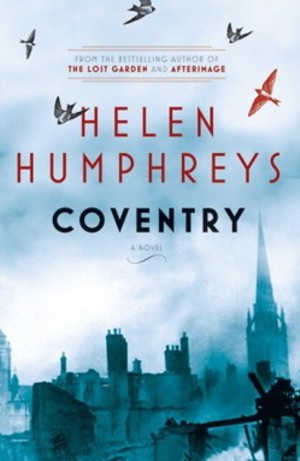
Helen Humphreys: Coventry (2008) Literature and War Readalong April 2012

Helen Humphrey’s novel Coventry starts with a woman and a young man standing on Coventry cathedral, on November 14, 1942. Harriet and Jeremy are fire fighters. It’s an eerie night, almost beautiful.

The moon is full and bright and the ground below the cathedral is white with frost. Harriet has never seen anything so beautiful. The ground glitters like the sea and smells of earthy cold.

This is the night in which Coventry cathedral will be bombed and most of the city destroyed. But when the bombs start falling and even after most of the destruction, Harriet still sees beauty.

The leaves have burnt black on the trees. The limbs are twisted and full of clothes, caught there like strange birds in the upper branches. The clothes must have blown up there from a bomb blast.

Harriet remembers the morning of November 14. How beautiful it was, all sun, and only a little wind to remind her of autumn. It was a thursday, early closing. She had gone round to the shops before lunch, and she had felt lucky because she was first in line at the butcher’s and got sausages.

Until this evening Harriet didn’t feel touched by the war. She is disappointed by it but not devastated. She will not, as she believes, suffer like she did in the last war when she lost the man she loved.

After the brief initial chapter, the novel moves back to 1914. A young Harriet sees her husband off to war. The very same morning, after returning from the train station, she meets Maeve, and lives a moment of intense friendship with the young woman. Harriet will not see her husband again. He goes missing in the trenches. And until the night of November 1940, she will not see Maeve again either.

Unbeknownst to all of them, the young man on the roof with Harriet, is Maeve’s son. The story of the two women’s lives will unfold during the novel, interwoven with the story of this tragic night in which the three fight in parallel and together, for their survival.

Harriet has never loved again and Maeve who left Coventry shortly after having met Harriet, gets pregnant. She doesn’t even know which one of the slodiers she was seeing is the father.

Most of the chapters focus on Harriet and Jeremy who flee from the burning cathedral, roam the streets, hide in shelters, run from the bombs and burning debris. They are looking for Maeve and their houses, anxious to discover how much they might have lost. The destruction is incredible, the sight of so many dead people is terrible but it’s even more harrowing to hear voices coming out from underneath demolished houses and not be able to help, to stand by and hear them suffocate. There are many descriptions of people whose life is snatched away within a second. One moment they are talking, shaving, walking, the next moment they are gone.

Coventry is a lyrical novel, written by a poet, telling the story of a poet who is trying to make sense. Since the tragic loss of her young husband, Harriet has written condensed descriptions. They shield her from emotion, give sense. That’s what she will do in the future as well. After the terrible night in which Coventry is destroyed, she will become a poet.

While Harriet paints with words, Maeve captures everything that has happened with her pencil. Already when they met in 1914 she was drawing constantly.

I’m in two minds about this book. It’s an intense description of what it meant to be in a city undergoing such massive destruction. This is well captured, at the same time, the addition of descriptions like the ones above, hold the horrors at arm’s length. I’m interested in the depiction and description of war. How do you put it into words, how do speak about the unspeakable? I think this was one of Helen Humphrey’s intentions, to show how a poet would write and feel about this horrible night. That’s why, more than a book about Coventry’s ordeal, this was for me a book about the birth of a poet. And that’s precisely what troubles me. I’ve read other books by Helen Humphreys and liked them, but in this case I feel the writing is too lyrical and esthetic for its topic. And there is the coincidence at the heart of the story, the fact that the young man Harriet spends the night with is Maeve’s son. Unfortunately I really don’t do well with this type of coincidence.

Coventry is a beautifully written book, the novel of a stylist but some rough edges would have given it a whole other dimension that would have been more appropriate for the subject. Still, and this may seem paradoxical, it is a book I would like to read again, if only for its language. Maybe I’m not doing it justice, maybe I’m just not used to someone describing war in such a lyrical way and depicting people who are so caught in their inner lives that they seem ultimately untouched by the collective experience of destruction.

I’m very curious to see what others thought.

Other reviews

Additionally to his review Tony has written an interesting post on his hometown Coventry and the Coventry Cathedral. It’s well worth reading.

Anna (Diary of an Eccentric)

Danielle (A Work in Progress)

TBM (50 Year Project)

Tony (Tony’s Reading List)

*******

Coventry was the fourth book in the Literature and War Readalong 2012. The next one will be Nigel Balchin’s Darkness Falls From the Air. Discussion starts on Monday May 28, 2012.

Tracy Chevalier: Remarkable Creatures (2009)

On the windswept, fossil-strewn beaches of the English coast, Mary Anning learns that she has a unique gift: “the eye” to spot fossils no one else can see. When she uncovers an unusual fossilized skeleton in the cliffs near her home, she sets the religious authorities on edge, the townspeople to gossip, and the scientific world alight. After struggling through cold storms, landslips, and other natural threats, her challenges only grow when she falls in love with an impossible man.

l often say I don’t like historical (genre) novels but I will not say this anymore. I may not pick them up frequently but when I do I often enjoy them. Even more so when they open a door to a world that fascinates me and of which I didn’t know a lot. Tracy Chevalier’s book Remarkable Creatures was exactly one of those books.

In the early 19th century the little working-class girl Mary Anning helps her family make a living with “curies” – curiosities – she finds on the beaches of Lyme Regis. Uneducated as she is, she doesn’t know a lot about fossils, she only knows that the rich people who come to stay at Lyme Regis give her money for her finds. Elizabeth Philpot who has moved to Lyme Regis with her two sisters is equally attracted by fossils. She is an unmarried woman who due to her unpleasing looks and the lack of money has no chance of ever finding a husband. When she meets Mary she is immediately aware that the girl has a gift. Where others see only stones and rubble, little Mary spots fossils. The two become friends and Elizabeth mentors the girl and helps her to sell her finds to a good price. When Mary makes a revolutionary discovery, the fossilized skeleton of an Ichthyosaurus, it is Elizabeth who fights for Mary’s right to be rewarded and acknowledged as the finder.

The book tells the life story of these two women in alternating first person narratives. It desribes their struggles, their failure at finding love and their fight for recognition. This is a time in which the idea of evolution, the fact that there once have been species that are now extinct, is thought to be blasphemous and heretic. And it’s even more problematic to acknowledge that women could contribute to science. Mary Anning’s discoveries are “remarkable” to some and shocking to many others.

This idea was too radical for most to contemplate. Even I, who considered myself open-minded, was a little shocked to be thinking it, for it implied that God did not plan out what He would do with all of the animals He created. If He was willing to sit back and let creatures die out, what did that mean for us? Were we going to die out too? Looking at that skull with its huge, ringed eyes, I felt as if I were standing on the edge of a cliff.

I was completely captivated by this story. The descriptions are so well done. Tracy Chevalier has a gift to bring the past to life. I already noticed that when I read Girl With a Pearl Earring. The period detail seems extremely well done. I have always been fascinated by fossils and delighted when I found some but I never bothered to read much about them. I had never heard of Mary Anning before and loved to be introduced to this amazing woman and her story.

I expected something slightly different though. I thought this would be a novel about a friendship which it is to a certain extent only not the type I had in mind. I’m obviously used to modern-day friendships with the emphasis on discussion and soul-baring. There is none of this in this book. Their friendship is expressed in silent company, not conversation. More than anything else, these two women form a little support group. Both have not been treated kindly by society and could be called outcasts. Elizabeth maybe less than Mary but still to some extent as well. Both are trapped by their respective class and their gender and if it hadn’t been for the fossils and their attachment to each other, they would have lived sad and lonely lives.

The melancholy mood and the evocative descriptions of the setting, the beaches of Lyme Regis, the weather, the danger of being killed in a landslip fascinated me even more than the story of these two women. The cover of the book captures some of this very well. A lonely rather rough-looking beach and two figures completely absorbed by what they see.

I’ve read that others found the book to be flat or lacking. It wasn’t any of this for me. I liked it a great deal and would highly recommend it to those who like Tracy Chevalier’s books.

Have you read this or other books by Tracy Chevalier? Which is your favourite?

Here is the link to Tracy Chevalier’s blog and a video in which you can see the beaches and listen to her talk about the creation of the book and why she chose to tell this story. It’s quite fascinating.

The book is part of a readalong hosted by Emma (Book Around the Corner). Unfortunately the book didn’t work for her. You can find her impressions here.

Suzanne Collins: The Hunger Games (2008)

I bought The Hunger Games long before even part II and III were out but never read it. Too much hype. Not that there is less of it now but I’d like to watch the movie and figured, I should read the book before. I finished it in barely two sittings and even spent one night dreaming of it.

I went through a few different phases while reading it and finally I had to admit that a lot of the problems I had with the book were entirely mine and resulted in some misconceptions. Sometimes we expect something from a book or a movie that isn’t there. I’m not the only one, I saw this reflected in a few of the reviews I’ve read so far. This isn’t a poetical fantasy story, nor a subtle YA coming-of-age novel. The Hunger Games is a dystopian adventure/action story. Following the logic of adventure and action movies and books, there isn’t a lot of introspection. Switching from Virginia Woolf’s world of characters with a rich inner life, I felt a bit lost at first but once I saw the book like a new take on an old theme, namely gladiators in a dystopian setting, I started to enjoy the ride.

A modern-day gladiator novel is pretty much what The Hunger Games is. When you’ve learned Latin in school you are familiar with the expression “Panem et Circenses” meaning “Bread and Games/Circuses”. The story plays in a distant future, in America, in the country of Panem. There are a lot of other elements taken from roman history: the Capitol, some of the names like Octavia, …

The 24 tributes of the 12 districts of Panem, 12 boys and 12 girls are sent into an arena where they fight against each other until there is only one survivor left. The games are not only shown on TV but they must be watched. The questions the book could have asked but only brushes is “Would you kill to survive?” and “How does it affect you to be forced to witness killing on a regular basis?” or “Are these killings murder?”.  The book can lead to this type of discussion but it doesn’t really look into those questions at all.

Katniss, the main character, volunteers in order to save her sister. She prays that her best friend Gale isn’t going to be sent in with her. Since there can only be one survivor it would mean she might have to kill her best friend. The boy chosen instead, Peeta, isn’t a much better choice as he saved her life once. She can only hope that either she or Peeta will be killed by someone else before the last fight.

The arena is a vast landscape with forests and lakes, bushes and caves. The game masters can change the weather, they can send wild animals, ice and storm, fire and frost. This adds to the difficulties. Only those who are skilled in all sorts of survival techniques, those who know how to hunt and hide will make it.

It is a quick read and I was captivated, not so much because I wanted to find out who will survive, no, there was no suspense in that department. It’s pretty clear from the start but it isn’t clear how they will survive. And I was interested to see whether Katniss would have to kill someone as well. And if and how it would affect her.

The Hunger Games is a page-turner, exploiting and re-inventing the gladiator theme, with some surprising ideas thrown in but I still have a few reservations.

Did there have to be a love story and did it have to play such an important role? I’m not going into details as that would be a major spoiler.

And the writing? That was a problem. I’m not a native English speaker and can be more tolerant occasionally but nothing could make me miss the fact that it’s not very well written. There is a constant use of present tense, hardly any subordinate clauses, a very limited vocabulary and a lot of repetition. I’d like to emphasize here that this isn’t typical for YA novels or dystopian novels. I’ve read several that were very well written.

As I haven’t read Battle Royale, I can’t compare but the violence in The Hunger Games is minor. Nothing very shocking. It’s more the thought that they are so easily ready to kill each other that is shocking.

I think, if you know what to expect, you will enjoy this novel as it is fast-paced, captivating and I personally liked the main characters. Just don’t expect anything poetical or introspective. The emphasis is on action not on ideas or feelings.

Will I read the next one? I have already started.

If you would like to read other reviews here is the link to Iris’ very interesting post. She has included a huge number of other reviews.

Claudia Piñeiro: All Yours – Tuya (2003) An Argentinian Crime Novel

I had never heard of Claudia Piñeiro before I saw her book All Yours reviewed on Guy’s blog. I wanted to read more Latin American literature this year and an Argentinian crime novel sounded like a good start.

All Yours, or Tuya as it is called in Spanish, is as entertaining as it is amusing. It introduces us to the world of Inés, a middle-aged housewife, mother of Lali and wife of Ernesto. A real perfectionist when it comes to her home and keeping up appearances, a master in the art of self-delusion. More than once while reading I was exclaiming “What a nutter”.  Of course I was glad that she was such a nutter as this is why Tuya is so entertaining.

When Inés discovers a lipstick-written note, a heart signed “All Yours”, in her husbands briefcase, we are at first startled to hear that she doesn’t think it’s all that bad. After all, she believes, sooner or later all men cheat on their wives. The outcome purely depends on how gracefully the wife handles it.

Since her own unfaithful father left her mother after having been confronted with his infidelity, Inés decides not to act but to observe. One night when her husband is called to his office – there seems to be a computer related emergency which happens quite frequently -, she follows him. Of course he doesn’t drive to the office and Inés observes him while he meets with his secretary in Palermo Park. They are fighting and at one point Ernesto pushes the secretary away. The woman trips, falls and breaks her neck in the fall. How wonderful, Inés thinks, she will help her husband to cover up the whole incident. She will provide him with an alibi… But for the time being, she stays in the dark, drives home and doesn’t say a word that she has watched everything. Inés is happy, she believes that the secretary was Ernesto’s lover, and now that she is dead, nothing can separate them anymore. Right? Not quite, as we will see and from here on, things do not go as planned at all.

This isn’t the only instance in which Inés is wrong and we start to learn that absolutely nothing is at is seems in this novel and that what Inés pretends to be a picture book family is in reality rotting from the inside.

All Yours is told in alternating points of view. The most important parts are Inés’ first person narratives. Being a highly unreliable narrator, she tries to pretend everyting is fine until the very end of the book. Other parts of the story focus on Lali, Inés’ daughter. They are in dialogue form and reveal that the daughter has as much to hide as her parents but that she knows everyting about the two of them. Lali blames and hates her mother more than anyone else and towards the end of the book we realize she may have reason. Some of the chapters are police reports and third person narratives. Each of these elements together give the reader the full picture.

All Yours reminded me a lot of German crime writer Ingrid Noll’s novels in which seemingly harmless and invisible women start to develop their criminal and vengeful side. They are perfectionists, driven by an urge to save appearances at any price. We don’t warm to these women, we don’t feel for them but we enjoy the delicious frisson that we experience while following them on their journey towards retribution.

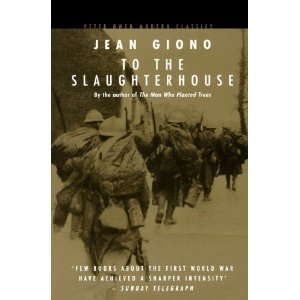
Jean Giono: To the Slaughterhouse – Le grand troupeau (1931) Literature and War Readalong March 2012

There are so many different ways to write about war. Some novels focus on the experience of the soldier, some will focus on what the civilians go through, some move back and forth between the front lines and the home front. While Jean Giono’s Le grand troupeau – To the Slaughterhouse does move back and forth, the book is still completely different from anything else that I have read so far.

Giono’s technique does need some getting used to. What he describes is equally beautiful and horrifying. The result may very well be one of the most radical anti-war books that I have read.

If you are looking for an action-driven novel, this isn’t one to turn to, Giono’s novel is far more like the description of paintings. I was reminded of Otto Dix’ WWI paintings more than once. Some of the very visual descriptions in this novel are as graphic and gruesome as Dix’ work.

The war has come to a little village in the French Provence region. All the men are drafted and go to war, leaving the women, old men, children and animals behind. Some of the men are shepherds. They have to abandon their herds. Left on their own,  the animals are endangered, they have accidents, get wounded. One day a massive herd enters the village. It’s an awful sight. So much suffering, so much pain.

Julia’s husband Joseph has gone to war, as has her sister-in-law’s young lover, Olivier. The story moves back and froth between life in the village and the men. It’s more a series of pictures than a real story. Very powerful and graphic pictures.

Giono chose to show us how war affects the body. It’s not the fighting he is interested in but what happens when someone is wounded. How the wounds fester, how the juices flow out the dead bodies. The rats which are always mentioned in WWI novels are present here as well but we see how they eat the faces of the dead men.

I had a faint feeling in my stomach for most of the time while reading but I saw what he wanted to achieve and I thought the idea was amazing. He didn’t stop at describing the horrors of the war and what it did to the bodies of the men, he described the beauty as well. The scents in the air, the taste of food, the beauty of the landscape.

There are hunting scenes and scenes of slaughter and the bodies of the dead animals resemble those of the dead and wounded men.

Human beings and animals both suffer pain, their bodies are vulnerable and frail, they can be killed and harmed and wounded and the result will be the same. At one point he goes one step farther, describing how the earth suffers too, when her body is ripped open by explosives. Giono includes the entirety of creation in his novel and shows that every being existing in this world, wants beauty, love and tenderness, shelter and food and when this is not provided, when aggression is let loose, the body is harmed, wounded and the being ultimately dies.

It’s a highly symbolical novel, with a profound message of peace. It was hard to read but I am glad I did. It really would be hard to find a more eloquent anti-war statement and a book which manages like this one, to show, that since we all, animals and human beings alike, suffer pain, we are equal. This profound message makes To the Slaughterhouse not only a plea for human rights but for animal rights as well.

Other reviews

Danielle (A Work in Progress)

To the Slaughterhouse is my fourth contribution to the War Through the Generations Challenge hosted by Anna and Serena.

*******

To the Slaughterhouse was the third book in the Literature and War Readalong 2012. The next one will be Helen Humphreys’ Coventry. Discussion starts on Monday April 30, 2012.

Jacqueline Winspear: Maisie Dobbs (2003) The First Maisie Dobbs Mystery

I’m not sure who mentioned Maisie Dobbs first. Either Danielle on A Work in Progress or Kailana on The Written World. Whoever it was I’m glad she did as Maisie is an amazing heroine. I really like her and the way she goes about her job. The period details are captured in a very descriptive way, reading often felt like watching a movie.

The story begins in London, 1929. Maisie Dobbs has opened her first office. She is a private investigator and psychologist who has been trained by a master of the art, Maurice Blanche, a friend of Lady Rowan, on whose estate Maisie used to be a maid.

Her first investigation leads her to follow the wife of Christopher Davenham. He suspects her to have a lover. What Maisie finds out is quite different from what Davenham and the reader think and will lead Maisie to investigate a crime and confront her with her own past.

The second part of the novel rewinds to 1910-1917. In 1910 Maisie is just a girl who lives alone with her father after her mother has died. She is unusually intelligent and her parents wanted to send her to college later but the mother’s illness has swallowed up all of their money and Maisie is sent to Lady Rowan as a maid. They soon find out about Maisie’s fondness for reading and learning and give her a private tutor, Maurice Blanche. Blanche is a special fellow with an eye for people and an unusual capability of seeing behind the masks.

Maisie finally goes to university and is about to embark on a splendid academic career when WWI breaks out. Like so many other young women she volunteers as a nurse and is sent to France where the man she has recently fallen in love with is serving as a doctor.

Maisie’s life story, the crime and its solution are all rooted in WWI. While I didn’t think the crime was gripping I thought the way the book revealed what happened to Maisie during the war was suspenseful. I truly admired the way it managed to convey an idea of WWI. Maisie and many other characters still suffer from various ailments or traumas. This, for example, is Maisie at the beginning of the novel.

Lucky, thought Maisie. Except for the war, I’ve had a lucky life so far. She sat down on the dubious oak chair, slipped off her shoes and rubbed her feet. Feet that still felt the cold and wet and filth and blood of France. Feet that hadn’t felt warm in twelve years, since 1917.

Facial wounds play and important role. The wounds and how society and the wounded handle them. But the horror of the trenches, the constant rain, mud and cold are rendered as well.

It’s certainly a novel that appeals to many people. To those who like cozy mysteries, to those who are interested in WWI. Fans of the upstairs-downstairs theme will love the middle section. Maisie Dobbs is a likable and clever character and to get to know the way how she reads people is fascinating. Her way of working is a mix of psychological analysis and psychic abilities that I enjoyed a great deal.

There are by now 9 books in the series and the fans and followers are numerous.

Because of its lovely design and a lot of information it is worth to visit Jacqueline Winspear’s Website.

If you are interested, March is Maisie Month on Facebook.

Maisie Dobbs is my third contribution to Anna and Serena’s War Through the Generations challenge.