Literature and War Readalong May 31 2013: All That I Am by Anna Funder

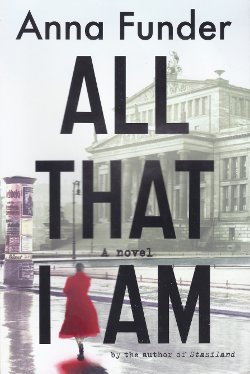
All That I AM

When I first heard of Anna Funder’s novel All That I Am  I wanted to start reading it right away as it sounded so appealing. The novel is inspired by – or based on – the tragic life of German-Jewish left-wing playwright Ernst Toller. Some have termed the book “faction” but judging from what I read about it, Funder took a lot of liberties, which makes the term “fiction” more appropriate in the  end. All That I Am is Funder’s first novel but she had a huge publishing success with her book Stasiland: Stories From Behind the Berlin Wall.

The book starts in 1933 with Hitler’s rise to power and tells the story of four young German exiles who try to raise awareness in the UK for the threat the new German government poses. Toller is one of them. In 1933 he lost his citizenship, left Berlin and went to live in London.

Here are the first sentences

When Hitler came to power I was in the bath. Our apartment was on the Schiffbauerdamm near the river, right in the middle of Berlin. From its windows we could see the dome of the parliament building. The wireless in the living room was turned up loud so Hans could hear it in the kitchen, but all that drifted down to me were waves of happy cheering, like a football match. It was Monday afternoon.

*******

The discussion starts on Friday, 31 May 2013.

Further information on the Literature and War Readalong 2013, including all the book blurbs, can be found here.

Literature and War Readalong April 29 2013: The Wars by Timothy Findley

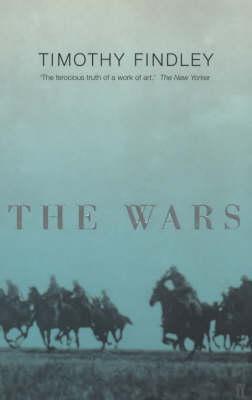
The Wars

On my intro post to the Canadian Book Challenge John, the host of the challenge, suggested I read Timothy Findley’s The Wars. There are quite a few Canadian WWI novels and this is said to be a Canadian classic.

Tomothy Findley wrote novels, plays, short stories and non-fiction. Many of his novels received prestigious prizes.On the back of my copy it says that he is Canada’s greatest living writer. That was back when the book was printed, in 2001. Findley died in 2002.

I must admit the first sentences make me feel anxious. Horses in WWI novels and movies are hardly ever a cheerful thing.

Here are the first sentences

She was standing in the middle of the railroad tracks. Her head was bowed and her right front hoof was raised as if she rested. Her reins hung down to the ground and her saddle slipped to one side. Behind her, a warehouse filled with medical supplies had just caught fire. Lying beside her there was a dog with its head between his paws and its ears erect and listening.

*******

The discussion starts on Monday, 29 April 2013.

Further information on the Literature and War Readalong 2013, including all the book blurbs, can be found here.

Karen Thompson Walker: The Age of Miracles (2012)

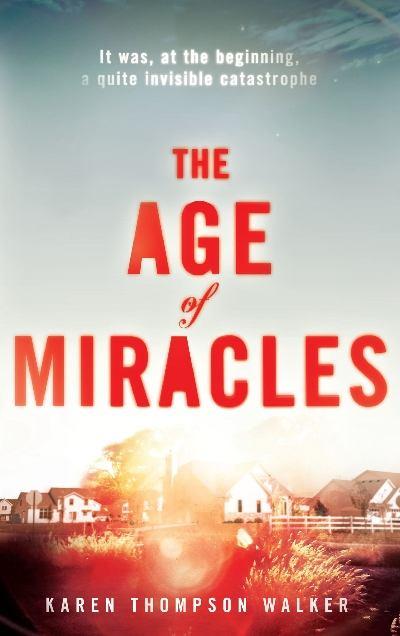
The Age of Miracles

Ever since Jacquelin Cangro reviewed The Age of Miracles, I felt like reading it. I assumed I would like it but I didn’t expect that I would love it so much. It may seem odd to love an “end of the world” story but The Age of Miracles is so much more. It’s as much the story of a disaster as a coming-of-age tale, an exploration of how we adapt to change and a meditation on the fragility of life on earth. Plus the tone of the whole book is lovely and nostalgic.

The Age of Miracles is told by 11-year-old Julia, an only child who is a bit of a loner and a keen observer. Suddenly, one day, they hear on the news that the rotation of the earth has slowed down and as a result the days have grown longer. At first this is minimal but gradually the days and nights extend until, at the end of the novel 72 hour days are followed by 72 hour nights.

The consequences are massive. Many animals and plants die. After a few months, it’s dangerous to go out during daytime as the sun’s radiation can be fatal. Plants only grow in hot houses, people need protection at all times.

Early on the government decides to disregard daylight and to stay on the usual 24 hour clock time. Opposing groups find this unacceptable and adjust to the sunlight. They stay awake longer, sleep longer. Soon there is hostility between those groups and most of the day timers flee after a while and live in communes outside of the cities.

Julia describes all this in great detail. She’s worried but is also surprised how quickly people get used to these changes. But there are many other things on her mind. She was always a loner but the slowing makes her lose even more friends. She is secretly in love with Seth Moreno who is also a loner  which makes it difficult for them to become friends but once they overcome some obstacles, they spend every minute together.

The tone of Julia’s voice and some hints, indicate that she tells this story looking back. It’s the grown-up Julia who tells about the year during which the biggest changes, in the outside world and in her personal world, take place. It’s the year of her first love, of the near collapse of her parent’s marriage and also the year in which everything anyone took for granted disappears forever.

I know that some people found the book alarming because it obviously touches on subjects like climate change and natural disasters. I was more touched by Julia’s personal story, by the tone of her voice which was infused with sorrow. There are as many scenes of great beauty as there are scenes of damage and loss. Ultimately this is a melancholic story about a long goodbye, goodbye from people, things and habits.

When I started reading, I was a bit afraid, the book would be gimmicky. It’s not. It’s a quiet, moving tale. The unusual event is just a means to tell a much deeper story; a story of change, loss and sorrow inherent to all of our lives.

Anna Raverat: Signs of Life (2012)

signs-of-life-

Ten years ago, Rachel had an affair. It left her life in pieces. Now, writing at her window, she tries to put those pieces together again. She has her memories, recollections of dreams, and her old yellow notebook. More than anything, she wants to be honest. Rachel knows that her memory is patchy and her notebook incomplete. But there is something else. Something terrible happened to her lover. Her account is hypnotic, delicate, disquieting and bold. But is she telling us the truth?

A review on Litlove’s blog a few weeks ago led me to Anna Raverat’s novel Signs of Life. I’m glad I discovered it, I liked it very much,

Ten years ago Rachel had a disastrous love affair. She was in a relationship with Johnny, content and maybe a bit bored. Carl was new in Rachel’s company. She wasn’t really attracted, Johnny was far more handsome, but maybe she sensed Carl was a “bad boy”, maybe she wanted to escape routine. One evening they kiss and from there they slide into a passionate affair, even though Rachel doesn’t really want that.

We know from the beginning that things go horribly wrong in the end but we don’t know what happened. Even Rachel doesn’t know everything. At the end of the affair she has a breakdown. She is hospitalised; trauma, stress and medication blur everything. Now, ten years later, she decides to write down the whole story, tries to make sense.

The story Rachel tries to write down is fragmented because her memories of what happened ten years ago are fragmented. And that leads us straight to one of the major topics of this novel. How does memory work?

Perhaps it never did snow that August in Vermont; perhaps there never were flurries in the night wind, and maybe no-one else felt the ground hardening and summer already dead even as we pretended to bask in it, but that was how it felt to me, and it might as well have snowed, could have snowed, did snow. Joan Didion

Might as well have; could have; did. The movement from possibility to certainty in the sentence is exactly how it works in the head; this is how imagination merges with memory, how dreams get confused with facts; why reality sometimes feels so unreal. The extract is from Joan Didion’s On Keeping a Notebook. It unlocked my own imagination; something in me resonated strongly and I wanted to use that, the feeling of recognition, almost of ownership, when you read something and think, that’s exactly the way I feel! And a feeling of entitlement slips in. I started with her line, took some words of, pegged others on – I wanted to absorb the sentence fully, make my own version.

The narration jumps back and forth in time, and precisely this fragmentation is what I liked so much. We don’t only discover a story, we discover how memory works. How things are altered, embellished, imagined.

The result is authentic. We take part in discovering the truth. Rachel took notes during the affair but she left out a lot. Reading was and is important to her. The books and stories she reads influence the way she perceives what happens. The final tale she tells is a patchwork made of different material.

Signs of Life is fascinating and gripping at the same time.  The end was to some extent what I had expected but still surprising enough to be memorable. And we wonder whether Rachel is not after all a very unreliable narrator.

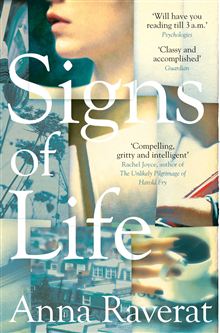
I’m often annoyed by book covers so it’s worth mentioning what a great exception this cover is. It’s rare that a cover fits a book so well. How to better represent a fragmented story than by using a collage of photos that illustrate various moments in the book. The only pictures missing here are that of a cat and of a woman writing.

Apart from depicting how memory works, Signs of Life is an excellent psychological study. It shows how some choices may alter our lives forever and that we are not always fully in charge. Intense emotions may push us to do things we don’t want to do and we may find that our life has fallen apart, is shattered and broken.

Readalong – Grande Sertão:Veredas – The Devil to Pay in the Backlands by João Guimarães Rosa

GSVlogo_jpg

Last year Richard (Caravana de recuerdos) mentioned João Guimarães Rosa’s novel Grande Sertão (1956) on his blog and since I wasn’t familiar with the book but saw it was called a Brazilian Ulysses, I had to get it. I bought what seems to have been one of the last copies available in German. Sure, I could have bought it in French or English but for some reasons, I thought German might be just as good. After having read the first ten pages I think I might have been wrong. Grande Sertão is a groundbreaking work of Brazilian literature and much of that comes from the fact that it uses oral traditions to create something new. It’s what is called “Oralisierung” in German. (I couldn’t find the quivalent in English.Would it be “Oralization”?) Obvioulsy it is meant to sound like a long monologue of someone using a not very sophisticated but colorful spoken language. And that’s where I have a problem. The spoken German rendered in the translation doesn’t sound like spoken German but it seems to mimic the Brazilian. I hope I’ll get used to it.

Despite my reservations regarding the German translation, I think this is a very interesting book and when I saw that Richard (Caravana de recuerdos), Rise (in lieu of a field guide), Miguel (St. Orberose) and Scott (seraillon) co-host a readalong of the book in May I signed up immediately. At the moment there are still more hosts than participants, so you might want to consider rebalancing that a bit and sign up as well. It might not be easy to find a copy but maybe the one or the other already has one somewhere and was just waiting for the right moment. And there are libraries who might have it too.

Here’s the synopsis on wikipedia

If you’d like to sign up. Here are the intros of the hosts:

Richard

Rise

Scott

Miguel

The discussion takes place during the last week of May 2013.

Do you know the novel? Will you join?

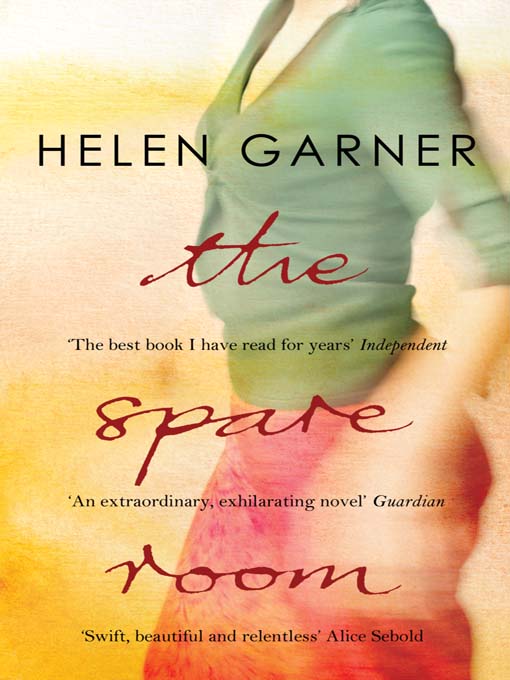
Helen Garner: The Spare Room (2008)

untitled

Helen Garner’s The Spare Room was one of the books I found at work. I started it immediately and finished it almost in one sitting. Garner has chosen a difficult topic and written about it beautifully. Despite the sad topic, it’s an uplifting book.

Helen’s friend Nicola is very ill. She has stage four metastatic cancer. This means it’s terminal. Chances that she will recover are less than minimal. Looking for a miracle cure she asks her friend if she can stay with her in Melbourne for three weeks. Helen doesn’t know any details. She doesn’t know that Nicola is in denial. She just wants to help her friend and accepts.

Nicola always used to believe in alternative medicine. But what works for all sorts of ailments, does not work for terminal cancer. Many late stage cancer patients cannot accept the fact that they are dying which makes them an easy prey for frauds and con men. The clinic Nicola will visit during her stay is not much different. The cure has no value but terrible side effects. And it costs a fortune. What Nicola would really need is palliative care but she thinks getting palliative care will speed up her death.

Caring for her friend is beyond Helen’s strengths. Like Nicola, she is over 60 and washing sweaty bed sheets every night, seeing her friend in horrible pain and denial sucks all her energy from her.

“It’s just that in my work,” said Carmel, “I’ve learnt that there are people who never, ever face the fact that death’s coming to them. They go on fighting right up to their last breath.” She paused. “And it is one way of doing it.”

This must sound like a bleak story but it’s not. It’s honest and even funny, stripped of everything but the bare reality. The worst part is that the two women have to live a fake relationship as Nicola doesn’t want to accept she will not be cured. She smiles constantly, pretending everything is alright. She doesn’t want to feel her emotions and in doing so triggers them in others. All those who care for her feel desperate, sad and angry while she keeps on grinning.

When Helen is at the end of her strength, she confronts her demonstrating that sometimes you really have to be cruel to be kind. When they finally speak openly about the fake cure and the probability that Nicola will die, things get better and they are able to live moments of true friendship again.

Oh, I loved her for the way she made me laugh. She was the least self-important person I knew, the kindest, the least bitchy. I couldn’t imagine the world without her.

I devoured this book. Its spare prose is beautiful. Its honesty was soothing.

I’ve seen this happen quite a few times around me. People get very ill, terminally ill but until the last moment they deny it. No real conversations are possible and what little time is left is spent chasing a miracle cure.

But Garner goes one step further. She also writes about the caregiver and how incredibly strong you must be to perform the tasks which are needed. How much you may come to hate the person who depends on you because it’s so tiring and stressful.

The Spare Room is astonishing because it’s so well written and manages to be ultimately uplifting through its gentle humour, honesty and in  showing what true friendship can achieve.

This review is my first contribution to the Aussie Author Challenge 2013

Aussie-Author-Challenge-2013

We all know that search engines work in mysterious ways that’s why I add this caveat: 

For anyone reading this who is afflicted by cancer or has friends or family who are ill, please be aware, that the case in this book is not just a simple case. It’s a stage four metastatic cancer. I’m saying this because I don’t want to rob anyone of their hope. Many cancer patients, especially when their illness has been discovered early on, can be cured, notably when the tumour is operable. There are but a few types like the very aggressive malignant glioblastoma multiforme which leave you with hardly any chance.

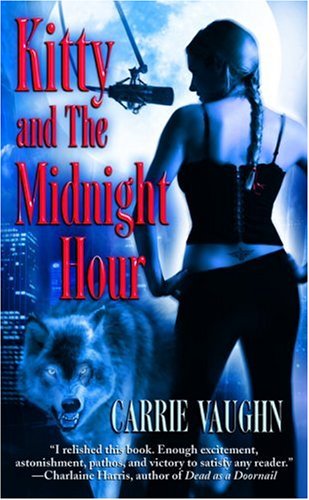
Carrie Vaughn: Kitty and the Midnight Hour (2005)

kitty 1

As regular readers of this blog know, I have a weakness for urban fantasy and I like to start new series. Often I stop reading them after volume 2 or 3 but that doesn’t matter much.

I’ve read a lot of good things about Carrie Vaughn’s  Kitty Norville series and thought I give it a try and read the first book in the series Kitty and the Midnight Hour. I didn’t regret it, it’s a breezy, fun read with a lot of elements which are typical in urban fantasy or paranormal crime but also infused with a nice dose of originality.

Kitty has two important features. She’s a radio DJ and she is a werewolf. Usually she works the night or rather the midnight shift at the radio station. It isn’t the most popular show until she has the uncanny idea to transform it in a late-night advice show for supernatural beings. Who would have thought that there are so many vampires, werewolves, shape shifters and what not in Denver? And that they all are in need of advice?

Kitty is still a young werewolf and as such at the bottom of the pack. Her new show and subsequent success upset the pack dynamics considerably and soon she must fear for her life. Someone is after her and wants her dead. On top of that there is a killer on the loose. A rogue werewolf who kills randomly.

While I wouldn’t say this is as well written as Kelley Armstrong’s’ truly great series, it’s a fun read. Kitty is very smart and witty and a lot of cultural references will even appeal to the more sophisticated reader. I also liked that Kitty didn’t just fit in but actively fought pack dynamics which demand that she, as the youngest female member, has to please the alpha males whenever they like. Kitty is too intelligent, strong and determined, to just accept things the way they are and always used to be. If it means to break with tradition to fight for her rights, so be it.

The idea of the “Midnight Hour” was what made this series stand out as it’s truly funny.

I might pick up book two in the series as the combination of witty humour, a strong endearing heroine and a gripping crime made for a very entertaining read.

Not everyone’s cup of tea but lovers of werewolf novels, fans of paranormal crime and urban fantasy should give it a try. It’s one of the best of its kind. For those who like their series with different paranormal creatures, yes, there are vampires as well.