Haruki Murakami: Sputnik Sweetheart (2001) aka Sputoniku no koibito (1999)

The narrator, a teacher, is in love with the beguiling, odd Sumire. As his best friend, she is not adverse to phoning at three or four in the morning to ask a pointless question or share a strange thought. Sumire, though, is in love with a beautiful, older woman, Miu, who does not, can not, return her affections. Longing for Sumire, K (that is all we are told by way of a name) finds some comfort in a purely sexual relationship with the mother of one of his pupils. But the consolation is slight. K is unhappy. Miu and Sumire, now working together, take a business trip to a Greek Island. Something happens, he is not told what, and so K travels to Greece to see what help he can offer.

Sputnik Sweetheart was my second Haruki Murakami. The first one I read was South of the Border, West of the Sun which I liked a lot but I was told many times that it wasn’t a typical Murakami.

It was a strange experience to read Sputnik Sweetheart but not because of the book, I didn’t think it was all that weird but my reactions to it were weird as it reminded me of a lot of other books I have read before. Instead of enjoying it my mind started to rush around like a hungry little monkey looking for food and trying to solve the riddles of the 1001 allusions. If I hadn’t been so busy doing this, I would have enjoyed it much more while reading it but looking back on it I think it is a marvelous book. Unusual, original and fascinating. And furthermore, having finished it, I saw that what happened to me, this mad chasing of “clues”, is probably not completely unintentional. I think the author is well aware of our European triggers and pulls them one by one.

I read quite a few reviews who stated that it wasn’t easy to describe what the book is all about. I don’t think that’s true. It’s a pretty straightforward story and you can summarize it in a few sentences. The problem is that wouldn’t do the book any justice as plot line is not Murakami’s main concern.

K, an elementary school teacher, is madly in love with Sumire, a strange, intelligent, loner type girl who wants to become an author. Sumire however falls for Miu, a married woman and 18 years her senior. They meet at a wedding reception and due to a misunderstanding related to the writer Jack Kerouac, Sumire’s favourite author of the month, Sumire calls Miu Sputnik Sweetheart.

Ever since that day Sumire’s private name for Miu was Sputnik Sweetheart. She loved the sound of it. It made her think of Laika, the dog. The man-made satellite streaking soundlessly across the blackness of outer space. The dark, lustrous eyes of the dog gazing out of the tiny window. In the infinite loneliness of space, what could Laika possibly be looking at?

Sensing that a change is needed in Sumire’s life, Miu offers her a job. Part of this job is a trip to Europe. The two women travel from France to Italy and from there to Greece and there Sumire disappears. Miu asks K to come to Greece and help her look for Sumire. He travels to Greece but the whole adventure proves to be futile.That is the story in a nutshell.

The central theme of this novel is loss. In many different forms. And getting lost and being lost, and losing as well as never reaching what we want. The people in this little universe that is Sputnik Sweetheart all chase something. Most of them love someone who loves someone else. They feel trapped and isolated like little satellites circling aimlessly through space.

So that’s how we live our lives. No matter how deep and fatal the loss, no matter how important the thing that is stolen from us – that is snatched right out of our hands – even if we are left completely changed people with only the outer layer of skin from before, we continue to play out our lives this way, in silence. We draw ever nearer to our allotted span of time, bidding it farewell as it trails off behind. Leaving behind a feeling of immeasurable emptiness.

They also chase dreams that seem unreachable. Sumire who wants to become a writer, can’t write a real novel, Miu who wanted to become a pianist had to give up the piano.

And there are the side stories of lost animals. Sumire had  a little tortoise-shell cat that climbs a tree and is never seen again. K had a little dog, his only childhood friend, whom he loses too. And there are the black cats. Since I am an owner of black cats I could relate to this very well. Many of Murakami’s novels are populated by black felines.

K’s and Sumire’s love and friendship is a very beautiful one. They are both loners and bookish people who talk endlessly on the phone. It is sad that Sumire does absolutely not feel attracted to K. Despite the attraction Sumire’s feels for Miu, K is her true love.

I have read a few newspaper articles that came out at the time of the publication of Sputnik Sweetheart in Germany and quite a lot of them stated that Murakami wasn’t really a Japanese author because there are endless references to European culture. It is true, that this is surprising. In this novel, he enumerates many European composers like Mozart and Brahms, and also European performers. Apart from one book, Soseki’s novel Sanshiro, every book, movie or city that is mentioned is European.

Does the fact that a Japanese author cites so many European things make him less of a Japanese writer? I absolutely don’t think so and believe that on the very contrary,  this is a typically Japanese novel. The excellent evocation of futility of beauty for one thing, but then also the mix of genres (adventure story, ghost story, detective and love story) and the quoting of books. And quoting is only one thing, there is also a subtle intertextuality. Does K not remind us of the K in Kafka’s book? And the Doppelgänger motif is reminiscent of a lot of German literature.

Maybe we have to study modern Japanese paintings to be able to get Murakami.

Be it as it may, I’m extremely glad I read this book and am looking forward to the next one.

As a little visual impression of Murakami’s books I attached another Murakami’s work.

Both paintings are by Takashi Murakami.

This was my first Murakami for the Haruki Murakami Reading Challenge. Other reviews of this and other Murakami novels can be found there.

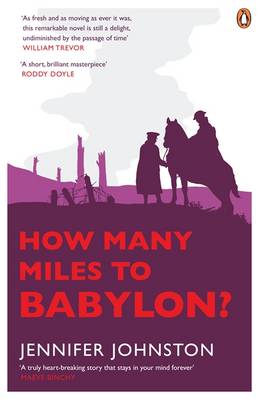
Literature and War Readalong February Wrap up: How Many Miles to Babylon?

I wanted to thank all of you who have participated this month. I loved the book and enjoyed the discussions.

Even though there is also a friendship at the heart of How Many Miles to Babylon? this book is totally different from Susan Hill’s novel Strange Meeting which we read in January. As you can easily see my review doesn’t emphasize the role of the friendship between Alec and Jerry as much as Anna’s or Danielle’s (and here as well) does.

I realized when reading the other posts and a few of the comments that some had a bit of a problem with this novel. There were different reasons for this. For one Alec doesn’t appear to be a very likable character, he was even called a coward by some. For several reasons I never thought of him like that and was wondering why. I realized that from the start, I was totally fixed on his going to be executed. I saw him like some Breaker Morant character (which he isn’t) and thinking he did something that would have this consequence set the tone for me from the beginning. Another point of criticism which, with hindsight, seems fair, is the fact that the WWI elements are toned down. WWI seems to serve more as a pretext for the tragic story and to write about Irish history. WWI itself is rather just a backdrop. I did not mind this at all but can understand that this can bee seen differently.

I think we all equally agreed that the mother in this book was an extremely negative figure, the whole family situation, as Kevin pointed out, is highly dysfunctional.

What I couldn’t really solve was the question about the title. Why did she choose this nursery rhyme as the title for her novel? In an article on the net I found one tiny hint, saying that it did underline the relationship between the soldier and his superior.

On Wikipedia I found this list which enumerates how many times the rhyme has been used in popular culture

In popular culture

In literature

In film

In popular music

  • It is parodied as “How many miles to Babyland?” on Lenny and the Squigtones– a comedy album by the characters Lenny and Squiggy from the 1970s sitcom “Laverne & Shirley”.

This is quite a considerable list. It eludes me why this rhyme is so popular with writers and I am still open for any interpretation why Jennifer Johnston chose it as her title.

Jennifer Johnston: How Many Miles to Babylon? (1974) Literature and War Readalong February

Alec and Jerry shouldn’t have been friends: Alec’s life was one of privilege, while Jerry’s was one of toil. But this hardly mattered to two young men whose shared love of horses brought them together and whose whole lives lay ahead of them. When war breaks out in 1914, both Jerry and Alec sign up – yet for quite different reasons. On the fields of Flanders they find themselves standing together, but once again divided: as officer and enlisted man. And it is there, surrounded by mud and chaos and death, that one of them makes a fateful decision whose consequences will test their friendship and loyalty to breaking point.

We know from the beginning of this novel that it is not going to end well. Alec is held in detention and knows that he will die. Because he is an officer and a gentleman, as he states, they have given him his notebooks, pen and ink and he writes down the story of his life. The story spans from his lonely isolated childhood in rural Ireland to the war-torn trenches in France. The tone of the novel is melancholic, full of nostalgia for a world that has been lost and is at the same time infused with the profound love of a country.

By now the attack must be on. A hundred yards of mournful earth, a hill topped with a circle of trees, that at home would have belonged exclusively to the fairies, a farm, some roofless cottages, quiet unimportant places, now the centre of the world for tens of thousands of men. The end of the world for many, the heroes and the cowards, the masters and the slaves.

Alec’s childhood was a lonely one. Caught between two parents who hated each other and who kept a polite and icy distance, he was the pawn with which his mother played. He didn’t like his mother, a haughty, cruel but beautiful woman whose strict rules and relentless following of etiquette ruined every childhood joy. What his parents do not know for a long time is that Alec has a secret friend. Alec and Jerry have a lot in common. Their love of horses, their sense of humour, they share so much, unfortunately not the social class. Alec is an only child of a wealthy Anglo-Irish couple whereas Jerry is part of the Catholic underclass. When their friendship is found out, Alec’s mother freaks out and decides to go on a 4 month trip to Europe with Alec.

When Alec comes back he doesn’t see Jerry anymore. Jerry is working while Alec is still studying. And then the war breaks out. At first there seems to be only a rumour of war. Jerry knows it long before Alec hears it and most people think it isn’t really true.

We paid very little attention to the war when it happened first. Belgium and Flanders seemed so far away from us. Our fields were gold and firm under our feet. Autumn began to stroke the evening air with frost. Smoke from bonfires was the only smoke to sting our eyes. Cubbing began in the early morning, the earth temporarily white with mist and dew. A few familiar faces disappeared. War was on the front pages of the newspapers daily brought from Dublin on the train.

Many do not feel that this is their war or that they should assist the British. Tensions inside of Ireland start to be palpable, tensions that bear the foreboding of the things that will come, the striving towards independence. However people who feel loyal towards Britain send their sons. Alec’s father considers it to be foolish to go to a war when you are not forced to go but his mother, out of spite and vengeance against his father, drives Alec away.

Meanwhile Jerry had already enlisted and the two young men meet in the training camp near Belfast in which they stay for six weeks until they get shipped to France. Their superiors do not like to see an officer talk to an enlisted man. Alec, due to his social class, has become an officer immediately.

When they finally arrive in France they stay separated. Alec shares quarters with a British officer, Bennett, a guy with a lot of humour, while Jerry sleeps with the other enlisted men. Still the three of them meet occasionally and ride about the country together.

They hardly see any action for a long time and stay far off the trenches for a while. When they are finally sent to the front line they will spend a lot of their time cleaning and reconstructing the badly damaged trenches.

We spent three more days in the front trenches, mainly shoveling and making props. It rained a considerable amount of the time. Sometimes sleet cut into the men’s bare hands, and at night there was sharp frost that covered the bottom of the trenches with a thin film of ice. We extended the line to our left. It was hard work moving the earth, heavy with water, always crouching till ones back and shoulders ached pitifully. The men hated it and worked slowly, grumbling most of the time. For most of the day there was concentrated shelling of the German lines by our artillery. The shells screeched over our heads sometimes for hours at a time. After a while I became so used to the noise that I felt strangely unprotected when it stopped, then slowly the process of thinking had to begin again.

The cold is unbearable and Alec suffers a lot from it. They constantly drink rum as it is the only way to warm up. Here again Alec and Jerry are caught talking together and the superior officer forbids it. But that is not the only trouble they are in. The Irish are not appreciated at all. On top of that there are rumors of a movement that wants to fight for the independence of Ireland. Jerry is suspected to be part of that movement and one day he confides in Alec.

“I don’t know how you can contemplate ever fighting again.”

“It won’t be like this. There’ll be no trenches, no front lines. No waiting. Every town, every village will be the front line. Hill, rock, tree. They won’t know which way to look. Even the children, for God’s sake, will fight them. It won’t be like this, I promise you that. Oh, Alec, it’s some thought.”

When Jerry receives a letter from his mother in which she informs him that his father has gone missing, he runs off to look for him and the tragedy unfolds.

I loved How Many Miles to Babylon? I think it is a beautiful book. It doesn’t teach you as much about WWI as Strange Meeting (see post 1) but it says a lot about Irish history. I found this look at the first World War from an Irish perspective extremely fascinating.

As Jennifer Johnston said, she wanted to write about the Troubles but didn’t feel ready yet. This is the prehistory of the Troubles. The Irish War of Independence started right after WWI in 1919 and was closely followed by the Irish Civil War. This succession of wars was the reason why Ireland stayed neutral during WWII. They simply couldn’t afford to be in another war in such short time.

How Many Miles to Babylon? hints at all this. But it is not only a very Irish novel because of the historical elements but also for its imagery, the symbolism and the many references to Irish mythology and culture.

The motif of the swans is a recurring element. There are swans on the lake on the property of Alec’s parents, they see swans in France, some soldiers shoot a swan which does upset Alec terribly. Since Alec reads W.B. Yates at the beginning of the book I think the swans are an allusion to Yates’ famous poem The Wild Swans at Coole which seems to mourn a time long gone.

In contrast to the gratuitous killing of the swans stand the mercy killings. Wounded horses are killed, a wounded man is killed…

I really liked this enchanting novel. I loved the poetical prose, the melancholic tone and the feeling of nostalgia that pervaded it.

What did you think of the novel in general and its treatment of WWI?

Other reviews:

Anna (Diary of an Eccentric)

Danielle (A Work in Progress) and here as well

Fence (Susan Hated Literature)

*****

How Many Miles to Babylon? was the second book in the Literature and War Readalong. The next one will be Rebecca West’s The Return of the Soldier. Discussion starts on Friday March 25, 2011 .

Daniel Glattauer: Every Seventh Wave (2011) aka Alle sieben Wellen (2009) The Sequel of Love Virtually

Every Seventh Wave

A while back I wrote about Daniel Glattauer’s Love Virtually which has been released meanwhile. I just saw that the sequel, Every Seventh Wave,  will be published this year as well. Usually I include the amazon blurb at the beginning of my posts but this one  contains too many spoilers of the first book.

Like its predecessor, I have read Alle sieben Wellen when it came out in Germany. For all those who like Love Virtually, they can look forward to a sequel that is very close to the first book. The story of Leo and Emmi, their e-mail exchange goes on. More passionate and more intense than before. And still they ask the same questions. Should they meet or should they not? To the somewhat playful tone of the first book Glattauer adds a bit of a darker undertone. I cannot say too much or it would be a spoiler.

Even though I didn’t like the idea of a sequel at all and if I had had something to say, it wouldn’t have been written but since it was and I liked the tone of the first book, I had to read this one as well. And it isn’t disappointing. It is as witty, charming, thought-provoking and enjoyable as the first.

All those who thought that Emmi and Leo’s story shouldn’t finish like it did in Love Virtually will enjoy this book. All those who loved the style of Glattauer the first time, will enjoy this as well. Although Love Virtually can be read on its own, this one can not. If you want to read Glattauer, you should start with the first one.

I have no problem with the translation of the title this time, it is pretty literal but I still like the German cover better.

The Austrian author Daniel Glattauer has written quite a few books that have been successful in Germany and other German speaking countries. Like so very often none of them has been translated. Should you read German you can find more information on his website.

Hop a long, Git a long, Read a long Western Reading Challenge

Have you ever read a Western? Well, I haven’t. It is just not a genre I ever really felt tempted to explore but one evening, watching TCM, a couple of years ago, I saw a made for TV movie  that really stunned me, namely Riders of the Purple Sage. It was a melancholic tale of a gunslinger looking for the guy who drove his sister to commit suicide. It showed Ed Harris, in what I would say, one of his best roles. It was such a moody and atmospheric movie. I found out later that it was based on a novel by Zane Grey, Riders of the Purple Sage. I bought it, wanted to read it and forgot all about it. When I stumbled upon this Western challenge/readalong in which you can participate reading only one book, I thought, now is the time .

My thanks go to Gavin from Page247 who presented this effortless challenge on her blog a while ago. The challenge itself is hosted by Ready When You Are, C.B.. Here is the link to the challenge that takes place in May.

It’s worth having a look at the definition of Westerns on C.B. James’s page and also at the list of possible books. People who love Willa Cather could read along as well as those who always wanted to read Jim Harrison.

For me this is a good opportunity to broaden my horizon. I wouldn’t call it get out of my comfort zone as that is a concept I don’t have. I can’t think of any genre or type of book I don’t feel comfortable with (but maybe I get the idea of comfort zone in this context wrong?).

Erri de Luca: Tre cavalli aka Three Horses (1999) The Scent of Earth, Sage and Flowers Pervading a Story of Love, Pain and War

Three Horses

From Argentina to Italy, the intense, metaphysical and poetic story of a gardener in love, by Italy’s most prominent writer. “A MAN’S LIFE LASTS AS LONG AS THREE HORSES. YOU HAVE already buried the first.” Somewhere along the coastline of Italy, a man passes his days in solitude and silence, tending a garden and reading books of travel and adventure. Through these simple routines he seeks to quiet the painful memories of the past: a life on the run from Argentina’s Dirty War; a young bride “disappeared” by the military; a terrifying escape through the wilds of Patagonia. Yet everywhere he turns, new life is pulsing, ready to awaken his senses, like the force that drives his fruit trees into bloom. People and events from the past and present migrate into patterns assigned by a metaphysical geometry. A woman of the world reintroduces him to love. An African day laborer teaches him the meaning of gratitude. In this intense narrative, every acute observation, every nuance, becomes a means of salvation. Using a language that is both gripping and contemplative, Three Horses is an unforgettable tale.

Imagine the smell of warm earth, the scent of sage, the intense aroma of mimosas. These are evoked like musical themes in this beautifully sensuous novel that reads like a hymn to beauty and pain. But Three Horses is about much more than this. It introduces us to one of the most endearing narrators. A while back Litlove had a post on favourite male characters. If I had read Erri de Luca’s  Tre cavalli at the time, I would have mentioned the narrator as one of the most appealing characters of all time.

I only read second-hand books. I lean them against the bread basket, I turn the page and it stays like this. This is how I chew and read. (…) Like this, at lunch time, I sit in the bistro, always on the same chair, I order soup and wine and I read.

I liked him from the start, this taciturn, profound reader, quietly eating, turning the pages but still open to everything around him. Open to life, and every little sign of it, even open to love, despite what he has been through. A man like a tree, deeply rooted in earth, poetical and down-to-earth at the same time. Through him, we catch glimpses of a painful past, a lover killed by the military junta in Argentina, thrown from a helicopter into the sea. Is this why he only reads novels with a watery theme?

You are also drawn into a war because you are ashamed of staying out of it. And then grief snatches you and keeps you there as a soldier of rage.

The narrator is back in Italy. He is a gardener and to touch the earth, to smell the richness of the herbs, sage, thyme, rosemary keeps him alive.

The sauce and a handful of oregano already announce the summer. I take a pinch and inhale it to awaken my senses.

This novel is so beautiful it is hard to describe. The narrator meets Làila and falls deeply in love. He meets Selim, a man from an unnamed African country who tells him to read the future in the ashes of burned laurel leaves. Everything is connected. Selim sells the mimosas that the narrator offers him, he sells the thyme and the rosemary. He pays back in kindness and friendship and even more if needed.

The gentleness and the tenderness of the narrator is overwhelming. He is a good man, a man who is trustworthy. A man who has the gift of being able to be a true friend. A reader who believes humans are changed through books much more than through the things they experience. A listener who lives life with all of his senses.

The days go by like this. In the evening, at home, I crush raw tomatoes and oregano over drained pasta and I nibble cloves of garlic in front of a Russian book.

Despite this gentleness he is capable of violence, he was a soldier, he killed people. He would even be able to commit a murder. Would he kill for the woman he loves? Or would someone else kill for him? Would that make him less of a murderer?

I’m often drawn to slim novels, novels that have been written by writers who are also poets. This is one of the most intense I have read in a long time. It has a floating quality, still it is very effortless to read, you could read it in one sitting but that would be a shame. It is too beautiful to rush through.

I was many times reminded of the poems of Octavio Paz.

Làila listens to me and she is so close to my ear that she manges to breathe islands into it.

De Luca writes about the relationship of Italy and Argentina in his foreword. Until 1939 Argentina let 7 million immigrants enter the country. Over half of that number came from Italy. You can easily hear the Italian influence on the Argentinian Spanish. It’s much softer and closer to Italian than any other variety.

De Luca is one of the very great Italian storytellers. His books are translated in many languages but only a very few are available in English.

The quotes are translated from the French as I read the novel in its French translation Trois chevaux.

For those of you who understand Italian I attached this homage. Those who don’t understand it can still try to feel the rhythm of his language. This is pretty much the rhythm of the novel.

Historical Novels

100 Must-Read Historical Novels (Bloomsbury Good Reading Guides)

I always thought that I didn’t like historical novels or that it was at least a genre that I hardly ever read. Still, when I came upon this little book (it’s a very small size) on amazon I was curious and as it was one that you can open and browse (as you can when clicking on the picture) I had a look and was astonished how many of them I had read or knew. I found Pat Barker’s Regeneration in it as well as Kate Grenville’s The Secret River and Penelope Fitzgerald’s The Blue Flower. Willa Cather is mentioned alongside with Umberto Eco’s The Name of the Rose and Giuseppe Tomasi di Lampedusa’s The Leopard. I was so curious that I finally had to order it and I am glad I did. It’s a great little book.

100 Must-read Historical Novels describes 100 books in detail, with a brief introduction to the author and  a summary of the book. Other books of the author are mentioned as well as books that are similar and movies based on the book.

In between the entries on the authors are book lists with themes. You can find a list of books on World War I and its aftermath, a list with books on the American West, a list with historical novels on Asia, a list with historical fiction for children, novels on ancient Greece and Egypt, The Renaissance, The Middle Ages and so on and so forth.

I picked two lists as examples and reproduced them for you:

Black History Fiction

David Dabydeen, A Harlot’s Progress

Barbara Hambly, A Free Man of Colour

Lawrence Hill, The Book of Negroes

Toni Morrison, A Mercy

Walter Mosley, Devil in a Blue Dress

Caryl Philipps, Cambridge

William Styron, The Confession of Nat Turner

Margaret Walker, Jubilee

Writers’ Lives

Andrew Taylor, The American Boy (Edgar Alan Poe)

Julian Barnes, Arthur & George (Sir Arthur Conan Doyle)

Anthony Burgess, Nothing Like the Sun (William Shakespeare)

Frederick Busch, The Night Inspector (Herman Melville)

Tracy Chevalier, Burning Bright (William Blake)

J.M. Coetze, The Master of Petersburg (Fyodor Dostojevsky)

Michael Didbin, A Rich Full Death (Robert Browning)

Helen Dunmore, Counting the Stars (Catullus)

Carlos Fuentes, The Old Gringo (Ambrose Bierce)

Tom Holand, The Vampyre (Lord Byron as one uf the undead)

Michèle Roberts, Fair Exchange (William Wordsworth)

Steven Saylor, A Twist at the End (O.Henry)

C.K. Stead, Mansfield (Katherine Mansfield)

Colm Toibin, The Master (Henry James)

Of those mentioned here I have Colm Toibin’s The Master and A Mercy on my TBR pile. I did start The American Boy but never really got into it but Devil in a Blue Dress is a favourite.

I realize that my understanding of historical novels was slightly narrower than what is shown in this book and maybe that was based on a misconception. A historical novel had to be set before the 20th century. That’s why I wouldn’t have considered Pat Barker to be a writer of historical novels. According to Nick Rennison, the author of the book guide, he applied the same rule that Sir Walter Scott once applied. In order for a novel to be called historical, the events that are described must have taken place at least 60 years prior to the year in which the writer lives.

My favourite three historical novels (in a narrow sense) are: Françoise Chandernagors L’allée du roi aka The King’s Way, Margaret Mitchell’s Gone with the Wind and Tracy Chevalier’s Girl with a Pearl Earring.

I know that many of you love historical novels. Which would be your top three?