Literature and War Readalong February 25 2011: How Many Miles to Babylon? by Jennifer Johnston

This is just a quick note to remind you to make sure to get your copy of Jennifer Johnston’s WWI novel How Many Miles to Babylon? in time, should you want to read along this month. This is the second novel in the Literature and War Readalong. It is, like Strange Meeting, a very short novel, only 160 pages. The story adds another twist as the protagonists are Irish. Jennifer Johnston has been quoted saying that she had a passion for WWI but that it was also a substitute for her. What she really wanted to write about were the Troubles.

I found these interesting quotes on contemporarywriters

Prohibited friendship is also at the heart of How Many Miles to Babylon? The first-person narrator is Alec Moore, an only child and heir to the Big House; his ‘private and secret friend’ is Jerry Crowe, a village boy he has known since childhood. In 1914, fighting together near the Belgian border, the friends’ loyalty is tested by a brutal enforcement of class divisions and a code that brooks no sentiment or mercy. Johnston is adept at suggesting her characters’ interior lives through image and symbol, and invites her readers to join the dots between what is said and felt, as in this incident, related by Alec, at his parents’ dinner table: ‘[My mother] looked at [my father] with contempt and said nothing. I blushed and looked down, away from them, at the smooth glowing silver neatly ordered around my plate. A griffin raised its talon in an angry gesture on the handle of each spoon and fork.’

The First World War is a ‘passion’ for Johnston, one she initially used as a metaphor. ‘When I started writing prose, I had it very seriously in my mind that I wanted to write about the Troubles … yet I couldn’t face taking them head-on. So I started to write about the First World War…  how people try to keep their lives normal, their feet on the ground, even though terrible things are going on’ (The Irish World, 24 October 2007).

I hope many will feel tempted to join me in reading and discussing Jennifer Johnston. Should you not have read anything by this wonderful Irish writer, this is a good opportunity.

Literature and War Readalong January Wrap Up: Strange Meeting

I just wanted to thank all of those who have participated either through reading, commenting or reviewing Susan Hill’s Strange Meeting. I think it was quite a success and everybody liked the novel. Various comments either on my or on other sites showed that there is a great interest in this novel and in the topic of WWI in general. I’m glad I chose a succession of WWI novels to start with as it will be interesting and thought-provoking to compare them.

Susan Hill’s novel is unique in so far as the biggest part of the novel takes place in a rest camp, off the front line. We approach the trenches very slowly. Erich Maria Remarque’s Im Westen nichts Neues aka All Quiet on the Western Front is much harder to read because of the importance of combat. We have a sequence in which Paul Bäumer is on leave and he does feel as lost as Hilliard on his stay in England. The isolation of the soldier who returns from combat to his home is a common theme. It’s very hard to imagine what it must have been like. They couldn’t speak and no one wanted to listen anyway.

Birdsong came to my mind as well, while reading. It’s an outstanding novel in many ways as good as or better than Pat Barker’s Regeneration Trilogy. There is much more emphasis on combat in Birdsong. Regeneration and its sequels are mostly exploring shell shock.

When reading the next novel in the readalong we have to bear in mind that the two main characters in Strange Meeting were both officers. This is important as this will not always be the case in all the novels we read and the life of an officer and a simple private was certainly much different. The main character in All Quiet on the Western Front is just a simple private.

One topic that we discussed and which I found interesting was the question whether Barton’s very explicit letters wouldn’t have been censored. I was wondering as well and luckily Susan answered this question by pointing out that Barton actually writes in one letter, that – because they are officers – their mail isn’t always censored.

Danielle pointed out in her post how very young Susan Hill was when she wrote this book. I think this explains the very fresh tone of Barton in some places. I had totally forgotten that all the Susan Hill books that I have read so far were the work of a much older woman.

Anna’s quote in her review reminded me that a big part of the book is dedicated to the devastation of the earth, the landscape, the animals. This is an important part and has also been emphasized in the comments. The French landscape still bear traces and I am not only talking of the memorials and cemeteries. The trenches were long, deep, the constant shelling ripped the earth apart. The horror of this war has not only wiped out a generation of young men but transformed and marked the earth forever.

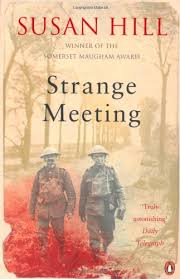
Susan Hill: Strange Meeting (1971) Literature and War Readalong January


John Hilliard, a young subaltern returning to the Western Front after a brief period of sick leave back in England, finds his battalion tragically altered. His commanding officer finds escape in alcohol, there is a new adjutant and even Hilliard’s batman has been killed. But there is David Barton. As yet untouched and unsullied by war, radiating charm and common sense, forever writing long letters to his family. Theirs is a strange meeting and a strange relationship: the coming together of opposites in the summer lull before the inevitable storm.

Strange Meeting, is set in the English countryside and the trenches in France, at the beginning of WWI. The book is divided into three parts. The first is written from John Hilliard’s point of view, the second mostly from David Barton’s and the third could be called the combined one. At the heart of the story is the juxtaposition of two very different themes; the intense and emotionally intimate friendship between John Hilliard and David Barton on the one hand, and the horrors of WWI on the other. The following quotes taken from page 158 illustrate this perfectly well:

“But they (the Germans) must know we are up to something.”

“Oh yes, though that fact is never obvious to High Command, whose faith in the Element of Surprise in the attack is really very touching and quite unshakeable.”

And a few lines later:

“Has it always been like that? Has it always been so easy for you to love people? To get on with them, to bring them out, say the right things at the right time? Have you always made friends as you’ve done out here?”

Whoever is familiar with novels or movies on wars knows that one of these two will die. It is the aim of books and movies on war to show an individual, to pick one person out of an anonymous number and to tell his story. As horrible as it is for us to know that in some offensives – especially in the early WWI ones – far over 100 000 young men were killed in less than an afternoon and millions died senselessly during the course of this war, we still need to be told an individual’s story and not only a huge number, to be touched emotionally. From the beginning of the novel until its end, the shadow of death hangs over these two young people and this is what makes it so touching. We know, one of them is doomed. It’s like a Greek tragedy.

Hilliard and Barton meet in France, during the first summer of WWI, in a bombed out village, away from the trenches and the front line. Hillard has just returned from a short sick leave to England. He is shocked to find his company reduced to a fraction. His commanding officer is drinking and seems to have lost his faith completely.

We lost three quarters of the Battalion in a day and a half. Getting on for two dozen officers. Mayor Gadney, young Parkinson, Ward – all the best. Half of them went because we didn’t get an order telling us the second push was cancelled. They just went on. You were well out of it. I’m glad you were out of it.

But Hilliard’s stay in England was horrible too. He couldn’t sleep, had no one to talk too. He showed signs of  shell-shock, only not enough to not return. The mindless cheerfulness of the people around him who had no idea what it was like to be in the trenches was unbearable. They did neither realize how useless the losses were, nor how futile the missions. The newspapers only gave a purified version and people everywhere were convinced, the war would be over by Christmas. Hilliard was suffering from this feeling of isolation and haunted by the images and smells that were stuck in his mind. He found the smell of roses revolting, the sweetness reminded him of the smell of dead bodies. He would have liked to talk to his sister, the only person from his family he felt close to, but finds her estranged. She is about to get married and he doesn’t approve of her choice until he realizes, there is really no one else left, most other young men are dying in France.

When he returns to France and finds out that most of the men of his company are dead, he also hears that there is a new guy that he will share his quarters with.  They don’t meet directly at first, instead we follow Hilliard into the room that they will share and discover Barton through his things.

The lettering (on the valise) was upright and plain and clear, done in black ink. The leather of the valise still shone, the buckles were not yet tarnished. There was a tortoise-shell backed hairbrush and comb and a slab of chocolat Meunier. A copy of The Turn of the Screw and of the complete works by Thomas Browne, and one of the Psalms, bound in navy morocco. Hilliard reached out a hand towards it, hesitated, drew his hands back.

This passage tells us such a lot in a few words. The new guy is still untarnished, naive, it seems he has prepared himself for a summer camp. Hilliard resents this at first but when he finally meets Barton and gets to know him, he understands that Barton would always have packed the same things, no matter where he would have gone. His belongings mirror his being and how he always tries to see the sunny side of things and make the best of it. Hilliard has never met anyone like Barton. He is cheerful, easygoing, open, direct and very communicative. Even though he is reluctant at first, Hilliard is swiped away by Barton’s exuberance. For the first time in his life he starts to open up to another person and speaks about himself and his feelings.

Part II is mostly told from Barton’s point of view and consists in large parts of letters home to his family. Barton writers the longest letters Hilliard has ever seen. This strikes him as his family sends expensive parcels but short, polite and distant notes.

The two friends are not at the front yet, Barton will still have to find out what life in the trenches is like but he already sees someone killed and feels responsible for the man’s death.

There is something all the men hate about this place. Now, I can sense it myself. Something old and bad and dead, a smell a feeling you get as you walk across the street. It is not simply the bodies lying all about us, and the fact that the guns are firing, it is something else, something…

Part III is set in the trenches and we see a considerably changed and disillusioned Barton who has been sent on a reconnaissance mission on which he has seen people get killed. They know by now that High Command prepares for a big offensive. Since most of these are high in losses their morale is low. Being the new guy,  Barton is sent on several reconnaissance missions without Hilliard who goes almost crazy when he imagines Barton might get hurt or killed. When the offensive finally begins the two friends are separated in the chaos and one of them dies.

Strange Meeting does an incredible job at rendering what it was like to be in France in the summer of 1914. It captures the difference between the relative luxury encountered by the companies who wait off the front line and the ugliness and ordeal of the trenches. Susan Hill describes all the details that we can also find in history books, memoirs and letters. She describes various elements that were typical for WWI, the futility and high losses of the offensives, the chaotic and bad planning, the underestimation of the situation and possible duration of the war. The trenches are rendered accurately. Once they are there we read about the constant shelling, the noise, the rats, the mud, the dirt, the stink, the wetness and the cold.

As accurately as she renders the dreary trenches and the sadness and futility of it all, it is not surprising to read the following in her afterword:

Yet I have not told the whole truth, for although I have accounted for my obsession with the First World War, I am still sometimes troubled by thoughts of those two young men of whom I became so very fond while I was writing about them and who stand for thousands upon thousands of others, so full of youth, strength and bright promise, who were slaughtered in a war perhaps more futile and meaningless than any other in history. I wrote the novel in memory of them and in tribute to them. But I hope it is not thought of only as a novel whose “subject is the war and the pity of war”, for, more than anything else it is about human love.

Srange Meeting is indeed a novel about friendship, much more than about the war. The war serves as a backdrop and an explanation for this very intimate exchange. In civilian life, men were not this close, opening up would have taken much longer. Strange Meeting excels in rendering the intensity of the feelings of two people for one another and the tragedy of their fate. As strange as this may seem, although the description of their feelings for each other can only be called love and Barton does also tell Hilliard that he loves him, I never had the feeling they were gay. Apparently Susan Hill has been asked if Hilliard and Barton did have a physical relationship and she denied this. As said this never occurred to me either. It is really about emotional love. It is sad that we immediately have to think that there must be some sexual attraction involved as soon as two people have very strong feelings for each other.

I read somewhere that it wasn’t possible to say if Strange Meeting had been written by a man or a woman. I would contradict this. I think we can feel that it was  written by a woman. This is mostly due to Barton’s narrative voice and the nature of their conversations. They constantly ask each other how they feel, speak out everything, clarify, share their emotions.

I think Strange Meeting is  a beautiful novel about a unique and fateful meeting that took place during one of the darkest moments of European history.

What did you think?

Other reviews:

Anna (Diary of an Eccentric)

Danielle (A Work in Progress)

*****

Strange Meeting was the first book in the Literature and War Readalong. The next one will be Jennifer Johnston’s How Many Miles to Babylon. Discussion starts on Friday February 25, 2011 .

Literature and War Readalong January 28 2011: Strange Meeting by Susan Hill

The end of the month will arrive sooner than we think and I just wanted to remind you that I am going to post on the first book in the Literature and War Readalong, Susan Hill’s Strange Meeting on January 28. I hope some of you have read it and will participate in the discussion and maybe post as well. It’s a short novel of barely 200 pages. The novel tells the story of two very different men who meet during WWI. The first four novels of this read along are all dedicated to WWI. The only one that is slightly longer (300 pages), is the April choice, Carol Ann Lee’s The Winter of the World.

To get you in the mood for Strange Meeting, here’ s a quote taken from Susan Hill’s website

My great uncle Sidney was killed on his 18th birthday at the Battle of the Somme and his photograph in uniform was on the dresser in my grandmother’s house so as a young child I always asked about him. The Great War began to haunt me from then and my interest became an obsession after I heard Benjamin Britten’s War Requiem in Coventry Cathedral. I knew I would have to write a novel about it but first I read everything I could – memoirs, biographies, history, letters. I wrote the novel in 6 weeks, at home in Warwickshire, and in my rented house in Aldeburgh, where I tramped across the marshes in the rain and mud and saw the ghosts of dead soldiers rising up in front of me.

But having finished it, my interest in the First World War was exorcised and it has never returned.

Another quote that seems important in the context is the poem Strange Meeting by Wilfred Owen which Susan Hill certainly had in mind.

It seemed that out of battle I escaped
Down some profound dull tunnel, long since scooped
Through granites which titanic wars had groined.

Yet also there encumbered sleepers groaned,
Too fast in thought or death to be bestirred.
Then, as I probed them, one sprang up, and stared
With piteous recognition in fixed eyes,
Lifting distressful hands, as if to bless.
And by his smile, I knew that sullen hall, –
By his dead smile I knew we stood in Hell.

With a thousand pains that vision’s face was grained;
Yet no blood reached there from the upper ground,
And no guns thumped, or down the flues made moan.
‘Strange friend,’ I said, ‘here is no cause to mourn.’
‘None,’ said that other, ‘save the undone years,
The hopelessness. Whatever hope is yours,
Was my life also; I went hunting wild
After the wildest beauty in the world,
Which lies not calm in eyes, or braided hair,
But mocks the steady running of the hour,
And if it grieves, grieves richlier than here.
For by my glee might many men have laughed,
And of my weeping something had been left,
Which must die now. I mean the truth untold,
The pity of war, the pity war distilled.
Now men will go content with what we spoiled,
Or, discontent, boil bloody, and be spilled.
They will be swift with swiftness of the tigress.
None will break ranks, though nations trek from progress.
Courage was mine, and I had mystery,
Wisdom was mine, and I had mastery:
To miss the march of this retreating world
Into vain citadels that are not walled.
Then, when much blood had clogged their chariot-wheels,
I would go up and wash them from sweet wells,
Even with truths that lie too deep for taint.
I would have poured my spirit without stint
But not through wounds; not on the cess of war.
Foreheads of men have bled where no wounds were.

I am the enemy you killed, my friend.
I knew you in this dark: for so you frowned
Yesterday through me as you jabbed and killed.
I parried; but my hands were loath and cold.
Let us sleep now…’

I will try from now on and post a quick note on all the books of the readalong during the first weeks of each month.

Literature and War Readalong 2011

Since the days of Voltaire’s Candide and even before (Grimmelshausen’s Simplicissimus or Homer’s Illiad….), war has had a prominent place in literature.

I recently had a look at my TBR piles and realized I would easily come up with 12 books centering on one war or the other. I ruled out quite a few books, like Matterhorn, The Thin Red Line and Catch 22, as they were by far too long. I hope that much more people will feel like participating, if the books are not too chunky. The only really substantial one I included is Elsa Morante’s La Storia aka History. As you can see, there are always a few novels on the same war following each other.

I would like to post on the chosen books on the last Friday of every month which leaves us with the following dates.

January, Friday 28

Susan Hill: Strange Meeting (UK), WWI, 192 pages

February, Friday 25

Jennifer Johnston: How Many Miles to Babylon? (Ireland), WWI, 156 pages

March, Friday 25

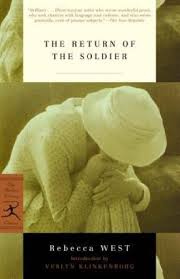
Rebecca West: The Return of the Soldier (UK), WWI, 92 pages

April, Friday 29

Carol Ann Lee: The Winter of the World (UK), WWI, 316

May, Friday 27

Shusaku Endo: The Sea and Poiso aka Umi to dokuyaku (Japan), WWII, 167 pages

June, Friday 24

Primo Levi: If this is a man aka Se questo è un uomo (Italy), WWII, 180 pages

July, Friday 29

Marguerite Duras: Hiroshima, mon amour (France), WWII, 155 pages

August, Friday 26

Elsa Morante: History aka La Storia (Italy), WWII, 768 pages

September, Friday 30

Tim O’Brien: The Things They Carried (US), Vietnam, 256 pages

October, Friday 28

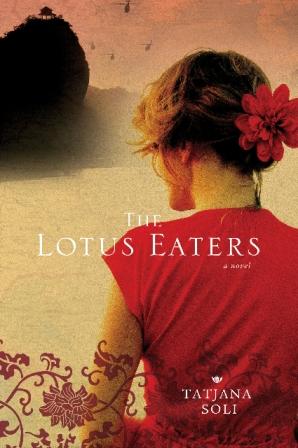
Tatjana Soli: The Lotus Eaters (US), Vietnam, 400 pages

November, Friday 25

Michael Shaara: The Killer Angels (US), American Civil War, 416 pages

December, Friday 30

Charles Frazier: Cold Mountain (US), American Civil War, 448 pages

I hope that  some of you will participate in reading the one or the other, or even all of them. All the books are available in English, apart from Hiroshima, mon amour. Should anyone feel like participating anyway, I suggest you watch the movie instead as the book is actually a script.

I created a page that will be accessible at all times. You can always leave comments. If you are planning on reading along and want to post as well, leave the comment in advance on the page so I can add your link to the post. Alternatively you can always add the link in the comments section.

I am really looking forward to this and hope that others might enjoy the idea as well.