Primo Levi: If This is a Man or Survival in Auschwitz – Se questo è un uomo (1947) Literature and War Readalong June 2011

Survival in Auschwitz is a mostly straightforward narrative, beginning with Primo Levi’s deportation from Turin, Italy, to the concentration camp Auschwitz in Poland in 1943. Levi, then a 25-year-old chemist, spent 10 months in the camp. Even Levi’s most graphic descriptions of the horrors he witnessed and endured there are marked by a restraint and wit that not only gives readers access to his experience, but confronts them with it in stark ethical and emotional terms.

Survival in Auschwitz or If This is a Man was difficult to read and the images it created will haunt me for a long time. Additionally I watched Alain Resnais’ Nuit et Brouillard – Night and Fog which intensified the reading experience.

Primo Levi was part of the Italian resistance when he was captured by Fascist militia in the winter of 1943. After hearing that he is Jewish, the militia hand him over to the Nazis and he is deported to Auschwitz. It’s towards the end of the war and despite Auschwitz being an extermination camp, as they needed many people to work there, they didn’t kill as many as before which is one of the reasons why Levi survived.

Stepping off the train, the people who have been captured, are divided, sometimes arbitrarily, sometimes depending on their strength and fitness. Those who are sent to another direction than Primo Levi will take a shower and we all know what that means. The others who are kept alive, have to strip, wait in the cold for hours and are finally shaved, tattooed and stripped of their old identity. 174517 is the number that is tattooed into Primo Levi’s arm. The numbers, that are like a bar code, tell the other prisoners a lot. They can deduce where the people come from, how long they have been at the Lager. Some numbers are famous, for example the lower numbers of the first ones to arrive from Polish Ghettos. Three years after their arrival some are still alive.

Levi describes their arrival in great detail. He also tells in great detail how everything ends, how after long days of bombardment, and when it becomes obvious that the Russians are not far, the Germans abandon the camp. They leave the weakest and the sick people, like Primo Levi, behind, the others are taken along and probably shot on the way. What a struggle it was for those left behind to survive. There was no more heating and it was icy cold outside, they had no more food, no more blankets, just dirt, debris, corpses and sick and dying people.

Flanked by these two long chapters – the arrival and the end – we get to read a succession of shorter chapters that describe every aspect of the life in a concentration camp. How they are fed, always just a little bit to keep them alive, but never enough to stop the hunger. How they sleep, two men on a small bed of 70cm together. They wake all night because their bladders are weak and the others wake them, it is cold, they have nightmares. He describes what clothes they wear, how dirty and torn they are, the work they do, which is mostly forced labour of the most strenuous kind. They are always cold, hungry and extremely tired. The only time they can recuperate a little bit is when they fall ill. But falling ill is dangerous as well, should they fall too ill, they will be exterminated.

What we read is horrible and shocking but what disturbed me the most is what he wrote about the increasing inhumanity of the prisoners. People turned into monsters under these conditions. They had hardly anything and tried to take advantage, they stole and cheated and did everything for the sake of a tiny little piece of bread, some small advantage over others. Give a man a few privileges under the condition to supervise, punish and abuse others and he will do it. This trait of human nature was cunningly exploited by the Nazi’s. Levi picks a few examples and describes them in more detail than others. It’s amazing what people would do to save themselves.

There are a few men who are kind or manage to stay kind but they are not numerous at all. Levi is lucky, there is one Italian a non-Jewish prisoner, better off than he is, who helps him.

Survival in Auschwitz is impressive for many reasons. It is one of the most precious and detailed testimonies and so well written. One can really understand what it must have been like.

I have written in the introductory post that my edition is French. At the end of the book is an annex of 25 pages in which Primo Levi answers eight questions. These are questions he was often asked when he presented the book, in schools or elsewhere. Some of these questions were on my mind as well while I was reading.

I’m just going to pick those that interested me personally the most.

Did Primo Levi go back to Auschwitz after the war? Yes, he did. In the 60s but it left him surprisingly unfazed as most of the barracks he had been in did not exist anymore and large portions of the rest were transformed into a museum. It was very hard for him to see Birkenau, where the crematorium was although he wasn’t there during the war. That part was like he remembered the Lager, mud, dirt, debris.

Why was there no uprising? Levi tried to answer the question as good as he could. When they arrived, they could have done it but as they didn’t know what was going on they didn’t try. Later there were uprisings but always by political prisoners, not by Jews, which is understandable. The Jews were treated far more badly and therefore much weaker and most were not political people, they had no idea how to resist.

Was there a difference between Soviet Gulags and the German Lager? Yes, the Soviets didn’t want to exterminate the prisoners and although they were awful too – forced labour, bad conditions – it wasn’t as brutal.

The last question was by far the most fascinating. Someone asked Levi, who he would be if he hadn’t been in Auschwitz. Of course, he stated, this was a philosophical question and he added, that the only thing he knew for sure was, that without Auschwitz he wouldn’t have become a writer. The experience in the Lager triggered the urge to write. He started to write in Auschwitz and as soon as he was back, wrote this book pretty much in one go. Without Auschwitz he would have stayed a simple chemist.

This last question and some passages in the book seem to indicate how it was possible that Primo Levi survived, why he had the mental force that was needed. He wrote that he always had an interest in human psychology and that he was fascinated to watch the people and what happened around him. This also helped him to still recognize those around him as humans, although they had been stripped of everything.

It’s a difficult and depressing book but I was touched by Levi’s humanity and his voice and I know I will read more of him. A while back I watched Francesco Rosi’s movie La Tregua aka The Truce based on Primo Levi’s novel. It tells the story of his odyssey back home from the Lager to Italy. Primo Levi’s part is played by John Turturro. If you want to get a good feeling for the man Levi, this is a great starting point. It manages to convey how he became a writer. I will certainly read the book.

I’m interested to know what others thought about this book. Was it too hard to read? Did you also think that he managed incredibly well to make us feel and understand what he went through?

Other reviews

Introduction by Danielle (A Work in Progress)

*****

Survival in Auschwitz was the sixth book in the Literature and War Readalong. The next one will be Marguerite Duras’ Hiroshima mon Amour. Discussion starts on Friday July 29, 2011 .
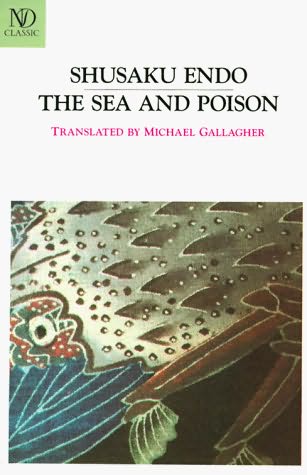
Shusaku Endo: The Sea and Poison aka Umi to dokuyaku (1958) Literature and War Readalong May

Against the backdrop of World War II, Japanese writer Endo ( Scandal ) explores the nature of morality. In this novel, originally published in Japan in 1958, the author examines the inner lives of three characters in the central drama, a grisly vivisection of an American prisoner of war, in an attempt to understand what conscience, or lack of conscience, allowed them to participate in such an atrocity.

The Sea and Poison is the first novel in this readalong that truly upset me. It’s an excellent book but so depressing and bleak, it reminded me of Kafka’s In the Penal Colony which was so far one of the most disturbing books I have ever read. I was afraid that the part on the vivisection might be too graphic but Endo is far to subtle a writer to be too explicit. The horror lies somewhere else.

The Sea and Poison is divided in three parts plus a prologue. Each part is told from another point of view, part 2 from different points of view. It is set during WWII in a hospital outside of the city of Fukuoka. Before we even hear about the planned vivisection on American prisoners of war we get to see the doctors at work. What we see is highly depressing. They do not seem guided by the love of their fellow human beings but purely because they are careerists and love power. Seldom have I read such an utterly negative depiction of doctors. This is best shown in the way they treat poor patients. They are unfriendly and heartless, whether they die or not, it doesn’t matter. It seems as if they did try to excuse this with the war as Suguro thinks:

No doubt it was a time when everybody was on the way out. If a man didn’t breathe his last in the hospital, he might well die that night in an air raid.

The central story is the vivisection which isn’t described in great detail. What is at the core is the study of the people who take part in it. “The old man”, chief surgeon Dr. Hashimoto and Dr. Asai are in charge. Dr. Toda and Dr. Suguro, two young interns, will assist, and two nurses will help as well. We do not hear much about Hashimoto’s motivations or only what Toda explains to Suguro:

“Doctors aren’t saints. They want to be successful. They want to become full professors. And when they want to try out new techniques, they don’t limit their experiments to monkeys and dogs. Suguro, this is the world and you ought to take a closer look at it. “

However we get to know Toda, the nurse and Suguro’s motivations and their stories. What is important is to underline that they could have refused. All three of them were asked whether they were willing to particpate and none of them refused.

Suguro is the only one with a conscience, still he accepts because the proposal comes at a moment of utter disillusionment. He has lost a patient and has seen how “The Old Man” lied about a patient he lost. He sees how many people are killed in air raids, how hopeless it is to help. When he is asked he doesn’t really say yes but he can’t refuse. Only at the last moment does he back off and doesn’t want to touch the patient.

The nurse has a complicated and sad life story. It seems as if there is nothing in this world for her anymore after her personal tragedy. It looks as if she was thinking “If I am miserable, why shouldn’t the others be?”

And Toda? Toda is a being without any feelings. Since his early childhood he is aware that he doesn’t care about other people, that he cannot connect. He has no empathy, no compassion. Occasionally he wonders if there is something wrong with him but at the end of the day he thinks that most people are like him.

I would like to ask you. Aren’t you too, deep down, unmoved by the death and sufferings of others? Aren’t we brothers under the skin perhaps? Haven’t you, too, lived your life up to now without excessive self-recrimination and shame? And then someday doesn’t there stir in you, too, the thought that you are a bit strange?

The questions the novel poses are manyfold and extremely interesting. One could ask whether those who do not directly kill the prisoners are as guilty as those who kill them. Is Suguro who can’t say no and watches but doesn’t touch the patient less guilty than the chief surgeon who performs the surgery?

And what about the chief surgeon? He is a man who is responsible for the death of many people. He performs a surgery and it goes wrong. He makes mistakes, people die. Is he less guilty of those deaths than of those of the American prisoners?

The type of questions this novel poses are the same that were asked in Germany after the war as well. Were those who watched and let things happen less guilty than those who took an active part? This made me think of Macbeth. Who is guiltier? Macbeth who did the killing or Lady Macbeth who had the idea?

I know it is said that this novel explores individual responsibility in wartime. I’m sure that is an important topic but I think two other things were far more important. I think this book criticises doctors and health care professionals in general, showing them as too keen on success and power, as heartless and inhuman. And it also wants to illustrate that people are selfish and mean.

I cannot say I “liked” this book but I did find it extremely thought-provoking, the writing is captivating and the character studies interesting.

I’m really looking forward to read what you thought of it.

Please read also what others wrote:

Anna (Diary of an Eccentric)

Danielle (A Work in Progress)

Gary (The Parrish Lantern)

Mytwostotinki

Novroz (Polychrome Interest)

*****

The Sea and Poison was the fifth book in the Literature and War Readalong. The next one will be Primo Levi’s If This is a Man aka Se questo è un uomo. Discussion starts on Friday June 24, 2011 .


Literature and War Readalong May 27 2011: The Sea and Poison by Shusaku Endo

Shusaku Endo’s The Sea and Poison is the first WWII novel of the Literature and War Readalong. The first time I read about this book was on Parrish’s blog (here is his review). Its topic is very unpleasant. Endo focuses on the theme of morality, exploring it through the central story of the vivisection of an American prisoner of war by three Japanese surgeons.
I just discovered that there is a movie based on the book that can be watched on YouTube. I did attach the first part as a teaser.

Although it might be an unpleasant topic I’m looking forward to read my first Endo. Since it is a very short book, only 160 pages, I hope some of you will be in the mood to read along but I would understand if the topic isn’t to everybody’s liking.

Should someone want to watch the movie instead and review it, that would be great as well and I would link the review.

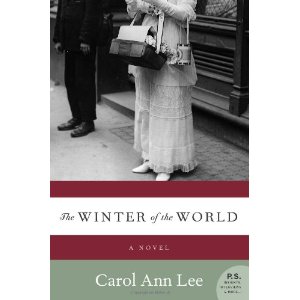
Carol Ann Lee: The Winter of the World (2007) Literature and War Readalong April

Journalist Alex Dyer made his name covering the bloody horrors of the European trenches. Yet even after the Great War is over, he cannot shake the guilt he feels for not serving on the front lines like his dearest childhood friend, Ted Eden. Worse still, Alex cannot put to rest the emotions that gnaw at him from the inside: his feelings for Clare, Ted’s wife—a woman they both have loved more than life itself. 

Carol Ann Lee’s The Winter of the World is the last novel on WWI in this read along. For the next one we will be moving on to WWII.

This wasn’t the easiest review to write as I am in two minds about this novel. There are parts in it that are so haunting and powerful but then again there were others were I was just rolling my eyes thinking “get on with it”.  Still it would be unfair to write a totally negative review because the good parts are among the best on WWI I’ve ever read.

Alex and Ted are childhood friends. They are close and attached to each other until the day Ted introduces Alex to his soon-to-be wife Clare. Very unfortunately this is a love at first sight moment for Alex and Clare. They try to fight it but, as we will see soon enough, the more the story advances, the less likely it is that they will succeed.

The marriage takes place just when the war breaks out. Ted will enlist, Alex will participate as a war correspondent and Clare will be one of the nurses in France.

The novel moves back and forth between Alex’s and Clare’s point of view. Alex sees a lot of atrocities and the descriptions are very graphic and extremely impressive without falling into the trap of being too clichéd. But since Alex isn’t fighting, it stays an outsider’s perspective. Clare’s point of view was captivating for totally different reasons. As a war nurse she has to deal with indescribable wounds and suffering. The abundance of facial wounds seems to be a trait of WWI and these parts reminded me of one of the best WWI movies I have ever seen, La chambre des officiers aka The officer’s chamber based on the eponymous novel by Marc Dugain. We seem to get an insider’s view of this truly harrowing aspect of the “Great war”. I can hardly imagine what it must have been like to have been the victim of this kind of facial mutilation and to be rejected by those you loved and who once loved you. The reactions of the relatives and fiancées were often brutal. Through Clare’s eyes we also get an equally close look at what mustard gas did to those who became its victims and how they suffocated or drowned slowly.

The only men more popular than I was were the ones in wheelchairs, or those with empty sleeves pinned against their chest. Everyone wanted to talk to them, to do something for them. Children presented them with flags and in the railway stations they got free tea or coffee. It was different for the ones whose faces had been destroyed. People averted their eyes quickly, the blood flooding their skin. No one wanted to make eye contact with a disfigured soldier; they were modern-day lepers.

While the war moves on – not stopping at Christmas, as was expected – the love affair develops as well. Clare and Alex meet secretly but are finally driven apart by conflicting emotions and wishes. Alex feels he needs to tell Ted everything, while Clare wants to protect him and keep the affair secret.

Through Alex’ voice we hear what it must have been like to cover this war as a correspondent. The journalists were not allowed to tell the truth. The numbers of casualties were not mentioned nor were the biggest defeats spoken of. While Clare’s parts rather focus on individuals, Alex’ parts illustrate the enormity of the losses. He evokes the incredible amount of wounded, disfigured and killed soldiers. At moments I had the feeling of seeing all these dead men standing in one huge row before my inner eye. When we visit those cemeteries we get a feeling for those massive losses.

He imagined a thin line linking the cemeteries along the old Western Front, from the smallest graveyards hidden away within woods to those huge, silent cities on the plains where the most ferocious battles had been fought. Some bore the names given to them by the soldiers themselves – Owl Trench, Caterpillar Valley, Crucifix Corner – while others were named after the battalion who had buried their own men there. He imagined how tha line would look from the air; so thick in parts that it resembled a child’s scribble, for they were everywhere these Gardens of Stone.

The novel slowly moves towards the culminating point which is the burial of the “unknown warrior”. The name is chose deliberately as “warrior” sounded more inclusive than “soldier”. The grave which is really located in Westminster Abbey was meant to commemorate all the dead fighters of this war, not only the infantry men. The burial is one of the best and most powerful parts in this novel.

Despite all these impressive elements, I had my problems, as I said. The biggest part of the story is told by Alex. He tells Lombardi, a guy he meets in Flanders after the war, why he is so tormented, why he cannot get over the war. I didn’t get this narrative device at all.  I would have preferred a more straightforward story, not this artificial telling of what happened to someone who has nothing to do with it. This was a common technique in 19th century novels but I think it doesn’t add anything to a modern novel at all. The next biggest negative aspect was the coincidence. I found it highly unlikely that Alex would meet Ted at the end. The third thing that I didn’t think well-done is the love-triangle. I think it was unnecessary that Alex and Clare had an affair. The descriptions of Alex’ feelings worked very well for me but not those of Clare. And the guilt-theme was just an element too much. Last but not least I missed Ted’s point of view.

I have a lot of questions at the end of this novel and would be curious to know what others thought.

Was this really the tone of a WWI novel? Especially the love-affair seemed very WWII to me but maybe that impression stems from the similarity to Pearl Harbor.

What about the facial wounds, does anyone know whether this was a consequence of the trenches? In The officer’s chambers, the young officer loses half of his face on the battle field, but I have really never heard so much about this type of injury from any other war.

Why do you think Carol Ann Lee left out Ted’s point of view? I think she might have risked to fall into the trap of cliché but I am not sure that’s why she chose to leave it out.

I’m really curious to read your thoughts.

Here are other reviews

Anna (Diary of an Eccentric)

Danielle (A Work in Progress)

*******

The Winter of the World was the fourth book in the Literature and War Readalong. The next one will be Shusaku Endo’s The Sea and Poison aka Umi to dokuyaku. Discussion starts on Friday May 27, 2011 .

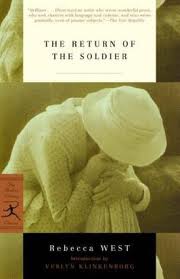
Rebecca West: The Return of the Soldier (1918) Literature and War Readalong March

The soldier returns from the front to the three women who love him. His wife, Kitty, with her cold, moonlight beauty, and his devoted cousin Jenny wait in their exquisite home on the crest of the Harrow-weald. Margaret Allington, his first and long-forgotten love, is nearby in the dreary suburb of Wealdstone. But the soldier is shell-shocked and can only remember the Margaret he loved fifteen years before, when he was a young man and she an inn-keeper’s daughter. His cousin he remembers only as a childhood playmate; his wife he remembers not at all. The women have a choice – to leave him where he wishes to be, or to ‘cure’ him. It is Margaret who reveals a love so great that she can make the final sacrifice.

The Return of the Soldier is unusual because it has been written by a woman and during the war. But it is also unusual in its treatment of the war. Although a tale that takes place on the home-front, the horrors of the war in the trenches shine through constantly.

The novel is a first person narrative,  told by Jenny, Chris’s cousin. It opens on a domestic scene showing Kitty, Chris’ wife and Jenny together in the nursery. We learn immediately that the child who lived there is dead and we also learn a lot about the very different characters of these two women. Kitty is not easily alarmed even though they haven’t heard from Chris for weeks. The very first paragraph shows that she treats the war lightly, does maybe not take it very seriously at all, rather like some adventure, while Jenny is aware of the dangers.

“Ah, don’t begin to fuss!” wailed Kitty. “If a woman began to worry in these days because her husband hadn’t written to her for a fortnight—! Besides, if he’d been anywhere interesting, anywhere where the fighting was really hot, he’d have found some way of telling me instead f just leaving it as “Somewhere in France. He’ll be alright.”

Jenny will tell us later what a very shallow woman Kitty is. Appearances is all that is important to her.

Now, why did Kitty, who was the falsest thing on earth, who was in tune with every kind of falsity, by merely suffering somehow remind us pf reality?

The initial scene is almost idyllic as the house and its surroundings are so lovely and Jenny cannot help but think of how much Chris must miss his life there. Rebecca West is excellent when she describes the surroundings. She chooses words like a painter who tries to get every little shade of what he paints right. Her writing is nuanced and poetical.

The house lies on the crest of Harrowweald, and from its windows the eye drops to miles of emerald pastureland lying wet and brilliant under a westward line of sleek hills blue with distance and distant woods, while nearer it ranges the suave decorum of the lawn and the Lebanon cedar whose branches are like darkness made palpable, and the minatory gauntness of the topmost pines in the wood that breaks downward, its bare boughs a close texture of browns and purples, from the pond on the hill’s edge.

Of the two women, Jenny is the one that brings the war into the novel through her worrying. It is deeply rooted in her consciousness as well as in her subconscious. Her feelings for her cousin are so intense, the identification is total at times and she seems to be the one experiencing the battlefield. Through Jenny we get a clear picture of how much was known on the home-front. In the movie theaters they were shown black and white footage of the front line. To be like Kitty, unaware of the real dangers, you had to be really determined to keep them away from you.

Of late I had had had dreams about him. By night I saw Chris running across the brown rottenness of No Man’s Land, starting back here because he rod upon a hand, not even looking there because of the awfulness of an unburied head, and not till my dream was packed full of horror did I see him pitch forward on his knees as he reached safety—it was that. For on the war-films I have seen men slip down as softly from the trench parapet, and none but the grimmer philosopher would say that they reached safety by their fall.

Into the initial idyll breaks a shabby and elderly looking woman. She is badly dressed and seems of the lowest social class. Both women feel revolted and when they hear why she has come they are quite shocked. Margaret has come to inform them that Chris has been is in a hospital in France and suffers from severe shell-shock. He is amnesic and has eradicated the last 15 years of his memory, believing to still have a relationship with Margaret. The reactions of the two women towards this member of the lower classes is quite disturbing. They almost react as if she was contaminating the house.

Soon after this conversation, Chris is brought back and has indeed lost every memory of his wife and barely recognizes his cousin who is now fifteen years older.

In what follows we see how each of the three women reacts so differently, how each wishes and longs for other things. We learn also about the relationship Chris had with Margaret and why he broke it off and what happened to her after he left her. Despite all this there is no sign of his recovering his memory and finally a doctor is called. At first he isn’t successful but he points out that there may have been a reason why Chris repressed the memory of his marriage. It is only after Margaret suggests to show Chris something that will trigger a strong emotion – in this case things that belonged to the dead child – that he will be able to regain his memory. I the moments before he is shown the baby’s things Jenny is suddenly painfully aware of what a recovery truly means. Should he recover, he will have to go back to the front. In sharp contrast to this, Kitty doesn’t care. She wants her husband to recognize her again, that’s all she cares about. Once the recovery has happened, it’s Jenny again who states clearly what will be.

He walked not loose limbed like a boy, as he had done that very afternoon, but with the soldier’s thread upon the heel. It recalled to me that, bad as we were, we were yet not the worst circumstance of his return. When he dad lifted the yoke of our embraces from his shoulders he would go back to that flooded trench in Flanders under that sky more full of flying death than clouds, to that No Man’s Land where bullets fall like rain on the rotting faces of the dead.

I found it very interesting that The Return of the Soldier can be read in many different ways. Considering the theme of the readalong, I focused on the way she treated WWI but that is not the only topic in this novel. One could also explore the psychological theories or the sociological dimension.

I think The Return of the Soldier is an incredibly subtle and artful novel. The war and it’s horrors are like threads that are woven into the fabric of the story. As a journalist Rebecca West was interested and did report on the war but she was also very interested in Freud’s theories, some of which she has applied in the novel. I think to make of Chris a shell-shocked soldier suffering from amnesia which was not realistic, shows us that she wanted this to be taken symbolically. The psychologist Glen Clifford kindly and eloquently pointed out in a comment on my introductory post that PTSD is characterized by the incapability to forget and amnesia is a very unlikely occurrence.

The three women all symbolize something else and represent different levels of consciousness. Kitty, the wife he has forgotten is the symbol of all the forces that contribute and maintain the class system and the war. She is a typical representative of the British upper class, of those who decide to send  thousands of young men to a certain death. Those who don’t care what is going on “over there”. She symbolizes the unconscious. Margaret on the other hand stands for the working classes, simplicity, those who have to endure what others force upon them. That seems to be pretty much how Chris feels as well. She may be read as the subconscious. Jenny is by far the most intriguing. She moves back and forth between the different levels of consciousness with a capability of seeing things clearly. She is his cousin but thinks and feels rather like a lover. She seems the most authentic, the most emotional, the one who feels what either Kitty or Chris should feel, namely the horror and despair caused by this horrible war and the sadness about the loss of the little boy. It may very well be that the death of the child drove the spouses apart.

I would like to say thanks to Ann Norton from the International Rebecca West Society, for pointing me towards a new critical edition by Bernard Schweizer and Charles Thorne. It contains invaluable material and background information to the book. If you want to have a look at the content here’s the link to the broadview press.

Ann Norton wrote the introduction to the Barnes and Noble Library of Essential Reading Edition.

I am really curious to read what others have to say about this complex novel, be it in a review or in comments.

Other reviews:

Anna (Diary of an Eccentric)

Bookaroundthecorner

Danielle (A Work in Progress)

*****

The Return of the Soldier was the third book in the Literature and War Readalong. The next one will be Carol Ann Lee’s The Winter of the World. Discussion starts on Friday April 29, 2011 .

Literature and War Readalong March 25 2011: The Return of the Soldier by Rebecca West

There is still plenty of time for anyone who wants to join the Literature and War Redalong this month to get a copy of Rebecca West’s The Return of the Soldier. It is only 90 pages long which makes it all the more feasible. If all those of you who expressed an interest in this book will read along we might be quite a crowd. We will see. There are at least two different paperback editions available. I got the one from The Modern Library with an introduction by Verly Klinkenborg. The other one is a Virago edition with an afterword by Sadie Jones.

Rebecca West’s book is unique as it was published in 1918, before the war had ended. She tells the story of a returning soldier who suffers from shell-shock. I am particularly interested in this topic and curious to compare her handling of it with Pat Barker’s Regeneration trilogy which is for me still one of the greatest books on WWI, shell-shock and the development of the new medical discipline, psychiatry.

I was very surprised to find out that The Return of the Soldier that seems so well-known in the English-speaking world has not been translated into German. The only two of her books that made it into German are Black Lamb and Grey Falcon and The Fountain Overflows.

Rebecca West was only 24 when she wrote this novel but already an acclaimed journalist and women’s rights activist. This isn’t an account of the front line but purely a story that takes place on the home front.

Shell-shock is extremely typical for most WWI accounts. It seems as if there had never been so many cases of shell-shock in any war as in WWI. Psychologists state that one of the reasons for this lies in the trench warfare. Being in the trenches for such a long time infused the soldiers with a deep feeling of helplessness that makes shell-shock much more probable than any othe type of warfare. The moment the soldiers were allowed to leave the trenches and move about shell-shock was far less frequent.

Here is the link to the Rebecca West Society if you want to find out more about the author, upcoming conferences and events.

The Return of the Soldier has also been made into a movie.

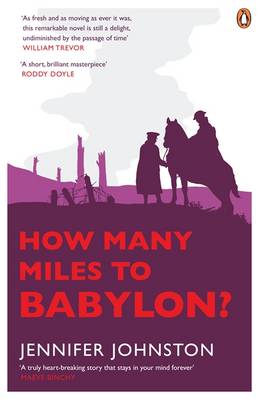
Jennifer Johnston: How Many Miles to Babylon? (1974) Literature and War Readalong February

Alec and Jerry shouldn’t have been friends: Alec’s life was one of privilege, while Jerry’s was one of toil. But this hardly mattered to two young men whose shared love of horses brought them together and whose whole lives lay ahead of them. When war breaks out in 1914, both Jerry and Alec sign up – yet for quite different reasons. On the fields of Flanders they find themselves standing together, but once again divided: as officer and enlisted man. And it is there, surrounded by mud and chaos and death, that one of them makes a fateful decision whose consequences will test their friendship and loyalty to breaking point.

We know from the beginning of this novel that it is not going to end well. Alec is held in detention and knows that he will die. Because he is an officer and a gentleman, as he states, they have given him his notebooks, pen and ink and he writes down the story of his life. The story spans from his lonely isolated childhood in rural Ireland to the war-torn trenches in France. The tone of the novel is melancholic, full of nostalgia for a world that has been lost and is at the same time infused with the profound love of a country.

By now the attack must be on. A hundred yards of mournful earth, a hill topped with a circle of trees, that at home would have belonged exclusively to the fairies, a farm, some roofless cottages, quiet unimportant places, now the centre of the world for tens of thousands of men. The end of the world for many, the heroes and the cowards, the masters and the slaves.

Alec’s childhood was a lonely one. Caught between two parents who hated each other and who kept a polite and icy distance, he was the pawn with which his mother played. He didn’t like his mother, a haughty, cruel but beautiful woman whose strict rules and relentless following of etiquette ruined every childhood joy. What his parents do not know for a long time is that Alec has a secret friend. Alec and Jerry have a lot in common. Their love of horses, their sense of humour, they share so much, unfortunately not the social class. Alec is an only child of a wealthy Anglo-Irish couple whereas Jerry is part of the Catholic underclass. When their friendship is found out, Alec’s mother freaks out and decides to go on a 4 month trip to Europe with Alec.

When Alec comes back he doesn’t see Jerry anymore. Jerry is working while Alec is still studying. And then the war breaks out. At first there seems to be only a rumour of war. Jerry knows it long before Alec hears it and most people think it isn’t really true.

We paid very little attention to the war when it happened first. Belgium and Flanders seemed so far away from us. Our fields were gold and firm under our feet. Autumn began to stroke the evening air with frost. Smoke from bonfires was the only smoke to sting our eyes. Cubbing began in the early morning, the earth temporarily white with mist and dew. A few familiar faces disappeared. War was on the front pages of the newspapers daily brought from Dublin on the train.

Many do not feel that this is their war or that they should assist the British. Tensions inside of Ireland start to be palpable, tensions that bear the foreboding of the things that will come, the striving towards independence. However people who feel loyal towards Britain send their sons. Alec’s father considers it to be foolish to go to a war when you are not forced to go but his mother, out of spite and vengeance against his father, drives Alec away.

Meanwhile Jerry had already enlisted and the two young men meet in the training camp near Belfast in which they stay for six weeks until they get shipped to France. Their superiors do not like to see an officer talk to an enlisted man. Alec, due to his social class, has become an officer immediately.

When they finally arrive in France they stay separated. Alec shares quarters with a British officer, Bennett, a guy with a lot of humour, while Jerry sleeps with the other enlisted men. Still the three of them meet occasionally and ride about the country together.

They hardly see any action for a long time and stay far off the trenches for a while. When they are finally sent to the front line they will spend a lot of their time cleaning and reconstructing the badly damaged trenches.

We spent three more days in the front trenches, mainly shoveling and making props. It rained a considerable amount of the time. Sometimes sleet cut into the men’s bare hands, and at night there was sharp frost that covered the bottom of the trenches with a thin film of ice. We extended the line to our left. It was hard work moving the earth, heavy with water, always crouching till ones back and shoulders ached pitifully. The men hated it and worked slowly, grumbling most of the time. For most of the day there was concentrated shelling of the German lines by our artillery. The shells screeched over our heads sometimes for hours at a time. After a while I became so used to the noise that I felt strangely unprotected when it stopped, then slowly the process of thinking had to begin again.

The cold is unbearable and Alec suffers a lot from it. They constantly drink rum as it is the only way to warm up. Here again Alec and Jerry are caught talking together and the superior officer forbids it. But that is not the only trouble they are in. The Irish are not appreciated at all. On top of that there are rumors of a movement that wants to fight for the independence of Ireland. Jerry is suspected to be part of that movement and one day he confides in Alec.

“I don’t know how you can contemplate ever fighting again.”

“It won’t be like this. There’ll be no trenches, no front lines. No waiting. Every town, every village will be the front line. Hill, rock, tree. They won’t know which way to look. Even the children, for God’s sake, will fight them. It won’t be like this, I promise you that. Oh, Alec, it’s some thought.”

When Jerry receives a letter from his mother in which she informs him that his father has gone missing, he runs off to look for him and the tragedy unfolds.

I loved How Many Miles to Babylon? I think it is a beautiful book. It doesn’t teach you as much about WWI as Strange Meeting (see post 1) but it says a lot about Irish history. I found this look at the first World War from an Irish perspective extremely fascinating.

As Jennifer Johnston said, she wanted to write about the Troubles but didn’t feel ready yet. This is the prehistory of the Troubles. The Irish War of Independence started right after WWI in 1919 and was closely followed by the Irish Civil War. This succession of wars was the reason why Ireland stayed neutral during WWII. They simply couldn’t afford to be in another war in such short time.

How Many Miles to Babylon? hints at all this. But it is not only a very Irish novel because of the historical elements but also for its imagery, the symbolism and the many references to Irish mythology and culture.

The motif of the swans is a recurring element. There are swans on the lake on the property of Alec’s parents, they see swans in France, some soldiers shoot a swan which does upset Alec terribly. Since Alec reads W.B. Yates at the beginning of the book I think the swans are an allusion to Yates’ famous poem The Wild Swans at Coole which seems to mourn a time long gone.

In contrast to the gratuitous killing of the swans stand the mercy killings. Wounded horses are killed, a wounded man is killed…

I really liked this enchanting novel. I loved the poetical prose, the melancholic tone and the feeling of nostalgia that pervaded it.

What did you think of the novel in general and its treatment of WWI?

Other reviews:

Anna (Diary of an Eccentric)

Danielle (A Work in Progress) and here as well

Fence (Susan Hated Literature)

*****

How Many Miles to Babylon? was the second book in the Literature and War Readalong. The next one will be Rebecca West’s The Return of the Soldier. Discussion starts on Friday March 25, 2011 .