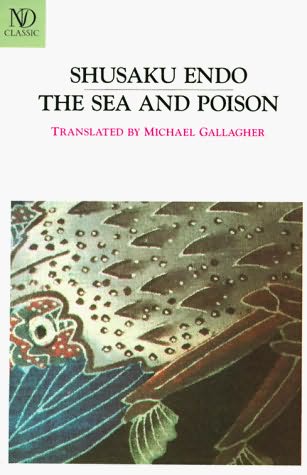
Against the backdrop of World War II, Japanese writer Endo ( Scandal ) explores the nature of morality. In this novel, originally published in Japan in 1958, the author examines the inner lives of three characters in the central drama, a grisly vivisection of an American prisoner of war, in an attempt to understand what conscience, or lack of conscience, allowed them to participate in such an atrocity.
The Sea and Poison is the first novel in this readalong that truly upset me. It’s an excellent book but so depressing and bleak, it reminded me of Kafka’s In the Penal Colony which was so far one of the most disturbing books I have ever read. I was afraid that the part on the vivisection might be too graphic but Endo is far to subtle a writer to be too explicit. The horror lies somewhere else.
The Sea and Poison is divided in three parts plus a prologue. Each part is told from another point of view, part 2 from different points of view. It is set during WWII in a hospital outside of the city of Fukuoka. Before we even hear about the planned vivisection on American prisoners of war we get to see the doctors at work. What we see is highly depressing. They do not seem guided by the love of their fellow human beings but purely because they are careerists and love power. Seldom have I read such an utterly negative depiction of doctors. This is best shown in the way they treat poor patients. They are unfriendly and heartless, whether they die or not, it doesn’t matter. It seems as if they did try to excuse this with the war as Suguro thinks:
No doubt it was a time when everybody was on the way out. If a man didn’t breathe his last in the hospital, he might well die that night in an air raid.
The central story is the vivisection which isn’t described in great detail. What is at the core is the study of the people who take part in it. “The old man”, chief surgeon Dr. Hashimoto and Dr. Asai are in charge. Dr. Toda and Dr. Suguro, two young interns, will assist, and two nurses will help as well. We do not hear much about Hashimoto’s motivations or only what Toda explains to Suguro:
“Doctors aren’t saints. They want to be successful. They want to become full professors. And when they want to try out new techniques, they don’t limit their experiments to monkeys and dogs. Suguro, this is the world and you ought to take a closer look at it. “
However we get to know Toda, the nurse and Suguro’s motivations and their stories. What is important is to underline that they could have refused. All three of them were asked whether they were willing to particpate and none of them refused.
Suguro is the only one with a conscience, still he accepts because the proposal comes at a moment of utter disillusionment. He has lost a patient and has seen how “The Old Man” lied about a patient he lost. He sees how many people are killed in air raids, how hopeless it is to help. When he is asked he doesn’t really say yes but he can’t refuse. Only at the last moment does he back off and doesn’t want to touch the patient.
The nurse has a complicated and sad life story. It seems as if there is nothing in this world for her anymore after her personal tragedy. It looks as if she was thinking “If I am miserable, why shouldn’t the others be?”
And Toda? Toda is a being without any feelings. Since his early childhood he is aware that he doesn’t care about other people, that he cannot connect. He has no empathy, no compassion. Occasionally he wonders if there is something wrong with him but at the end of the day he thinks that most people are like him.
I would like to ask you. Aren’t you too, deep down, unmoved by the death and sufferings of others? Aren’t we brothers under the skin perhaps? Haven’t you, too, lived your life up to now without excessive self-recrimination and shame? And then someday doesn’t there stir in you, too, the thought that you are a bit strange?
The questions the novel poses are manyfold and extremely interesting. One could ask whether those who do not directly kill the prisoners are as guilty as those who kill them. Is Suguro who can’t say no and watches but doesn’t touch the patient less guilty than the chief surgeon who performs the surgery?
And what about the chief surgeon? He is a man who is responsible for the death of many people. He performs a surgery and it goes wrong. He makes mistakes, people die. Is he less guilty of those deaths than of those of the American prisoners?
The type of questions this novel poses are the same that were asked in Germany after the war as well. Were those who watched and let things happen less guilty than those who took an active part? This made me think of Macbeth. Who is guiltier? Macbeth who did the killing or Lady Macbeth who had the idea?
I know it is said that this novel explores individual responsibility in wartime. I’m sure that is an important topic but I think two other things were far more important. I think this book criticises doctors and health care professionals in general, showing them as too keen on success and power, as heartless and inhuman. And it also wants to illustrate that people are selfish and mean.
I cannot say I “liked” this book but I did find it extremely thought-provoking, the writing is captivating and the character studies interesting.
I’m really looking forward to read what you thought of it.
Please read also what others wrote:
Anna (Diary of an Eccentric)
Danielle (A Work in Progress)
Gary (The Parrish Lantern)
Mytwostotinki
Novroz (Polychrome Interest)
*****
The Sea and Poison was the fifth book in the Literature and War Readalong. The next one will be Primo Levi’s If This is a Man aka Se questo è un uomo. Discussion starts on Friday June 24, 2011 .

 Beauty is a Sleeping Cat