Ferdinand von Schirach: Guilt – Schuld (2010)

After having read Ferdinand von Schirach’s excellent first collection CrimeVerbrechen (here is my review), I had to have his second collection Guilt – Schuld and his novel Der Fall Collini right away. The novel isn’t out in English yet but it is due end of 2012.

Any which way you want to look at von Schirach’s books, “literary”, “true story”, whatever, they make for pretty addictive reading. I finished this in a sitting or two.

The angle in this collection is a bit different but some of the striking features of the first are present here as well. Most of the crimes are astonishing, many go wrong, often the perpetrator ends up being the victim and not everybody gets punished.

The focus is less the tipping point than the question of guilt. Interestingly not only the criminal’s guilt but to a certain degree even the lawyer’s guilt. There are a few cases, some date back to von Schirach’s early days as a criminal defense lawyer, where at the end I had the feeling that he felt guilty. Guilty because someone walked who shouldn’t have.

Like in the first collection, we get a close look at the German criminal system. I find it interesting how important it is for the lawyer to follow the law 100% even if the punishment doesn’t sound just. I always find it fascinating how a definition can alter the sentence completely. There is one case in which it is crucial to establish whether if someone kills a sleeping man it can ever be anything else than murder. Can it be manslaughter or even self-defence when the person is asleep? Or let’s say someone tries to kill someone, hurts the person badly but then stops before he is dead. That changes everything as well. These details were the best parts in this collection.

There are cases in which you even wonder whether there is not some superior justice at work, for example when a perpetrator gets run over by a car before being even able to commit the gruesome murder he had planned in many details and written down in his diary.

The tone is close to the first book, laconic, brief, to the point. There is no judging of people, no pointing the finger, just a very factual account of what happened.

All in all I liked this collection but not as much as the first. Whether there is a difference – I felt the cases in the first collection were more astonishing as a whole – or whether they are too alike, I’m not sure but I found it a bit less original and not as touching but still well worth reading. I’m really looking forward to read the novel and as I know it will be published soon in English, I will review it in a couple of weeks. If you don’t have any of the two collections yet it may be worth waiting as they will be released together in September Crime and Guilt.

If you are interested in hearing Ferdinand von Schirach talking about crime, punishment, guilt and his very special laconic writing style you might enjoy watching this interview (English and German with translation).
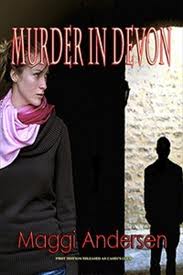
Maggi Andersen: Murder in Devon (2009)

I have never participated in a book tour before and thought it would be something new to try. When I was asked if I would like to read Australian writer Maggi Andersen’s Murder in Devon I accepted gladly. I like mysteries. I was aware that she is rather known for her Romance novels and that this crime novel belongs to the sub-category of Romantic Suspense. Although I’m really not a Romance reader, I have read Romantic Suspense in the past and liked it.

Casey wakes up, one morning in the cottage of her friends, in Devon. To her horror, someone has broken into the house, killed Don, her friend, and badly wounded his wife Tessa who is lying on the floor unconscious. Maybe due to a few glasses too many or exhaustion, Casey didn’t hear a thing. Don and Tessa are her oldest and closest friends. There are not many other people in her life as she isn’t good at relationships and has no family left. All this together makes the murder all the more painful.

Casey is the deputy editor of a woman’s magazine, while Don was a famous investigative reporter. Her friend Tessa is a psychologist working with abuse victims. Both Tessa and Don have had intense conflicts with people related to their work. Needless to say that there are many suspects.

While Chief Inspector Carlisle, who is responsible for the case  seems capable, Casey cannot let it be and has to actively investigate on her own. She isn’t even aware at first that she is a suspect. Carlisle isn’t amused that she is interfering with his investigation and when the two realize that they are drawn to each other and begin an affair, even less. Not only does he not want her to interfere but he knows she puts herself in great danger.

When Casey searches Don’s things and finds a list of paintings that are known to have been stolen by the Nazis – most of them are still missing – the discovery triggers a hunt that leads her from London to Germany and back.

I’m not an expert when it comes to romance novels but I can easily see that this part of the book did not work. The attraction came out of the blue and didn’t feel realistic. It somehow even felt like it was glued on the rest of the story which could have done very well without it. Despite the fact that the book is in serious need of editing (sentences were missing, many typos…) the crime part was gripping and I really wanted to finish and know who did it. I didn’t think it was too predictable at all.

If you like an entertaining crime novel which isn’t too gruesome but not exactly cozy crime with some history thrown in and if you prefer your crime to be action-driven and not psychological, then you’re in good hands here. It wasn’t really my thing but at least I was not bored.

One tiny thing I’d like to add is that Maggi Andersen supports the RSPCA (Royal Society for the Prevention of Cruelty to animals). There are always animals featuring in her books. In this one it’s a cat called Socrates. Here is her website.

I received a copy from the author and reviewed it as part of a Virtual Author Book Tour If you’d like to read the impressions of other participants, click on the link.

Ferdinand von Schirach: Crime – Verbrechen (2009)

Are they true? Are they not? The discussion of Ferdinand von Schirach ‘s stories circled to a large extent around these questions  in Germany  and what the respective answers might mean. For the book. For life. And human nature in general. In English speaking countries there is no emphasis on whether they are based on true cases or not. People admire the crisp, precise, unadorned prose, the philosophical background, the look into human depravity, into guilt, gruesome crime and its possible punishment. They are seen as literature and not as true crime accounts. I find this interesting. In this faz interview von Schirach says that all the cases happened and are true. A lot has been changed to guarantee anonymity of the people involved but other than that, this is what happened. Does it matter? Maybe not.

Von Schirach is a famous German defence lawyer. His grandfather Baldur von Schirach was even more famous. He was one of the Nazi criminals convicted in Nuremberg.

The stories in Crime – Verbrechen are astonishing. Some are shocking, some made me laugh, some are puzzling, others thought-provoking, even very touching at times. Often the person who sets out to commit a crime isn’t the person the lawyer in the story will have to defend. Somewhere along the line, the roles are reversed. The initial victim can become the perpetrator. This happens especially in those cases in which silly small-time-crooks inadvertently attack a “big fish”. Some of those stories are hilarious.

But there are stories in which a lot of pain and cruelty pushes a person over the edge. As von Schirach writes in the introduction, this is what the stories are about; the tipping point. We are all, as he says, walking on thin ice, but not all of us make it to the other side. The moment when the ice crashes, is the moment he is interested in.

Punishment is one of the key themes of all of those stories and surprisingly, for various reasons, not many of the delinquents get sentenced. The book, being written by a defence lawyer, gives a lot of insight into the German criminal system, comparing it to other systems, showing how it has changed over time, how it has become more just but much more complicated as well.

I cannot write all that much about the individual stories as that would spoil the fun of discovering what happened. I’m glad I discovered the review of the book on Lizzy’s blog last year.

Some of the stories are gruesome but the majority is just absolutely fascinating and thought-provoking. Many give insight into the German society, it’s problems and challenges; many illustrate that some people are just born unlucky.

Crime was von Schirach’s first book. It was an immense success in Germany and translated into 30 languages. One of the stories of the collection have been made into a movie Glück – Bliss by none other than Dorries Dörrie. It’s in the cinemas in Germany right now.

Another short story collection Guilt – Schuld and a novel Der Fall Collini have followed. Guilt just came out in English.

Der Fall Collini which Die Welt calls a”cristal clear story of disconcerting amorality” will certainly be translated very soon. I want to read both, Schuld and Der Fall Collini. And watch the movie.

Have you read von Schirach or heard about him?

Claudia Piñeiro: All Yours – Tuya (2003) An Argentinian Crime Novel

I had never heard of Claudia Piñeiro before I saw her book All Yours reviewed on Guy’s blog. I wanted to read more Latin American literature this year and an Argentinian crime novel sounded like a good start.

All Yours, or Tuya as it is called in Spanish, is as entertaining as it is amusing. It introduces us to the world of Inés, a middle-aged housewife, mother of Lali and wife of Ernesto. A real perfectionist when it comes to her home and keeping up appearances, a master in the art of self-delusion. More than once while reading I was exclaiming “What a nutter”.  Of course I was glad that she was such a nutter as this is why Tuya is so entertaining.

When Inés discovers a lipstick-written note, a heart signed “All Yours”, in her husbands briefcase, we are at first startled to hear that she doesn’t think it’s all that bad. After all, she believes, sooner or later all men cheat on their wives. The outcome purely depends on how gracefully the wife handles it.

Since her own unfaithful father left her mother after having been confronted with his infidelity, Inés decides not to act but to observe. One night when her husband is called to his office – there seems to be a computer related emergency which happens quite frequently -, she follows him. Of course he doesn’t drive to the office and Inés observes him while he meets with his secretary in Palermo Park. They are fighting and at one point Ernesto pushes the secretary away. The woman trips, falls and breaks her neck in the fall. How wonderful, Inés thinks, she will help her husband to cover up the whole incident. She will provide him with an alibi… But for the time being, she stays in the dark, drives home and doesn’t say a word that she has watched everything. Inés is happy, she believes that the secretary was Ernesto’s lover, and now that she is dead, nothing can separate them anymore. Right? Not quite, as we will see and from here on, things do not go as planned at all.

This isn’t the only instance in which Inés is wrong and we start to learn that absolutely nothing is at is seems in this novel and that what Inés pretends to be a picture book family is in reality rotting from the inside.

All Yours is told in alternating points of view. The most important parts are Inés’ first person narratives. Being a highly unreliable narrator, she tries to pretend everyting is fine until the very end of the book. Other parts of the story focus on Lali, Inés’ daughter. They are in dialogue form and reveal that the daughter has as much to hide as her parents but that she knows everyting about the two of them. Lali blames and hates her mother more than anyone else and towards the end of the book we realize she may have reason. Some of the chapters are police reports and third person narratives. Each of these elements together give the reader the full picture.

All Yours reminded me a lot of German crime writer Ingrid Noll’s novels in which seemingly harmless and invisible women start to develop their criminal and vengeful side. They are perfectionists, driven by an urge to save appearances at any price. We don’t warm to these women, we don’t feel for them but we enjoy the delicious frisson that we experience while following them on their journey towards retribution.

Jacqueline Winspear: Maisie Dobbs (2003) The First Maisie Dobbs Mystery

I’m not sure who mentioned Maisie Dobbs first. Either Danielle on A Work in Progress or Kailana on The Written World. Whoever it was I’m glad she did as Maisie is an amazing heroine. I really like her and the way she goes about her job. The period details are captured in a very descriptive way, reading often felt like watching a movie.

The story begins in London, 1929. Maisie Dobbs has opened her first office. She is a private investigator and psychologist who has been trained by a master of the art, Maurice Blanche, a friend of Lady Rowan, on whose estate Maisie used to be a maid.

Her first investigation leads her to follow the wife of Christopher Davenham. He suspects her to have a lover. What Maisie finds out is quite different from what Davenham and the reader think and will lead Maisie to investigate a crime and confront her with her own past.

The second part of the novel rewinds to 1910-1917. In 1910 Maisie is just a girl who lives alone with her father after her mother has died. She is unusually intelligent and her parents wanted to send her to college later but the mother’s illness has swallowed up all of their money and Maisie is sent to Lady Rowan as a maid. They soon find out about Maisie’s fondness for reading and learning and give her a private tutor, Maurice Blanche. Blanche is a special fellow with an eye for people and an unusual capability of seeing behind the masks.

Maisie finally goes to university and is about to embark on a splendid academic career when WWI breaks out. Like so many other young women she volunteers as a nurse and is sent to France where the man she has recently fallen in love with is serving as a doctor.

Maisie’s life story, the crime and its solution are all rooted in WWI. While I didn’t think the crime was gripping I thought the way the book revealed what happened to Maisie during the war was suspenseful. I truly admired the way it managed to convey an idea of WWI. Maisie and many other characters still suffer from various ailments or traumas. This, for example, is Maisie at the beginning of the novel.

Lucky, thought Maisie. Except for the war, I’ve had a lucky life so far. She sat down on the dubious oak chair, slipped off her shoes and rubbed her feet. Feet that still felt the cold and wet and filth and blood of France. Feet that hadn’t felt warm in twelve years, since 1917.

Facial wounds play and important role. The wounds and how society and the wounded handle them. But the horror of the trenches, the constant rain, mud and cold are rendered as well.

It’s certainly a novel that appeals to many people. To those who like cozy mysteries, to those who are interested in WWI. Fans of the upstairs-downstairs theme will love the middle section. Maisie Dobbs is a likable and clever character and to get to know the way how she reads people is fascinating. Her way of working is a mix of psychological analysis and psychic abilities that I enjoyed a great deal.

There are by now 9 books in the series and the fans and followers are numerous.

Because of its lovely design and a lot of information it is worth to visit Jacqueline Winspear’s Website.

If you are interested, March is Maisie Month on Facebook.

Maisie Dobbs is my third contribution to Anna and Serena’s War Through the Generations challenge.

Drive – The Book by James Sallis (2006) and The Movie by Nicolas Winding Refn (2011)

James Sallis’ taut neo-noir novel Drive is nothing if not surprising. All the more so should you have seen the movie first and now want to read the novel. I had barely finished the book when I watched the movie and it was extremely interesting to see what and how they changed it. I don’t want to spoil the fun for those who have read the book first and have not seen the movie yet. I will just mention a few differences.

Sallis’ book is extremely well-crafted and has an interesting structure. I know I will read it again, just because of that. The story can be summarized in a few sentences. At the beginning of the book we see Driver in a pool of blood, three dead bodies next to him. How he got there and why will be revealed in bits and pieces during the novel. The story jumps backwards and forwards in time, only revealing a little in each chapter. The chapters can be read like short stories. They work on their own. This structure and the way information is given, only in the smallest of slices, exemplifies one of the main themes of the book.

Life sends us messages all the time – then sits around laughing over how we’re not gonna be able to figure them out.

Driver is a stunt driver for the movies. He is the best. Driving is what he knows best. His reputation is such that he is contacted by some criminals and hired as the driver for getaway cars in robberies. Driver is non-colloquial to the extent that even his delinquent bosses are stunned. Try to be more mono-syllabic and you’d be reduced to complete silence. Driver doesn’t want to know details. He drives. Period. And tells you that. In very short sentences.

Driver and many other people stay nameless all through the book which symbolizes a lot and mirrors an element of his childhood.

Mostly, when she spoke to him at all, she just called him boy. Need any help with the schoolwork, boy? Got enough clothes, boy? You like those little cans of tuna for lunch, right, boy? and crackers?

With a mother like that no wonder Driver never really attaches any meaning to his name or is much interested in elaborate conversation. This doesn’t mean he isn’t interested in people or relationships. He tries to be with people, he does contact people and hang out with them. He even takes care of some. Despite this lack in open communication, Driver’s interior life is far from empty. Passages like the one below are frequent in the novel.

Driver marvelled at the power of our collective dreams. Everything gone to hell, the two oft them become running dogs, and what do they do? They sit there watching a movie.

It’s rare that I’m this fascinated by a crime novel, this amazed by the writing. After having finished it, I could hardly wait to see the movie.

Maybe it’s lucky book and movie do not have a lot in common. Some story lines that are not very important in the book, have a major importance in the movie. The movie has nothing of the staccato rhythm of storytelling of the novel but delivers the story chronologically, leaving out everything about Drivers’ childhood and developing a major love story.

I didn’t mind those liberties at all because you can see book and movie as two separate things, one serving as a draft to the other. This is one of those movies I see myself re-watching many times. I absolutely loved it and one of the major reasons for that is the soundtrack. This is one of those glossy movies in which picture, story, actors and score form a tight whole and each part is perfect. Remove or change one thing and it would crumble. What I liked best was the extremely soulful, almost dreamlike atmosphere the soundtrack created, those beautiful pictures of the illuminated L.A. skyline at night and the surprisingly tender love story. I have often issues with the cast but it’s perfect in this movie. I couldn’t imagine a better Driver than Ryan Gosling or a better person for Irina than Carey Mulligan.

With a director like Nicolas Winding Refn (Valhalla Rising) it was to be expected that the movie would be visually compelling but not shy away from graphic scenes and strong violence.

You can watch this movie, see the differences with the book and still like it, and you can still admire the book as well.

Probably still under the influence of the movie, I haven’t done the book enough justice. If you want to read more focussed reviews, Guy reviewed it here (that’s the one that made me discover the book) and Max reviewed it here.

Thanks to the major success of this film the books by Sallis are now reissued. I’ve heard a lot of good things about Ghost of a Flea. The re-release is due in May 2012.

S.J. Bolton: Sacrifice (2008)

Danielle recently wrote about S.J. Bolton’s book Now You See Me and I really liked the tone of it and wanted to read one of her books. I got her first novel Sacrifice instead because I liked the idea of a book set on The Shetland Islands. I know some of the islands off the Scottish coast and I find the landscape incredibly beautiful.

Tora, an obstetrician from London, is married to a man from The Shetland Islands. Duncan hasn’t been living on the islands for over twenty years but now he wants to return and Tora follows him. She has found a job in a local clinic. They live in a house in the country, quite far away from any other houses or farms which doesn’t bother Tora too much as she grew up on a horse farm.

The novel opens with Tora trying to bury her beloved horse Jamie. While digging in the field she finds something utterly disturbing, namely a corpse wrapped in fabric. Whether the dead person has been lying in its peat grave since the earliest days of Shetland Civilization or been buried recently isn’t sure at first but the police soon find out, the body hasn’t been dead for longer than two years. When they unwrap the corpse they discover something quite grisly. The dead womans heart has ben cut out and there are runic symbols carved into the skin of her back. On top of that the dead woman must have given birth right before she was killed.

Tora is a very determined woman and the shock to find a body on her land triggers an urge to help find the killer. Being a doctor allows her to have access to much more information than even the police. She teams up with a police woman, Dana, also a foreigner, who has a hard time being accepted by the locals. The two women start to dig quite deep into some mysterious things. Tora’s investigation isn’t entirely legal but she can’t stop it, even less when she discovers that the dental records of a woman who has died of cancer two years ago match the records of the dead body in her peat field.

From the early moments in the novel, it’s obvious that Tora endangers herself with this investigation. And when she wakes one night and thinks that someone is in her bedroom, she is sure her life is threatened.

The fact that Tora lives in this lonely house on her own most of the time, because Duncan is away for work, heightens the feeling of threat. She and Dana stumble from one eerie discovery to the next and I really speeded through the 550 pages because I wanted to find out what was going on.

This is a book to read in almost one sitting, if you break the speed for a while, which I did, you lose momentum and the end might not go down so well. I saw Danielle reviewed Sacrifice here as well and there is a comment from the author saying that she herself wasn’t too sure about the ending (if you intend to read this book don’t read the authors’ comment it does give away a lot).

I can only say, this is a great read, if you rush through it but a part of the explanation was a disappointment for me. It’s too unbelievable. Still, the book works well on many levels. It’s very suspenseful and has a great atmosphere. Something I really liked was the description of the friendship between Tora and Dana. They both do not easily trust other people but they soon feel quite close. Also these are not your typical “women in jeopardy”, they are threatened but they are gutsy and can fight for themselves. Being threatened worries them but doesn’t keep them from going on. I might very well read another S.J. Bolton. Judging from the comment she left on Danielle’s blog, I could imagine, she did in her more recent books stay away from stretching believability too much.