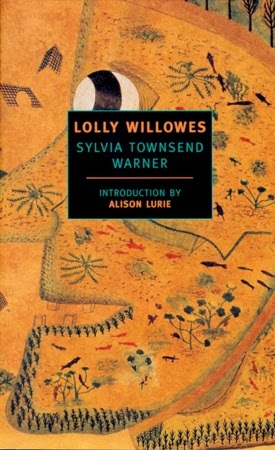
Sylvia Townsend Warner: Lolly Willowes (1926)

Lolly Willowes is a twenty-eight-year-old spinster when her adored father dies, leaving her dependent upon her brothers and their wives. After twenty years of self-effacement as a maiden aunt, she decides to break free and moves to a small Bedfordshire village. Here, happy and unfettered, she enjoys her new existence nagged only by the sense of a secret she has yet to discover. Finally that secret will set Lolly Willowes free.

Danielle (A Work in Progress) has an interesting series called Lost in the Stacks in which she introduces us to authors who have been forgotten or are not read much anymore. One of these authors was Sylvia Townsend Warner as you can read here: Lost in the Stacks – Sylvia Townsend Warner. Danielle mentioned that some of her novels are re-issued by NYRB or Virago and one of the titles Lolly Willowes looked especially interesting. And what a find it was. Not only does the novel tell the story of a unique and independent character but it is a lovely and very feminist book.

Until not too long ago the spinster was a character which could frequently be found in novels. I’ve read more than one novel containing either a spinster or which was about a spinster. They were mostly tragic and often infuriating. The way society treated these unmarried women who were clearly seen as a failure was not only condescending but very often exploitive. As Sarah Waters says in her excellent introduction to the Virago edition of Lolly Willowes, we can see the book to some extent as a re-write of older “spinster novels” like W.B. Maxwell’s The Spinster of this Parish (1922) and F.M. Mayor’s The Rector’s Daughter (1924). As the title of Townsend Warner’s book indicates, the topic has undergone a great change in her novel. The spinster has a name, she is no longer a helpless, independent appendage. Apart from being one woman’s story, the book contains also a subtle reflection on the times, just before and after WWI. The role of the spinster changed considerably after WWI. With so many young men gone, these unmarried elderly women were now seen even more as a useless burden.

Laura, called Lolly, Willowes lives with her father until the age of 28. When he dies her family assumes she will be better off living with her married brother and his family in London instead of staying in the country on her own. The loss of her father is a great tragedy for Lolly. She who lost her mother at an early age, loved living with her father and being relatively independent. She  was never interested in men or getting married. A quiet, introspective life, dedicated to her hobbies, botany and brewery, was all she ever wished for.

She disliked going out, she seldom attended any but those formal parties at which the attendance of Miss Willowes of Lady Place was an obligatory civility; and she found there little reason for animation. Being without coquetry she did not feel herself bound to feign a degree of entertainment which she had not experienced, and the same deficiency made her insensible to the duty of every marriageable young woman to be charming, whether her charm be directed towards one special object or, in default of that, universally distributed through a disinterested love of humanity.

Still she doesn’t make a fuss and follows her brother and his wife and stays with them for several decades. She doesn’t like it there, her sister-in-law is too well-organized, too strict, in other words too boring. She relies completely on her husband, never contradicts him and never seems to spend time on her own. In these surroundings Lolly undergoes a transformation which starts to alarm her more and more over the years.

Or rather, she had become two persons, each different. One was Aunt Lolly, a middle-aging lady, light-footed upon stairs, and indispensable for christmas Eve and birthday preparations. The other was Miss Willowes , ‘my sister-in-law Miss Willowes’, whom Caroline would introduce, and abandon to a feeling of being neither light-footed nor indispensable.

Before WWI breaks out, the Willowes spend all their summer months in the country. Lolly loves these stays and the memory of the beauty of the country side and her reception for everything related to the senses – scents, colors, aromas – open a door in her soul and offer an escape route. She often sits in front of the fire in London and dreams of being in the country on her own. This character trait gives the author the opportunity to include beautiful and evocative descriptions like this one.

At certain seasons a fresh resinous smell would haunt the house like some rustic spirit. It was Mrs Bonnet making the traditional beeswax polish that alone could be trusted to give the proper lustre to the elegantly bulging fronts of tallboys and cabinets. The grey days of early February were tinged with tropical odours by great-great aunt Salome’s recipe for marmalade; and on the afternoon of Good Friday, if it were fine, the stuffed foxes and otters were taken out of their cases, brushed and set to sweeten on the lawn.

After WWI, the society has undergone serious changes. Lolly feels restless. The children of her brother do not really need her anymore and she wants to leave. Finally she wants what her heart has been desiring since years; live in the country on her own. Her relatives are shocked. Her brother has to confess that he has lost a lot of her money due to reckless investments and she cannot afford the house she wanted. Nevertheless, nothing can hold Lolly back, she leaves anyway.

The second half of the novel is dedicated to Lolly’s life in the country. The village she has picked is very mysterious and slowly Lolly undergoes a transformation and becomes a witch. It may sound as if we were entering the realm of the fantastic here and to some extent we do, but the Satan we meet in this book, has more in common with Bulgakov’s Satan than with some fantasy figure.

I’m glad I discovered this wonderful novel. It has freshness and vivacity, is clever and witty and the descriptions are detailed and atmospheric, the portraits of the society and the people are true to life and Lolly is a very endearing character, an illustration of the importance of “a room of one’s own” and the right of women to live an independent life, even outside of society and without a man. It’s certainly one of the rare novels in which a being considered to be a useless burden on society shows that she doesn’t need society in order to live a truly happy and  fulfilled life.

Have you read this or any other of Sylvia Townsend Warner’s novels?

Len Deighton: Bomber (1970) Literature and War Readalong June 2012

It is very rare that I abandon a book. Often I regret this persistence when I finish it anyway and have to find out that it simply isn’t good. Sometimes I’m incredibly glad I went on. Len Deighton’s Bomber was one of those. I struggled badly for 150 pages and the idea to have to go on for another 400 seemed daunting. But it was worth the effort, it really was and looking back, I have to say, how lucky this was part of my readalong or I would have given up and missed out greatly. Bomber is amazing. It’s maybe not refined and highly literary but it’s a huge achievement. Not only because it is extremely accurate and detailed but also because it’s very engaging and admirably well constructed.

Bomber is an epic. A book with a huge cast and numerous different settings and story lines. Deighton really needed 150 pages to set the scene and introduce everyone, including the different aircraft. That part was really challenging to read as there were so many names and one had to try to constantly picture a map to see where they were located. Once the set up was done, the story moved on nicely, all the different story lines were tied together, the characters had become more than just names but people with a story.

Bomber tells the story of a bombing raid that takes place on June 31st 1943. Deigthon deliberately chose a date that doesn’t exist, knowing well that his book felt so realistic and authentic that people would always end up assuming it was non-fiction.

The 31st is a full moon night and all the crews get ready for a night of bombing and fighting. The target is the city of Krefeld in Germany. The planes take off from Warley Fen, head towards Krefeld and have to try to not get shot down before they have dropped the bomb. But before they can drop a bomb

First the PFF Mosquito aircraft will mark the target with red markers. Their gear is much more accurate than anything we have, so their reds are what the Finders must look for. The Finders will put long sticks of flares over the reds. Mixed in with the Finder aircraft there are Supporters – and these are mostly crews on their first couple of trips – who are carrying only high-explosive bombs. That’s because incendiaries could be mistaken for red markers.

What you just read is part of the instruction the pilots receive before flying off. But this part is more than that, it points towards the core of the book because the tragedy of the story has it’s source in the fact that, due to many unlucky circumstances, the markers were dropped on the wrong targets and what was bombed was the small city of Altgarten. No factories, no strategic points, just civilian buildings.

The first third of the book, sets the scene, the next third describes a lot of action and how the mistake happened and the last third is describing the drama in the air and on the ground in a very graphic way. I had to swallow hard a lot of times.

What I liked is that Deighton described a wide range of German characters, from the fanatic Nazi to the likable soldier. The portraits are nuanced and we get a feel for the diversity of the people.

The British crews are equally diverse but for other reasons. There are also Canadians and Australians, upper class and lower class men, married guys and womanizers, men who just do their duty, cowards and heroes.

In the death scenes Deighton’s sympathies clearly lie with the German civilians and the British bomber crews. Each part has one or two main characters and a lot of secondary characters and the fate of the main characters is equally sad in all the parts. I cannot go into too much detail, if you want to read it, you want to find out for yourself who will survive and who will die.

I’ve read a few harrowing accounts in the past and the one or the other book has depressed me incredibly. Bomber didn’t depress me but it brought a few tears to my eyes, a thing that rarely if ever happens to me unless something sad happens to an animal.

Bomber offers an interesting mix of emotional story telling, accuracy and numbers. We are informed of everything. How many people were involved, how many died, how many were injured, how many bombs hit target, how many were jettisoned, how many missed or didn’t go off and so on and so forth. At the end of the book were also informed about each and every surviving character’s future. It’s as if Deighton wanted to answer each and every question someone reading his novel might have.

If you ever wondered what it is like to be in a city which is bombed, this book will bring you close to this experience. If you ever wondered what it is like to be in plane on a bombing raid, this book will allow you to experience this as well.  In any case, if you are interested in WWII and how it was fought in the air, this is the book you should read.

If you’d like to find out a few things about Deigthon and his other books don’t miss visiting the Deighton Dossier. It is a site dedicated to Deigthon’s work and it is done with a lot of passion.

Other reviews (I’m somewhat doubtful that there will be any)

*******

Bomber was the sixth book in the Literature and War Readalong 2012. The next one will be Masuji Ibuse’s Black Rain. Discussion starts on Monday July 30, 2012.

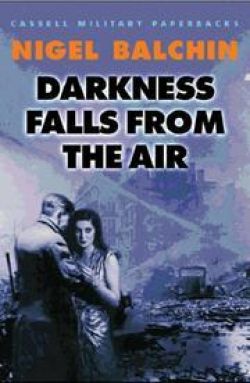
Nigel Balchin: Darkness Falls From the Air (1942) Literature and War Readalong May 2012

With ostentatious lack of concern, Bill Sarratt, his wife and her lover spend the war wining and dining expensively, occasionally sauntering out into the Blitz with cheerful remarks about the shattered night-life of London’s West End. But beneath the false insouciance lies the real strain of a war that has firmly wrapped them all in its embrace. Wit may crackle at the same pace as buildings burn, but personal tragedy lurks appallingly close at hand.

I have always wondered how people lived during the Blitz. How they coped with the fear, the chaos, the exhaustion and lack of sleep. I have seen a couple of movies set during WWII. Something that struck me more than once was the depiction of the Londoners during the Blitz. More than one movie showed them dancing or dining all through an air raid. Almost as if nothing was happening. I always wondered if this could have been the case. And what about the air raids that went on during the whole night? How would you cope with that? A lot of the questions I had have been answered by Darkness Falls From the Air. While I’m sure Blachin took some liberties and may have exaggerated, I think it still manges to give a good impression. It is one of the rare books that has been written during the Blitz which makes it especially interesting. Balchin worked as a psychologist for the British War Office and later as Deputy Scientific Advisor to the Army Council. Both occupations can be felt throughout the novel.

What I liked is how the main characters’ personal story, their marriage, work life and the war are interwoven.

In the beginning of the novel, the air raids aren’t as frequent at night and whenever a bomb falls down somewhere, Bill and his wife Marcia go and watch because it’s to a certain extent exciting. They do not feel threatened at all. They dine in underground restaurants and sleep in their own apartment. But the longer the war lasts, the more precarious the situation gets. People start to live in the tube and Marcia and Bill move to a hotel as their apartment house has no shelter. They still go out and dine underground and walk around the city to see the damage but it starts to become a bit less carefree. What gets to Stephen the most is the lack of sleep.

The day raids were dying down now. I suppose the pace was too hot to last. But to make up for it the nights were getting rougher than ever. The chief difficulty was to get enough sleep to keep going. Everybody was turning up at the office looking half asleep and sour as hell. I think it was this which led up to my row with Lennox. Lord knows there were enough reasons for quarreling with Lennox even if you were sleeping eight hours a night. When you got dow to an average of about three the thing was a certainty.

The narrator of Darkness Falls From the Air, Bill Sarrat, is a public servant. He must be one of the most cynical characters I’ve ever encountered in a novel. I didn’t expect this to be an amusing book but it was. Grim but funny. Passages like the one below illustrate what type a of person Sarrat is. He has an acute sense of the times he’s living in but at the same time he evades self-pity because he ultimately doesn’t take himself too seriously.

I’d decided that, what with work and Marcia and one thing and another, I was getting out of touch with the war. So I got out an atlas and Whitacker’s Almanack and so on and studied the war. That took about ten minutes. Then I tried forecasting the next bits. The last time Ted and I did that was at the beginning of the year. Ted put down that Germany would invade Switzerland, and that Japan would have a crack at Burma. I said that Germany would attack Hungary and Rumania and that Turkey would join up with us. The next morning Russia invaded Finland. An experience like that takes the heat out of you as a prophet.

The book follows three different narratives. The first is the marriage between Bill and Marcia which becomes more and more dysfunctional the longer the war goes on and the deeper Marcia entangles herself in her love affair with Stephen. The second story line centers on the depiction of life during the Blitz. The third narrative strand evolves around Bill’s occupation as a Civil Servant. The absurdity of the bureaucracy stands in stark contrast to the urgency of the matters they deal with. While “there is a war on”, they spend hours and days in useless meetings. Half of the staff is unprepared while others try to sabotage great projects out of sheer jealousy or incompetence. These parts reminded me so much of corporate life where people who have no clue will add tons of comments, questions and words of caution to a well prepared concepts just to pretend to be involved and competent. Additionally nobody wants to take a decision and those who work and think are the one’s seeing the useless people being promoted because they are in the way and no one knows how to deal with them otherwise. All this is captured by Balchin and these elements made this a very amusing book.

Blachin was, as I have mentioned, working as a psychologist and that shows in the parts dedicated to the love triangle. While I could have slapped Marcia and her vain lover Stephen, the discussions, the back and forth and Bill’s analysis of the whole story rang remarkably true.

While Darkness Falls From the Air has been called the novel of the Blitz, which it certainly is, it’s an amazing analysis of bureaucracy and a hopeless marriage. This was my first Balchin and I’m glad I discovered this author on Guy’s blog. It isn’t a flawless novel, it could have done with some editing but the voice and the tone are unique and the grim sense of  humour appealed to me a lot.

Other reviews

Danielle (A Work in Progress)

*******

Darkness Falls From the Air was the fifth book in the Literature and War Readalong 2012. The next one will be Bomber by Len Deighton. Discussion starts on Friday June 29, 2012.

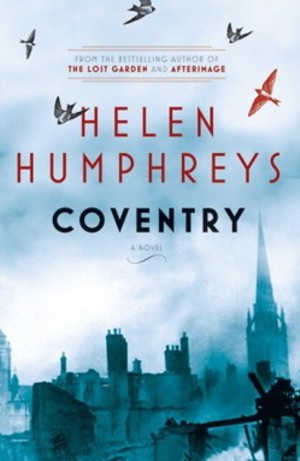
Helen Humphreys: Coventry (2008) Literature and War Readalong April 2012

Helen Humphrey’s novel Coventry starts with a woman and a young man standing on Coventry cathedral, on November 14, 1942. Harriet and Jeremy are fire fighters. It’s an eerie night, almost beautiful.

The moon is full and bright and the ground below the cathedral is white with frost. Harriet has never seen anything so beautiful. The ground glitters like the sea and smells of earthy cold.

This is the night in which Coventry cathedral will be bombed and most of the city destroyed. But when the bombs start falling and even after most of the destruction, Harriet still sees beauty.

The leaves have burnt black on the trees. The limbs are twisted and full of clothes, caught there like strange birds in the upper branches. The clothes must have blown up there from a bomb blast.

Harriet remembers the morning of November 14. How beautiful it was, all sun, and only a little wind to remind her of autumn. It was a thursday, early closing. She had gone round to the shops before lunch, and she had felt lucky because she was first in line at the butcher’s and got sausages.

Until this evening Harriet didn’t feel touched by the war. She is disappointed by it but not devastated. She will not, as she believes, suffer like she did in the last war when she lost the man she loved.

After the brief initial chapter, the novel moves back to 1914. A young Harriet sees her husband off to war. The very same morning, after returning from the train station, she meets Maeve, and lives a moment of intense friendship with the young woman. Harriet will not see her husband again. He goes missing in the trenches. And until the night of November 1940, she will not see Maeve again either.

Unbeknownst to all of them, the young man on the roof with Harriet, is Maeve’s son. The story of the two women’s lives will unfold during the novel, interwoven with the story of this tragic night in which the three fight in parallel and together, for their survival.

Harriet has never loved again and Maeve who left Coventry shortly after having met Harriet, gets pregnant. She doesn’t even know which one of the slodiers she was seeing is the father.

Most of the chapters focus on Harriet and Jeremy who flee from the burning cathedral, roam the streets, hide in shelters, run from the bombs and burning debris. They are looking for Maeve and their houses, anxious to discover how much they might have lost. The destruction is incredible, the sight of so many dead people is terrible but it’s even more harrowing to hear voices coming out from underneath demolished houses and not be able to help, to stand by and hear them suffocate. There are many descriptions of people whose life is snatched away within a second. One moment they are talking, shaving, walking, the next moment they are gone.

Coventry is a lyrical novel, written by a poet, telling the story of a poet who is trying to make sense. Since the tragic loss of her young husband, Harriet has written condensed descriptions. They shield her from emotion, give sense. That’s what she will do in the future as well. After the terrible night in which Coventry is destroyed, she will become a poet.

While Harriet paints with words, Maeve captures everything that has happened with her pencil. Already when they met in 1914 she was drawing constantly.

I’m in two minds about this book. It’s an intense description of what it meant to be in a city undergoing such massive destruction. This is well captured, at the same time, the addition of descriptions like the ones above, hold the horrors at arm’s length. I’m interested in the depiction and description of war. How do you put it into words, how do speak about the unspeakable? I think this was one of Helen Humphrey’s intentions, to show how a poet would write and feel about this horrible night. That’s why, more than a book about Coventry’s ordeal, this was for me a book about the birth of a poet. And that’s precisely what troubles me. I’ve read other books by Helen Humphreys and liked them, but in this case I feel the writing is too lyrical and esthetic for its topic. And there is the coincidence at the heart of the story, the fact that the young man Harriet spends the night with is Maeve’s son. Unfortunately I really don’t do well with this type of coincidence.

Coventry is a beautifully written book, the novel of a stylist but some rough edges would have given it a whole other dimension that would have been more appropriate for the subject. Still, and this may seem paradoxical, it is a book I would like to read again, if only for its language. Maybe I’m not doing it justice, maybe I’m just not used to someone describing war in such a lyrical way and depicting people who are so caught in their inner lives that they seem ultimately untouched by the collective experience of destruction.

I’m very curious to see what others thought.

Other reviews

Additionally to his review Tony has written an interesting post on his hometown Coventry and the Coventry Cathedral. It’s well worth reading.

Anna (Diary of an Eccentric)

Danielle (A Work in Progress)

TBM (50 Year Project)

Tony (Tony’s Reading List)

*******

Coventry was the fourth book in the Literature and War Readalong 2012. The next one will be Nigel Balchin’s Darkness Falls From the Air. Discussion starts on Monday May 28, 2012.

Muriel Spark: Territorial Rights (1979)

I have been looking forward to Muriel Spark Week hosted by Simon from Stuck in a Book  and Harriet from Harriet Devine’s Blog. I liked both of the Muriel Spark novels I’ve read so far,  The Girls of Slender Means and The Prime of Miss Jean Brodie. It was about time to read another one. Territorial Rights had been on my piles for a while and that’s why I decided to read it.

Sadly this book did not work for me and if it hadn’t been for Muriel Spark Week  – and if I was not a notorious book-finisher – this would have been a DNF for me. But first things first.

Territorial Right is set in Venice and as a Venice novel it is remarkably well done. I was there, I saw the streets, the canals, the piazzas, the palazzi, the churches, the street cafés and the back gardens. I enjoyed the descriptions a lot.

Now take this setting and throw in a motley crew of people, all magically coming to Venice at the same time. They know each other either from Paris, England or Bulgaria. They do not only know each other but they are all connected and even fleeing from each other only to bump into each other in Venice. Hmmmm. Add a dark secret that is hidden by two elderly women owning one of the local pensions, murmur of political machinations, drug dealers, an unfaithful husband, an elderly  woman wo likes young men, a Bulgarian artist in exile who jumps in the canal because she finds out she has been in bed with a Jew, a rich art dealer who is in love with a young man who disappears while his father abandons his lover for his sons ex-lover…

All is resolved in the end. Nothing was as it seemd at first. We find out what was hidden in the garden and get to know the past and the future of each character. Does it sound quirky? It sure was.

I think there is a lot going on in this novel that mirrors unresolved conflicts in Spark’s life and I’m sure from what little I have read after finishing the book that it would be interesting to analyze it in the light of this. Little incidents like the girl jumping into the canal to clean herself after having had sex with a Jew are meaningful when you know Muriel Spark had a falling out with her son because he was an Orthodox Jew and she a devout Catholic (as read on Wikipedia).

Since this is a very well written book, I can see how it could appeal to someone else. It’s a must for those who love novels set in Venice.

I hope others have been more successful in their book choices. Despite not having liked this, I will certainly read another of her novels soon.

Has anyone read Territorial Rights? Did you like it?

Literature and War Readalong April 30 2012: Coventry by Helen Humphreys

With last month’s book we have left WWI behind us and move on to WWII. The first of the WWII books is Helen Humphreys’ novel Coventry. I thought this would be my first novel by this author but I have read another one before, The Lost Garden, a wonderfully lyrical coming-of-age story which I liked a lot. With this in mind I’m keen on reading Coventry. Helen Humphreys is British but she lives in Ontario, Canada. Helen Humphreys has won several prizes, she is the author of 4 novels, one book of narrative non-fiction and four collections of poetry. I have a weakness for poets who write novels or novelists who write poetry because the writing is usually far above the average.

On the back cover of the novel it says that Coventry is “a memorial to the terrible losses of wartime, and a celebration of remembrance, determination and resilience.” The book tells the story of two women and moves back and forth between 1919 and the night of the 14 November 1940.

Here are the first sentences

The swallow arcs and dives above the cathedral. Harriet March watches it flicker through the darkness ahead of her as she walks along the cobblestones towards the church. The bird moves in the night air with all the swiftness of sudden feeling, and Harriet stops at the base of the ladder, tracking the flight of the lone swallow as it shivers up the length of the church spire.

*******

The discussion starts on Monday, 30 April 2012.

Further information on the Literature and War Readalong 2012, including all the book blurbs, can be found here.

Returning to Virginia Woolf

Maybe it’s because I’m reading Alexandra Johnson’s books and Virginia Woolf is an author who is central in them or perhaps it is because of Sigrun’s (sub rosa) Virginia Woolf project which I like to follow, whatever it is, Virginia Woolf was often on my mind lately.

I have this odd habit that when I like an author a lot I try to keep at least one of his or her books for later. There are a few authors whose complete works I have read but, due to my reluctance to run out of books to look forward to, they aren’t numerous.

Virginia Woolf is one of those authors where the thought I may finally have read all she has ever written fills me with a certain apprehension. While I’m still keeping Moments of Being for later, I have finally started The Voyage Out, the only novel I hadn’t read yet.

It’s funny to return to her and finalize the reading of her novels with the first book she wrote. It feels as if I had completed a circle. I started reading Virginia Woolf with Mrs Dalloway. I didn’t know that Mrs Dalloway was a returning character. I didn’t even know that Virginia Woolf had any returning characters. But here she is, in The Voyage Out, Mrs Dalloway, in all of her “glory”. Was she always this obnoxious? Frankly, I don’t remember. What I remember of my first Virginia Woolf novel was how much I liked the style.

The Voyage Out is very different from later books but at the same time it contains so many aspects typical for Virginia Woolf”s writing. I know many people read the body of work of an author they cherish chronologically but in her case, reading backwards wasn’t a bad choice. One could too easily overread important aspects of this early novel or, as was done when it was published, dismiss it as being nothing special.

Reading The Voyage Out makes me realize once more what I like the most about her writing. Yes, the style, especially in the later novels, is fantastic, with its flow of interior monologue, the way she uses time and how she describes the passing of time. But there is something else that stayed with me forever since the day I have read Mrs Dalloway. Her writing has an exhilarating quality, an effervescent intensity of feeling that made me think of a German expression which I adore: “Champagner Wetter” or “Champagne weather”. Champagne weather is used to describe a very fresh but sunny spring morning on which the air is still cool, nature has returned to life, the first tentative, tiny leaves appear, the first blossoms can be seen. It’s already a bit warm in the sun but still chilly in the shade. It’s like drinking the first glass out of a freshly opened, nicely cooled Champagne bottle. It bubbles and goes to your head. Virginia Woolf’s novels are full of scenes conveying the mood of champagne weather.  

I will write a “proper” review once I have finished the book but I’m enjoying it too much to wait until then. So far I can see that the story is told chronologically and sequentially, nothing daring really. But there is already a very striking way of writing about people’s interior lives. One of the main themes is the role of women and the way they are treated or rather mistreated by society. Parts of the novel reminded me of E.M. Forster, others of Henry James’ Portrait of a Lady. Rachel, one of the main characters, has a lot in common with Isabel Archer. Still there are scenes which are already typically Woolf. She had a very particular way of showing the passing of time or how the interior worlds of people coexist. There is a wonderful scene towards the middle of the novel in which we see a hotel at night.  First we see it from the outside, all its windows are illuminated, the people are getting ready to go to bed. Later we approach and enter the building, brief glimpses into the various rooms draw pictures of the inhabitants. At the end of the scene, they are lying in their beds, separated only by thin walls, dreaming or just sleeping, drifting off into unknown territory, as if on a big ocean liner. It is a recurring scene really, as the book starts with the voyage on a ship.

It is possible that I will start rereading her books in chronological order when I have finished The Voyage Out and Moments of Being. My favourite of her books are Mrs. Dalloway, To the Lighthouse and Flush. I didn’t like The Years or The Waves much and can never even keep them apart. I also didn’t care for Orlando at all. Not sure why, it’s generally a favourite of many people but I remember I found reading it was painfully boring. Jacob’s Room and Between the Acts were two I liked but the memory of them is barely more than a vague impression.

I often hear people say, they are intimidated by Virginia Woolf, just like many are intimidated by Proust or James Joyce. For those who didn’t dare reading her so far, The Voyage Out and Flush are excellent starting points.

Have you read The Voyage Out or any other of Virginia Woolf’s novels? Which is your favourite?