Steven Millhauser: Enchanted Night (1999)

“This is the night of revelation. This is the night the dolls wake. This is the night of the dreamer in the attic. This is the night of the piper in the woods.”

Hot summer nights have a special magic. In the middle of the night, when everyone is sleeping and only night creatures are awake, the hot still air is heavy, time seems to stand still and the world is indeed enchanted. This is the magic captured by Steven Millhauser in his beautiful and poetical novella Enchanted Night. I have never read this book before but the images, the atmosphere felt so familiar. It was a bit like looking into my own imagination.

Thanks to Carl who reviewed the book not long ago (here is his review), I waited for a hot summer night to read it. I’m glad I did. It felt so right to read this novella during one of the very few hot nights we had this summer.

Here is the beginning of this wonderful book.

A hot summer night in southern Connecticut, tide going out and the moon still rising. Laura Engstrom, fourteen years old, sits up in bed and throws the covers off. Her forehead is damp. her hair feels wet. Through the screen of the two half-open windows she can hear a rasp of the crickets and a dim rush of traffic in the distant thruway. Five past twelve. Do you know where your children are? The room is so hot that the heat is a hand gripping her throat. Got to move, got to do something. Moonlight is streaming in past the edges of the closed and slightly raised venetian blinds. She can’t breathe in this room, in this house.

Laura isn’t the only restless being on this hot and sultry night whose quiet darkness is illuminated by moonlight. All over the little town people feel their yearnings and desires, think of their dreams and wishes. Many of them feel lonely and driven by a secret longing. There is the writer who has turned the nights into days. He writes until midnight, then goes out to visit an elderly woman, roams the streets and sleeps until after noon. He is 39 years old, lives with his mother and has been trying for years to write the definite historical novel. Mrs Kasco, the widow he visits in the middle of the night, still regrets that she didn’t seduce him, when he was still a teenager and she a fairly young woman. On the other side of the city a mannequin in a shop window feels a secret stirring and comes to life. A young man who has never made love to a girl is visited by the moon Goddess while he lies in a backyard dreaming. A mysterious piper plays a flute and attracts stray children. Black cats haunt the streets, four girls wearing masks break into houses. A lonely woman walks the street in a pink bathrobe. A sleezy man spies on a young girl who takes a moon bath.

The story of this hot enchanted summer night, in which abandoned dolls come to life in the attics of the houses, is told in small tableaux, little atmospherical sketches that seem to originate in our childhood imagination. I remember how, when I was a child, I used to check in the morning  whether my toys had moved. Like many children I secretly thought and hoped they were alive at night. My biggest wish was to catch a glimpse of their doings.

Millhauser doesn’t only capture childhood dreams and wishes but also those of teenagers, grown-ups and the elderly and interweaves them in this haunting tale which is written in beautiful, melodious prose that seems inspired by lyrics.

He’d like to wipe it all out, start things over again, give the land back to the Indians. Or better yet, give it to him, to Haverstraw, King of the New World: trapper, hunter, fisher, farmer, sower of appleseed, stargazer, trailblazer, pathfinder, deerslayer, barefoot boy with cheek of tan, Huck Finn on the Housatonic, crackerbarrel philosopher, wily old coot in a coonskin cap, shrew-eyed Yankee, inventor of the cotton gin, the printing press, the typewriter, founder of libraries, distributor of American jeans to the Indians, self-made tycoon in a thirty room mansion, a hometown boy, worked his way up, one in a million, lone ranger, a wayfaring stranger, a born loser, a man down on his luck.

I don’t know anything about Millhauser, only that he won the Pulitzer Prize for Martin Dressler, but his style is so accomplished that I’m curious about his other books.  Does anybody know them?

Indonesian Short Stories

Thanks to Novroz from  Polychrome Interest and Mel U from The Reading Life I discovered Indonesian short stories.

Novroz who is from Indonesia and Mel U who lives in the Philippines are hosting an Indonesian short story month this August and everyone is welcome to join. If you want to know more, check out Novroz’ Introductory Post where you can find suggestions and links to sites where you can read Indonesian short stories online.

I read a few stories but the one I liked the most was by Nenden Lilis A., an author from West Java. I found the story which is called The Rooms Out Back in the issue Tropical Currents of Words Without Borders.

I liked The Rooms Out Back a lot, it opens a door to a world we don’t know, to ways of life we are not familiar with.  There is such a lot in this story, I hardly know where to start.

A young woman, mother of a small child, lives with her husband in a very lively, somewhat chaotic apartment building. Every morning at 7.30 they are woken by the shadow of a cat. Usually they get up at 4.30, do various things, chat with neighbours, pray and nap for a little while until they finally get up for good.

From the first scene we are drawn into this world where a lot happens outside of the apartments and the narrator tells us something about all the inhabitants of the house.

Unlike most of the others she is a happy wife, her husband is kind and gentle and helps a lot while the other husbands tend to drink, have affairs and beat their wives.

What I found extremely fascinating is the narrator’s relationship with Umi, one of the women in the house. Umi has been abandoned by her husband and tries to make a living selling lotions and potions and massaging people.

Reading about this reminded me a lot of my studies of cultural anthropology where I learned how much of the money gained for some households in some countries stems from informal economy. Like housework it is invisible but contributes to a large extent to the family’s survival. These women have to be industrious and ingenious to make a living.

The casualty in their discussions fascinated me, they mention sex naturally and without shame, the body is important and treated as such. Umi offers to massage the narrator because she feels tense. Imagine we would offer that to someone we hardly know?

Just one word on the writing. It isn’t anything special but we have to bear in mind that these stories have been translated from the original language. Maybe the style is more refined in Indonesian.

You can read the story here. I’m interested to read more of her work and to discover other authors.

Simone van der Vlugt: Shadow Sister – Schaduwzuster (2005) A Dutch Thriller

Married. One child. A career: Lydia has her life in perfect order – if only everyone else around her could be as organised as she is. Her unmarried twin sister Elisa is still struggling to find what she wants to do. And her colleagues at the school where she teaches often fail to reach her high standards.But one day, it all falls apart from Lydia. When she is threatened by one of her pupils, her sister is the first person she turns to. But Elisa is powerless to stop the campaign of intimidation that follows. How far will it go? Or is someone else taking advantage of the situation? And what is Elisa’s part in all of this? Twins are close. Aren’t they?

I was looking forward to reading Shadow Sister because Simone van der Vlugt’s first novel Reunion was excellent, a gripping page-turner with a surprising ending. Shadow Sister wasn’t as good but despite its flaws I couldn’t put it down and thought the ending was not foreseeable.

The story is told from a first person point of view, alternating between the two sisters. While we know early on that Lydia was killed, we still read her chapters. The chapters of the sister start after Lydia has died while hers progress slowly towards her death.

Lydia is a Dutch teacher at a school for immigrant kids. It isn’t an easy job but she loves it. She thinks she can make a difference and that is all that matters to her. The kids aren’t very disciplined and get into fights among each other but mostly they respect her. Until Bilal, a Moroccan boy, feels ridiculed by Lydia and attacks her with a knife. She has him suspended from school and from that moment on she feels threatened. Someone stands in front of her house at night, someone follows her from the school. The police take it very seriously but she just reports it. When she is killed, no one has doubts that it was the boy but Bilal has an alibi.

From her sisters point of view we start to see another side of Lydia. We realize that she was maybe not as perfect as everybody believed and we also realize that there were problems in the marriage. Her husband Raoul is a bit too good-looking and he seems to be having an affair or be in love with someone. We also find out that Elisa has feelings for her brother-in-law.

All this together makes for gripping reading. The description of the school and the problems schoolteachers face nowadays with children who are not motivated, who come from other cultures, who don’t take a woman seriously, who feel threatened in their masculinity the moment you criticize a tiny thing, is interesting. What I didn’t like is the fact that van der Vlugt uses present tense all through the book. And I wouldn’t call Shadow Sister a psychological thriller as there isn’t much in terms of character analysis. Both sisters sound exactly the same and also the other characters are a bit flat. The person that is rendered best is Lydia’s little daughter.  If you are looking for another Ruth Rendell, this isn’t your book but if you look for a gripping page-turner offering social elements, you might enjoy it.

Literature and War Readalong August 26 2011: La Storia – History by Elsa Morante

The readalong book for August, La Storia or History,  is one of the most important books of Italian literature. It is also quite a substantial book, depending on the edition, it is over 800 pages long which is why I decided to post the introduction already today to give anyone who would like to read along the opportunity to do so.

I’m already on page 150 and fascinated by her writing that reminds me of Latin American literature in its exuberance. Before the individual chapters there are detailed accounts of the history of Italy. La Storia is pretty much the story of a woman, the schoolteacher Ida Ramundo, and the history of a country. Given all the atrocities Germany committed we tend to forget that there were allies like Italy. The history of Italy during WWII is  story of megalomania, bad choices and bad planning and borders quite often on the ridiculous. But there are also stories of resistance and heroism. This, however, is not the topic of this novel.

I did a bit of research and found out that a lot of this novel is based on Morante’s own life. Her mother was half Jewish and a teacher, like Morante herself.

Elsa Morante was married for quite a long time to Alberto Moravia, author of  La Noia (Boredom) and many other outstanding books.

History isn’t Morante’s only novel, she is also the writer of Aracoeli and L’isola di Arturo (Arturo’s Island).

La Storia has been made into a mini-series starring Claudia Cardinale as Ida Ramundo.

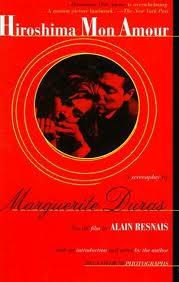
Marguerite Duras and Alain Resnais: Hiroshima mon Amour – Book and Movie (1959/60) Literature and War Readalong July 2011

How do you talk about war? How to put it into words, into pictures? How to tell and show the unspeakable, the horror, the atrocity? How much can you know about something that you have not experienced? These are but a few questions Marguerite Duras and Alain Resnais explore in the book and the movie.

Hiroshima Mon Amour is maybe the most difficult book of this readalong to write about. A summary wouldn’t do it justice. I was amazed once more how good it is, how profound and how the book and the movie seem like two different ways of exploring, with two different languages, the atrocity that we call war. What is fascinating is how they seem to converse with each other.

In 1959 a Japanese man and a French woman meet in Hiroshima. They are both a bit over thirty and happily married. They spend a night together. It is shortly before the woman’s return to France. She is an actress who has come to Hiroshima to play a nurse in a movie on peace. They make love and talk. First about Hiroshima, then about the past of the woman. They part for the day but he follows her and they spend another night together, stay awake, spend  time in a tea house. During the second night, the woman tells the man the whole story of her past in Nevers and her tragic first love. She hasn’t told anyone this story before because there was never anyone like her first lover after that until this day.

I’m glad I read the book again before watching the movie. It was interesting to see how different it is when we first imagine something and when we then see it as well.

During the initial part of the movie we hear a voice-over. The woman tells the man everything that she has seen in Hiroshima. In the news at the time, in the museum during her stay. When you read it, you see in your imagination what you have seen before in documentaries or on photos but the movie shows you how it really was and on the other hand you have the man’s voice telling you, that you have seen nothing, know nothing. There is no replacing the actual experience.

The first pictures show bodies, parts of bodies, first covered in what looks like fall out, then in sweat. This reminded me of Resnais’ documentary Night and Fog. It is the same visual language that tries to show us what violence does to the body, that tries to capture the devastation. Hiroshima Mon Amour seems also to say that war and love can be equally destructive. There is violence in aggression and in passion.

What struck me is that we do not know their names. At the end they give each other the name of the places in which their mutual tragedies happened. She calls him Hiroshima, he calls her Nevers.

One of the themes of the book and the movie is how the collective and the personal tragedies are linked. While Hiroshima and WWII stand for a collective tragedy, Nevers stands for a personal tragedy. This is one of the achievements of  Hiroshima Mon Amour. One approach in war stories or war movies is to pick one exemplary person and tell his/her story. We understand the individual far better, can identify far better with one person’s story but the large-scale of the collective should not be forgotten. Hiroshima Mon Amour is one of the rare movies/books who manages to show both and make clear that they are interdependent.

For those who have not read the book, I would say that it is a valuable addition and it is fascinating to see how they complement each other. First there is the script, including proposals by Marguerite Duras, then she adds information on what scenes Resnais finally chose, plus there is an annex in which Duras goes deeper, explores the woman’s story, gives it more density. I liked the appendix, that was mostly dedicated to the woman’s story, a lot.

There are many things that are worth discussing and I am looking forward to hear your thoughts. One question that has been on my mind since I re-watched the movie is the choice of the Japanese actor. He struck me as looking quite European. I had kept the appendix for last and was glad that Duras mentioned this choice, saying they had wanted to make a more universal statement with this. They didn’t want people to think “That’s an attractive Japanese” but “That’s an attractive man”. I was not completely happy about this. It’s a sad fact that whenever a person from another continent is casted in a European movie, the film directors think of the European taste and choose someone less typical. This is unfortunately exactly how exotism works. I think Resnais and Duras were honest in their attempt but I’m not sure it was ok.

Other reviews:

Emily (Evening All Afternoon)

Litlove (Tales from the Reading Room)

Richard (Caravana de recuerdos)

*****

Hiroshima mon Amour was the seventh book in the Literature and War Readalong. The next one will be Elsa Morante’s History. Discussion starts on Friday August 26, 2011.

On Re-Reading Ambrose Bierce

Some classics are part of our childhood reading. There are many different writers that I haven’t re-read since I was quite young. Ambrose Bierce was one of them.

I remember sneaking off with a volume of his short stories and liking them very much when I was little. I knew nothing about the man, only much later when I read a lot of Latin American literature and came across Carlos Fuentes’ Gringo ViejoThe Old Gringo, that was also made into a movie, did I learn something about the man himself. Or rather the mystery of his ending. In 1913, at the age of 71, he rode off to Mexico and was never seen again. Fuentes’ exploration of his vanishing is a great book. I have also seen the movie but can’t remember if I liked it or not. It is believed that Bierce, who also fought in the Civil War, joined the forces of Pancho Villa.

But even without such a mysterious ending, Ambrose Bierce would be an interesting character. He was known for his satirical writings in which he used an acerbic and vitriolic tone. Some of his articles seem to have ruined more than one career of a new writer. He also wrote a lot of short stories and his famous The Devil’s Dictionary.

Since my time is limited these days, I’m much more inclined to read short stories and novellas besides my chunky August Readalong choice (Elsa Morante’s History – one of the great works of Italian literature ! – Yes, you can still join me).

Yesterday I decided to re-read some of Ambrose Bierce’s short stories. I wanted to see how I would like them as a grownup and how the knowledge of his disappearance would influence my reading. I read An Occurrence at Owl Creek Bridge, Beyond the Wall, An Adventure at Brownville, The Damned Thing, One of the Missing and The Stranger. Most of Ambrose Bierce’s short stories can be found online here.

I really loved these stories. Bierce is a fantastic writer. Realistic, yet capable of creating an eerily haunting atmosphere. The Civil War, in which he served, is often a backdrop. The stories are either set in San Francisco or rural California, one takes place in an Arizona desert. The city as well as the country provide material for mysterious descriptions.

In my memory, Bierce’s stories had a certain resemblance with Edgar Allan Poe. It is also said that H.P. Lovecraft was influenced by him. Of the 90something short stories written by Bierce far over 50 have a supernatural, macabre or horror theme. What I had not realized when reading them before is the fact that he has a lot in common with Maupassant. The descriptions more than anything bear a strong resemblance with Maupassant’s short stories. Poe’s descriptions are different.

An Occurrence at Owl Creek Bridge is one of his most famous stories. It is set during the Civil War and tells the story of a man who has been sentenced to be hanged. The story is, like so many others, quite surprising, it is non-linear and offers an unexpected ending. There isn’t anything supernatural in this one, just a touch of it.

Beyond the Wall is a ghost story set in San Francisco during a cold winter night.

The night of my visit to him was stormy. The Californian winter was on, and the incessant rain plashed in the deserted streets, or, lifted by irregular gusts of wind, was hurled against the houses with incredible fury.

An Adventure at Brownville is an atmospherical exploration of the mind’s faculties. It is a beautiful story with great descriptions.

As I leaned wearily against a branch of the gnarled old trunk the twilight deepened in the somber woods and the faint new moon began casting visible shadows and gliding the leaves of the trees with a tender but ghostly light.

The Damned Thing is the story that reminded me the most of Maupassant. It is a very subtle horror story in which two men go hunting.

One of the Missing is the longest story in the collection. It is a tragic story of the Civil War in which a soldier of General Sherman’s army is sent on a dangerous mission.

The Stranger is a ghost story in form of a Western. A party of men camping in the Arizona desert meets a mysterious stranger who tells them an uncanny tale.

If I think of the story of his life and compare its ending to his tales, I think, it is safe to say that Bierce loved mysteries. Maybe he didn’t want to return, maybe he got lost on the way or something occurred that was similar to what happened to the soldier in One of the Missing. One thing is certain, we will never know.

As I said, I enjoyed reading these stories a great deal and since we have autumn-like weather it was quite fitting. I sat on the balcony floor while reading them, it was raining and quite cool. One of the cats was lying on a table, the other one sitting with me under the woolen blanket I had draped around myself. There were a dozen ravens sitting on the huge maples in the back garden flapping their wet wings and cawing.

Frank Herbert: Dune (1965) Book III The Prophet

It is Saturday once again and time for the third and last Dune readalong post. I’m so glad I participated despite the initial feeling of “What have I gotten myself into?”. I can still not say, I loved Dune, that would be a lie but I can say I loved the readalong. It was a great experience, the dedication and the discussions were great and I’m looking forward to the next readalong. The readalong is hosted by Carl V from Stainless Steel Droppings,  The Little Red Reviewer and Grace from Books without any Pictures. This weeks questions have been sent by Grace. Here are the other links.

What is your reaction to finally learning the identity of Princess Irulan?  Do you think that her convention added to the story?

I wanted to “meet” her from the beginning and was very intrigued by her character. The parts quoted from her manuals and books stand out style wise. I was not surprised that she was the Emperor’s daughter but saddened about the plans they had for her. She strikes me as too special to be handled like some goods.

Were you satisfied with the ending?  For those reading for the first time, was it what you expected?

I still don’t think it feels like a standalone novel. For me the story is just about to start, I also think that this third part felt rushed. There were some fastworwarding moments that did not feel right to me. Comparing it to the first parts, there were much more things that were just mentioned but we did not see them happen.

On both Arrakis and Salusa Secundus, ecology plays a major role in shaping both characters and the story itself.  Was this convincing?  Do you think that Paul would have gone through with his threat to destroy the spice, knowing what it would mean for Arrakis?

I thought that it was very well done how ecology and characters of the different cultures were interwoven and for me this was the special appeal of Dune. I’m fascinated how surroundings influence and form cultures or how one thing that is meaningful because it is scare in one place, becomes unimportant in another to an extent that it isn’t even appreciated anymore.

There certainly is a possibility that Paul would destroy the spice but I’m sure he will find a solution not to do it. Someone who gets married to a woman for purely political reasons doesn’t strike me as someone who will give up a pricey resource.

Both Leto and Paul made their decisions on marriage for political reasons.  Do you agree with their choices?

This ties back to answer no. 1. I found this quite horrible, horrible for the concubine and, in Paul’s case. also for the future wife and I have also a feeling that this will not work and this is also why I thought the book ended at an awkward moment. I can’t imagine that Paul will use the Princess Irulan purely for breeding or, I hope, she will not let him do that to her.

What was your favorite part in this section of the book?

I enjoyed it when they rode the worms. I was fascinated by these creatures the whole time and thought it showed so well to what extent the Fremen are capable of mastering their hostile surroundings.

One of the things I noticed in the discussions last week was Herbert’s use of the word “jihad.”  What do you think of Herbert’s message about religion and politics?

I said it in the last posts and the discussion that I found the use of the word jihad problematic but I also found the use of the word messiah problematic and I can’t see Paul as a Messiah figure. He has some superior mental faculties but that isn’t enough for me to see a saviour figure in him. What Herbert does, is mix a lot of elements from all sorts of religions, it is a real religious hodgepodge what he offers.  I am not sure what he wants to tell us with this. That all religions are equal? That the elements are interchangeable? The religious world he created has no new elements, that’s for sure. Maybe the most striking is that he created a world in which everything is tied to politics and religion. And politics and religion are once more tied together, something the West has overcome. There is no laicism on Dune, their political system is far from secular which will always be problematic.