Jacqueline Winspear: Maisie Dobbs (2003) The First Maisie Dobbs Mystery

I’m not sure who mentioned Maisie Dobbs first. Either Danielle on A Work in Progress or Kailana on The Written World. Whoever it was I’m glad she did as Maisie is an amazing heroine. I really like her and the way she goes about her job. The period details are captured in a very descriptive way, reading often felt like watching a movie.

The story begins in London, 1929. Maisie Dobbs has opened her first office. She is a private investigator and psychologist who has been trained by a master of the art, Maurice Blanche, a friend of Lady Rowan, on whose estate Maisie used to be a maid.

Her first investigation leads her to follow the wife of Christopher Davenham. He suspects her to have a lover. What Maisie finds out is quite different from what Davenham and the reader think and will lead Maisie to investigate a crime and confront her with her own past.

The second part of the novel rewinds to 1910-1917. In 1910 Maisie is just a girl who lives alone with her father after her mother has died. She is unusually intelligent and her parents wanted to send her to college later but the mother’s illness has swallowed up all of their money and Maisie is sent to Lady Rowan as a maid. They soon find out about Maisie’s fondness for reading and learning and give her a private tutor, Maurice Blanche. Blanche is a special fellow with an eye for people and an unusual capability of seeing behind the masks.

Maisie finally goes to university and is about to embark on a splendid academic career when WWI breaks out. Like so many other young women she volunteers as a nurse and is sent to France where the man she has recently fallen in love with is serving as a doctor.

Maisie’s life story, the crime and its solution are all rooted in WWI. While I didn’t think the crime was gripping I thought the way the book revealed what happened to Maisie during the war was suspenseful. I truly admired the way it managed to convey an idea of WWI. Maisie and many other characters still suffer from various ailments or traumas. This, for example, is Maisie at the beginning of the novel.

Lucky, thought Maisie. Except for the war, I’ve had a lucky life so far. She sat down on the dubious oak chair, slipped off her shoes and rubbed her feet. Feet that still felt the cold and wet and filth and blood of France. Feet that hadn’t felt warm in twelve years, since 1917.

Facial wounds play and important role. The wounds and how society and the wounded handle them. But the horror of the trenches, the constant rain, mud and cold are rendered as well.

It’s certainly a novel that appeals to many people. To those who like cozy mysteries, to those who are interested in WWI. Fans of the upstairs-downstairs theme will love the middle section. Maisie Dobbs is a likable and clever character and to get to know the way how she reads people is fascinating. Her way of working is a mix of psychological analysis and psychic abilities that I enjoyed a great deal.

There are by now 9 books in the series and the fans and followers are numerous.

Because of its lovely design and a lot of information it is worth to visit Jacqueline Winspear’s Website.

If you are interested, March is Maisie Month on Facebook.

Maisie Dobbs is my third contribution to Anna and Serena’s War Through the Generations challenge.
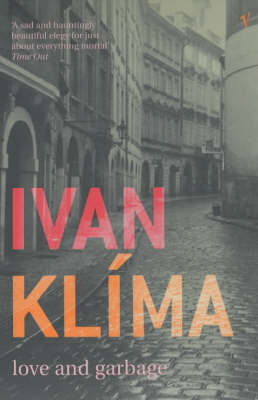
Ivan Klíma: Love and Garbage – Láska a smetí (1988)

Donning an orange vest, the narrator–a banned Czech writer–sweeps the Prague streets with a group of the society’s other outcasts–an old sailor given to drink, a sickly teenager, a foul-mouthed former beauty, a failed inventor, and an ex-pilot. As they go about their mindless job, the narrator learns of the dreams and sorrows of his coworkers and meditates on the life and work of Franz Kafka, the power of literature, and his relationship with his dying father. 

Love and Garbage is my first book by Czech writer Ivan Klíma. It’s said to be one of his best. Klíma had a difficult life. Born in Prague in 1931, he spent some years of his childhood in the concentration camp Theresienstadt.  Later he was an editor in his home town. He spent 1969/70 in the US where he taught Czech literature at a university but when he returned to Prague in 1970 he was forbidden to publish until 1989. Love and Garbage contains a lot of Klíma’s own story but it isn’t, as he says, autobiographical.

The narrator, a writer who isn’t allowed to publish, starts working as a street sweeper. The slow and contemplative work allows him to explore his city, to think about his life and an essay on Kafka he is writing and helps him forget his lover. Because he chose to work as a street sweeper and it isn’t necessity who forces him to do this job, he likes it. He likes his colleagues, most of them are outcasts too. The work he is doing doesn’t only allow him to think about his life but it turns into a philosophical meditation on what the society deems worthless. Garbage and human beings alike. As a child the writer who is Jewish lived in Theresienstadt and most of his relatives were killed. The Jews, he muses, were like garbage for the Germans, worthless and had to be discarded and burned. The novel is full of linked symbols and elements, of scenes that are mirrored and repeated.

After he was forbidden to publish, he was desperate, caught in a marriage that didn’t mean much anymore, to a wife who had started a new life. She was studying psychology and trying to help others while he spent his days locked inside, chasing thoughts, trying to write. During this time he meets the sculptor Daría and falls passionately in love with her. When the affair ends, he decides to sweep the streets. This is symbolical as well, he starts to clean the city around him, to make room inside for another, clean start.

The writer is working on an essay about Kafka and often returns to him. He is reminded of Kafka constantly. For him, Kafka was the purest possible writer, an outcast like himself, not really understood and unhappy in love.

When the novel begins, the narrator is heartbroken but that doesn’t explain the sadness in the book. The sadness comes from looking back, thinking about his childhood in the concentration camp and all the people he lost. The only person still alive from that period is his father but he is very old and ill. The saddest thing is that despite everything that happened in the past and that his country had to endure, instead of having a better life now, they live under a communist regime. The constant threats and lack of freedom make life unbearable. His affair with Daría is an attempt at finding happiness but it turns bitter eventually and when he tells his wife about it, it seems at first that he will end up losing both women.

Love and Garbage is a challenging read. It demands concentration as the story moves back and forth in time, breaking up the chronology, sometimes up to three times per page. It took a bit of getting used to but once I had read a few pages I liked it. This type of writing doesn’t allow you to fall into some sort of reader’s trance but wakes you up constantly. This may sound like a gimmick but that’s not what it is at all. It’s a cunning way to mirror the narrator’s interior life.  It’s not so much an interior monologue as a way to render how freely thoughts move, unlike the person who thinks them. We easily move back and forth in our minds, a childhood memory can be followed by some thoughts about the past day. In our minds we can go wherever we want, at any time we choose.

I have read a lot of Czech writers who wrote in German but only a very few who write in Czech. As I have found out, Love and Garbage was meant as an answer to Kundera’s Unbearable Lightness of Being which Klíma considered to be chauvinistic.

I liked Klíma’s writing. It’s unusual, complex, poetic and highly descriptive. There is hardly an aspect of human life that isn’t touched and that’s why the book is like a delicately woven tapestry. One pattern evokes another one, one angle mirrors the next, all is linked and intertwined. Poetical passages follow psychological insights, philosophical thoughts come after realistic descriptions. The book is sad but the way the writer fights for the tiniest bit of happiness and the richness of his interior life are so beautiful, they illuminate the book from within.

Have you read Klíma or other Czech writers?

Maureen Gibbon: Thief (2010)

Maureen Gibbon’s novel Thief is a powerful account of a young woman who has been raped as a teenager and now, in her thirties, is still trying to come to terms with this event. The life she is leading is like a walk on a tightrope. One dangerous boyfriend follows the next and even as a very young teenager she already led a promiscuous and risk-taking life.

At the beginning of the novel, she has left the Twin Cities and rented a lonely cabin near a lake. A bit too lonely maybe or she wouldn’t place an ad in the local newspaper looking for a “Great kisser, good listener”. One of the men who answers her ad, is Alpha Breville, an inmate in a state penitentiary. She writes and finds out that he was convicted because he raped a woman seven years ago.

What is it that makes her write back and go and visit this man week after week? She thinks it is because she is looking for closure and he will help her with this. Or is it once more her addiction to danger, sex and romance? It’s a little bit of everything, as we come to understand. But while Alpha sits behind bars, she still sees other men. One of them a cowboy who reveals to be as dysfunctional as all the others she has left before.

This is a highly disturbing book. Disturbing, honest and intriguing. I was very captivated and found it believable. I used to read a lot of psychology books and some of them were dedicated to addictions. The portrayal of a self-destructive, promiscuous woman who acts out via sex and romance was realistic for me. After I finished it, I noticed, how numbed Suzanne is, she is very self-destructive, seeks out men who have the potential to harm her, falls in love as soon as she had sex with a man, even a complete stranger, but she remains unemotional. The most important thing for her is, as soon as something is over, to find someone new.

The big question at the heart of the story is whether the rape victim and the rapist can heal each other and whether she brought the rape upon herself. This last question was particularly disturbing.

Maureen Gibbon has been raped as a young girl, just like Alice Sebold, the author of The Lovely Bones. The difference in their approach is interesting. I didn’t like The Lovely Bones but I liked Thief.

It’s a book that would be ideal for an open-minded discussion group or book club. Open minded because it asks uncomfortable questions about rapists and their victims and also because there is some very explicit sexual content. It’s not gratuitous as one of the topics is sexual addiction but I felt I needed to say it.

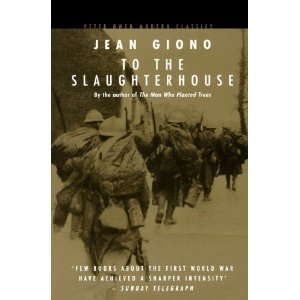
Literature and War Readalong March 30 2012: To the Slaughterhouse – Le grand troupeau by Jean Giono

Jean Giono’s To the Slaughterhouse – Le grand troupeau is the last WWI novel of this year’s readalong. Giono is one of the great French writers, famous for books like L’homme qui plantait des arbresThe Man Who Planted Trees, Joy of Man’s Desiring – Que ma joie demeure orLe hussard sur le toit – The Horseman on the Roof which has been made into a successful movie. His books are deeply rooted in the South of France and he is often compared to Pagnol.

I try not to be too enthusiastic this time, but, let me just say, cautiously, I think, this should be a good book. At least he is an author who has never disappointed me so far and I’m even planning on (re-)reading a few of his other books this year, like Colline, Un de Baumugnes and Regain, the so-called Pan trilogy. Giono is famous for the way he describes the joy of life and that’s why I’m particularly interested to see how he treated such a bleak subject.

Here are the first sentences

Last night they watched as all the men left. It was a thick August night smelling of corn and horse-sweat. The animals were harnessed in the station-yard. The big plough-haulers had been tied up to the shafts on the carts; their solid rumps held back the loads of women and children.

The train moved off quietly in the night, spattering the willow trees with embers as it took on speed. Then all the horses started moaning together.

*******

The discussion starts on Friday, 30 March 2012.

Further information on the Literature and War Readalong 2012, including all the book blurbs, can be found here.

Madeleine St.John: The Women in Black (1993)

With the lightest touch and the most tender of comic instincts, Madeleine St John conjures a vanished summer of innocence. The Women In Black is a great novel, a lost Australian classic.

Madeleine St. John wasn’t on my initial list of authors for the Aussie Author Challenge but after one of Litlove’s (Tales From the Reading Room) comments I thought I’d like to read one of her books and picked The Women in Black. Coincidentally Litlove reviewed it recently as well as you can see here.

The Women in Black is Madeleine St. John’s first novel. She wrote it at the age of 52. It was followed by three other novels which, unlike the first, were not set in St. John’s native Sidney but in London where the author had been living since the 60s. The book is set in the 50s in Sidney and takes place to a large extent in a famous department store, just before the Christmas rush, on the floor of Cocktail Frocks and Model Gowns. It centers on a little group of interestingly different women, Patty, married to Frank (the brute), Mrs. Jacob, the mysterious, Fay, the thirtysomething single woman, Lisa aka Lesley the assistant (temporary) and Magda, the glamorous European refugee who has more elegance and style than all of them together.

Magda and Lisa are the characters where most of the other stories converge and are the indicators that this novel, as lovely, bubbly and playful as it seems, still is a satirical comedy of manners, depicting a society undergoing great change. One of those changes concerns the status of women. No longer only dependent housewives, this decade sees the first female university students who want more than just a husband and children.

When you have a confined environment like an office, a hotel, a shop or anything like this, a newcomer like Lisa, is sure to stir things up, no matter how kind and nice the person is. Lisa is a new type of Australian woman, one that has only recently emerged, more interested in books and studying than attracting a husband.

“A clever girl is the most wonderful thing in all creation you know: you must never forget that. People expect men to be clever. They expect girls to be stupid or at least silly, which very few girls really are, but most girls oblige them by acting like it. So you just go away and be as clever as ever you can: put their noses out of joint for them. It’s the best thing you could possibly do, you and all the clever girls in this city and the world.”

The World depicted in The Women in Black is gone. The importance for a woman to attract a man has considerably diminished, it isn’t exotic for a woman to study and the composite post-war society, mixing European refugees and born Australians, has certainly become more homogenous. At the time however it seems, Europe is as far as the moon and the ways of its people quite exotic which is a source of comedy for St. John.

“Do Russians count as Continentals?” she asked Myra. “Who are you thinking of?” asked Myra. “Oh, no one in particular,” said Fay. “I just wondered.” “Well, I suppose they do, ” said Myra. “But you know they’re not allowed out, Russians. You never really see any Russians, do you? They are all in Russia.” “I suppose you’re right, ” said Fay. “Still, if they were allowed out, they’d be Continentals, don’t you think?” “Oh yes, I reckon so, ” said Myra. “All them peoples are Continentals.”

This is a witty and cheerful novel in which each chapter is like a vignette and tells episodes of the one or the other woman’s story. As much as it depicts a change of values it shows that some things will always be of importance to women and much of this is reflected by the clothes and gowns sold at the department store. The power of dresses and fashion cannot be underestimated. A beautiful dress, sexy lingerie can become more than just a piece of garment, it can tie you down or free you.

Lisa stood gazing her fill. She was experiencing for the first time that particular species of love-at-first-sight which usually comes to a woman much earlier in her life, but which sooner or later comes to all: the sudden recognition that a particular frock is not merely pretty, would not merely suit one, but answers beyond these necessary attributes to ne’s deepest notions of oneself. It was her frock: it had been made, however unwittingly for her.

I enjoyed this a lot, and was reminded of my grand-mother who supplied Haute Couture dressmakers with haberdashery. I still have some of her elegant gloves and scarves, even some of her handbags and a black evening coat. It made me very nostalgic to read about the changes linked to clothes. Lisa’s mother sows a lot of her daughter’s clothes, alters them, mends them. Nowadays we just throw them away, buy something new. Only the most expensive Haute Couture dresses are still handmade.

As I said, it’s a cheerful novel that captures a changing society and a vanished world. It’s not free of social criticism but it manages to show that even this long-gone era with its antiquated beliefs had its charm. There are infuriating moments and people in the book, mostly men who repress women and the women who support them, but each negative character gets a chance to develop. The positive habits of one character are passed on to another one and all of them win something in the end. Lisa, for example is a reader and when she passes on her copy of Anna Karenina to Fay this isn’t only a symbol – shortly afterwards, she meets a nice Hungarian man – but reading literature is a new habit. There are many instances like this in the novel. Maybe at some other time I would have found this to be overly optimistic but it was exactly what I needed after my last readalong title.

If you want to spend a few moments with a cheerful and intelligent book, this is one you shouldn’t miss.

The Women in Black is my first contribution to the Aussie Author Challenge 2012.

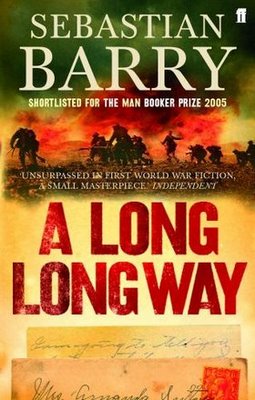
Sebastian Barry: A Long Long Way (2005) Literature and War Readalong February 2012

Sebastian Barry’s A Long Long Way is one of a few WWI novels told from an Irish perspective. Unlike How Many Miles to Babylon or many other WWI novels, its main theme isn’t class which was something I was glad for. Not that I think it wasn’t important but it has become one of the clichés of WWI literature. That and so many other elements. Luckily there aren’t all that many clichés in Barry’s novel.

Nineteen year-old Willie Dunne from Dublin volunteers in the early days of WWI. Like so many before or after him, he has no real reason, or they are at best quite vague and mostly personal. Maybe little Willie wants to prove himself and prove his father that he is worthy despite of his size. His father, a tall and imposing fellow, is a policeman. Something little Willie could never have become because he is barely taller than a midget. The army doesn’t care. They are in such great need of volunteers that they accept almost anyone.

We follow naive little Willie to Belgium where he spends his first months in the relative comfort of the rear camp, hardly seeing any fighting at all. Nothing really bad happens to little Willie and his company until one day, the soldiers see a yellow cloud hovering slowly over no-man’s-land. It takes them far too long to realize what that yellow cloud means, and only much too late, when many of them are already dying a cruel death or maimed for life, do they flee in horror. After this moment the novel takes a turn and becomes graphic and tragic and Willie loses his naivety at a breathtaking speed.

Although he sees many horrible things, it is only after his first leave to Ireland, that Willie is really affected. Not because he doesn’t fit in anymore – Barry doesn’t use this cliché either – but because Ireland is on the brink of the War of Independence and Willie, a compassionate man, is saddened to see the death of a young rebel and to realize that for the first time in his life, he doesn’t see things like his father.

Back in the trenches he tells the other Irish lads what he has seen at home. The newspapers write about it too and the British officers are aggressive and see them even more as cannon fodder than before. The longer the war lasts, the more intense the fighting in Ireland gets, the less the efforts and losses of the Irish are appreciated. In the end there are finally no more volunteers from Ireland. They do not want to fight for the enemy anymore and some would even gladly join the Germans. When Willie takes his second leave to Dublin, the aggression in the streets against his British uniform is open.

It is rare that I resent an author for his narrative technique but I do resent the way Barry wrote this novel. Furthermore I had a hard time with his style, I think it’s far from fluent and the overuse of adjectives at times was annoying. Just one example:

Now they rose up in the violent moonlight and entered bizarrely a huge field of high corn, the frail stems brushing gently against their faces, and because Willie was a small man, he had to grip the coat of the Sergeant-Major Moran in front or he would be lost, set adrift to wander for ever in this unexpected crop. The absurd bombs followed them religiously into the field, smashing all about the darkness, the stench of cordite and other chemicals obliterating the old dry smell of the corn.

As if the violent moonlight wasn’t enough, they have to enter the field bizarrely, followed religiously by absurd bombs? Admittedly, this was one of the worst passages but there were others, equally florid. This doesn’t explain why I resent him but it’s part of it. I felt tricked. This novel works like a trap door. You are lured into a devastated house which is bad enough but the moment you are inside, the carpet is pulled away from under you and the trap door opens. There is a building up of graphic scenes and an intensification of the tragedies that befall poor Willie that felt really mean. I was upset that the book had to end like it did, so absolutely depressing, without the tiniest little bit of hope or light. Don’t get me wrong, it’s not because the book describes graphic scenes, it’s because he intensifies them and accelerates it towards the end, when we do not see it coming anymore and, on top of that, has poor Willie experience one personal tragedy after the other.

With the exception of the dishonest structure, and an almost sadistic finishing off of the main character, the novel has a lot of elements that I thought well done. I haven’t read any WWI novel this eloquent on the use and the horrors of mustard gas. Nor any novel that showed the role of the priests so well. Father Buckley was my favourite character in this novel. A Catholic Priest with true compassion and a wide open heart. And I liked Barry’s choice of theme. His look at authority and its major representative, the father is very interesting. The father as a figure comes in many different forms, as the biological father, the King, the Priest. Coming to terms with authority and ultimately becoming a man and independent are important aspects. Little Willie isn’t a boy anymore at the end of the book, he is a man, with his own opinions, his own life. The book stays away from the usual criticism of high command but uncovers all sorts of hidden false authority.

A Long Long Way has been my second Sebastian Barry novel and I was also annoyed by the first. I just don’t like this type of artifice and manipulative writing that is so keen on effect.

I hope others have liked the book better. After all it has won many prizes. I’m looking forward to see what you thought.

Other reviews

Anna (Diary of an Eccentric)

Danielle (A Work in Progress)

Serena (Savvy Verse and Wit)

A Long Long Way is my second contribution to the War Through the Generations Challenge hosted by Anna and Serena.

*******

A Long Long Way was the second book in the Literature and War Readalong 2012. The next one will be Jean Giono’s Le grand troupeau – To the Slaughterhouse. Discussion starts on Friday March 30, 2012.

Robin McKinley: Chalice (2008)

Beekeeper Marisol has been chosen as the new Chalice, destined to stand beside the Master and mix the ceremonial brews that hold the Willowlands together. But the relationship between Chalice and Master has always been tumultuous, and the new Master is unlike any before him.

My favourite fantasy authors are Marion Zimmer Bradley, Julliet Marillier, Patricia McKillip, Charles de Lint and Neil Gaiman. I’m not such an avid fantasy reader but I think when it comes to genre writing, psychological crime and high fantasy are my favourites. Of course I was intrigued every time I saw Robin McKinley mentioned but what really pushed me to read her was when I saw the review of Chalice on BookRain’s blog and that she compared her to Julliet Marillier.

I wasn’t disappointed, Chalice is such a lovely book, one of the most beautiful fantasy novels I’ve ever read. It’s like the honeycombs it evokes, with every sentence fitting in its right place and making it a finely constructed whole.

Marisol the beekeeper and woodkeeper has become Chalice of the demesne of Willowsland. Never has there been a honey Chalice. And never has there been a Chalice who hasn’t been an apprentice before. The Chalice is the second most important person of the Circle, the entity who rules over the ritual part of the demesne, responsible for its spiritual and physical well-being.  At the head of the circle is the Master, followed by his Chalice.

Usually there is a bloodline for both Master and Chalice but in this case, the former Master and Chalice have died a violent death and since there was no heir, the next in line, the master’s brother, a Fire priest, had to be called back. He isn’t human anymore, his touch can burn a human to the bones, his face is black with red, flickering eyes.

Marisol, the Chalice and the Fire Priest are both unprepared and struggle to find their way in this highly ritualized environment. The Chalice studies as many books as she can find, looks up on ceremonies and meanings and at the same time invents new rituals, helped by her bees and the earthlines who speak to her.

Not everybody is happy about a pair like these two and so the Overlord, the political head of the demesne, wants the Master to leave and hand over his place to an outblood heir.

Marisol knows that this is the worst that could happen to the demesne. That would mean turmoil and chaos and she hopes it will never happen. But whether he can stay or not, will be decided in a duel.

What I loved so much about this book is the atmosphere. Sweet and floating, like the scent of beeswax candles. The descriptions are beautiful and following Marisol’s journey has something enchanting and almost hypnotic. The world building is exquisite. I was there in Willowsland the whole time. And Marisol is such a great character, so real. She is very insecure and has to find her way in an hostile environment but her strength and her love for her home guide her. I liked how she lived, on her own, outside of the Great House or the village, only with her bees whom she treats like pets. She learns about the tradition of Chalice but because she never underwent a proper training she dares to invent new ways which she combines with the tradition. Every Chalice mixes ritual cups but Marisol adds honey to hers. Even before she was Chalice she knew how to heal with honey, knew that every variety has its own properties.

Chalice is a magical story, a love story as well as the description of a land in chaos that is slowly brought back to peace by a heroine who can accept her weakness and trusts herself completely.

I’m going to read more of Robin McKinley. I’m not sure which one I will read next, maybe Beauty or Sunshine. Any recommendations? Which is your favourite Robin McKinley book?