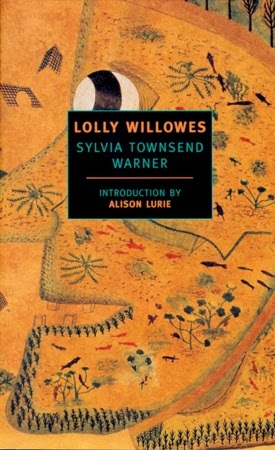
Sylvia Townsend Warner: Lolly Willowes (1926)

Lolly Willowes is a twenty-eight-year-old spinster when her adored father dies, leaving her dependent upon her brothers and their wives. After twenty years of self-effacement as a maiden aunt, she decides to break free and moves to a small Bedfordshire village. Here, happy and unfettered, she enjoys her new existence nagged only by the sense of a secret she has yet to discover. Finally that secret will set Lolly Willowes free.

Danielle (A Work in Progress) has an interesting series called Lost in the Stacks in which she introduces us to authors who have been forgotten or are not read much anymore. One of these authors was Sylvia Townsend Warner as you can read here: Lost in the Stacks – Sylvia Townsend Warner. Danielle mentioned that some of her novels are re-issued by NYRB or Virago and one of the titles Lolly Willowes looked especially interesting. And what a find it was. Not only does the novel tell the story of a unique and independent character but it is a lovely and very feminist book.

Until not too long ago the spinster was a character which could frequently be found in novels. I’ve read more than one novel containing either a spinster or which was about a spinster. They were mostly tragic and often infuriating. The way society treated these unmarried women who were clearly seen as a failure was not only condescending but very often exploitive. As Sarah Waters says in her excellent introduction to the Virago edition of Lolly Willowes, we can see the book to some extent as a re-write of older “spinster novels” like W.B. Maxwell’s The Spinster of this Parish (1922) and F.M. Mayor’s The Rector’s Daughter (1924). As the title of Townsend Warner’s book indicates, the topic has undergone a great change in her novel. The spinster has a name, she is no longer a helpless, independent appendage. Apart from being one woman’s story, the book contains also a subtle reflection on the times, just before and after WWI. The role of the spinster changed considerably after WWI. With so many young men gone, these unmarried elderly women were now seen even more as a useless burden.

Laura, called Lolly, Willowes lives with her father until the age of 28. When he dies her family assumes she will be better off living with her married brother and his family in London instead of staying in the country on her own. The loss of her father is a great tragedy for Lolly. She who lost her mother at an early age, loved living with her father and being relatively independent. She  was never interested in men or getting married. A quiet, introspective life, dedicated to her hobbies, botany and brewery, was all she ever wished for.

She disliked going out, she seldom attended any but those formal parties at which the attendance of Miss Willowes of Lady Place was an obligatory civility; and she found there little reason for animation. Being without coquetry she did not feel herself bound to feign a degree of entertainment which she had not experienced, and the same deficiency made her insensible to the duty of every marriageable young woman to be charming, whether her charm be directed towards one special object or, in default of that, universally distributed through a disinterested love of humanity.

Still she doesn’t make a fuss and follows her brother and his wife and stays with them for several decades. She doesn’t like it there, her sister-in-law is too well-organized, too strict, in other words too boring. She relies completely on her husband, never contradicts him and never seems to spend time on her own. In these surroundings Lolly undergoes a transformation which starts to alarm her more and more over the years.

Or rather, she had become two persons, each different. One was Aunt Lolly, a middle-aging lady, light-footed upon stairs, and indispensable for christmas Eve and birthday preparations. The other was Miss Willowes , ‘my sister-in-law Miss Willowes’, whom Caroline would introduce, and abandon to a feeling of being neither light-footed nor indispensable.

Before WWI breaks out, the Willowes spend all their summer months in the country. Lolly loves these stays and the memory of the beauty of the country side and her reception for everything related to the senses – scents, colors, aromas – open a door in her soul and offer an escape route. She often sits in front of the fire in London and dreams of being in the country on her own. This character trait gives the author the opportunity to include beautiful and evocative descriptions like this one.

At certain seasons a fresh resinous smell would haunt the house like some rustic spirit. It was Mrs Bonnet making the traditional beeswax polish that alone could be trusted to give the proper lustre to the elegantly bulging fronts of tallboys and cabinets. The grey days of early February were tinged with tropical odours by great-great aunt Salome’s recipe for marmalade; and on the afternoon of Good Friday, if it were fine, the stuffed foxes and otters were taken out of their cases, brushed and set to sweeten on the lawn.

After WWI, the society has undergone serious changes. Lolly feels restless. The children of her brother do not really need her anymore and she wants to leave. Finally she wants what her heart has been desiring since years; live in the country on her own. Her relatives are shocked. Her brother has to confess that he has lost a lot of her money due to reckless investments and she cannot afford the house she wanted. Nevertheless, nothing can hold Lolly back, she leaves anyway.

The second half of the novel is dedicated to Lolly’s life in the country. The village she has picked is very mysterious and slowly Lolly undergoes a transformation and becomes a witch. It may sound as if we were entering the realm of the fantastic here and to some extent we do, but the Satan we meet in this book, has more in common with Bulgakov’s Satan than with some fantasy figure.

I’m glad I discovered this wonderful novel. It has freshness and vivacity, is clever and witty and the descriptions are detailed and atmospheric, the portraits of the society and the people are true to life and Lolly is a very endearing character, an illustration of the importance of “a room of one’s own” and the right of women to live an independent life, even outside of society and without a man. It’s certainly one of the rare novels in which a being considered to be a useless burden on society shows that she doesn’t need society in order to live a truly happy and  fulfilled life.

Have you read this or any other of Sylvia Townsend Warner’s novels?

Literature and War Readalong August 31 2012: The Story of a Life – Sippur chajim by Aharon Appelfeld

I haven’t read a lot of literature written by Israeli authors which is one more reason why I was keen on including Aharon Applefeld’s The Story of a Life – Sippur chajim. But that’s not the only reason. The Literature and War Readalong is also an opportunity for me to read some highly acclaimed authors I haven’t read before. The first time I read something about Aharon Applefeld I was surprised to find out that some poeple think he is one of the finest writers alive. An exquisite writer with a sense for language and style.

The Story of a Life is a literary memoir, one of my very favourite genres. At the outbreak of WWII Aharon Appelfeld was living in Romania with his parents, middle-class Jews. His memoir tells about a boy coming-of age during one of the worst periods in history. Applefeld had to endure a lot – the loss of his mother, the ghetto, escape, traversing many countries – until he found a new home in Israel. The book tells this story. If the whole book reads like the quote below I think we are in for a treat.

Here are the first sentences

At what point does my memory begin? It sometimes seems to me as if it only began at four, when we set off for the first time, Mother, Father and I, for a vacation into the heart of the shadowy, moist forests of the Carpathians. But I sometimes think that memory began to bud from within me before that, in my room, next to the double-glazed window that was decorated with paper flowers. Snow is falling and fleecy soft flakes are coming down from the sky with a sound so faint you cannot hear it. For hours I sit and gaze in wonder, until I merge with the white flow and drift to sleep.

*******

The discussion starts on Friay, 31 August 2012.

Further information on the Literature and War Readalong 2012, including all the book blurbs, can be found here.

Balzac: The Deserted Woman – La Femme abandonnée (1832)

When I read Le Père Goriot Old Goriot years ago I was fascinated by the tragic story of Mme de Beauséant. I knew Balzac had dedicated a novella to her which is included in the Scenes from Private Life. After reading one of Guy’s recent Balzac reviews, I decided it was about time to finally read the story. For those who read French you can find the story of The Deserted Woman or La Femme abandonnée in  Les Secrets de la Princess de Cadigan et autres études de femmes.

Gaston de Nueil, a young noble man, leaves Paris for Bayeux, a provincial city located in the Basse-Normandie region. His health is rather poor and he has to stay away from the capital until he recovers. Used to more interesting society than the one he finds in Bayeux, he is soon terribly bored and his imagination is set on fire by the story of the countess de Beauséant who lives like a recluse in her château in the Normandy. She is said to be a young woman of great beauty and even greater esprit who fled to Bayeux after having been abandoned by her former lover, the marquis d’Ajouda-Pinto. The separation was devastating and as she is trapped in a loveless marriage which cannot be divorced, the only way to keep at least some of her self-esteem was to withdraw from the world and dedicate her days to reading and praying.

Young, bored and curious about love, de Nueil falls in love with the unhappy countess before he has even set eyes on her. He walks in her gardens in the night, tries to catch a glimpse of her and is finally so love-sick that he decides to use a ruse in order to get access to her house.

When he finally stands before the woman he fell in love with because of her story and her reputation, he finds her even more beautiful and tragic than he expected.

The countess is 30 years old by now, while de Nueil is barely 23. She is trapped in a void, a loveless life, no contact to society, no future joy in sight. It’s not surprising that de Nueil’s infatuation moves her and finally leads her to accept him as her lover.

Writing more would spoil the story which is one of the best of Balzac’s short stories. You can read it on its own but when you are familiar with the Comédie Humaine you will like it even more. The countess is a key figure in Old Goriot and therefore important for the whole oeuvre. The story as such reminded me of many others. It bears some resemblance with Mme de Lafayette’s The Princesse de Clèves. The countess sounds just like the princesse when she first meets de Nueil. I was also reminded of  Henry James’ Mme de Mauves but most of all it reminded me of Colette’s Chéri. The end however is entirely different from all of these.

I like it when the title has a special significance, is complex and multi-layered. The title of this story seems simple but is excellent. To fully appreciate it, you will have to read the story.

As excellent as this story is, I wouldn’t recommend it to anyone who is not familiar with Balzac. I would still recommend Old Goriot as the best starting point. Paired with this novella, it would be an amazingly great introduction to Balzac’s work and convey a good feeling for the diversity of his talent. The Deserted Woman also contains all of the themes which are important in Balzac’s work such as the mechanics of society, the role of women, marriage, adultery, money and some sub-themes like the “inheritance”, the “fallen woman”, the “aging woman” etc.

I liked the story a great deal. I thought the way Balzac described how de Nueil falls in love is perceptive and uncanny at the same time. Falling in love of an idea, or ideal, may unfortunately very often be the reason for falling in love. I haven’t seen it described as eloquently very often. I think this part of the story applies to all sorts of idealisations; people falling in love with stars or other people they hardly know like people in chat rooms, internet forums or blogs.

If you’d like to read the novella in English and are interested in an overview of Balzac’s work and how it is grouped here is an excellent link The Human Comedy – La comédie humaine.

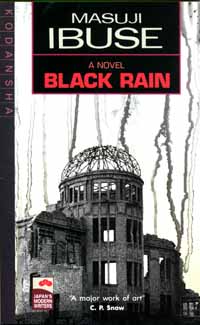
Masuji Ibuse: Black Rain – Kuroi Ame (1969) Literature and War Readalong July 2012

Reading Masuji Ibuse’s Black Rain was an intense experience. Beautiful and horrifying. In all honesty though I have to say the horror prevailed and I have to contradict those who say it’s not depressing. For sure, Ibuse isn’t a manipulative writer, he doesn’t strive for emotional reactions in his readers, but still, I couldn’t help being affected by what I read as no amount of toning down – something Ibuse has been accused of – can minimize the atrocity of what people had to endure on August 6 1945, in Hiroshima and the days and months that followed the bombing.

I think one hast to call Black Rain a documentary style novel. In order to write the book Ibuse has used real diaries and notes of victims and incorporated them in his book. Additionally the descriptions are so detailed and often matter-of-fact that the book reads in parts like a non-fiction account.

The main story is the story of Shigematsu Shizuma’s niece Yasuko. She would like to get married but a marriage is endangered as there are rumours that she got in the Black Rain after the bombing of Hiroshima and suffers of radiation sickness. Shigematsu himself is afflicted by a mild form of radiation sickness which he tries to fight by eating as healthily as possible and with mild exercise and a lot of rest. At the beginning of the novel which starts a few months after the bombing, Yasuko shows no signs of sickness at all. In order to help his niece and to prove that she didn’t get in the Black Rain and is not ill, Shigematsu starts transcribing his niece’s and his own diary covering the days before and after the bombing. The diaries are meticulous and incredibly detailed accounts of those days. The novel moves back and forth between the diary entries of August 5 – 15 and the present in which the entries are copied.

I have seen pictures of Hiroshima and read a few things but never anything like this book which was absolutely overwhelming in its details and the way it captured human suffering. The descriptions always move back and forth between individual and collective experiences. There were descriptions of people who had only mild burns and some whose whole body was an open wound. Some died in agony, some in grotesque positions. There were descriptions which showed how some people afflicted by radiation sickness a few days or weeks later died suddenly while others agonized for months. Towards the end there is a real account of a doctor who served in the infantry and was almost directly under the bomb when it exploded. It was unbearable to read about the suffering he went through.

I was surprised to see what an important element food is in the book. We read detailed accounts of what food was available during the war, how it was prepared and how they had to substitute a lot. Food is also one of the major elements in a successful treatment of radiation sickness. It was fascinating and sad to read.

What shocked me more than anything else, more than the descriptions of the wounded humans and animals and the ensuing total chaos, was the utter helplessness which was expressed in the way how they spoke about the bomb. They had no clue what had happened. They knew it was something unheard of,  never used before, but they didn’t know anything specific. What were the effects? Were burns the only thing or would there be more to come later? How did you treat radiation sickness? Days later they find out what had hit them.

“The name of the bomb had already undergone a number of changes, from the initial “new weapon” through “new-type bomb” to “special high-capacity bomb.” That day I learned for he first time to call it an “atomic bomb”.

The confusion and helplessness of the people is terribly sad. Even more when you read how they started to realize that even people who were not in Hiroshima on August 6, but part of rescue teams who came later, all died. This meant that each and every person who had been in Hiroshima on the 6th or came later would have to wait, sometimes for months, to be sure they were not affected by radiation.

After having read all this you will probably wonder why I called this book “beautiful”. I thought it was beautiful because the way Ibuse describes the Japanese culture, Japanese sensibilities, the descriptions of the food, the habits, some customs and many details of things we are not familiar with is full of beautiful moments like this description of Shigematsu’s childhood.

As a boy, Shigematsu had seldom come to the flat rock to play, but he had often been to play under the ginkgo tree at Kotaro’s place. When the frosts came and the ginkgo tree began to shed its leaves, the roof of Kotaro’s house would be transformed into a yellow roof, smothered with dead leaves. Whenever a breeze sprang up, they would pour down from the eaves in a yellow waterfall, and when it eddied they would swirl up into the air – up and up to twice, three times the height of the roof – then descend in yellow whirlpools onto the road up the slope and onto the oak grove.

Of course the same culture which had such a lot of beauty was also trapped in a destructive system of total obedience which is mentioned more than once in the novel. It takes a masterful writer to be able to convey so much insight into a culture and render a tragedy the way he did it. While Black Rain was not an easy book to read and has to be absorbed in small doses, I think it’s an outstanding book.  Without ever accusing anything or anyone Ibuse shows drastically that in the case of Hiroshima the end didn’t justify the means.

Other reviews

Danielle (A Work in Progress)

Judith (Reader in the Wilderness)

Rise (in lieu of a field guide)

Older reviews

Mel U (The Reading Life)

Gary (The Parrish Lantern)

The review is my first contribution to Bellezza’s Japanese Literature Challenge 6.

*******

Black Rain was the seventh book in the Literature and War Readalong 2012. The next one will be Aaron Applefeld: The Story of a Life – Sippur chajim. Discussion starts on Friday August 31, 2012.

Ferdinand von Schirach: The Collini Case – Der Fall Collini (2011)

After having liked both short story collections Crime (here) and Guilt (here) by Ferdinand von Schirach it was only a matter of time until I’d get to his first novel The Collini CaseDer Fall Collini. It has been published in Germany end of last year and is due out in English in a few weeks.

Ferdinand von Schirach is one of Germany’s most prominent defence lawyer’s. And he is the grandson of Baldur von Schirach who was convicted of being a war criminal. Given this family history it’s not surprising his new book has a WWII theme. But it wouldn’t be a Ferdinand von Schirach book if it was only about a war crime.

It’s not easy to write a decent review about The Collini Case without giving away too much. Collini is a 6o-year-old Italian who has been living in Germany for a long time. One day – and this is not a spoiler as it happens on the first pages – he enters a hotel room pretending to be a journalist and brutally kills the 80-year-old business tycoon Hans Meyer. He then waits patiently until he is arrested.

Leinen is a young lawyer. The Collini case is his very first case. While there is no doubt that Collini has murdered Meyer, finding out why he did so is important as it can determine the sentence. Unfortunately Collini doesn’t want to speak. This makes it hard for the young lawyer and there are other adversities which make it even harder.

Von Schirach said in an interview that he doesn’t think of himself as a crime writer as the “who did it” doesn’t interest him at all. He wants to know why. And so it’s not surprising that the novel entirely focuses on the question why a spotless man like Collini committed a gruesome murder.

What fascinated me and most readers of von Schirachs’s stories was the fact that they were all based on true stories. Very naturally I was wondering the same here. Is it true? While it is obvious that the lawyer isn’t von Schirah in this case, the trial and the many amazing twists and turns are all based on a real case.

The case as such and how it is presented, the court room part, the look into the way Germany has dealt and still deals with its past are really interesting and I liked reading about it. Some of it left me speechless and was quite shocking. Some of it was very sad. Interestingly though that wasn’t the main appeal of this novel for me. I’ve read quite a few reviews and was surprised how much people wrote about the case and the trial only. What makes this an outstanding book in my eyes is another dimension. Without revealing too much I can say that one of the most important points of the book is the loss of memories. Imagine you find out that a person you like is not what you thought but that on the contrary has been hiding a dark and unpleasant secret. Wouldn’t that make you feel as if you’ve lost all your memories tied to that person? That’s I think one of the reasons why family secrets are so damaging. They can alter the perception of your past to such an extent that you will feel robbed of it.

Once more von Schirach has shown that he not only knows how to tell a story in crystal clear and very taut prose but that he can write interesting, thoughtful and thought-provoking books.

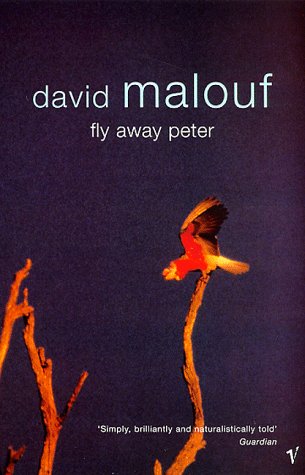
David Malouf: Fly Away Peter (1982)

There really are numerous ways to write about war. While some elements will always remain the same – especially when one of the novel’s themes are the trenches of WWII – accomplished authors, will still find a way to write something completely new. David Malouf’s Fly Away Peter is an excellent example for this.

Being an Australian writer Malouf writes about the war from the Australian perspective which works on two very different levels. One focuses on the land and nature, the other on the people. I have a feeling I would have overread a lot if I hadn’t seen so many Australian WWI movies and read Charlotte Wood’s stunningly beautiful The Submerge Catherdral (here).

It seems to be a trademark of a lot of Australian writing to emphasize the beauty and uniqueness of the flora and the fauna of the continent. Much of it must seem like paradise to the inhabitants and so it’s not surprising Malouf starts the book with the description of nature. Jim Saddler, a young Australian who has never been outside of the country, knows more than anyone about birds. He lies hidden in the marshes and watches them for hours. Ashley Crowther, another young man, but from a very different background, has returned from England where he went to university and come back to take care of his vast family estate. The marshes are part of it. When the two men meet, something almost miraculous happens. Without knowing Jim, Ashley senses the knowledge and the passion he has for birds and offers him a job. This is a dream come true for Jim, a man from a very modest background. The plan is to turn the marshes into a bird sanctuary and Jim will work there, observing, making lists.

While observing one of the rare birds, Jim meets Imogen, an English woman who arrived in Australia not long ago, and has decided to stay here. She is a photographer and earns a living with nature photography.

When the war breaks out none of the three characters thinks at frist it has a lot to do with Australia but in the end, the two men sign up. Of course Ashley will be an officer, while Jim becomes just a simple soldier.

Once in France, the tone and style of the book changes considerably. During the first half of the book, Malouf’s writing was poetic and the structure of the sentences unconventional but when he starts to describe the horror of the war, the writing, moves into the background and is more conventional.

Most of what is described from Jim’s point of view, we know from other WWI novels; the rats, the mud, the corpses, the gas. That is not new but what is new is how the earth is evoked which leads to comparisons. The rich earth of the Australian marshes produced so much beauty, here the earth swallows up everything, they all sink into it in the end.

One of my favourite war movies, Beneath Hill 60,  describes the contribution of Australian miners to WWI. Something the film directors chose to leave out, is mentioned in the book. While digging the tunnel systems beneath Hill 60 and arriving at the enemy lines, the miners discovered the skeleton of a  mammoth.

Jim is a witness of this discovery. It’s a key scene in the novel as it is an example of continuity.

It was a great wonder, and Jim stared along with the rest. A mammoth, thousands of years old. Thousands of years dead. It went back to the beginning, and was here, this giant beast that had fallen to his knees so long ago, among the recent dead, with the sharp little flints laid out beside it which were also a beginning. Looking at them made time seem meaningless. (….)

Continuity is a major theme of the book, continuity and opposites. The land and nature exist and will always exist. They are endless while humanity is not and the individual man even less so. Man creates opposites, the good and the bad, the ugly and the beautiful, the cowardly and the heroic, they all take place inside of the continuity.

The mammoth is a symbol for this and so are Imogen’s photos. At the end of the novel she thinks about how she met Jim. She captured a bird on a  photo while he captured it in his mind. The bird is long gone and so is the picture in Jim’s mind because Jim is gone, but it’s still here, as she remembers both and there is still the photo as well.

It’s hard to do justice to a book like Fly Away Peter in a short post. I hope I was able to convey the beauty and make you curious to find out for yourself. I couldn’t help but had to compare it to two other shorter WWI novels we read last year, Susan Hill’s Strange Meeting (here is the review) and How Many Miles to Babylon by Jennifer Johnston (here is the review). While the latter will always be my favourite, Fly Away Peter is excellent as well and adds another dimension. It contains a rich a meditation and philosophical exploration of WWI from an Australian perspective which is well worth reading.

Have you read David Malouf? Which is your favourite of his books?

The review is a contribution to the Aussie Author Challenge as well as to War Through the Generations.

If you’d like to read another review, Danielle hast posted about it here.

Nicci French: Tuesday’s Gone (2012)

Psychotherapist Frieda Klein thought she was done with the police. But once more DCI Karlsson is knocking at her door.

A man’s decomposed body has been found in the flat of Michelle Doyce, a woman trapped in a world of strange mental disorder. The police don’t know who it is, how he got there or what happened – and Michelle can’t tell them. But Karlsson hopes Frieda can get access to the truths buried beneath her confusion.

A few months ago I read and reviewed Blue Monday, the first in the new series written by writer duo Nicci French. I thoroughly enjoyed it as you can read here and was looking forward to the sequel. Tuesday’s Gone is the second novel in the series with psychotherapist Frieda Klein and DCI Karlsson. I didn’t expect it but I’m glad to say that this book was even far better than the last. The characters are more rounded, the story is much more suspenseful and some loose strands of the first book are nicely tied together. The only bad news is, you should read Blue Monday first as the sequel contains numerous spoilers, even mentioning the solution to part one.

Who is this man the police find in Michelle Doyce’s apartment, sitting on a sofa, naked and decomposed? The autopsy shows the man was murdered and since Michelle is a woman with a rare mental disorder it seems likely she killed him. Or at least the police would hope so as that would cut a lengthy investigation short and save a lot of tax money.

For some reason DCI Karlsson isn’t happy with this interpretation and asks psychotherapist Frieda Klein to talk to Michelle. Frieda is no expert in this type of disorder and consults with a specialist. As hard as it is to talk to Michelle, they find a way to communicate and it seems highly unlikely she committed the crime.

Frieda thinks it’s far more crucial to find out who the man was. It takes a while and they discover that his name is Robert Poole but when they inform his brother that they found his body they are in for a surprise. Robert Poole died six years ago. It looks as if the dead man on the sofa used a fake identity, had a lot of money transferred to a bank account in Poole’s name and withdrew it again on the day of his murder.

While the police are willing to pay Frieda for her work, like in the first book she does a lot of research on her own account. One cannot shake the feeling that a lot of what she does has something to do with personal atonement.

Once they find out that the victim was a con man and they start interrogating some of his victims, the book gets really interesting. There are many loose ends but they are all tied together in the end. Some elements of part two are still important in this part and will also play a role in the next.

We get to know Frieda much better in this book, some of her family history is revealed, her love life gets a new twist. DCI Karlsson and some other secondary characters are further developed. And once more the location, the city of London, plays an important part and we learn a few interesting historical facts while following Frieda on her nightly walks through her beloved town. While the book has a satisfying ending, there are clearly indications that there will be a third part soon.

I really enjoyed Tuesday’s Gone and could hardly put it down. While the first in the series had some minor flaws Tuesday’s Gone is as good as Nicci French’s standalones. This has turned into a really gripping series with complex, flawed but likable main characters.