Literature and War Readalong July 29 2013: Children of the New World – Les enfants du nouveau monde by Assia Djebar

Children of The New World

Assia Djebar’s novel Children of the New WorldLes enfants du nouveau monde is the first novel about the war in Algeria in this readalong. Assia Djebar is one of the most important, if not the most important North African writer. She is also a translator, essayist and filmmaker.

I’ve been meaning to read her for years as I got other books by her on my piles and I’m glad to finally get a chance to do so.

She was the first writer from the Maghreb to be elected to the Académie Française in 2005. Djebar is known to be anti-patriarchal and anti-colonial; her novels focus on women’s lives. She writes in French, not in Arabic.

Children of the New World is about the war in Algeria from the point of view of the women.

Here are the first sentences

In the old Arab quarters at the foot of the mountain the whitewashed houses all look alike. Before the city grew larger, this was the only place where affluent families would come to find a bit of cool air, near the b rooks and orchards at the end of spring. Each home is at the end of a cup de sac, where, after wandering through a maze of silent little alleyways, one must stop. All that can be heard is some vague whispering suddenly interrupted by the shrill cries of children, whom the mothers are trying to keep at home, but to no avail. The military guard can show up any moment. Then there is barely enough time to gather the children and muffle their voices behind closed doors.

*******

The discussion starts on Monday, 29 July 2013.

Further information on the Literature and War Readalong 2013, including all the book blurbs, can be found here.

Jan Terlouw: Winter in Wartime – Oorlogswinter (1972) Literature and War Readalong June 2013

Winter in Wartime

Dutch author Jan Terlouw’s award-winning novel Winter in Wartime  (Oorlogswinter), which has been made into a movie, is a book for YA. It tells the story of 15-year old Michiel and is set during the hunger winter, in the Netherlands in 1944.

Michiel lives in a Dutch village with his parents, older sister and younger brother. His father is the mayor of the village. Like the rest of the Netherlands, their village is occupied by the Germans. It’s obvious for everyone that the war will come to an end soon and that the Germans are losing it. However, instead of giving up, they intensify their hostile activities; they search houses, arrest, torture and shoot people.

The village is divided, some are collaborating, some are suspected to collaborate, while others are in the resistance. Michiel’s parents are anti-German; they are good people who try to help those who have less, as much as possible. Every night they open their doors to distant relatives, people on the run, displaced persons, provide shelter and food for one night. Uncle Ben who is in the resistance is one of the regulars.

Michiel has an outsider position. He isn’t really a child anymore but doesn’t seem old enough for resistance work. When Dirk, an older boy who has joined the resistnace, asks him to deliver a letter, should he not return from a mission, Michiel feels honoured.

That same day his father and a group of other people is arrested because someone has killed a German soldier. Some of the men who are arrested will be hanged. When Dirk doesn’t return and Michiel fails to hand over the letter, he opens it and discovers that Dirk has been hiding a wounded British pilot. What should he do now? Who will help him? Is there anyone he can trust? That’s what you will discover if you decide to read Winter in Wartime.

Towards the end of the book (p. 121) Michiel remembers something his father said

Michiel often thought of something his father once said: “In every war dreadful things happen. Don’t think that it is only the Germans who are guilty. The Dutch, the British, the French, every nation has murdered without mercy and perpetrated unbelievable tortures in times of war. That is why, Michiel, you shouldn’t allow yourself to be misled by the romance of war, the romance of heroic deeds, sacrifice, tension and adventure. War means wounds, sadness, torture, prison, hunger, hardship, and injustice. There is nothing romantic about it.”

This short paragraph is central and summarises the theme of the book. The novel looks exactly into this and tests it. While the story confirms that war is horrible, it still shows that heroism is possible. There will always be courageous and kind people in every war, people who will try to stay good and do good.

This is a book for young people and I was very interested to see how WWII would be handled. In all the resistance books and movies torture plays an important role. How would that be handled for children. I’d say Terlouw did a great job. He was explicit but not gruesome. Not for one second we think it may not have been as bad but still he isn’t too explicit.

Books for children and YA always have a message. A lot of that message is captured in the quote above but there is another central theme, which is illustrated too – not every German was bad. No people is bad as a whole.

I think Terlouw’s book is well done, it captures he Netherlands during the winter of 44 very well. The hunger, the masses of  fleeing people, the occupation, the suspicions, all this is well drawn. The tone isn’t depressing as the end of the war is in sight. Horrible things happen still but there is a lot of hope.

I saw the movie a few years ago that’s why I possibly didn’t like the novel as much as I would have if I hadn’t known the story already. It isn’t one of my favourite readalong titles but it’s still well worth reading and, as a children’s book, I’d say, it’s excellent.  Don’t miss it if you’re interested in WWII, occupied Holland, the Dutch resistance, and are looking for all of these topics done in a way that is appropriate for younger readers.

Other reviews

Anna (Diary of an Eccentric)

Danielle (A Work in Progress)

Iris (Iris on Books)

Judith (Reader in the Wilderness)

Movie review

Kevin (The War Movie Buff)

*******

Winter in Wartime was the sixth book in the Literature and War Readalong 2013. The next is the novel is Children of the New World aka Les enfants du nouevau monde on the war in Algeria by Algerian writer Assia Djebar. Discussion starts on Monday 29 July, 2013. Further information on the Literature and War Readalong, including the book blurbs can be found here.

Rachel Klein: The Moth Diaries (2002)

The Moth Diaries

Did you like being an adolescent? Looking back I can’t say it was much fun. I would even say it was pretty awful. A whole lot of insecurities, suffering and drama. When I studied cultural anthropology some years later we read Margaret Mead’s Coming of Age in Samoa, which was her first publication. At the time when she wrote it, cultural anthropology was seen as a means to better understand Western culture and society. When she went to Samoa Mead’s wish was to investigate adolescence in another culture and to see how much of what girls in the US went through was rooted in the culture. Pretty much everything that is experienced as awful when growing up in the US or Europe was missing in Samoa. While her research was later criticized for being to idealizing, it still contains a lot of valuable information. Maybe Samoa wasn’t the idyllic paradise she saw in it but the young Samoan girls decidedly didn’t suffer like many girls did and still do in Western societies.

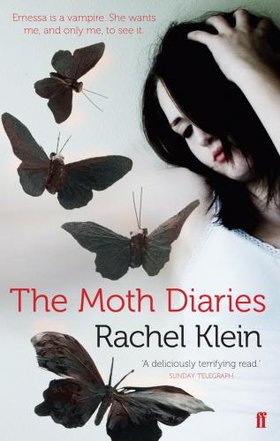
The Moth Diaries depicts adolescence in its most dysfunctional forms. Obsessions, anorexia, self-inflicted wounds, suicide. It is an intense and intriguing book, a painful story told by an unreliable narrator, in form of diary entries. The microcosm of a boarding school, set in an old Gothic looking building adds further depth to the story.

Her psychiatrist later tells the narrator that she suffered from “borderline personality disorder complicated by depression and psychosis”.  The prologue tells us that she has left this behind. But is she really cured, is she really better? What prize did she pay for that? And was everything she experienced and witnesses just the output of a vivid imagination?

The narrator’s father has committed suicide. Her mother cannot deal with an adolescent and sends her to boarding school where the narrator forms a close relationship with another girl, Lucy. Returning after a longer holiday break, the narrator must realize that her best friend is more interested in the new girl Ernessa. Ernessa is pale and mysterious, she never eats or sleeps and the narrator is convinced that she is a vampire.

What is interesting in the way this is told is how the book manages to show that when you are alone during an important phase of your life, isolated even, and you are surrounded by suffering that you don’t understand, you may end up interpreting facts in a fantastical way. Or, to say it differently, you may have a psychotic episode.

While books like Twilight and The Vampire Diaries, tell a normal college story spiced up with vampires, The Moth Diaries does exactly the opposite. What really goes on in this boarding school, the obsessive dieting that turns into self-inflicted starvation, the claustrophobic friendships that turn into erotic relationships, the mobbing, all this is much more painful than the vampires populating contemporary high school dramas could ever be. Whether or not Ernessa is a vampire, is ultimately not that important.

What made me feel particularly uncomfortable is how the grown-ups deal with the girls in this book. With the exception of one or two teachers, they are all dysfunctional and abusive.

The Moth Diaries is an eerie and uncanny depiction of adolescence with a very Gothic feel. It is full of  inconvenient emotions, told by a narrator who is confused but at the same time extremely wise and insightful. One could call The Moth Diaries a contemporary and female version of The Catcher in the Rye. I found it painfully poignant.

The Moth Diaries has been made into a movie. Has anyone seen it?

Natalie Babbitt: Tuck Everlasting (1975) Exploring Books for Children and Young Adults

Tuck Everlasting

Doomed to – or blessed with – eternal life after drinking from a magic spring, the Tuck family wanders about trying to live as inconspicuously and comfortably as they can. When ten-year old Winnie Foster stumbles on their secret, the Tucks kidnap her and explain why living forever at one age is less than a blessing that it might seem.

Ever since I’ve read Tom’s Midnight Garden a few years ago, I felt like reading more children’s books. The beautiful novels of Meg Rosoff reminded me of this again and so I’ve decided to embark on a more systematic exploration of the genre. That doesn’t mean I’ll be reading only books for children but you might see the occasional review in the future.

Natalie Babbitt’s famous novel Tuck Everlasting was an ideal book to get re-aquainted with the genre.  The question that Tuck Everlasting explores is “What if you could choose to live forever?” This type of question is what I like about childrens’ books. They don’t shy away from exploring big themes: life, death, meaning of life, illness, friendship, moral choices.  Much more than many books for grownups do.

Winnie is a ten-year old girl who is growing up in a very strict family. Her mother and her grandmother monitor her every move, tell her constantly what is right and what is wrong. She is not allowed to leave the garden, let alone to go into the forest but one afternoon, tired of all those rules, she leaves and ventures into the forest. In the forest she meets a beautiful young man and sees him drink from a spring. Shocked that somebody finds out about the secret fountain of youth, he brings Winnie to his family and they kidnap her.

Unbeknownst to all of them, a man in a yellow suit is following them. He has been looking for the secret fountain since years and wants to make money with its water.

Winnie is confused and anxious at first but she likes the Tuck family. Unlike her own family they are warmhearted and affectionate. The father tells her how they discovered the spring and that whoever drinks from its water will live forever. While Winnie thinks at first that it would be wonderful not to die, she slowly comes to understand that it would mean she wouldn’t change anymore. She would stay the same young girl forever. One of the consequences if people found out and would drink from the water would be that soon there would be too many people in the world and they would all stagnate. She realizes that the beauty of life is linked to change and that she shouldn’t be afraid of death but of the unlived life.

It was interesting to watch the movie right after having finished the book and for once I must say, I preferred the film. I even liked it a great deal. It’s beautifully filmed and the cast was great. Alexis Bledel plays Winnie, William Hurt and Sissy Spacek are father and mother Tuck and the man in the yellow coat is played by Ben Kingsley. The Winnie in the film is a bit older, maybe 14 and a main part of the movie centers on the love story between her and the younger Tuck brother which is really lovely.

I liked the ideas, characters and the ending which was bitter-sweet but overall I found the tone of the book a bit annoying. I think it’s a great book for younger children but not exactly for older ones and grownups. The movie however is really charming. Ideal for a rainy Sunday afternoon. My DVD had an interview with the author in which she tells how she became a writer. She started to write together with her husband, or rather to illustrate his books. When he didn’t have enough time anymore, she had to do the writing as well and she became very famous. She has written and illustrated far over 15 books for children.

I’m not sure which will be my next children’s book. Maybe David Almond’s Skellig or Neil Gaiman’s Coraline.

Lisa Moore: February (2010)

February

In 1982, the oil rig Ocean Ranger sinks off the coast of Newfoundland during a Valentine’s night storm. Helen O’Mara, pregnant with her fourth child, receives a call telling her that her husband, Cal, has drowned.

A quarter of a century later, Helen is woken by another phone call. It is her wayward son, John, calling from another time zone to tell her that he has made a girl pregnant and he wants Helen to decide what to do. As John grapples with what it might mean to be a father, Helen realises that she must shake off her decades of mourning in order to help.

With grace and precision and an astonishing ability to render the precise details of her characters’ physical and emotional worlds, Lisa Moore reveals the story that unfurls around those two moments.

Lisa Moore is an acclaimed Canadian author whose books are regularly nominated for awards and prizes. She won the Commonwealth Writers’ Prize for her novel Alligator. Her novel February was longlisted for the Man Booker in 2010. I discovered her when I was looking for authors for The Canadian Book Challenge 6. For those who are interested – Challenge 7 will start in July 2013.

February starts in 2008. Helen receives a phone call from her son John, telling her, he will be a father. John has always been the most difficult of her four children and the news fills her with joy and apprehension and triggers a flood of memories.

Helen has been a widow since 1992 when her husband died. He was working on the oil rig Ocean Ranger, which sank off the coast of Newfoundland during a stormy night. All the men died. It took three days until all the families had the certitude that nobody survived. Helen who was pregnant with her fourth child knew immediately that Cal was dead. They had such a strong connection, she felt that he would not return.

Grief holds Helen firmly in its grasp. For more than 20 years, she still belongs to the love of her life but deep down inside she knows she isn’t cut out to stay alone forever. There is a longing, a yearning. She wants to be touched, feel another person’s presence. At the time of the phone call, Helen has her house redecorated and falls in love with the man in charge of the redecoration.

The book jumps back and forth in time. A scene set in 2008 follows an episode from 1982; the next will take place in 2006 and the book will then move back to 1992 and finally return to 2008. The chapters indicate the year, it’s easy to follow but at first I didn’t understand why she chose this approach until I realized how much sense it made. Imagine you arrive at a crucial point in your life and look back on the years before that moment. I don’t think anyone would do this in a chronological order. We remember this and that, bits from that year, others from another year. That’s how February is constructed. Helen is finally ready to let go of her grief and these intense new feelings bring back the past with a new acuteness.

This is the kind of thing Helen remembers, bits of afternoon that sharpen in focus until they are too bright. Just moments. Tatters. How the kids climbed on Cal. Flung themselves. How they clambered over him. He tickled them. Gave them horseback rides. Told stories. He did the airplane. Lying on his back, his legs in the air, their little rib cages resting on his grey wool socks. Soaring.

February is a quiet, introspective book. Moore captures feelings masterfully and her style mirrors their complexity and depth. Her descriptions of love, loss, grief and hope are intense and powerful, entirely free of kitsch. Helen’s sadness is palpable, her loneliness can be felt.

February tells the story of a woman whose emotional life has come to a standstill. The man she lost was the love of her life and the relationship they shared was strong and deep. It was physical and emotional. There is incredible pain to imagine how he died, sinking into the icy cold water, with no hope to be rescued. Imagining this takes its toll. It’s as if she feels she will betray him, if she lets go of his memory.

When Helen reawakens to her needs, she feels like a young girl inside of the body of and elderly woman. She’s 58 and shocked to find out that she isn’t considered to be attractive anymore. I liked the way Moore showed this, the scenes she chose to illustrate how invisible older women become in our society which only values women who are young and beautiful. Moore shows this with so much compassion, it’s touching and painful at the same time. Here’s Helen after a date with an online acquaintance she’s been writing to daily for three months has gone an unexpected way

‘Heathcliff’ had come and looked at her and didn’t find her attractive. It was so far outside the scope of what she knew to be decent human behaviour that she could not fathom it, though some part of her also knew it exactly. She went to the bathroom and got down on her knees in front of the filthy toilet and puked. The floor of the bathroom had slush all over it and the knees of her nylons were soaked; a single stone dug sharply into her knee. What she was vomiting was the belief that getting old didn’t matter. Because it did matter. It mattered a lot and there was no stopping it, and everything inside her heaved out that idea.

Moore’s achievement is to describe the pain and the loss of the beloved man in an understated way and to pair them with the pain of lost youth and possibilities. This could be a depressing book but it’s not, it’s very beautiful because Helen learns that there may not be so many possibilities anymore but there are still some and life can start anew.

I began February last year but had to put it aside because it’s a book that demands attention. It’s best read slowly as it’s very rich and the style is fresh and diverse. It’s a very authentic book that rings true at every moment. It has what you would call a happy ending but it’s not corny as, in a way, it is a narrow escape. There is always the danger of staying alone and lonely, of spending old age abandoned from life and love.

I liked the idea that Lisa Moore chose a true story, the Ocean Ranger Disaster, and based her novel on that tragedy. Just like the Titanic, the Ocean Ranger was said to be unsinkable. Nobody saw the disaster coming. Does that make it worse? Was Helen better off because she knew right away and with an absolute certainty that Cal was gone while others were still hoping for her husbands and sons to return?

This is the second author I have discovered thanks to The Canadian Book Challenge. And, like Mary Lawson, she is an author I want to read more of. She writes beautifully and with a rare authenticity.

Simon R. Green: Something From the Nightside (2003)

Something From the Nightside

The Nightside is really just like any other major city, only amplified, intensified, like the city streets we walk in dreams and nightmares.

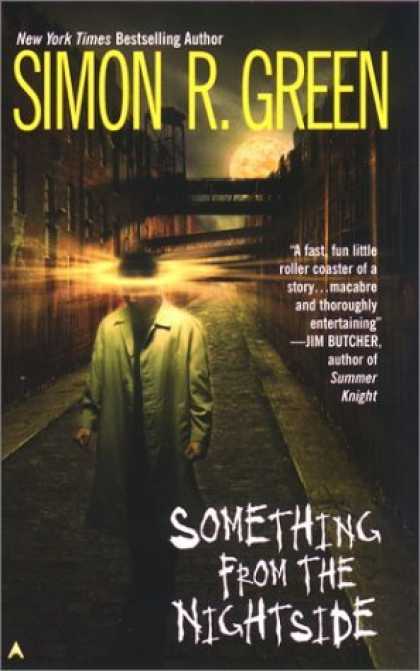
If Chandler’s Marlowe had been investigating paranormal crime, he’d probably be a lot like John Taylor, the hard-boiled PI from Simon R. Green’s Nightside series. While Harry Dresden, Jim Butcher’s PI, is currently the most famous psychic or occult detective, I decided to read Something From the Nightside before finally trying my first book of the Dresden Files. Both PI’s have their fan base but as long as I haven’t read anything else but a few short stories featuring Harry Dresden, I cannot compare. For the time being, I really like John Taylor.

One afternoon a beautiful woman knocks on John Taylor’s office door. Taylor is surprised. He is a luckless PI with fewer cases than a beginner, so he thinks that if anyone wants to hire him, there must be a catch. He is right. Joanna Barrett’s daughter went missing. But not in London. She went missing in the Nightside, the dark, mysterious, dangerous otherworldly heart of London. A place John Taylor has left and sworn to never return to. Why? Well, he has his reasons but he won’t tell. If he wasn’t in a precarious situation, he would never accept to help Joanna Barrett but he’s broke, so what can he do?

The story is a tale of paranormal crime, structured as portal/quest story which is very interesting. The Nightside can only be accessed through a portal hidden in the London underground tunnels.

It’s always night in the Nightside. It’s always three o’clock in the morning and the dawn never comes. People are always coming and going, drawn by needs that dare not speak their names, searching for pleasures and services, unforgivable in the sane daylight world. You can buy or sell anything in the Nightside, and no-one asks questions. No-one cares. There’s a nightclub where you can pay to see a fallen angel forever burning inside a pentacle drawn in baby’s blood. Or a decapitated goat’s head, that can tell the future in enigmatic verses of perfect iambic pentameter. There is a room where silence is caged, and colors are forbidden, and another where a dead nun will show you her stigmata, for the right price….

Crimes that are committed in the Nightside, are more gruesome than anywhere else in the world. People are crazy, addicted, deranged and evil. That’s why John Taylor left the place. That and because people want him dead which has something to do with his mother and what he inherited from her. Unfortunately John doesn’t know his mother and what she was.

Once in the Nightside, Joanna and John follow every lead they can find, interrogate people, fight monsters. They meet some extraordinary characters in the Nightside. Shotgun Suzie and Razor Eddie are just two of them. Both have their names for a reasons. They visit sleazy bars and derelict houses, travel into the future and back again.

Green’s imagination is quirky and amusing. The ideas he comes up with are a lot of fun. And I loved John Taylor’s voice, his sarcasm and macabre humour.

Maybe I will end up liking Harry Dresden more but for the time being, I really enjoyed the paranormal noir story Simon R. Green has concocted in Something from the Nightside. I may very well read the next volume as well.

Michelle Paver: Dark Matter – A Ghost Story (2010)

Dark Matter

It’s been raining for weeks and very cold. It feels a bit like autumn, which could explain why, all of a sudden, I was in the mood to read a ghost story.

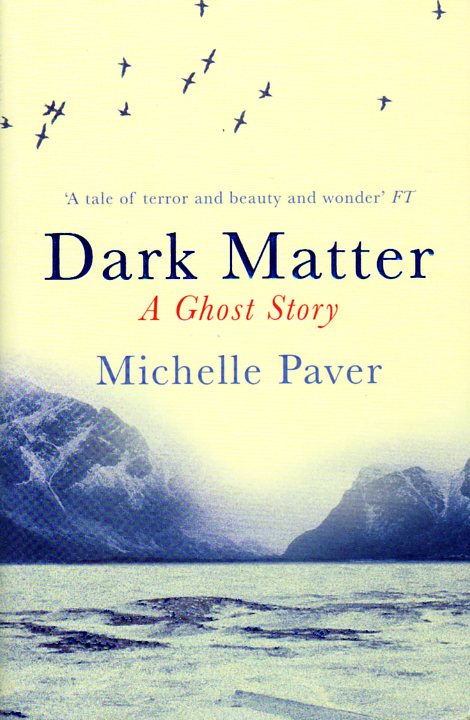
Dark Matter starts in London in 1937. Jack’s life isn’t going the way he was hoping it would. When he is offered the opportunity to accompany an expedition to the Arctic he accepts gladly. It sounds like the chance of a lifetime. Together with four other men he is to leave London just before summer. They will overwinter in Spitsbergen, or, to be more precise, on the fictional island of Gruhuken. When they arrive they are amazed how much life there is in the Arctic in summer. So many animals, so much light. By the time they have set up their camp, only three men and a pack of huskies are left.

When the nights get longer and the daylight is about to disappear for a couple of months, Gus, one of the remaining men, has appendicitis and needs surgery. His friend Algie leaves Gruhuken with him. Jack stays behind on his own, he wants to save the expedition. The two men promise to be back in a couple of weeks. Although the idea of eternal darkness frightens Jack, and the fact that he senses a malevolent presence near the camp doesn’t make it any better, he still wants to prove himself and please Gus.

The novel is told in form of a diary. In writing it, Jack tries to make sense and stay sane in the long dark Arctic night. Allusions by the captain and a trapper confirm what he felt early on: there is a dark presence lurking outside. When he discovers Gus’ diary he learns that he and Algie saw something too.

Most ghost stories are deeply rooted in their setting which is one reason why I like them so much. Haunted houses are my favourites but extreme weather conditions and wild landscapes are ideal too. I must say, to set this story during the cold and endless nights of the Arctic winter was a terrific idea. While the haunting as such wasn’t that creepy, to image what it would be like to spend days and days all alone in the darkness was scary. There is an instance in which Jack gets lost in the night and I could feel the dread. He couldn’t just wait until morning, as the morning would be as dark as the night, so he stumbled around blindly, got panicky and almost gave up. I found it equally unsettling to imagine living inside of an illuminated cabin located in the middle of nowhere and to never know whether someone was outside looking in or not.

Michelle Paver has spent a few times in the Arctic, in summer and in winter, which is certainly the reason why the location is rendered so well, everything was captured in such vivid details.

The story has another layer, which is even darker than the setting or the haunting. In a few scenes Paver manages to say more about cruelty than many other authors I’ve read before. There were two scenes in which cruelty against animals was described, both of which I found very unsettling. The history of the ghost was equally sordid. In some ways you could also say that the cruelty and injustice of society was another main topic. Those who are well-off have all the chances in the world, while people like Jack who come from a humble family or very poor people like the trapper, will always be taken advantage of.

It was interesting to read this novel just after having watched The Wall. While The Wall isn’t a ghost story, the dread and menace are very similar. Nature and loneliness are seen as hostile but ultimately what is to be feared the most are other human beings.

Dark Matter is a wonderful book, I really loved it. It is scary in more than just a supernatural way and works on many levels. Anyone who loves a good ghost story, has an interest in the Arctic or a love for dogs would like this book.

I’m still in the mood for ghost stories and would love to read some more. Has anyone a suggestion? Do you have a favourite ghost story?