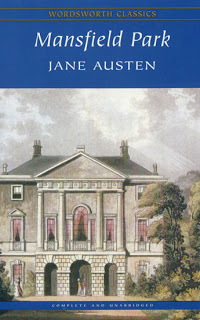
Jane Austen: Mansfield Park (1814)

Mansfield Park

I’m nearing the end of my Austen journey. Now that I have read Mansfield Park, I’ve only got Persuasion and her short fiction left. I was surprised to like Mansfield Park so much as I know it’s not a favourite of many. The reason for this is to some extent its heroine Fanny Price. I wouldn’t go as far as saying I liked Mansfield Park better than Pride and Prejudice, but it may come in second, before Emma.

The story can be summarized briefly. Three women make three very different marriages. Mrs Price gets married to a poor man who likes his drink too much. She bears him some 12 children, one of them is Fanny. Lady Bertram marries a very rich man, owner of an impressive country estate, Mansfield Park. The third, Mrs Norris, lives near Mansfield Park with her husband in a small parsonage. The two ladies often speak about their unfortunate third sister who lives in Portsmouth in squalor and one day Mrs Norris urges the Bertrams to send for Fanny, who is about ten years old, and suggests they raise her at Mansfield Park, together with her four older cousins, Tom, Edmund, Maria and Julia.

Fanny is extremely timid but over the years she is doing well. She grows up to be an educated and very pretty young woman. She’s secretly in love with her cousin Edmund who was the only one who was nice to her. Edmund has decided to join the clergy as being the younger brother he will not have a lot of money to live on. A lot of the Bertram’s money comes from the colonies and when the plantations don’t do so well, Sir Bertram travels to Antigua with his older son.

Mrs Norris who is a widow by now had to vacate the cottage for the new pastor, Mr Grant, and while Sir Bertram travels to Antigua, Mary and Henry Crawford, the younger brother and sister of Mrs Grant, arrive and set in motion a series of dramatic events.

If you know Austen well, you know that all of her heroines are tested. Some more, some less, but in the end they are always rewarded and the reward is a happy marriage.

Fanny Price is a unusual heroine because she comes from a very poor family and the way she is treated by the Bertram’s is often quite shocking. Especially the unlikable Mrs Norris lets her feel daily that she is an inferior. Fanny reminded me much more of a Dickens character and when she is sent back to Portsmouth, as a form of punishment, towards the end of the book, it’s even more Dickensian. I don’t think we find such a close up of a poor family in any other of Austen’s novels. But Fanny Price is unusual for other reasons. She is so timid and fearful and very frail as well. I was surprised to find the portrait of a highly sensitive person who even shows some signs of what used to be called neurasthenia. She has to be careful at all times; she catches colds more easily than others, she’s more easily exhausted. Her symptoms are never as pertinent as when she stays in Portsmouth. She suffers from the noise, the dirt and the smells far more than anyone else would. I have seen her called passive by people but I would say she is quiet and withdrawn, she’s not so much a dreamer as a thinker. Sure, to some extent she is passive, but if you are told daily that you are nothing, that you have to be grateful, that you have to stay in the shadow, then it’s hard to be any other way. Even if she is passive, I don’t think she has a weak mind at all. When they want to force her to marry Henry, she opposes this strongly.

I think a lot of the dislike of Fanny Price stems from her opponent Mary Crawford. I saw people mention that they like her far better than Fanny. When the book was written, she was clearly one of the negative people but we, with our 21st Century mentalities, can’t help but like her and find a lot of what she says quite reasonable. I don’t think I spoil the novel if I mention that it is also about adultery. From our point of view Mary’s reaction to this event is understandable, but when the book was written it was quite shocking. I think small elements like this show very well why many people prefer a historical novel set in 1814 than the real thing because a writer of historical novels would take our mindset into consideration.

Mansfield Park has one of my favourite villains Mrs Norris. She’s a self-centered, selfish and cruel person and tries to exclude Fanny from every little bit of joy, denies her a fire in her room and reminds her constantly that she is an outsider. I loved to hate her and the end is so rewarding.

Mansfield Park has a minor flaw. It is Austen’s longest novel but it’s not long enough. I felt the end was rushed. Many of the most important scenes happen offstage and the final emotional developments happen too quickly. I wasn’t surprised when I watched the ITV production right after finishing the book to see, that those elements were shown in the film while the first parts were compressed. I can’t remember if Austen rushes all of her endings like this. I found it a bit disappointing, which doesn’t mean I preferred the movie version. Not at all. It’s OK but not great and it contains a lot of major changes.

I think that when people write unkindly about Fanny Price, they seem to forget that being adopted into a rich family, means that you are leaving your family behind. Being cut off from what you know, not seeing your beloved brother for years, must be a terrible shock, no matter how stately a home you get in exchange. The story of the little girl Fanny Price who became a delicate but strong heroine has moved me. It’s a rags to riches story that I wouldn’t have expected from Austen. Most of her heroines marry well and improve economically through their marriage, but they don’t start out being as destitute as Fanny.
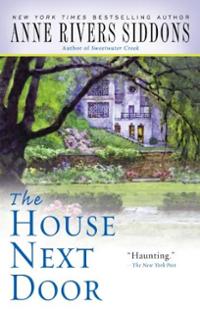
Anne Rivers Siddons: The House Next Door (1978)

The House Next Door

This summer I was suddenly in the mood to read ghost stories and haunted house stories. Looking for books to read I came across Anne Rivers Siddons The House Next Door, which is mentioned in Stephen King’s Danse Macabre as one of the best of its kind. I saw it mentioned again, some time later, in American Nightmares: The Haunted House Formula in American Popular Fiction by Dale Bailey. I’m a huge fan of the so-called Southern Gothic, which was another reason why I wanted to read The House Next Door as it clearly falls under that sub genre.

I had some preconceived ideas of what a haunted house story had to look like and I must say none of those match The House Next Door. It’s a really unusual take on the theme and maybe because of that particularly successful.

Nobody would suspect horrific events in suburban Atlanta, in a world of affluence, in which people lazily discuss their equally rich neighbours over a cocktail, but, if we believe Colquitt, the narrator of The House Next Door, horror has come to haunt the quiet, elegant neighbourhood, in which she and her husband live. Right at the beginning she tells us that the house next door is haunted and then describes why she thinks so in eloquent and elaborate details.

Colquitt and her husband are not the richest in this leafy suburban neighbourhood but they own a house next to a big piece of land, which has proven to be too difficult to build on as a small stream runs right through it. Colquitt cherishes this woodsy piece of land and spends a lot of time looking out of the window into the trees. One day, to her utter shock, her friend and neighbour announces that the land has been bought by a very young couple and that soon the beautiful land will turn into a construction site.

Colquitt dreads the destruction, the noise and dirt, and she also dreads the loss of privacy. While she isn’t a big fan of the young couple, she becomes friends with the young architect and falls in love with the plans of the house, and eagerly watches how it takes form and rises out of the ground. The house is spectacular. It looks as if it was growing out of the earth; it’s a dream made of glass and walls and strikingly beautiful.

While the construction progresses, strange things start to happen. Dead animals are found, people have accidents. I can’t say more or the book will be spoilt.

The Haunted House is unique because it really captures what domestic horror is all about: the place where we feel safest, our home, can turn into the unsafest place imaginable. The book is also unique because it’s not set in a remote wild landscape but in an elegant Southern suburb. The evil breaks into the lives of affluent, sheltered people, and turns their world upside down.

I have never read anything by Anne River Siddons before and while I had some problems with the characters, I really admire her descriptive skills. She elaborates the scenes so well, you think you’re watching a movie. I loved the descriptions of the house and how evil started to spread slowly. I didn’t like the characters, I found them annoying. I’m not the type who wants to gossip over a cocktail every evening, which they happily did. There’s a lot of drinking going on between these pages; not one social encounter takes place without abundant intake of alcohol. Still, I could feel with Colquitt. The shock over the loss of that beautiful untouched piece of land was something I could relate to. I also identified with her enthusiasm once she knew the project for the house. I love all sorts of houses and while this would be a bit too modern for me (I’m not so keen on too much glass), I can see how a house like this would work surrounded by so many trees. I would be like a big tree house.

The House Next Door is a unusual, atmospherical and well written example of a haunted house story with strong images that will stay with you long after you’ve finished the book. I liked that for once the house in question was not an old decrepit mansion, but a brand new stylish house designed by an artistic architect.

This is my first contribution to Carl’s RIP VIII Challenge. Don’t miss visiting the review site.

Literature and War Readalong September 30 2013: There’s No Home by Alexander Baron

There Is No Time

I discovered Alexander Baron’s There’s No Home  thanks to Guy who read an article about this forgotten author a while back.

Reading the beginning of the afterword I’m astonished he was forgotten. John L. Williams writes the following.

Alexander Baron was, arguably, the great British novelist of the Second World War, and for a while he was also the most popular. The three books in which he covered the conflict  –There’s No Home, From the City, From the Plough, and The Human Kind– received glowing reviews and sold in vast numbers on their first appearance on the bookstands and in book club editions.

That these titles have receded from view, rather than becoming established classics – on a par with, say, the wartime books of Evelyn Waugh, Graham Green e or Olivia Manning – seems as mysterious as it is unjust. Perhaps it is due with Baron’s concern with the infantryman’s point of view, rather than the officer class. Or perhaps it is that Baron’s style is so effortlessly simple and unsensational that it is easy to overlook the virtuosity of the writing.

This certainly puts me in the mood to pick up the book and discover this author for myself.

Here are the first sentences

This is not a story of war but of one of those brief interludes in war when the almost-forgotten rhythms of normal living are permitted to emerge again, and when it seeps back into the consciousness of human b wings – painfully, sometimes heartbreakingly – that they are, after all human.

*******

The discussion starts on Monday, 30 September 2013.

Further information on the Literature and War Readalong 2013, including all the book blurbs, can be found here.

It’s Time For R.I.P. VIII

RIP8main300

I’m always in the mood for Carl’s R.I.P., but this year even more so than ususally. I have collected tons of “rippish” reads all through summer, even started a few already.

For those not familiar with the challenge or who have forgotten the “rules” these are the genres you can choose from:

Mystery.
Suspense.
Thriller.
Dark Fantasy.
Gothic.
Horror.
Supernatural.
Or anything sufficiently moody that shares a kinship with the above. That is what embodies the stories, written and visual, that we celebrate with the R.eaders I.mbibing P.eril event.

I intend to cover pretty much all of them and therefore sign up for

rip8peril1st

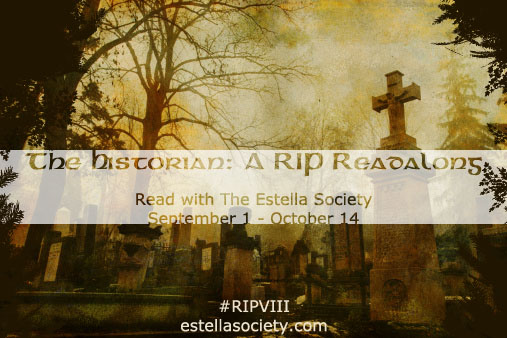
There is also a readalong of The Historian which tempts me as well

Vintage Cluj Cemetery

Details can be found here

Here is a choice of books I want to read, have already read or am about to finish

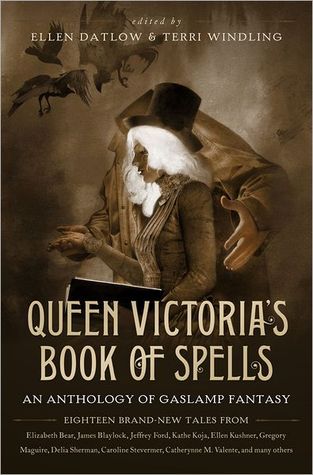
Gaslamp Fantasy

Queen Vistoria’s Book of Spells

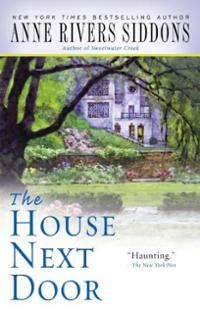
House Next Door

Anne River Siddons The House Next Door

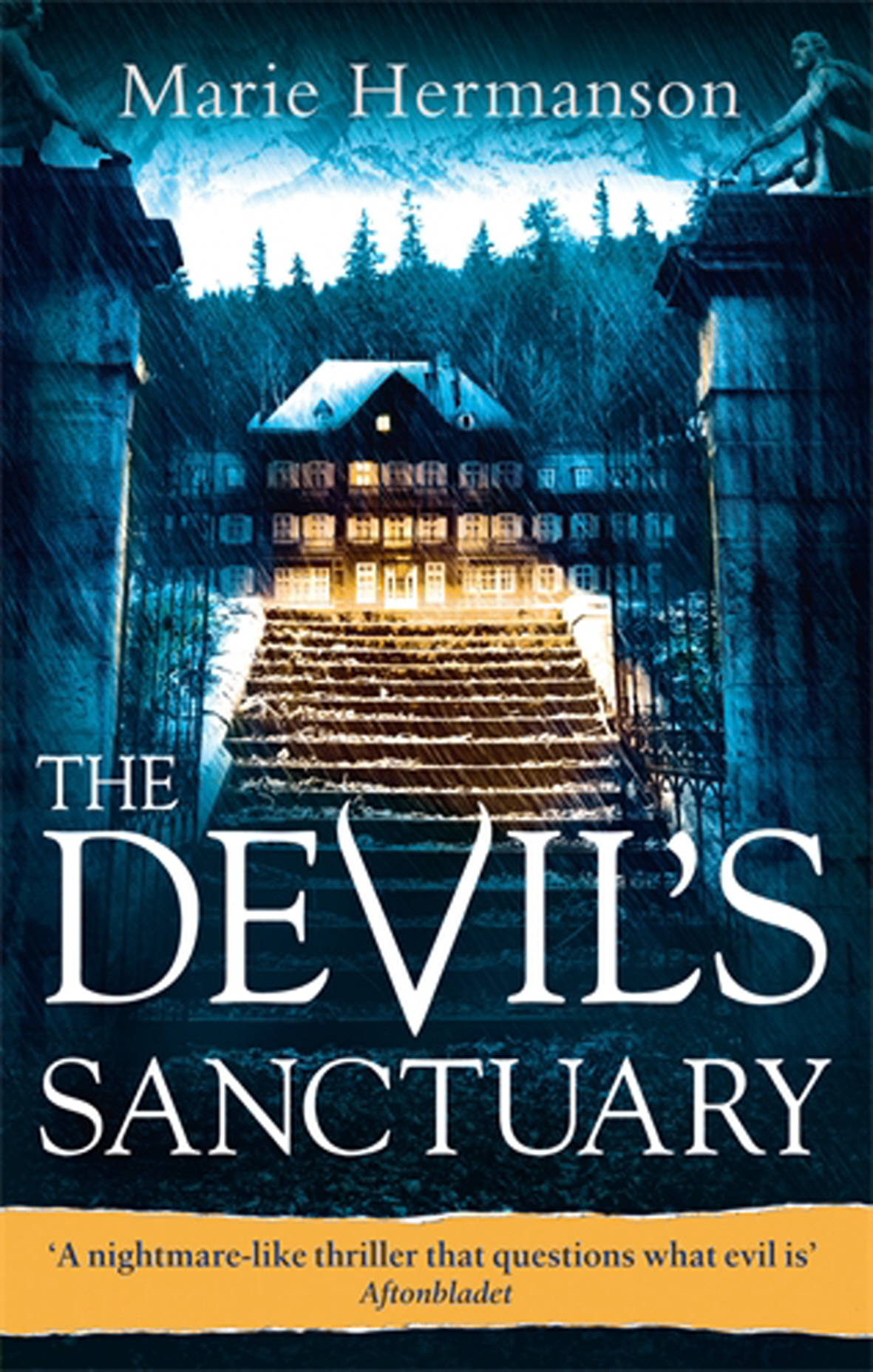
Devil's Sanctuary

Marie Hermanson’s The Devil’s Sanctuary

Ghost of a Chance

Simon R. Green Ghost of a Chance

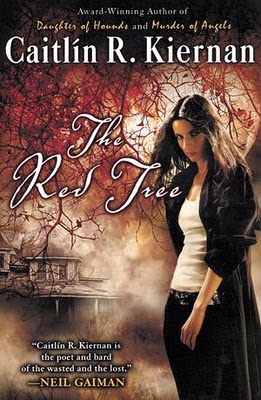
Red Tree

Caitlín R. Kiernan’s The Red Tree

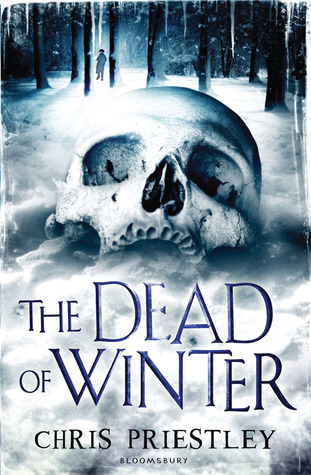
Dead of Winter

Chris Pristley’s The Dead of Winter

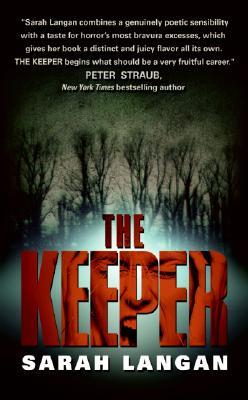
The Keeper

Sarah Langan’s The Keeper

And these are the movies I might review. I’ve watched them all in the last two weeks or so.

The Conjuring (2013)

The Crazies (2010)

Jeepers Creepers I (2001) and Jeepers Creepers II (2003)

The Thing (1982)

If you’d like to sign up here’s the link

And here’s the link to the Review Site.

Will you join as well? What will you read?

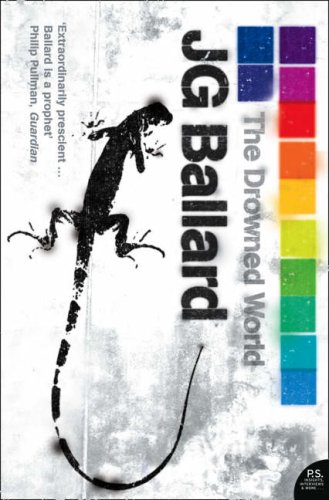
J.G. Ballard: The Drowned World (1962)

The Drowned World

Ballard is an author I’ve always wanted to read, but I was never sure which novel to pick first, so I postponed reading him again and again. Why I finally picked  The Drowned World is an interesting story because it mirrors the content of the book in an uncanny way.

I keep on dreaming about the city I’m living in. In my dreams it doesn’t look like the actual city but is completely overgrown, drowning in vegetation, all the streets look like rivers of grass. It’s not hot in this city and it’s not necessarily a post-apocalyptic setting, but it’s a completely altered landscape. Curious to see whether anyone ever wrote something like this, I googled a few key words, which eventually led me to Ballard’s The Drowned World. What an amazing experience to find an echo of my own dreams and imagination in this book. Furthermore I have always been very fond of  surrealist paintings and the idea of archetypes makes sense to me; both are important elements in this novel.

The Drowned World is set in a post-apocalyptic world, or, to be more precise, in a submerged, overgrown, tropical lagoon that once used to be the city of London. Solar radiation melted the ice-caps; the land was flooded. The heat and the floods have changed the climate completely.

Dr Robert Kerans, a team of researchers and an army unit map the flora and fauna of the different lagoons. While the team wants to move north, Kerans and a few others want to remain south. They have begun to dream strange dreams, which are a sign of their devolution. It seems as if they were regressing; the changing landscape has affected their psychology.

As Bodkin, one character, says:

“Well, one could simply say that in response to the rises in temperature, humidity and radiation levels the flora and fauna of this planet are beginning to assume once again the forms they displayed the last time such conditions were present – roughly speaking the Triassic period.”

Because the landscape once used to look like it does now, the subconscious of the people reacts:

“But I’m really thinking of something else. Is it only the external landscape which is altering? How often recently most of us have had the feeling of déjà vu?, of having seen all this before, in fact of remembering these swamps and lagoons all too well.”

The premise is that everything the species has ever experienced is stored in the subconscious of each one of us and with the devolution, the memories are triggered:

“The brief span of an individual life is misleading. Each one of us is as old as the entire biological kingdom, and our bloodstreams are tributaries of the great sea of its total memory.”

I thought this was highly fascinating and it does make sense. Maybe not as literally as Ballard states it, but it’s sure that landscape influences us, it even influences our deep psychology, and it’s entirely possible that the memories of the species are stored in our subconscious as well.

The novel is not very action-driven but there is conflict. At first the army wants everyone to leave and move up north, but they finally give in and depart. Kerans, Bodkin and Beatrice Dahl – Kerans enigmatic lover – stay behind. They know they will not be able to survive for long but before they can decide on their future Strangman and a group of pirate-like characters appear. They are looters. They travel from lagoon to lagoon and rob all the submerged buildings of their riches. What nobody knows at first is that they dry up the lagoons and towards the end of the novel, we see the silt- and algae-covered London emerge from the waters. Another uncanny moment.

The end is predictable, but that doesn’t make it any less powerful. It reminded me a lot of Joseph Conrad’s Almayer’s Folly.

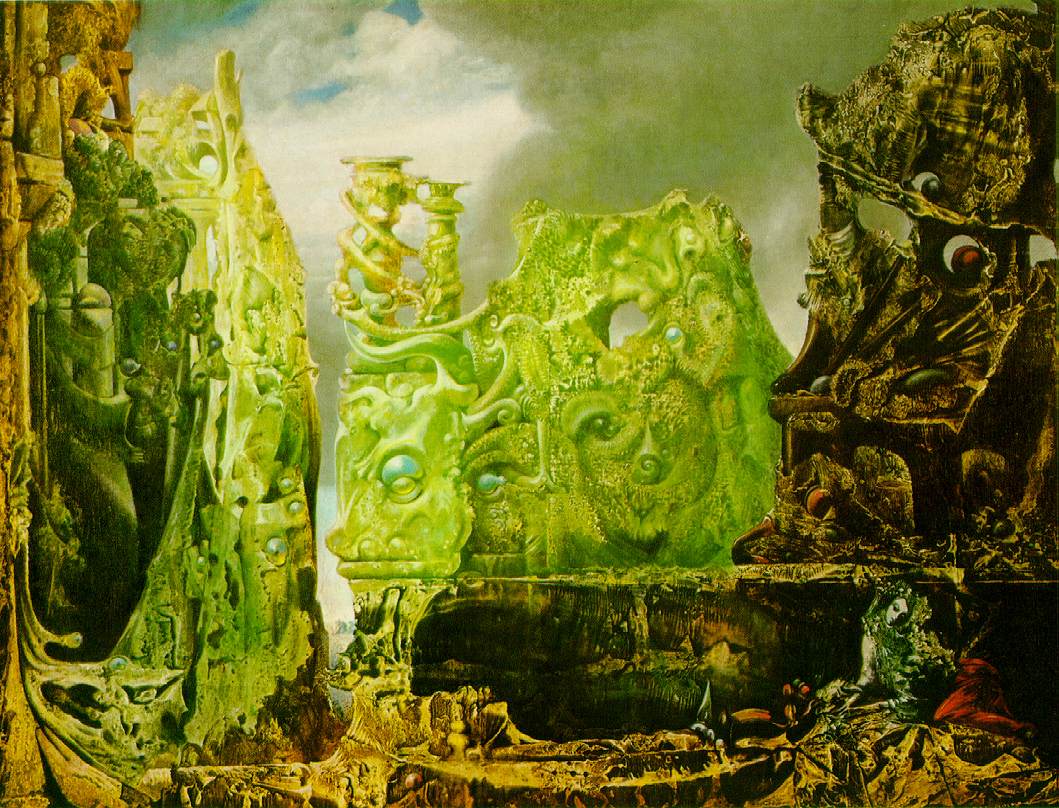
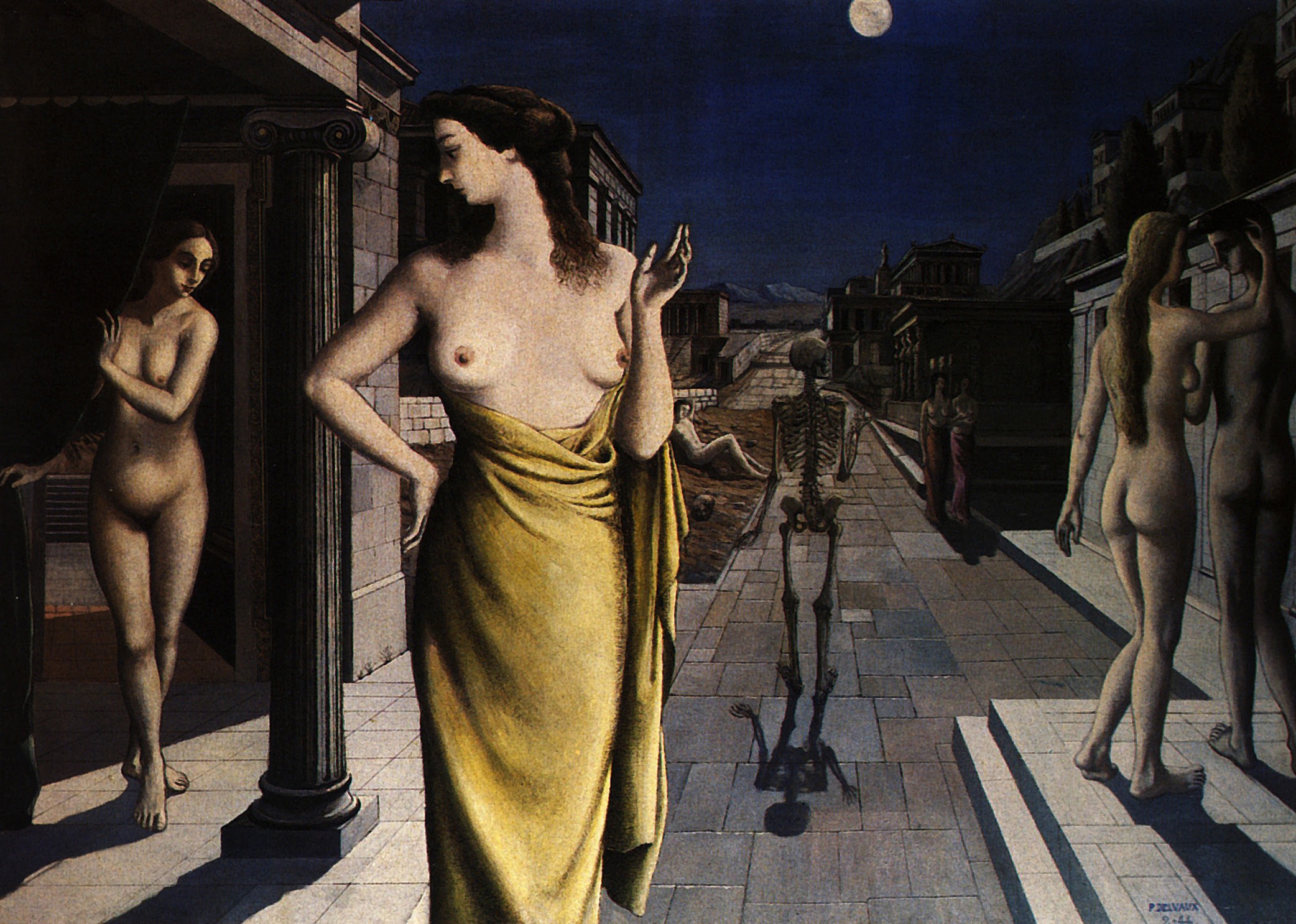
My edition of the novel contains an interview with Ballard and a short essay by him. In these two texts he underlines that surrealism, dreams and the fact that he grew up in Shanghai were important in the writing of this book. Max Ernst and Paul Delvaux are mentioned in the novel and have influenced Ballard’s imagery. As a child he witnessed how Shanghai was flooded every summer and that as well has contributed to create the images in the novel.

Eye of Silence

Max Ernst

Lunar City

Paul Delvaux

The Drowned World is not an easy book because it’s heavy on descriptions. As a lot of what he describes felt familiar from my dreams and my travels to Asia, it was easy for me to see what he painted with words, but I suppose it could be a challenge if you prefer action driven books. If you have never experienced the humid heat of the tropics it’s equally hard to imagine how that climate could affect you. That’s why I compared it to Conrad. The way Westerners are affected by the tropics is quite explicit in Conrad’s work, while it is much more implicit in Ballard’s book. Comparing the two is interesting.

I know that I wasn’t able to do this book justice. I think that is because I liked it too much. That may sound weird but that’s how it is. The Drowned World is one of the most fascinating books I’ve ever read. I loved the premise and the imagery; it was so powerful, reading it felt like lucid dreaming. It’s making my best of this year list, and maybe even my all-time favourite list.

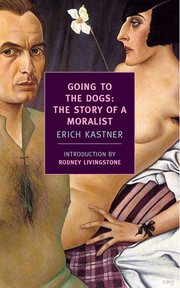
Erich Kästner: Going to the Dogs. The Story of a Moralist – Fabian. Die Geschichte eines Moralisten (1931)

Going to the Dogs

Going to the Dogs: The Story of a Moralist is set in Berlin after the Wall Street crash of 1929 and before the Nazi takeover, years of relentlessly rising unemployment when major banks and companies were in collapse. The moralist in question is Jakob Fabian, “aged thirty-two, profession variable, at present advertising copywriter, 17 Schaperstrasse, weak heart, brown hair,” a young man with an excellent education but, at least in the current economy, no prospects-permanently condemned, so far as anyone can see, to a low-paid job without security in the short or the long run. What’s to be done? Fabian and friends make the best of it-they go to work every day even though they may be laid off at any time, and in the evenings they head out to the cabarets.

Erich Kästner is famous for his children’s books like Emil and the Detectives but he was also a highly regarded author for grown ups and one of the first whose books were burnt by the Nazis. His harsh portrayal of Berlin between the wars Going to the Dogs. The Story of a Moralist or Fabian. Die Geschichte eines Moralisten is still widely read and considered a classic of German 20th Century literature and has been made into two movies. It’s a pessimistic and satirical but clear-sighted depiction of a society in collapse and the “waiting room”- feeling that was so typical then. Another world war seemed impending, Germany was heading towards disaster; the Nazi party which had already been rearing its ugly head for a while, showed that it had come to stay and would eventually take over Germany. It’s a world of depravity and unemployment. People have two possibilities; either they go under or they make the most of it. Making the most of it, means that morals are loose to the extreme. In this book people jump into beds and change partners as easily as the Hippies during the 60s, only this is a very different society and the implications are different. These are not free young people jumping into bed with each other but mostly married men and women who do it behind the back of their partners. Women who sell their bodies because there is no other way to make money; men who try to fight their depression with promiscuity and alcohol.

The novel is told from the point of view of Fabian an unemployed academic. He and his best friend Labude try to stay true to their ideals despite their own misery. Labude is waiting for news about his habilitation while Fabian has just lost his job. Fabian and Labude try to survive somehow. During the day Fabian is looking for work; at night they hit the cabarets, dance clubs, sex clubs and brothels. At the beginning of the novel, they drift but are still having fun. After a while things turn darker and what started like an amusing tale turns into a terrible tragedy.

I expected this to be a good book but I didn’t expect it to be so funny and witty. The end is sad but the beginng is hilarious.  Fabian is a very attractive man, sarcastic but fundamentally good, compassionate and highly educated. Women throw themselves at him. All sorts of women from every possible background. Young unemployed academics, wives of rich industrialists, little housewives whose husband are travelling salesmen, prostitutes and addicts.

Fabian doesn’t judge but the way the story is told clearly indicates that it’s satirical.

Kästner also manages to show how these transitions came to be. A whole generation grew up with a fear of the father induced by black pedagogy. These young men were then sent to the trenches and those, like Fabian, who came back alive and unharmed had lost all of their beliefs. Fabian is happy he’s not one of those hidden away in a hospital because his face was destroyed but inside he’s destroyed as well.

I have always been fascinated by this time period and this place. Berlin between the wars. While certainly overdrawn in places, Kästner manages an uncannily realistic portrait. We, with our knowledge of everything that came later, don’t even find it all that satirical. I was amazed that a book that was published in 1931 was this clear-sighted. There is not doubt about Germany’s future development, no doubt that there are parties fighting for supremacy and no doubt who will win. This is a society that is dancing on its own grave. Laughing, singing but crying as well. Sexuality and money are the major currencies. Everyone tries to snatch a bit of both and many go too far for that. It made me realise what fertile ground Hitler found.

If you’re looking for a second opinion – here’s a review by Guy (His Futile Preaoccupations)

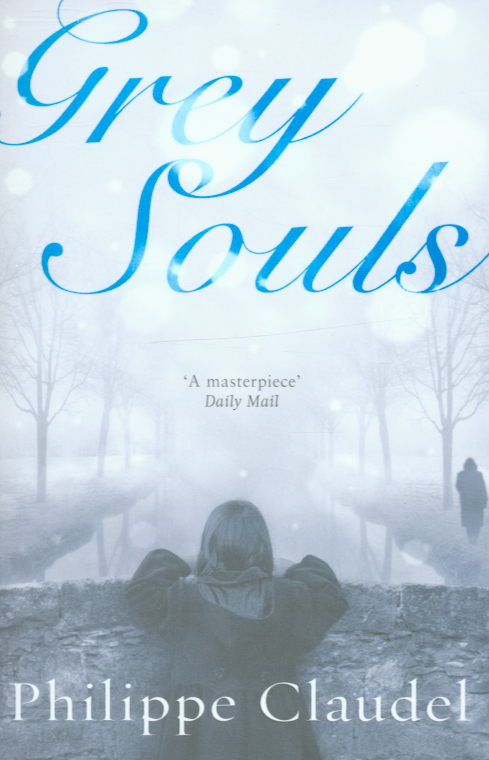
Literature and War Readalong August 30 2013: Grey Souls by Philippe Claudel

Grey Souls

I wanted to read Philippe Claudel since years and looking for a WWI novel I came across his Grey SoulsLes âmes grises. Like most of his other books the novel has been translated into 25 languages and was generally liked by readers and critics. From what I know so far, the war is not predominant in the novel. It’s more like the starting point to a crime which is solved much later. From some of the reviews I got that it’s quite heavy and brooding.

Here is the blurb

This is ostensibly a detective story, about a crime that is committed in 1917, and solved 20 years later. The location is a small town in Northern France. The war is still being fought in the trenches, within sight and sound of the town, but the men of the town have been spared the slaughter because they are needed in the local factory. One freezing cold morning in the dead of winter, a beautiful ten year old girl, one of three daughters of the local innkeeper, is found strangled and dumped in the canal. Suspicion falls on two deserters who are picked up near the town. Their interrogation and sentencing is brutal and swift.

Twenty years later, the narrator, a local policeman, puts together what actually happened. On the night the deserters were arrested and interrogated, he was sitting by the bedside of his dying wife. He believes that justice was not done and wants to set the record straight. But the death of the child was not the only crime committed in the town during those weeks.

The first sentences:

I don’t really know where to start. It’s quite difficult. All this time that has gone by, which words will never bring back, the faces too, and the smiles, the wounds. Still I need to try to say it. Say what’s been bothering me for twenty years. The remorse and the big questions. I have to cut open the mystery with a knife, just like a belly, and sink my hands in, even if that’s not going to change a thing.

The book has been made into a movie but I don’t know whether it’s available in English

*******

The discussion starts on Friday, 30 August 2013.

Further information on the Literature and War Readalong 2013, including all the book blurbs, can be found here.