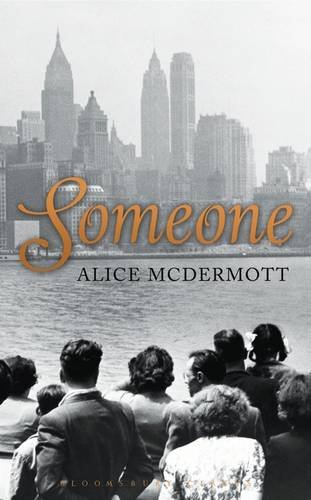
Alice McDermott: Someone (2013)

Someone

Someone begins on the stoop of a Brooklyn apartment building where Marie is waiting for her father to come home from work. It is the 1920s and in her Irish-American enclave the stories of her neighbours unfold before her short-sighted eyes. There is war-blinded Billy Corrigan and foolish, ill-fated Pegeen – and her parents’ legendary Syrian-Irish marriage – the terrifying Big Lucy, and the ever-present Sisters of Charity from the convent down the road.

As the years pass Marie’s own history plays out against the backdrop of a changing world. Her older brother Gabe leaves for the seminary to study for the priesthood, his faith destined to be tested to breaking point. Marie experiences first love – and first heartbreak – marriage and motherhood, and discovers how time can reveal us all to be fools and dreamers, blinded in one way or another by hope, loss or the exigencies of life and love.

It took a while until the title Someone of Alice McDermott’s latest novel made any sense, but once it did, I thought it was a brilliant choice. It refers to the narrator, Marie, the Brooklyn-born daughter of Irish immigrants, an unremarkable woman whose life story becomes meaningful because it is so universal. She is just “someone”, nobody special, just a woman who was born in the 20s, has experienced the aftermath of WWII, first love, work for an undertaker, marriage, her fist child, loss, grief and finally old age. It’s a mix of intense joy and pain told in delicately evocative scenes, in which every detail is rendered with a lot of care. Some say Philip Roth is the master of writing scenes. Alice McDermott maybe his female counterpart.

“Someone” also refers to other people in the book. One girl says, that there is always someone kind somewhere and when Marie, after her first heartbreak, asks her brother Gabe if she will ever find love, he tells her that someone will love her one day.

Someone isn’t told chronologically. It moves back and forth in time, picking the most important moments of Marie’s life. If it wasn’t for the writing it wouldn’t be as impressive as it is, but Alice McDermott is a writer you could read simply for her craft.

While reading I was wondering how this book that is so deeply rooted in Brooklyn would compare to Colm Toíbín’s novel Brooklyn. Just like it is the story of one woman’s life, it’s also the story of the changes Brooklyn undergoes. The way Marie’s neighbourhood is described makes you think much more of village life than life in a big city, but then again, that’s typical of the largest cities, in which some inhabitants never venture any future than their neighbourhood. Marie is particularly attached to Brooklyn. Unlike her brother Gabe she never wanted to leave or even work anywhere else. That’s why she comes to work for an undertaker, a job she’s wary of at first. It proves to be an opportunity to learn a lot about life and loss.

Since this novel is told entirely in elaborate scenes, one more wonderful than the next, I couldn’t even pick a favourite. I loved how they were descriptive and at the same time full of hidden meanings and allusions.

It’s one of those books, I’ll read again, some day, just to see, once again, how she did it, how she captured the tiny gestures of people, the way they hold themselves, the way they speak and betray their feelings in doing so.

But I didn’t only love it for the craft. I loved it for its themes – birth, marriage, family, religion, faith, too many to name them all –  and for its quiet gentleness, the belief in kindness and the many characters who all hope for a fulfilled life, but face as much disappoinment as joy and happiness. And I loved it for some lovely insighst like this one on sleep.

All the thought and all the worry, all the faith and philosophy, the paintings  and the stories and the poems, all the whatnot, gone into the study on heaven and hell, and yet so little wonder applied to the sinking into sleep. Falling asleep. All the prayers I had said before bed throughout my life, all the prayers I had made my children say – Our Father, Hail Mary, Glory Be – the Confiteor if some transgression had taken place – missed the mark entirely. It was grace, the simple prayer before meals, that we should have been murmuring into our clasped hands at the end of the day: Bless us, oh Lord, and this thy gift, which we are about to receive.

I’d love to read another of her novels. Does anyone have suggestions?
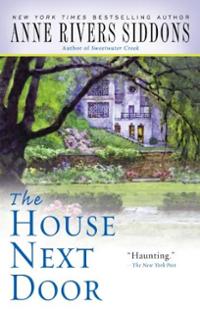
Anne Rivers Siddons: The House Next Door (1978)

The House Next Door

This summer I was suddenly in the mood to read ghost stories and haunted house stories. Looking for books to read I came across Anne Rivers Siddons The House Next Door, which is mentioned in Stephen King’s Danse Macabre as one of the best of its kind. I saw it mentioned again, some time later, in American Nightmares: The Haunted House Formula in American Popular Fiction by Dale Bailey. I’m a huge fan of the so-called Southern Gothic, which was another reason why I wanted to read The House Next Door as it clearly falls under that sub genre.

I had some preconceived ideas of what a haunted house story had to look like and I must say none of those match The House Next Door. It’s a really unusual take on the theme and maybe because of that particularly successful.

Nobody would suspect horrific events in suburban Atlanta, in a world of affluence, in which people lazily discuss their equally rich neighbours over a cocktail, but, if we believe Colquitt, the narrator of The House Next Door, horror has come to haunt the quiet, elegant neighbourhood, in which she and her husband live. Right at the beginning she tells us that the house next door is haunted and then describes why she thinks so in eloquent and elaborate details.

Colquitt and her husband are not the richest in this leafy suburban neighbourhood but they own a house next to a big piece of land, which has proven to be too difficult to build on as a small stream runs right through it. Colquitt cherishes this woodsy piece of land and spends a lot of time looking out of the window into the trees. One day, to her utter shock, her friend and neighbour announces that the land has been bought by a very young couple and that soon the beautiful land will turn into a construction site.

Colquitt dreads the destruction, the noise and dirt, and she also dreads the loss of privacy. While she isn’t a big fan of the young couple, she becomes friends with the young architect and falls in love with the plans of the house, and eagerly watches how it takes form and rises out of the ground. The house is spectacular. It looks as if it was growing out of the earth; it’s a dream made of glass and walls and strikingly beautiful.

While the construction progresses, strange things start to happen. Dead animals are found, people have accidents. I can’t say more or the book will be spoilt.

The Haunted House is unique because it really captures what domestic horror is all about: the place where we feel safest, our home, can turn into the unsafest place imaginable. The book is also unique because it’s not set in a remote wild landscape but in an elegant Southern suburb. The evil breaks into the lives of affluent, sheltered people, and turns their world upside down.

I have never read anything by Anne River Siddons before and while I had some problems with the characters, I really admire her descriptive skills. She elaborates the scenes so well, you think you’re watching a movie. I loved the descriptions of the house and how evil started to spread slowly. I didn’t like the characters, I found them annoying. I’m not the type who wants to gossip over a cocktail every evening, which they happily did. There’s a lot of drinking going on between these pages; not one social encounter takes place without abundant intake of alcohol. Still, I could feel with Colquitt. The shock over the loss of that beautiful untouched piece of land was something I could relate to. I also identified with her enthusiasm once she knew the project for the house. I love all sorts of houses and while this would be a bit too modern for me (I’m not so keen on too much glass), I can see how a house like this would work surrounded by so many trees. I would be like a big tree house.

The House Next Door is a unusual, atmospherical and well written example of a haunted house story with strong images that will stay with you long after you’ve finished the book. I liked that for once the house in question was not an old decrepit mansion, but a brand new stylish house designed by an artistic architect.

This is my first contribution to Carl’s RIP VIII Challenge. Don’t miss visiting the review site.

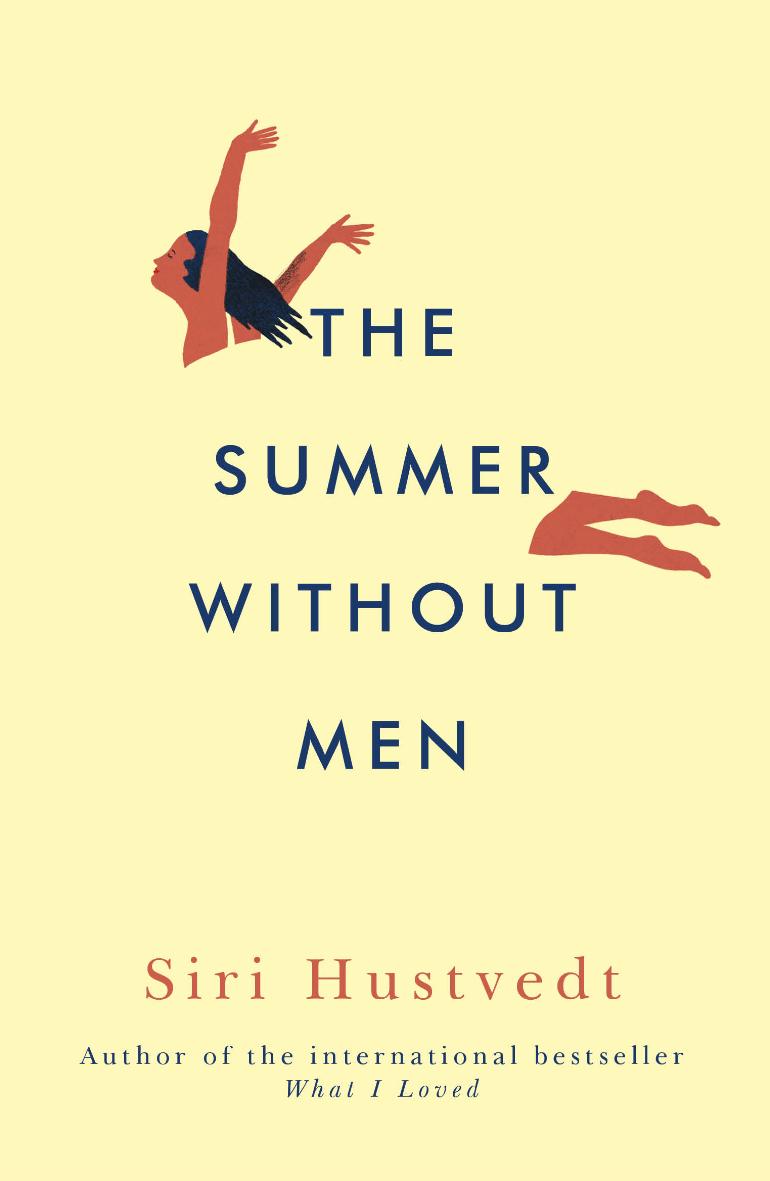
Siri Hustvedt: The Summer Without Men (2011)

The Summer Without Men

I’ve read three of Hustvedt’s novels so far, The Blindfold, The Enchantment of Lily Dahl, What I Loved, the memoir The Shaking Woman and some of the essays in A Plea for Eros. The novels are among my favourites, the essays are thought-provoking and so was her memoir. After finishing The Summer Without Men all I can do is wonder – What happened to Siri Hustvedt?

Not every writer is an academic, I’d say among the great it’s probably a minority and when you read a book like The Summer Without Men, it becomes apparent, that there may be a good reason. The intellectual baggage can enrich a book but it can also turn into a hindrance and in this case, what meager story Hustvedt had, she pumped up with theory. Derrida, Kierkegaard, Samuel Johnson, Jane Austen, and many more are mentioned and interpreted by Mia, the main protagonist. That could have been done well, but here it felt like a lecture. And to some extent it felt like she was talking down to the reader. Readers with no knowledge whatsoever of the theories and people behind them, will feel alienated, the others slightly bored as there are only snippets. The history of gender theory is an especially pertinent example. Everyone who’s ever been interested in that, will know as much as Mia but reading about it as if she’d just invented the wheel is jarring.

These were the theoretical parts of the novel. The novel has also a more story driven part. Funny enough however that read like pure chick lit for women over 50.

Mia, a 54-year-old poet is left by her husband a 65-year-old for a woman who is 20 years younger than Mia and French (yes it’s very original). Her reaction is intense. She has a psychotic episode and ends in a psychiatric hospital. That beginnning, I must say, was powerful and the pain, shock and horror behind it was palpable. After this Mia decides to spend her summer in Minnesota where her elderly mother lives in a nursing home. She meets the Swans, a group of elderly friends, Lola, her 20 something neighbour with two kids, and a group of pubescent girls who take a poetry course with her. If you think of the triad virgin-mother-crone then you are spot on as the whole story is meant to illustrate the various stages of womanhood. Some of this is arresting, some of it, notably the description of bullying among the very young, is touching, but overall it was nothing new.

Chosing a very intellectual protagonist would allow that theory is included, but that should have been done in a more subtle way. On top of that Mia often talks directly to the reader, which feels artificial.

It’s the first time, while reading this, that I noticed how bland Hustvedt’s writing is. Hustvedt uses only the most common words and the most simple sentence structures.  Her strength lies in her ideas, but they must be wrapped up better.

I wonder why this book has received such a lot of very good reviews by critics. Were they afraid they would come across as not savvy if they criticized it? I suspect so.

The end was a let down as well. In essence the book consists of parts which I’ve seen done better elsewhere. There are excellent YA books on bullying, amazing books about being a middle-aged woman like Lisa Moore’s February, and a few who look at old age, loss and grief.

As for the title, it’s not well-chosen. The Summer Without My Husband would have captured it far better.

I’ve still got Sorrows of an American here, but I think that is far better than this one. Hustvedt used to be a writer whose every book I bought without even thinking about it. That has changed radically.

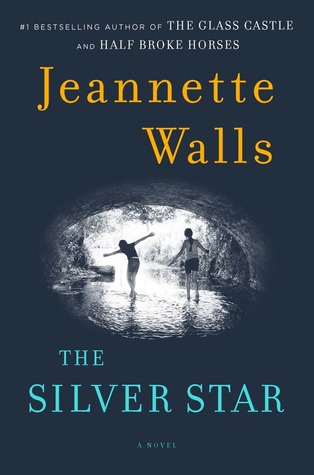
Jeanette Walls: The Silver Star (2013)

The Silver Star

I still remember when Jeanette Wall’s The Glass Castle came out. I devoured it and absolutely loved it. I was a bit disappointed to find out her second book, Half Broke Horses, wasn’t a memoir but a novel. I bought it but never read it. Last week I got her latest, The Silver Star, as a present and just finished it yesterday.

If you know Jeanette Walls, The Silver Star will not surprise you. Like in her memoir we are introduced to some really bad parenting, children who have to cope on their own, a murky family history and abusive grown-ups.

Some writers always return to familiar territory, mining their lives and telling a similar story over and over again. I don’t mind that when it is well done. And Jeanette Walls writes well. Her writing has an almost cinematic quality, her way of conjuring up a scene is very powerful.

Bean and Liz are 12 and 15 respectively when her single mum has a break down and leaves the two girls alone, with just about enough money for a month. Their mother is 36 but still a wannabe singer/songwriter/actress. Nothing she tries ever seems to work out and all of her plans invariably end in disaster. That she disappears for a couple of days is nothing new, but for a whole month is a novelty. When social services turn up in front of the house, the girls decide to go to their mother’s hometown and see if their uncle will take them in.

Their mother is originally from a small town in Virginia. The family used to be very rich but all they have left is a decaying mansion. The girls don’t know why their mother left right after Bean was born. They also don’t know who their respective fathers are.

When they turn up on uncle Tinsley’s doorstep he isn’t too thrilled at first, but eventually he gives in and lets the girls stay with him. It turns out that Bean and Liz really love the small town and settle in quickly. They make new friends, get to know Bean’s father’s family and have a great time. Their mother comes to visit but it ends in a huge drama.

When the local bully and mill supervisor Maddox tries to rape Liz, things escalate.

The book is set in the 70s; the Vietnam war and racial tensions are important topics. But gender is maybe even more important. There is an instance in which To Kill a Mocking Bird is mentioned and that’s no coincidence. There is a parallel to the novel, as in The Silver Star there is also a trial. Only with a very different outcome. Afro-American’s are still not treated like white people but women are treated even worse.

What I really liked about this book is what it says about parenting. It is obvious that Bean’s and Liz’s mother is incapable of taking care of her girls but despite this I was wondering how bad her parenting really was. She is often absent, not there when they need her, she’s “bonkers” as both girls say but she is kind and raises girls with a very strong self-esteem. I don’t try to say it’s OK for parents to just abandon their children but as a matter of fact, they were quite capable of taking care of themselves and if she’d been there, the attempted rape would still have happened. She is far from an ideal mother, she can’t cope and went through a lot of awful things but both girls are strong and very resilient. Many children who have parents who never abandon them, and provide for them materially, nevertheless crush their children’s self-esteem, abuse and neglect them emotionally. I find that far worse.

I saw that this book has received a lot of negative reviews on amazon (A lot of readers hated it because of the mother. I really wonder if they are all that perfect). Sure, it’s similar to her other books but I thought it was very enjoyable. It’s warmhearted and humorous. I loved the two girls who are very different, their uncle, and even the mother is fun as a fictional character. I’m glad I’ve got Half Broke Horses already. I’ll certainly read it soon.

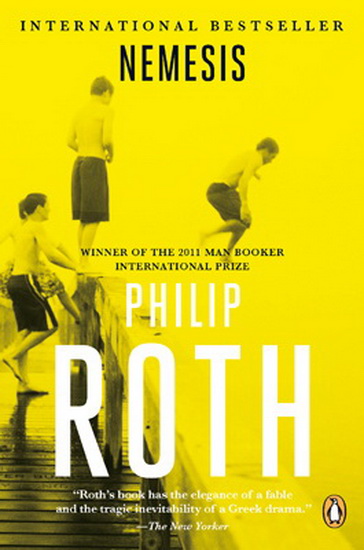
Philip Roth: Nemesis (2010)

Nemesis

There have been a few reviews of Philip Roth books recently (on Babbling Books here and here and on Book Around the Corner here) and because I commented on the one or the other posts saying that I didn’t like him, Leroy suggested I read Nemesis. The premise of the book sounded very interesting and so I finally read it. While I cannot say I’m a convert, I can still say that this is a very fine book and one that’s topical, well written and thought-provoking too.

The first thing I noticed, was that you can feel that this is an assured writer. You can feel it for many reasons. The most important one was that the writing seemed so effortless. It’s free of artificiality, flows nicely, contains many well captured scenes and the way it is told is quite wonderful. The book is told by a first person narrator, who appears only very briefly and then disappears and blends into the background of the story he tells. It isn’t his story and we will have to wait almost until the end of the book to find out who tells it and why. This is artful, and that’s why Nemesis is a great example that it’s worth to finish books because some really need all the pages to become a whole and to fully reveal their meaning.

It’s the summer of 1944. A scorching summer in Newark, New Jersey. Bucky Cantor is a young man, a physical education teacher who just graduated and starts his first job as a playground supervisor in the Jewish neighbourhood of Newark. It’s a summer job to which he has been looking forward to and which he executes with a lot of energy, enthusiasm and passion. Bucky is a small but strong and muscular man and if he wasn’t so terribly short-sighted he would be off fighting against the Germans like his best buddies Jake and Dave.

Bucky lives with his grandmother. His mother died in childbirth, his father, a thief, disappeared and the beloved grandfather has just passed away. But Bucky is by no means lonely as he has a fiancé, Marcia,  who comes from a rich Jewish family who accepts him and loves him just as much as Marcia herself does. Things look promising for Bucky if it wasn’t for a nasty, evil God, as Bucky sees it,  who decides to send the plague, in form of a polio epidemic, on Newark and the Jewish neighbourhood in which Bucky lives and works.This is 11 years before the vaccine is invented and Polio is a devastating disease. It’s not entirely clear how you contract it and while some forms are mild, most are not only crippling but can lead to death.

Roth does a great job at describing the panic, sadness, shock and horror that follow the outbreak of this epidemic. It has an absolutely devastating effect on the community of Newark and underlying racial and social tensions break out with a horrifying force.

While Nemesis tells the story of a disaster which strikes a whole community it also tells one man’s story and how he copes with disaster.

What I found amazing is the way Roth showed that in the end it’s far less important what befalls us but what really counts is how we deal with it. I can’t reveal too much or the book would be spoilt, let’s just say, that when guilt and blame come into the equation a bad situation can turn into a nightmare.

Disaster and how we cope with it isn’t the only theme in the novel. There are others like loss, regret and guilt which are all equally well illustrated.

Nemesis is a book which takes a while to develop its full aroma. I could imagine that the one or the other reader would find it a bit slow at first but it’s worth reading until  the end. While I’m still no Philip Roth enthusiast, I really liked this book and think I might pick up another of his novels some day.

Ray Bradbury: Fahrenheit 451 (1953) Folio Society Edition

Yes, I know, it’s November and I should be reading German literature but…. After having read Bradbury’s The Halloween Tree in October I was so in the mood to read Fahrenheit 451 which was one of the few famous Bradbury novels I hadn’t read so far. What a coincidence that Jackie reviewed it a few weeks later. While she wasn’t too keen on the book I was still very tempted to read it right away and luckily someone saw my comment and a few days later I had a stunning Folio Society edition in my letterbox. It’s my first Folio Society book and it will not be my last. I love the nice paper and the illustrations by Sam Weber.

And the book? It’s not what I had expected. It’s so different from The Halloween Tree which is rich in descriptions and warm atmosphere. But I loved it anyway. It’s such a strange book, reading it felt a bit like walking around in a surreal dream.

Fahrenheit 451 is set in a dystopian future in which books are forbidden. If anyone is in possession of books, the firemen come to his home at night and burn it down. The job of the firemen in this novel is not to extinguish fire but to start it. They are feared but that doesn’t mean people let go of their books easily.

Montag is a fireman who secretly hides a few books. He doesn’t even read them and why he keeps them isn’t clear. It is something in his unconscious that pushes him to act this way. One evening when he returns home he meets Clarisse, a young girl. She is like nobody else he knows; she speaks with him, sees him, shows interest. What she tells him of her family is most unusual too. They sit together in the evenings and talk. Meeting her changes Montag in subtle ways and when she disappears he changes even more.

The society depicted in Fahrenheit 451 is a society in which real relationships are substituted by fake ones with people who are projected on walls in the living rooms of the houses. Giant TV screens replace real life, real experiences. It’s like a collective trance. Montag’s wife spends more time in front of those screens than she spends with her husband.

“Stuff your eyes with wonder, ” he said, “live as if you’d drop dead in ten seconds. See the world. It’s more fantastic than any dream made or paid for in factories. Ask no guarantees, ask for no security, there never was such an animal. and if there were, it would be related to the great sloth which hangs upside down in a tree all day every day, sleeping its life away. To hell with that, ” he said, “shake the tree and knock the great sloth down on his ass.”

I liked this book a lot for many reasons. I liked the haunting atmosphere and the images it created.  I also liked some of the characters like Clarisse. And there are other amazing elements. Most of the novel takes place at night, the people of this society are all isolated from each other, nobody shares anything, still they feel strongly but live life vicariously through the people on the screens. I’m not much of a TV watcher but I’ve heard people talk about things they saw on TV, series or reality TV, which made me think they were talking about real people. Depicting a society like this was very perceptive in 1953.

Fahrenheit 451 is not my favourite Bradbury but it’s an amazing book, one that is really worth reading.

Thanks again to the Folio Society for this lovely book.

Joyce Carol Oates: Rape – A Love Story (2003)

Rape: A Love Story begins with what is almost unspeakable. It tells of the brutality and cowardice that overtakes the city of Niagara Falls in the aftermath of an attack on a woman and her young daughter. A diamond-hard dissection of modern mores, it is also the tale of Teena and Bethie’s silent champion – a man who knows the meaning of justice. And love. 

It’s a provocative title, Joyce Carol Oates has chosen for her book: Rape: A Love Story. Maybe it’s because of titles like this that people are divided when it comes to her work. I don’t know. This is maybe the fifth of her books I’ve read so far and every time I read her I think I want to read every thing she has ever written, because even books which are not as good, like The Falls, are still so much superior than most other books. Some like Solstice are of a rare beauty, others like Foxfire and Rape are bound to trigger intense discussions.

Rape tells the story of a bad decision. One single moment which changes a life forever. Because it is a beautiful night, because she comes home from a party and is happy, Teena decides to walk through a park at midnight, together with her 12-year-old daughter. It’s a decision that shouldn’t have any major consequences but it has. She is followed by a group of young men, attacked, raped and almost beaten to death. Her young daughter escapes and gets help. The police officer who finds her is a veteran of the gulf war, a quiet, silent man. He knows the young widow and likes her very much. He is incredibly shocked about what happened to her and the girl. Bethie hasn’t been raped but beaten as well.

This is only the beginning of the story, the first few pages. What follows is maybe less violent, but not less shocking. The town – Niagara Falls – turns against Teena. Rumours start to spread. Was she not too good-looking, too sexy? Did she not like men too much? There is gossip and finally threats. Her prosecutor, a woman, is ridiculed in court, everybody turns against them.

The novel is told in alternating voices, changing points of view. Many of the chapters are second person narratives. A voice seems to be talking to Bethie, the young daughter. I found the novel masterful and impressive. Especially the end. It’s an analysis of violence, guilt, justice and retribution. It doesn’t end like we would expect it will. Of course not, remember, there is the subtitle – A Love Story.… It almost feels as if Joyce Carol Oates wanted to say: “If we cannot have justice in real life, let’s at least have it in our books.”

I found it particularly eerie that Rape had a lot in common with one of the stories in Ferdinand von Schirachs’ second collection Guilt which I just reviewed here. The perpetrators even when they are known are not always brought to justice if evidence is lacking or the defence lawyer is better than he should be.

Another reason why I found the book so good and important is because this is such a universal topic. Something I sometimes fear that will never go away. I have two girl friends who have been raped. None of them reported the crime. One was drunk when she came home, wearing a leather skirt and afraid they would tell her it was her fault. The other one had chosen a way which is known for being a bit dangerous and felt she had deserved it for her stupidity. I have been followed twice and could run away and was once attacked in broad daylight. If my dog hadn’t chased the attacker… I don’t know.  On top of that there has been a series of rapes since a couple of months in the city in which I live. Every weekends since a few months young women are raped on their way home. Sometimes relatively early, around 18.00, sometimes late at night. In many different areas of the city, by one or more men. It’s appalling.

The book captures this and much more so well. One single moment changes everything, a decision that wouldn’t have an impact if we were living in a healthy world, a world in which women and girls would not constantly have to fear being attacked. It manages to say a few powerful things about going to war and being a soldier as well. A short book. But so complex.

These numbers from feminist.com may be of some interest Facts About Violence. They only look at the US which isn’t even one of the most violent places for women to be.