Dickens in December – A Christmas Carol – Readalong

Dickens button 01 resized

It didn’t take Delia and me very long to decide which book to choose for our Dickens in December readalong. There really couldn’t be a more fitting book to read just before Christmas than Dickens’ A Christmas Carol.

Last week we sent out a few questions. Some of you have chosen to answer them for the readalong, others wrote a review. Both is fine and all the links to the different contributions can be found at the end of my post and will help you to find the participants and visit their blogs. It’s updated regularly, so come back and check who else has contributed.

Is this the first time you are reading the story?

I have read A Christmas Carol before, I guess some 5 or 6 years ago and already knew then that I would read it again some day.

Did you like it?

I liked it very much 5 years ago that’s why I knew I would read it again. I still liked it this time around but for very different reasons. I was much more attentive this time to the moral of the story. The first time I was paying more attention to the descriptions.

Which was your favorite scene?

I have two favourite scenes or parts. One is the scene when Marley’s ghost appears. It’s quite spooky and Scrooge’s shock is shown so well. It’s also a very dark passage as there is clearly no redemption for Marley. It’s too late for him to change anything. While the whole story is about the power of change, this first part is a cautionary tale showing us that while Dickens did believe in change that didn’t mean he was an optimist who didn’t see that there were lost souls too.

The second part I liked a lot was when Scrooge first follows the second spirit. The descriptions are among the most evocative. They show Dickens’s style amazingly well.

Which was your least favorite scene?

I couldn’t think of a scene I didn’t like.
Which spirit and his stories did you find the most interesting?

I found the third spirit and how he was described, his appearance, the most interesting. He was the most ghostly but I liked the stories and what the second spirit showed Scrooge the most. These were the stories, I think, which reached Scrooge’s heart and let it melt.
Was there a character you wish you knew more about?

I would have liked to know more about Marley. Why did he become such an embittered old man?
How did you like the end?

It’s a perfect ending, Scrooge’s joy can be felt in every line and is very contagious. It’s the illustration of the belief that people can always change as long as they are still alive. And it also shows that there are good people in the world. While Scrooge has to make an effort and change, if the others were not ready to forgive him, we wouldn’t have this happy ending.
Did you think it was believable?

I think that someone can change profoundly but maybe not in such a short time.
Do you know anyone like Scrooge?

I know people with Scrooge-like traits but nobody who is as bad as he is.
Did he deserve to be saved?

Scrooge had a heart of stone but he wasn’t treating himself any better than others which I think makes a huge difference. If he had been spending a lot, living in luxury, feasting but depriving others, I would not so easily say yes to this question but given that he didn’t harm others for his own sake or actively inflict pain, I’d say, yes, the change of attitude and sentiment is reason enough for him to be saved.

Other contributions

50 Year Project (TBM)

Dolce Bellezza (Bellezza)

Kaggsy’s Bookish Ramblings

Polychrome Interest (Novia)

Postcards from Asia (Delia)

The Argumentative Old Git (Himadri)

The Things You Can Read  (Cynthia)Questions and Answers

The Things You Can Read Student Comments

The View From the Palace (Shimona)

Lost in the Covers (Elisa)

Leeswamme’s Blog (Judith)

Lynn’s Book Blog

Love. Laughter and a Touch of Insanity (Trish)

A Work in Progress (Danielle)

Sandra – please see comments section

Tabula Rasa (Pryia)

Slightly Cultural, Most Thoughtful and Inevitably Irrelevant (Arenel)

My Reading Journal (Ann)

Vishy’s Blog (Vishy)

Resistance is Futile (Rachel)

Too Fond of Books

Beauty is a Sleeping Cat (Caroline)

Charles Dickens: Great Expectations (1861)

In Great Expectations the orphan Pip tells the story of his life. He tells us how, after having lost his parents as a small child, he was brought up “by hand” by his mean and quarrelsome sister who hit him and her husband. How his sister’s husband Joe and Biddy the teacher were the only kind people in his life. How he met a convict and helped him. How he was invited to the excentric and melancholy Miss Havisham to play at her house. How he saw the wonderous house for the first time and met the beautiful Estella who would be the love of his life. How being introduced to Miss Havisham and Estella made him long for another life and feel ashamed of his own. How finally he was made rich and hoping for great expectations from an unknown benefactor. And how in the end things turned out in a very different way.

Great Expectations offered everything I expected from Dickens and so much more. The only thing I could criticize is that it was predictable and that there were a lot of coincidences which didn’t seem all that realistic but who cares. There is so much in this novel to like that I can easily forget its flaws. The characters were, as was to be expected, quirky and over-the top, much more caricatures than portraits, but drawn which such a wonderful imagination that I loved each one of them.

I also liked the atmosphere, how with a few words, a few sentences he captures a mood, a season, the weather, a location, a house, a street. All his descriptions are highly evocative and one sees every little detail.

There were many uncanny, witty and captivating scenes and I would have a hard time picking favorites. I liked all the chapters at Miss Havisham’s house. The sorrow and grief which had made the time stand still in that place and entrapped its owner for eternity, gave the book a very gothic feel.

But I also loved all the scenes including Mr Jagger’s clerk Wemmick and his father. They made me chuckle very often. They are such an endearing couple.

To do this book justice and write properly about it, I would need more time which I don’t have. Maybe I will return to it next year and write something a bit more detailed.

For now I would just like to say, I loved it for many reasons but what stood out the most is that Dickens comes across as a writer with a huge heart who can even  make many of his villains endearing.

Dickens button 01 resized

Guy de Maupassant: Bel-Ami (1885)

When I used to think of Maupassant, I used to think of short stories. That was all I had read by him so far and because he is so excellent at it – probably one of the very best short story writers you can read – I thought that his novels might be pale in comparison. I was wrong. After having read Bel-Ami, I think that he might very well be one of the best writers in any genre. It’s one of the most perfect books I’ve ever read. I couldn’t name one single flaw. As much as I like Balzac there is always this and that, minor things, sure, but still, some imperfections. Not with Maupassant. What also surprised me is that this book could have been written nowadays. The society has changed, the world has changed but the way he writes about love, sex, power, money, careers… It’s outspoken and modern.

More than anything Bel-Ami is a character portrait paired with the portrait of a society, the Parisian high society. Georges Duroy, who receives the nick name Bel-Ami from the daughter of his lover Mme Marelle, is one of the most unlikable characters of French literature. An arriviste who has only one striking feature, his good looks, and one talent, the talent to know how to use people or, to be more precise, women.

At the beginning of the  novel he is working as a clerk and hardly knows how to pay his meals. He was a sergeant in the colonial army and served in Algeria. One evening, strolling down the boulevards of Paris and debating with himself how to use his last francs, he bumps into Forrestier, a former comrade. Forrestier has become a journalist in a new and not very respected newspaper which belongs to a Jewish man, Mr Walter. Forrestier is married to a beautiful and very intelligent woman and lives a cushy life. It wasn’t entirely clear to me why he chose to help Bel-Ami but he does and in doing so sets in motion the spectacular ascension of Georges Duroy. Forrestier opens the door to his house and helps him to a position as assistant journalist. Although, just like Forrrestier himself, he isn’t capable of writing one coherent piece, he will become a famous journalist. I’m not going to tell you how, you have to read it to find out.

One trait I found interesting in the novel is to see why people invite other people into their houses. Women invite Bel-Ami because they want him close, they are in love with him. Men on the other hand invite him because he doesn’t have a lot and they all love to display their riches. The women in this society are all easily seduced and the men become victims of their vanity.

While he is still somewhat naive but envious at the beginning of the novel, once he has understood how easily he gets access to the high society and can achieve almost anything through these two weaknesses, the easy seduction of women and the vanity of their men, he turns into a manipulative and calculating machine. Using one woman after the other, duping one husband after the other, he ascends the social ladder with dizzying speed.

While Bel-Ami is the central character, the women and their husbands are not less well-drawn. One perfect little scene after the other shows Bel-Ami “at work”. It’s amazing that he becomes a famous journalist although he isn’t capable of writing. And later he even becomes a politician despite the fact that he is clueless and knows nothing about politics. He is just clever enough to know who does and to get to their knowledge via the one or the other woman.

Bel-Ami is vain, he is self-centered and cares only about his own pleasure, power and money. He seduces people and uses them and when they are no longer of any value he discards them which leads to some fantastic scenes. While he is unlikable, one has to be fair, he doesn’t force women, he seduces them and it’s ultimately their weakness which leads him to success. Men like Bel-Ami still exist and things have not changed much in our society in that regard. I still see women falling for this type of guy who has nothing to offer but looks and sweet talk. And an erotic appeal. Let’s face it, without that erotic appeal not even Bel-Ami would have gotten that far. It’s obvious in the novel, and quite explicit too, that the women  do not fall for him because he is bright or because they want to spend hours gazing into his eyes. They want to go to bed with him. Even the very young ones like Mme Marelle’s daughter who invented the nickname Bel-Ami, cannot hold back and want physical contact.

Maupassant’s novel is one of those that should be read by people who think 19th Century literature is old-fashioned and has nothing to offer to contemporary readers. It could open a door to a whole new reading experience. 

Bel-Ami is an entirely captivating and well-told story, combining descriptions of opulent interiors and detailed character portraits with the analysis of a society addicted to power and fame and one man who knows how to exploit it all.

Balzac: The Deserted Woman – La Femme abandonnée (1832)

When I read Le Père Goriot Old Goriot years ago I was fascinated by the tragic story of Mme de Beauséant. I knew Balzac had dedicated a novella to her which is included in the Scenes from Private Life. After reading one of Guy’s recent Balzac reviews, I decided it was about time to finally read the story. For those who read French you can find the story of The Deserted Woman or La Femme abandonnée in  Les Secrets de la Princess de Cadigan et autres études de femmes.

Gaston de Nueil, a young noble man, leaves Paris for Bayeux, a provincial city located in the Basse-Normandie region. His health is rather poor and he has to stay away from the capital until he recovers. Used to more interesting society than the one he finds in Bayeux, he is soon terribly bored and his imagination is set on fire by the story of the countess de Beauséant who lives like a recluse in her château in the Normandy. She is said to be a young woman of great beauty and even greater esprit who fled to Bayeux after having been abandoned by her former lover, the marquis d’Ajouda-Pinto. The separation was devastating and as she is trapped in a loveless marriage which cannot be divorced, the only way to keep at least some of her self-esteem was to withdraw from the world and dedicate her days to reading and praying.

Young, bored and curious about love, de Nueil falls in love with the unhappy countess before he has even set eyes on her. He walks in her gardens in the night, tries to catch a glimpse of her and is finally so love-sick that he decides to use a ruse in order to get access to her house.

When he finally stands before the woman he fell in love with because of her story and her reputation, he finds her even more beautiful and tragic than he expected.

The countess is 30 years old by now, while de Nueil is barely 23. She is trapped in a void, a loveless life, no contact to society, no future joy in sight. It’s not surprising that de Nueil’s infatuation moves her and finally leads her to accept him as her lover.

Writing more would spoil the story which is one of the best of Balzac’s short stories. You can read it on its own but when you are familiar with the Comédie Humaine you will like it even more. The countess is a key figure in Old Goriot and therefore important for the whole oeuvre. The story as such reminded me of many others. It bears some resemblance with Mme de Lafayette’s The Princesse de Clèves. The countess sounds just like the princesse when she first meets de Nueil. I was also reminded of  Henry James’ Mme de Mauves but most of all it reminded me of Colette’s Chéri. The end however is entirely different from all of these.

I like it when the title has a special significance, is complex and multi-layered. The title of this story seems simple but is excellent. To fully appreciate it, you will have to read the story.

As excellent as this story is, I wouldn’t recommend it to anyone who is not familiar with Balzac. I would still recommend Old Goriot as the best starting point. Paired with this novella, it would be an amazingly great introduction to Balzac’s work and convey a good feeling for the diversity of his talent. The Deserted Woman also contains all of the themes which are important in Balzac’s work such as the mechanics of society, the role of women, marriage, adultery, money and some sub-themes like the “inheritance”, the “fallen woman”, the “aging woman” etc.

I liked the story a great deal. I thought the way Balzac described how de Nueil falls in love is perceptive and uncanny at the same time. Falling in love of an idea, or ideal, may unfortunately very often be the reason for falling in love. I haven’t seen it described as eloquently very often. I think this part of the story applies to all sorts of idealisations; people falling in love with stars or other people they hardly know like people in chat rooms, internet forums or blogs.

If you’d like to read the novella in English and are interested in an overview of Balzac’s work and how it is grouped here is an excellent link The Human Comedy – La comédie humaine.

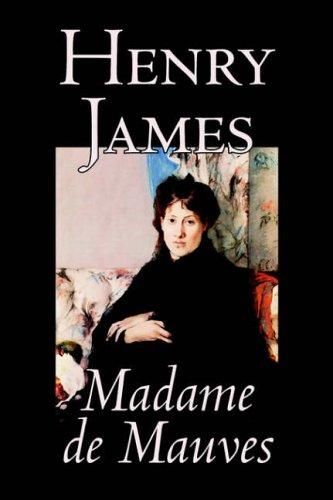
Henry James: Mme de Mauves (1874)

It was exactly one year ago that I reviewed Edith Wharton’s Mme de Treymes. Mme de Treymes – Mme de Mauves? Both novellas, both set in Paris, or in the case of Mme de Mauves in St-Germain-en-Laye. It’s hardly a coincidence. And who was influenced by whom is also not hard to find out as James wrote his novella in 1874, while Edith Wharton published Mme de Treymes in 1907.

Henry James and Edith Wharton are both novelists whose each and every book I would like to read sooner or later. Discovering Madame de Mauves of which I hadn’t known anything before was a real pleasure and the first sentences managed to capture me right away.

The view from the terrace at St.Germain-en-Laye is immense and famous. Paris lies spread before you in dusky vastness, domed and fortified, glittering here and there through her light vapours and girdled with her silver Seine. Behind you is a park of stately symmetry, and behind that a forest where you may lounge through turfy avenues and light-chequered glades and quite forget that you are in half an hour of the boulevards. One afternoon, however, in mid-spring, some five years ago, a young man seated at the terrace had preferred to keep this in mind. His eyes were fixed in idle wistfulness on the mighty human hive before him.

Like in Mme de Treymes we have the theme of intercontinental marriage and its difficulties. The young American Longmore, the narrator of Henry James’ novella, meets the beautiful and sad Mme de Mauves on one of his walks in St. Germain. A mutual friend introduces them and before leaving for London asks him to keep her company and distract her, as she is trapped in an unhappy marriage. Mme de Mauves is a young, very rich American woman, married to an aristocratic Frenchman. While she married because she romantically idealized the title, she also married for love, while he married her for the money only. It is known that he not only spends her money but has one affair after the other.

The more time Longmore  spends in her company, the more he admires her, pities her and finally falls in love with her. He would want her to confide in him but she refuses. As much as he is in love with her, he would never attempt anything and is taken aback when her sister-in-law suggests they should have an affair. It’s only natural, according to the sister-in-law, for a Frenchman to have affairs but it isn’t natural for a woman to make him one scene after the other and to torment him with reproaches. In an earlier conversation with Longmore, M de Mauves complains about his wife. He thinks that she is too morbid, to fond of reading and solitude.

A lot of what we find in James’ later novels can already be found here. The contrast of morals between France and America, the almost impossibility of a marriage between a rich American and an aristocratic Frenchman. Adultery. Divorce seems no option although Longmore hopes so at a certain point. I think it would be really great to read Wharton’s and James’ novella together. Both have drastic and surprising endings but in the case of Mme de Mauves, I’m not sure whether it isn’t surprising because it is implausible. If anyone has read the novella I’d love to discuss the ending.

It seems that of all of his novels The Golden Bowl is the most similar to this novella, although, without the tragic end. The negotiation that fails in Mme de Mauve is successful in The Golden Bowl, or so it seems. I have not read the Golden Bowl yet but would like to very much.

The writing in Mme de Mauves is complex, typical for James, it’s by far less readable than Mme de Treymes.

While this may not be his best work, it has reminded me of all I like in his writing and has certainly put me in the mood for another of his longer novels.

Has anyone read Mme de Mauves? Which are your favourite Henry James novels? Portrait of a Lady is one of my favourite novels but I also like many of his other books with the exception of The Turn of the Screw. I didn’t get along with that at all.

Herman Melville: Bartleby the Scrivener. A Story of Wall Street (1853)

bartleby

Academics hail it as the beginning of modernism, but to readers around the world—even those daunted by Moby-Dick—BARTLEBY THE SCRIVENER is simply one of the most absorbing and moving novellas ever. Set in the mid-19th century on New York City’s Wall Street, it was also, perhaps, Herman Melville’s most prescient story: what if a young man caught up in the rat race of commerce finally just said, “I would prefer not to”?

There is a specific reason, why I read Melville’s novella Bartleby. I have just read and reviewed Delerm’s novel Quelque chose en lui de Bartleby and since it was obviously inspired by Melville’s story, I had to read it.

I was never tempted to read Moby Dick although my parents had a copy with beautiful etchings. I can’t tell you why but some books just do not sound like you would like them.

Reading Bartleby I was very surprised how humorous it is. The characters are very eccentric and so is the story. It is basically the story of a young man called Bartleby who just doesn’t want to comply. Like the raven, in Poe’s eponymous poem, he has his stereotypical sentence which is “I would prefer not to.” Whatever it is he is asked to do, Bartleby invariably refuses it uttering the sentence I just quoted.

Bartleby is told in the first person peripheral, by a lawyer who has his office on the Wall Street. He once hired Bartleby as a copyist or scrivener. He already had three different copyists, each one of them with his own eccentricities, that’s why at first he didn’t pay too much attention when Bartleby declares that “he would prefer not to” read the copies together with anyone else.

The lawyer thinks at first that this is just a whim but soon enough it is obvious that there is more to it. While in the beginning he doesn’t want to read with the others, never goes out or seems to eat, after a certain time Bartleby stops working altogether. On a Sunday morning the lawyer makes another discovery which leaves him quite fazed. Bartleby never leaves the office. He stays there over night and during the weekends.

As much as he threatens him, offers him money, tries to negotiate, Bartleby doesn’t work anymore and he doesn’t leave either. If he wants to get rid of him, the lawyer has to take extreme measures. After some time and many frustrations, he decides to change the office and move away from Wall Street.

Not long after he has moved, he hears complaints by the new lawyer about Bartleby. The man is still there and haunts the building.

I’m not going to tell you the end in all its details, it should just suffice to say that the narrator tells the reader, that he thinks he might have found out what drove Bartleby to this extreme behavior. Bartleby used to work for another lawyer handling “Dead Letters”. I must admit I had no idea what “dead letters” are. It reminded me vaguely of Gogol’s Dead Souls and it proved that the association wasn’t totally wrong. “Dead letters” are letters that never reach their recipient because he has died or disappeared or left without leaving an address.

While reading this novella I was reminded of many other books. Not only Poe’s The Raven came to mind but some of Poe’s other writings. He didn’t only write Tales of Mystery and Imagination but a fair amount of absurd tales like we find them again in Kafka’s work. The already mentioned Gogol came to mind as well. I was also reminded of the first scene in Balzac’s Le Colonel Chabert (see my review in which the clerks bicker and quarrel.

Bartleby is the tale of someone who gives up on life, who stops participating and contributing. He is tired of it all. I often wonder when I see beggars in the streets how many chose to live like that. I met Clochards in Paris who told me that the hassle of a job, an apartment, a wife and children was just too much for them and they found it easier to live on the street. At first this may seem absurd but thinking of it for a while, it may make sense.

If it hadn’t been for Delerm, I wouldn’t have read this novella but I’m glad I did. It’s surprisingly modern. It is interesting to discover its intertextuality and a  more thorough analysis would be fascinating. I’m sure Kafka read it, as sure as I am that Melville was influenced by Poe, Gogol and maybe Balzac. However, I must say, I don’t think that Delerm’s Spitzweg and Bartleby have much in common.

Elizabeth Gaskell: The Moorland Cottage (1850)

Growing up in Yorkshire, the daughter of a deceased clergyman, Maggie Browne is encouraged to devote herself to her brother, Edward, upon whom their widowed mother dotes. Through the example and guidance of her mentor, Mrs Buxton, Maggie learns that self-sacrifice is the key to living a fulfilled life. How much personal happiness will she forgo in the name of duty and devotion to her brother? This novella depicts the struggle of a strong-minded Victorian woman, torn between her dreams and her duty towards her family. Maggie’s love story, Edward’s perfidy and the dramatic conclusion at sea, make The Moorland Cottage a timeless tale.

Elizabeth Gaskell’s novel The Moorland Cottage is said to be the precursor and the template for George Elliot’s The Mill on the Floss as we can read on the inner sleeve of this very nice Hesperus edition. As a matter of fact this and the blurb sounded so interesting and the book looked so appealing that I bought it and only realized later that this was the very same novel I had seen reviewed on Violet’s blog and sworn to stay away from. It wasn’t a positive review at all. I trust Violet’s taste and felt quite silly that I bought it. I must add that the cover of her edition looked very different. Tacky is the word for it. I have never read anything by Elizabeth Gaskell and this was short enough (140 pages) so I thought I give it a try anyway. Halfway into the book I discovered that Katherine from the Gaskell Blog, who is hosting a group read of The Moorland Cottage, dedicated one of the first posts to a stunning photo tour of the first chapter of the book.

The descriptions are easily one of the best things in this novel. For very personal reasons I also liked the character portraits. The mother does, in some instances, sound so much like my own mother used to be that it felt spooky to read how she reprimanded little Maggie the whole time, trying to crush her joy and preferring the brother over the girl for no particular other apparent reason than that he is a boy.

The Moorland Cottage tells Maggie Browne’s story. She is the daughter of a clergy man who has died a few years ago and leaves little Maggie, her brother Edward and a cold-hearted wife, who has adopted a theatrical, ostentatious way of mourning him. In the little cottage also lives a housemaid, Nancy, an old woman who is very fond of little Maggie and loves her dearly. This is lucky as her own mother only cares for the boy who is an obnoxious, selfish and reckless child. He suppresses and exploits his sister whenever he can.

One day the family is invited to the estate of the Buxton family. The Buxton family consists of the invalid Mrs Buxton, Mr Buxton, their son Frank and the niece Erminia. In the Buxton family Maggie encounters acceptance and love. Mrs Buxton as well as the girl Erminia like her a great deal and in the absence of her mother Maggie shows her true nature. She isn’t only a subdued little girl but very intelligent and truly kind.

After the death of Mrs Buxton the novel fastforwards a few years. Maggie and Frank have fallen in love, Edward has become a lawyer and handles some affairs for Mr Buxton The two lovers want to marry but Frank’s father is opposed to the idea. Chapter 7 is by far the most interesting. It displays all the themes that are recurring in Gaskell’s novels, one of them is the situation of the poor.

I found it particularly interesting because Frank asks Maggie to go away with him, to Australia or Canada.

I would go off to Australia at once. Indeed, Maggie, I think it would be the best thing we could do. My heart aches about the mysterious corruptions and evils of an old state of society such as we have in England.

Frank has lost all faith in the European society. He longs for a clean start in an uncorrupted environment. Where would Frank want to go nowadays, I wondered. To the Moon?

Frank has a huge problem with the way the rich treat the poor and the lovers discuss this at length. Maggie says she would be glad if there really was such a thing as “Transmigration”, something she has read about in an Indian tale. She would like to be transmigrated into a slave owner to see his side of things.

I quite enjoyed the first 8 chapters. I have to agree with Violet, the tone of the novel is mawkish throughout and there is a lot of crying but up to chapter 9 I could forgive it. From then on the novel unfortunately takes a turn. Maggie commits a huge act of self-sacrifice and the story’s plausibility is stretched a lot.

Still I enjoyed it overall because I cannot compare it to any of her other novels yet and because I could see what a truly good Elizabeth Gaskell novel would have to offer. Her descriptions are nuanced and beautiful, the changing of the seasons is rendered masterfully. Depending on the season her descriptions are either light and cheerful or dark and gloomy. Some character descriptions are interesting. Mrs Buxton, despite her insufferable moral teachings, is an interesting character. Why is she ailing and why does she love little Maggie so much?  The awareness of social injustices and the social criticism are themes Elizabeth Gaskell is known for and there is already quite a lot of it in this early novel.

Although the end dampened the overall impression, I will always remember the beautiful descriptions of the English countryside and feel like reading either North and South or Cranford very soon.

Do you have any other suggestions? Did someone else read The Moorland Cottage?