F. W. Murnau’s Nosferatu – A Symphony of Horror aka Nosferatu – Eine Symphonie des Grauens (1922)

Murnau’s Nosferatu is the first horror movie that has ever been made. I think it is not the first vampire movie. There was another one that is forgotten by now, but Nosferatu is the first to be based on Bram Stoker’s Dracula.

The German movie Nosferatu has written cinema history for many reasons. I had wanted to see it since years and thought I take the opportunity of the R.I.P. challenge to do so.

Murnau’s Nosferatu is one of the oldest movies  I have ever seen. As I am not such a fan of silent movies I was really sceptical. No need for that. Nosferatu is highly watchable. And very spooky. I got the restored version and it looks brilliant, the black and white is toned with different colours. Murnau chose to follow Bram Stoker’s Dracula very closely. Since it is a silent movie much of the horror is conveyed through facial expressions. If you have never seen a silent movie it takes some getting used to but then it is fascinating. It is quite relaxing to hear music and no talking for a change. If it was only for the figure of Nosferatu himself the movie would already be worth watching. The role made Max Schreck famous. Nosferatu is not a beautiful or erotic vampire although the element of sexual attraction is present. Murnau’s Nosferatu is dark and scary.

Hutter, the young assistant of a real estate agent, travels to Transylvania to close a contract with the ominous count Orlok. Orlok wants to buy an old house that is located opposite to where Ellen, Hutter’s young fiancée, lives.  The moment Hutter arrives in Transylvania there are many signs that point to something dark and evil. The castle in which Orlok lives towers gloomily over the city and no one wants to accompany young Hutter when he asks for a guide. When Hutter finally meets the count he let’s him see a picture of his bride and Orlok falls instantly in love. He can’t wait to get to Germany and boards a ship immediately. Hutter sees a horse carriage loaded with coffins and is shocked. He senses that his bride might be in danger.

Both travel to back to Germany as fast as they can. One by ship, the other one on horseback. When the ship arrives, the crew is found dead and rats are running all over the ship’s planks. When the dead are examined they have little marks on their necks and show all the signs of having died from the plague. Soon the whole town is struck by the plague.

Many of you know the story but for those who don’t I will stop here.

There are many elements that contribute to make this movie scary. The rats and the plague. The faces of the actors, heavily made-up with dark make-up around the eyes. The black and white pictures that make the scary elements look much more threatening. The locations, Bremen and other original places in Eastern Europe. Nothing was filmed in the studio. But there is more to it. We can feel a really dark undercurrent in this movie since it was meant to allude to the Spanish flu epidemic that had afflicted and traumatized Germany (and many other countries) from 1918-1919 and cost more lives than the Great War. And it also reflected the German’s fear of the Slavic people stemming from their experience of the war in Serbia.

Nosferatu is a truly haunting and very expressive movie that should be discovered or rediscovered by many.

I would be curious to know if anyone else has seen Nosferatu or what you think of the trailer.
Black Cat Awareness Month

P1030196

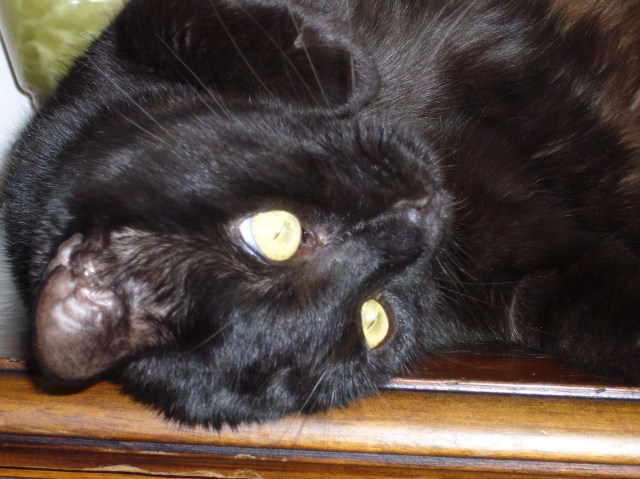
As much as I like Halloween, I do believe that this custom does a great disservice to black cats. Seeing as it is coming up at the end of the month I decided to declare October to be the Black Cat Awareness Month.

I have another reason however to choose October as this is the month when I got the first of my two black cats. The story is a sad one actually even though it turned out to be a lucky one for them.

It was a cold October morning in 2008 when me and my boyfriend decided to drive to a cat shelter in Colmar, France, just about 40 minutes from where we live. I had wanted a cat for quite a while and seen the homepage of the shelter. When we arrived I was shocked. I had never seen a place like this before. The place looked rundown and there were only dilapidated houses and  shacks. Most of them were lacking any kind of heating. Dozens of mangy looking stray cats were roaming the place and big noisy dogs in cages barked frantically. It was noisy, dirty and off-putting. Total chaos. We looked around a little bit and finally asked someone for help. They were quite nice and later I understood that these people are doing a terrific job. None of them gets paid and they really struggle. That week they had received far over 100 new cats, many of them not older than a few days. Usually in French shelters the animals get put down within a month, if no one takes them but in this one they don’t do it and they often take those from the so-called “killing-shelters”.

“What type of cat are you looking for?” the woman asked us.

“Preferably a quiet one.” I said.

“Really?” I did not understand her emphasizing this word as I did not know that quiet meant shy, meant maybe difficult. A combination no one would want. “Long hair, short hair, any ideas about the color?” she asked next.

“Black. Short hair.”

“Black?”

“Black”

I have hardly ever seen anyone speed like this. She ran in front of us to a little house and up some horrible stairs that looked as if they were going to cave in any minute. When we stood in front of the door she asked again “Black, right?”

I nodded and then she opened that door and I swear, until the end of my days, I am never going to forget this. The little house was swarming with black cats.

“You know,” she said, a little embarrassed. “In France, we are still quite superstitious. No one wants a black cat. That’s why we have at least two houses full of black cats.”

There was one very tiny, little cat, a female that had already been at the shelter for almost a year although she was barely 1.5 year old. I looked at her and I knew:  That’s her. I realised later that if we hadn’t taken her, no one would have. Too little, too timid and – let’s face it – hard to handle as she was semi-feral.

We had to come back the next day as she needed a rabies shot to be allowed to cross the border. At home we spoke about names and decided to call her Isis as she looked quite Egyptian. The next day when we returned she had received her shot and her international passport had been fixed.

“I’m sorry,” said the girl who was there. “I had to put a name in the passport, else she cannot cross the border but you can always change it later.”

Guess what name she chose? Right, Isis.

A month later we decided to get another one because she did not like to stay alone during the day. And that’s how we got another black cat. Little Max. He was only 4 months old but extremely sick when we got him. He almost didn’t make it.

They are both lovely cats, although Isis is difficult and accepts hardly anyone but me. She was frankly bad when we got her. She seemed traumatized and had probably been hit and one leg looked as if it had been broken.

I often ask people what they think of black cats and mostly get the same reactions. I asked the vet if she knew if it was any better in Switzerland or Germany and she said that it was the same as in France. Black cats will sit in shelters endlessly. Until they get sick or lose their mind. Apart from England, where black cats are said to bring luck, they are not appreciated. I think this is very sad. When I watched the IKEA TV commercial with the cats in it I was stunned once more.  Not one black cat in it.

Black cats are not more difficult than other cats. They are not moodier or less friendly. They have wonderful shiny fur and their eyes look so smashing in those dark faces.

Should you consider to take a cat from a shelter, think of the black cats who have a much smaller chance of being taken.

Do you have any thoughts or stories to share about black cats?

J. Courtney Sullivan: Commencement (2009)

A sparkling debut novel: a tender story of friendship, a witty take on liberal arts colleges, and a fascinating portrait of the first generation of women who have all the opportunities in the world, but no clear idea about what to choose.

Assigned to the same dorm their first year at Smith College, Celia, Bree, Sally, and April couldn’t have less in common. Celia, a lapsed Catholic, arrives with her grandmother’s rosary beads in hand and a bottle of vodka in her suitcase; beautiful Bree pines for the fiancé she left behind in Savannah; Sally, pristinely dressed in Lilly Pulitzer, is reeling from the loss of her mother; and April, a radical, redheaded feminist wearing a “Riot: Don’t Diet” T-shirt, wants a room transfer immediately.

Celia, Bree, Sally and April are best friends even though they couldn’t be more different. During their time at Smith’s College they are inseparable. They help each other through minor and bigger disasters. Four years after graduating they meet again at Sally’s wedding. A stupid dispute drives them apart and they avoid each other for almost a year when April disappears.

Commencement is a novel of ideas. I don’t know why it has been called chick-lit. Because four young women are the protagonists? Quite unfair. It is as if this label proves the point the book wants to make. Even years after women’s lib began, we are still nowhere. A large part of Commencement is dedicated to topics like sex-trafficking, rape and child abuse. Despite the serious topics it tackles, it is an entertaining book with a lighthearted quality. But it is definitely a feminist novel in the vein of Marilyn French’s The Women’s Room and not chick-lit. I needed some time to get into it as each chapter is told by someone else. We hear that person’s story and get to know the others through her eyes. That wouldn’t be confusing, but they sound similar and their names are similar. Sullivan let’s her characters explore all the possibilities women have today. Getting married, staying single, having kids, having no kids, become lesbians, have various sexual partners, be monogamous. She looks into the mechanics of family and friendship. One girl’s parents are still in love, another has lost her mother, the third grew up with a single hippie mom and the fourth has a career mom. Regarding their professional choices Sullivan goes a similar way. They all chose something quite different. Sullivan who is a feminist deliberately chose to show every possible combination/choice. This could have gone wrong but it is well done. From page to page I liked those girls more. I wouldn’t go as far as comparing it to Mary Mc Carthy’s The Group but it is very good.  Ronnie, April’s boss, a militant feminist and audacious filmmaker is a very interesting character. Her ideals are such that she is blinded by them and becomes a true fanatic. A selfish zealot who does not shy away from endangering others for the cause. Another interesting aspect is that even though one girl loves another girl, she never considers herself to be a lesbian. The depiction of a women’s college is probably very realistic as Sullivan went to Smith herself. The friendship of those girls is very touching. It’s cute how they cuddle up in bed together, watch movies or chat.

If you are looking for an interesting, thought-provoking but still entertaining read, go for it. Especially when you are a feminist, interested in women’s topics or just love stories about friendship among women.

I mentioned The Group and The Women’s Room before which I loved both. Which books about female friendships and developpment did you like?

The Young Victoria (2009) The Early Years of Queen Victoria. A Gorgeous Period Drama

This movie is a gift. It is gorgeous, sumptuous, enchanting and simply uplifting. Emily Blunt as the young Queen Victoria is such a good choice. She is really lovely. No one who enjoys this period, the style, those wonderful clothes should miss this movie. It makes you dream. I am enthusiastic about the colors they chose for her dresses, always very strong colors, purple, emerald-green, ruby-red, saffron yellow and sapphire blue. She wears them with matching headdresses and exquisite jewellery.

The Young Victoria follows the early years of the young queen. It starts shortly before she becomes Queen and shows how she had to fight for her right to become Queen despite her young age (she was only 18 years old). Her mother was her worst enemy at the time, although she herself was under the influence of another. She controlled and manipulated young Victoria to an unimaginable extent. Once Queen, Victoria freed herself. Lord Melbourne, her Prime Minister, helped her and assisted her in all her duties. She was a very spirited young woman and I enjoyed to see how capable she was to fight for herself. The love story between Victoria and her German cousin Albert is one of the most beautiful I have ever seen. They are really a cute couple. It wasn’t a head over heels passion but a strong fondness from the beginning. After initial struggles they reigned together for twenty years. I had no idea about any of this, frankly. I did not know that they loved each other so much until his early death parted them. I did not know that she was the first sovereign to live in Buckingham Palace.

The Young Victoria is really a must-see for everyone who loves period drama, this particular era and the story of a strong woman and a true love.

Barbara Trapido: Sex & Stravinsky (2010)

This was my first book by Barbara Trapido but I think it will not be the last. It has flaws but I could generously overlook them as there is so much to enjoy in Sex & Stravinsky.

Sex & Stravinsky is told in alternating points of view something I usually  don’t like unless it is done as well as Barbara Trapido does it. What is really impressive is how different those voices sound. The story could be told in a few words as the book is really focussing more on the characters than on the plot.

The Australian Caroline meets Josh, a South African, in London. Josh is fascinated by opera, ballet and pantomime, dedicating his whole live to these topics. They have a daughter Zoe who would love to become a ballet dancer but since money is tight she has to make do with reading ballet books that are written by Hattie whom she doesn’t know.

Hattie is the secret love of Josh’s life. She still lives in South Africa with Hermann, the tall blond of Boer descent. They have a daughter Cat who is highly creative but hates her mother’s guts.

And there is Jack, Jacques or Giacomo, depending on the mood of the day, a young man of modest background who reinvents his own story as he moves from South Africa to Senegal, to Italy and back to South Africa.

There are a lot of coincidences in this book that seem unrealistic and still Barbara Trapido can get away with it as her characters are truly wonderful.

At the beginning of the novel, the couples are in their respective countries, at the end they all meet in South Africa, more or less by chance.

Caroline is by far the most appealing character and I could relate to her story. She was followed to London by her awful mother who exploits and abuses her whenever she can. Although Caroline is strong – she can renovate and redecorate a house like any man could, she is over six feet tall and a stunning blonde beauty, she transforms a bus into a little paradise, she knows how to cook delicious meals out of nothing, sews the most wonderful clothes out of old pieces -she cannot fight her own mother and her horrible sister. Unfortunately the description of her mother, the event of her cerebral hemorrhage including the story of the will and the unhappy discoveries linked to it felt all too familiar…

Each one of them does not live the life they had dreamt of but they will all get their chance in the end.

I really enjoyed this book. It exudes globalization and all the elements of living in a multicultural world. We hear as much about Stravinsky as about the masks of the Dogon. But, and this is my critique, it sort of flies over these cultural elements. It is a bit like standing at an enormous buffet with fingerfood from every corner of the world. A little taste of Moroccan cuisine, morsels of Northern Italian anti-pasti, a sandwich with a Caribbean spread.

Still, I liked it a lot: I loved the descriptions of the characters. Talented Caroline, Hattie the petite dancer, rebellious Cat, adopted Josh, Herman the boorish architect, little Zoe who discovers France on a school trip.

Zoe’s school trip to France is one of the best parts. Poor Zoe lands in a dysfunctional lower class family with unhealthy habits, a lot of shouting, awful driving in a smoke-filled car.

One theme that we find in the whole novel is legitimacy. There are three characters in this book who don’t know who their real parents are.

I believe Barbara Trapido just invented the genre of the  21st century multicultural fairytale.

One thing I would be interested in however, why did she choose this title? Has anyone an idea?

Mary Higgins Clark: Voices in the Coalbin (1989) A Ghost Story

This is not on my R.I.P. list but it suits just fine and I am in the mood to stray from the path. I felt like reading some Mary Higgins Clark after having visited The Book Whisperers’ Blog the other day. I remembered that I had a collection of her short stories (in German Träum süss, kleine Schwester). They  don’t exist in this combination in English but that does not matter as I think there are only two very goods ones in it and those are available as Audio Book. However That’s the Ticket does not classify for an entry in R.I.P. as it is neither fish nor fowl. No ghost story, no mystery, but it is OK.

Voices in the Coalbin is also in The Mammoth Book of 20th Century Ghost Stories (Danielle from A Work In Progress has reviewed some of them and will go on reviewing more for R.I.P.) as it is really an eery story, something  I did not expect from Mary Higgins Clark. It has all we like in her writing, great descriptions, detail, atmosphere. And it is spooky. It tells the story of a young couple, Mike and Laurie, who drive to a weekend house in the country that belonged to Mike’s grandmother. The trip is meant to help Laurie to recover from nightmares, depression and phobias. She has been seeing a psychiatrist who warned the husband to be very careful as she is fragile. She seems to be on the brink of remembering things that are linked to her own grandmother who mistreated and abused her emotionally as a child.  When they arrive at the holiday house  nothing is like he remembered it. It’s rather bleak and sad. When something happens that reminds Laurie of her childhood, she panics and then disappears. I am not revealing anything more. I already said it, it is not a mystery, it is really a ghost story and the end was creepy.

I loved to read it, cuddled up in bed, both cats close by and sipping a cup of tea. It is already quite cool over here, crows are sitting in the trees in front of the window and their cries sound already much more eery and lonelier than in summer…