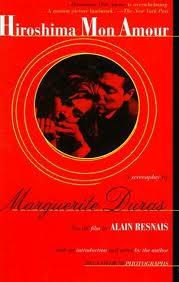
Marguerite Duras and Alain Resnais: Hiroshima mon Amour – Book and Movie (1959/60) Literature and War Readalong July 2011

How do you talk about war? How to put it into words, into pictures? How to tell and show the unspeakable, the horror, the atrocity? How much can you know about something that you have not experienced? These are but a few questions Marguerite Duras and Alain Resnais explore in the book and the movie.

Hiroshima Mon Amour is maybe the most difficult book of this readalong to write about. A summary wouldn’t do it justice. I was amazed once more how good it is, how profound and how the book and the movie seem like two different ways of exploring, with two different languages, the atrocity that we call war. What is fascinating is how they seem to converse with each other.

In 1959 a Japanese man and a French woman meet in Hiroshima. They are both a bit over thirty and happily married. They spend a night together. It is shortly before the woman’s return to France. She is an actress who has come to Hiroshima to play a nurse in a movie on peace. They make love and talk. First about Hiroshima, then about the past of the woman. They part for the day but he follows her and they spend another night together, stay awake, spend  time in a tea house. During the second night, the woman tells the man the whole story of her past in Nevers and her tragic first love. She hasn’t told anyone this story before because there was never anyone like her first lover after that until this day.

I’m glad I read the book again before watching the movie. It was interesting to see how different it is when we first imagine something and when we then see it as well.

During the initial part of the movie we hear a voice-over. The woman tells the man everything that she has seen in Hiroshima. In the news at the time, in the museum during her stay. When you read it, you see in your imagination what you have seen before in documentaries or on photos but the movie shows you how it really was and on the other hand you have the man’s voice telling you, that you have seen nothing, know nothing. There is no replacing the actual experience.

The first pictures show bodies, parts of bodies, first covered in what looks like fall out, then in sweat. This reminded me of Resnais’ documentary Night and Fog. It is the same visual language that tries to show us what violence does to the body, that tries to capture the devastation. Hiroshima Mon Amour seems also to say that war and love can be equally destructive. There is violence in aggression and in passion.

What struck me is that we do not know their names. At the end they give each other the name of the places in which their mutual tragedies happened. She calls him Hiroshima, he calls her Nevers.

One of the themes of the book and the movie is how the collective and the personal tragedies are linked. While Hiroshima and WWII stand for a collective tragedy, Nevers stands for a personal tragedy. This is one of the achievements of  Hiroshima Mon Amour. One approach in war stories or war movies is to pick one exemplary person and tell his/her story. We understand the individual far better, can identify far better with one person’s story but the large-scale of the collective should not be forgotten. Hiroshima Mon Amour is one of the rare movies/books who manages to show both and make clear that they are interdependent.

For those who have not read the book, I would say that it is a valuable addition and it is fascinating to see how they complement each other. First there is the script, including proposals by Marguerite Duras, then she adds information on what scenes Resnais finally chose, plus there is an annex in which Duras goes deeper, explores the woman’s story, gives it more density. I liked the appendix, that was mostly dedicated to the woman’s story, a lot.

There are many things that are worth discussing and I am looking forward to hear your thoughts. One question that has been on my mind since I re-watched the movie is the choice of the Japanese actor. He struck me as looking quite European. I had kept the appendix for last and was glad that Duras mentioned this choice, saying they had wanted to make a more universal statement with this. They didn’t want people to think “That’s an attractive Japanese” but “That’s an attractive man”. I was not completely happy about this. It’s a sad fact that whenever a person from another continent is casted in a European movie, the film directors think of the European taste and choose someone less typical. This is unfortunately exactly how exotism works. I think Resnais and Duras were honest in their attempt but I’m not sure it was ok.

Other reviews:

Emily (Evening All Afternoon)

Litlove (Tales from the Reading Room)

Richard (Caravana de recuerdos)

*****

Hiroshima mon Amour was the seventh book in the Literature and War Readalong. The next one will be Elsa Morante’s History. Discussion starts on Friday August 26, 2011.

Frank Herbert: Dune (1965) Book III The Prophet

It is Saturday once again and time for the third and last Dune readalong post. I’m so glad I participated despite the initial feeling of “What have I gotten myself into?”. I can still not say, I loved Dune, that would be a lie but I can say I loved the readalong. It was a great experience, the dedication and the discussions were great and I’m looking forward to the next readalong. The readalong is hosted by Carl V from Stainless Steel Droppings,  The Little Red Reviewer and Grace from Books without any Pictures. This weeks questions have been sent by Grace. Here are the other links.

What is your reaction to finally learning the identity of Princess Irulan?  Do you think that her convention added to the story?

I wanted to “meet” her from the beginning and was very intrigued by her character. The parts quoted from her manuals and books stand out style wise. I was not surprised that she was the Emperor’s daughter but saddened about the plans they had for her. She strikes me as too special to be handled like some goods.

Were you satisfied with the ending?  For those reading for the first time, was it what you expected?

I still don’t think it feels like a standalone novel. For me the story is just about to start, I also think that this third part felt rushed. There were some fastworwarding moments that did not feel right to me. Comparing it to the first parts, there were much more things that were just mentioned but we did not see them happen.

On both Arrakis and Salusa Secundus, ecology plays a major role in shaping both characters and the story itself.  Was this convincing?  Do you think that Paul would have gone through with his threat to destroy the spice, knowing what it would mean for Arrakis?

I thought that it was very well done how ecology and characters of the different cultures were interwoven and for me this was the special appeal of Dune. I’m fascinated how surroundings influence and form cultures or how one thing that is meaningful because it is scare in one place, becomes unimportant in another to an extent that it isn’t even appreciated anymore.

There certainly is a possibility that Paul would destroy the spice but I’m sure he will find a solution not to do it. Someone who gets married to a woman for purely political reasons doesn’t strike me as someone who will give up a pricey resource.

Both Leto and Paul made their decisions on marriage for political reasons.  Do you agree with their choices?

This ties back to answer no. 1. I found this quite horrible, horrible for the concubine and, in Paul’s case. also for the future wife and I have also a feeling that this will not work and this is also why I thought the book ended at an awkward moment. I can’t imagine that Paul will use the Princess Irulan purely for breeding or, I hope, she will not let him do that to her.

What was your favorite part in this section of the book?

I enjoyed it when they rode the worms. I was fascinated by these creatures the whole time and thought it showed so well to what extent the Fremen are capable of mastering their hostile surroundings.

One of the things I noticed in the discussions last week was Herbert’s use of the word “jihad.”  What do you think of Herbert’s message about religion and politics?

I said it in the last posts and the discussion that I found the use of the word jihad problematic but I also found the use of the word messiah problematic and I can’t see Paul as a Messiah figure. He has some superior mental faculties but that isn’t enough for me to see a saviour figure in him. What Herbert does, is mix a lot of elements from all sorts of religions, it is a real religious hodgepodge what he offers.  I am not sure what he wants to tell us with this. That all religions are equal? That the elements are interchangeable? The religious world he created has no new elements, that’s for sure. Maybe the most striking is that he created a world in which everything is tied to politics and religion. And politics and religion are once more tied together, something the West has overcome. There is no laicism on Dune, their political system is far from secular which will always be problematic.

Frank Herbert: Dune (1965) Book II Muad’Dib

It’s time for the second Dune readalong post. The readalong is hosted by Carl V from Stainless Steel Droppings,  The Little Red Reviewer and (slight change of the initial three) Grace from Books without any Pictures. This weeks questions have been sent by Redhead (The Little Red Reviewer). Check out the other links here.

I’m happy to report that I liked part II much better. There is far less dialogue and if there is, it is an exchange between two people and not purely an instruction of the reader.

Was Liet’s identity a surprise?  Who do you think he really works for?

I’m not totally sure about this question. I thought he died? I thought since he was a Fremen he also secretly worked for them.

What do you think of the Fremen culture?  Is this a culture you think you’d enjoy spending some time with?

They sound like a very proud and interesting people and reminded me a bit of the Tuareg or any other desert dwelling nomads. A lot of Dune is inspired by North African culture. But since I like rain and plants more than anything else in the world and as appealing as I think some of it sounds, thanks but no thanks, I wouldn’t want to live with them. Furthermore I’m not into duelling. A fierce fighting people isn’t the kind I would want to spend time with. One aspect that I liked is their patient attempt to re-green the desert. Their elaborate plans sounded very convincing.

What do you think of Count Fenring’s unusual verbal mannerisms?  

I found it quite annoying and was trying to imagine how it would sound. I’m not sure what Herbert wants to tell us with this?

This is a far future empire with very little in the way of computerization. Information is often passed down orally, and schools (such as the Mentats and the Bene Gesserit) have formed to train young people in memorization and information processing.  What are you thoughts on a scifi story that is very “low-tech”?  Does that sound like a feasible future? A ridiculous one?

This is precisely the reason why I thought from the beginning that it really is a bit of a sci-fi/fantasy blend. Considering the fact that resources are limited on earth, and very likely on other planets as well, low-tech seems a more viable way to go. These people are advanced in other ways. The mental faculties are far more developed and this would be something to wish for. Unfortunately, humans stay humans, and will, even with low-tech support only , try to exploit others. At least that’s how it is on Dune.

If you found the beginning of the book tough to get into, do you find that you’re having an easier time with the middle portion, now that all the “set-up” is complete?

Yes, it is far easier, as I said in the intro, there is much less dialogue in this part and finally people seem to talk to each other. At least to a certain extent. In part I the dialogue was meant for the reader to understand life on Dune, which is a highly artificial way of getting information across. Since a lot is “set-up” now, he did let go of this. The reading was more fluent and there was quite a bit of action. I liked the part when Paul and his mother are on their own. That part was quite gripping.

The center portion of the book is still pretty dialog heavy, but what I’ve noticed is the subtlety of the dialog. Things left unsaid are often more important than things that are said.  What do you think of that as a stylistic choice? does it make the dialog more interesting? less interesting? 

Any change in the dialogue form was a welcome change for me. I appreciate it much more the way it is handled here but it is still far from realistic. And whenever the parts are centered on the Baron, the dialogue is still heavy (meaning too much and artificial).

Dune was written in the 60’s. Does it feel dated to you? How does it compare, writing style-wise, to more contemporary science fiction you’ve read?

I don’t know any new science fiction. It doesn’t feel dated, no. Maybe the strong Arabic element is dated. I have a feeling a contemporary writer wouldn’t use a word like jihad and would try to be more inventive in terms of cultural elements and not just pick from existing cultures.

If you’ve never read this book before, where do you think the storyline is headed?

I’m really not sure. I start to have a feeling that we will be left with a lot of open questions at the end of Part III. It’s epic, so that seems logical. I wonder if we will even get introduced to the Princess Irulan. I would like to read something about her. But – should anyone wonder – I will not go on reading this series. The moment I close part III, that’s it for me.

Frank Herbert Readalong: Dune (1965) Book I Dune

It’s time for the first Dune readalong post. The readalong is hosted by Carl V from Stainless Steel Droppings, Kailana from The Written World and The Little Red Reviewer.

It’s a bit different from other readalongs I have participated in so far, as we are all sent questions to answer. I like this different approach and will dedicate the whole post to those questions and not summarize anything at all. I think some of the answers should suffice to help potential readers decide whether or not they want to embark on the Dune journey as well. This week’s questions have been sent by Carl V. Don’t forget to head over to his site and check out the links for the answers of the others.

1.  What, if any, preconceived ideas did you have before you started reading Dune and how has the first section measured up to those preconceptions?

I will keep this answer quite short as part of this question will be answered when I answer question 5.

I had not a lot of preconceived ideas regarding the story. I knew that it was called an epic but I had never read a summary and so pretty much the whole story came as a surprise. I had preconceived ideas regarding the form. I had read that it was compared to Lord of the Rings, I never thought this meant that the story was similar but that I would find engaging, fluent writing. That is not what Dune is like at all. I found it very unwieldy so far.

2.  What did you think about the plot device of the early revelation that Yueh was to be the traitor?

This type of revelation doesn’t always work well but here it added to the feeling of threat. Knowing more than the main protagonists made me feel closer to them. A bit as if you knew friends are in danger and you wanted to warn them. Despite the fact that we know he is a traitor, we do not know everything yet and the outcome of the whole episode remains surprising.

3.  What was your favorite part of this first section?  Which character(s) do you find most interesting and why?

I really liked the description of the planet and the over-importance of water. I couldn’t help and find it prophetic. When Herbert wrote this, our planet wasn’t as polluted as it is now and, if we believe what certain experts say, the importance of water might sooner look like it is described in Dune, than we would like.

Another uncanny element is the use of Arabic sounding or genuinely Arabic names and concepts. There is talk of a jihad and the emperor’s name is Shaddam…

The scene in the wet-plant conservatory was one of my favourite ones. I liked the description a lot and also the way lady Jessica finds a hidden message. It is one of the rare scenes in the book with hardly any dialogue (see answer 5).

I find all the Bene Gesserit characters extremely interesting. The mental training they undergo, how they master themselves and others is fascinating. The Lady Jessica is a favourite but I also like Paul, her son, a great deal.

I also liked the idea of “spice” a lot. Something that enlightens and can make you dependent at the same time.

There were a few almost scary elements which I appreciated as well. Those sandworms could also be used in a horror story to great effect.

4.  Did the revelation about the Harkonnen surprise you? Why or why not? Thoughts.

It did surprise me to a certain extent but I wasn’t sufficiently interested in that part. The conspiracy, the treachery, that was not what interested me the most. I liked other elements better. I am not often reading for suspense, I like well-drawn characters, descriptions, settings and scenes.

5.  Finally, please share some overall thoughts on this first section of the book.  Are you finding it difficult to follow? Easy to understand? Engaging? Boring?  Just share what you are thinking thus far.

The writing in Dune is as dry as the planet Arrakis. I did find the beginning extremely difficult to follow because of the concepts and words that you had to look up constantly in the glossary at the back of the book. It gets easier after a few pages.

The biggest problem I had was the story telling itself. I’m sorry to have to say this but I think Frank Herbert cannot write. I don’t think “show but don’t tell” is something you have to follow religiously when writing literary fiction but it is needed in genre fiction. Dune is probably the most extreme example of genre fiction to disregard this advice. This is all tell and hardly any show. The first part consist to 80% of dialogue. And even the thoughts are rendered in “direct speech mode”. Whenever he described something, I came up for air and also enjoyed parts of it. More scenes and less dialogue would have made me like it more.

I am very honestly, disappointed in this book so far. If the story telling was half as good as the concepts, ideas and characters, this could have been terrific. I will still go on reading, hoping for a change of style in part II. So far… It’s a bit of a chore.

A Dune Readalong

I discovered yesterday that Carl V from Stainless Steel Droppings, Kailana from The Written World and The Little Red Reviewer will host a group read of one of the most famous Science Fiction novels there is.
I always wanted to read Dune but never really got around to doing it. Now is the time.
The book is divided into three parts and so the readalong will take place over a period of three weeks, starting this Friday, July 1st.
Details can be found on Carl’s blog.
I’m looking forward to it.
Will you join as well?

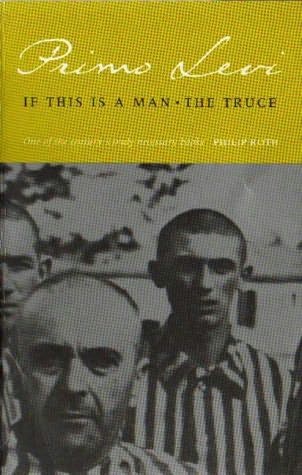
Primo Levi: If This is a Man or Survival in Auschwitz – Se questo è un uomo (1947) Literature and War Readalong June 2011

Survival in Auschwitz is a mostly straightforward narrative, beginning with Primo Levi’s deportation from Turin, Italy, to the concentration camp Auschwitz in Poland in 1943. Levi, then a 25-year-old chemist, spent 10 months in the camp. Even Levi’s most graphic descriptions of the horrors he witnessed and endured there are marked by a restraint and wit that not only gives readers access to his experience, but confronts them with it in stark ethical and emotional terms.

Survival in Auschwitz or If This is a Man was difficult to read and the images it created will haunt me for a long time. Additionally I watched Alain Resnais’ Nuit et Brouillard – Night and Fog which intensified the reading experience.

Primo Levi was part of the Italian resistance when he was captured by Fascist militia in the winter of 1943. After hearing that he is Jewish, the militia hand him over to the Nazis and he is deported to Auschwitz. It’s towards the end of the war and despite Auschwitz being an extermination camp, as they needed many people to work there, they didn’t kill as many as before which is one of the reasons why Levi survived.

Stepping off the train, the people who have been captured, are divided, sometimes arbitrarily, sometimes depending on their strength and fitness. Those who are sent to another direction than Primo Levi will take a shower and we all know what that means. The others who are kept alive, have to strip, wait in the cold for hours and are finally shaved, tattooed and stripped of their old identity. 174517 is the number that is tattooed into Primo Levi’s arm. The numbers, that are like a bar code, tell the other prisoners a lot. They can deduce where the people come from, how long they have been at the Lager. Some numbers are famous, for example the lower numbers of the first ones to arrive from Polish Ghettos. Three years after their arrival some are still alive.

Levi describes their arrival in great detail. He also tells in great detail how everything ends, how after long days of bombardment, and when it becomes obvious that the Russians are not far, the Germans abandon the camp. They leave the weakest and the sick people, like Primo Levi, behind, the others are taken along and probably shot on the way. What a struggle it was for those left behind to survive. There was no more heating and it was icy cold outside, they had no more food, no more blankets, just dirt, debris, corpses and sick and dying people.

Flanked by these two long chapters – the arrival and the end – we get to read a succession of shorter chapters that describe every aspect of the life in a concentration camp. How they are fed, always just a little bit to keep them alive, but never enough to stop the hunger. How they sleep, two men on a small bed of 70cm together. They wake all night because their bladders are weak and the others wake them, it is cold, they have nightmares. He describes what clothes they wear, how dirty and torn they are, the work they do, which is mostly forced labour of the most strenuous kind. They are always cold, hungry and extremely tired. The only time they can recuperate a little bit is when they fall ill. But falling ill is dangerous as well, should they fall too ill, they will be exterminated.

What we read is horrible and shocking but what disturbed me the most is what he wrote about the increasing inhumanity of the prisoners. People turned into monsters under these conditions. They had hardly anything and tried to take advantage, they stole and cheated and did everything for the sake of a tiny little piece of bread, some small advantage over others. Give a man a few privileges under the condition to supervise, punish and abuse others and he will do it. This trait of human nature was cunningly exploited by the Nazi’s. Levi picks a few examples and describes them in more detail than others. It’s amazing what people would do to save themselves.

There are a few men who are kind or manage to stay kind but they are not numerous at all. Levi is lucky, there is one Italian a non-Jewish prisoner, better off than he is, who helps him.

Survival in Auschwitz is impressive for many reasons. It is one of the most precious and detailed testimonies and so well written. One can really understand what it must have been like.

I have written in the introductory post that my edition is French. At the end of the book is an annex of 25 pages in which Primo Levi answers eight questions. These are questions he was often asked when he presented the book, in schools or elsewhere. Some of these questions were on my mind as well while I was reading.

I’m just going to pick those that interested me personally the most.

Did Primo Levi go back to Auschwitz after the war? Yes, he did. In the 60s but it left him surprisingly unfazed as most of the barracks he had been in did not exist anymore and large portions of the rest were transformed into a museum. It was very hard for him to see Birkenau, where the crematorium was although he wasn’t there during the war. That part was like he remembered the Lager, mud, dirt, debris.

Why was there no uprising? Levi tried to answer the question as good as he could. When they arrived, they could have done it but as they didn’t know what was going on they didn’t try. Later there were uprisings but always by political prisoners, not by Jews, which is understandable. The Jews were treated far more badly and therefore much weaker and most were not political people, they had no idea how to resist.

Was there a difference between Soviet Gulags and the German Lager? Yes, the Soviets didn’t want to exterminate the prisoners and although they were awful too – forced labour, bad conditions – it wasn’t as brutal.

The last question was by far the most fascinating. Someone asked Levi, who he would be if he hadn’t been in Auschwitz. Of course, he stated, this was a philosophical question and he added, that the only thing he knew for sure was, that without Auschwitz he wouldn’t have become a writer. The experience in the Lager triggered the urge to write. He started to write in Auschwitz and as soon as he was back, wrote this book pretty much in one go. Without Auschwitz he would have stayed a simple chemist.

This last question and some passages in the book seem to indicate how it was possible that Primo Levi survived, why he had the mental force that was needed. He wrote that he always had an interest in human psychology and that he was fascinated to watch the people and what happened around him. This also helped him to still recognize those around him as humans, although they had been stripped of everything.

It’s a difficult and depressing book but I was touched by Levi’s humanity and his voice and I know I will read more of him. A while back I watched Francesco Rosi’s movie La Tregua aka The Truce based on Primo Levi’s novel. It tells the story of his odyssey back home from the Lager to Italy. Primo Levi’s part is played by John Turturro. If you want to get a good feeling for the man Levi, this is a great starting point. It manages to convey how he became a writer. I will certainly read the book.

I’m interested to know what others thought about this book. Was it too hard to read? Did you also think that he managed incredibly well to make us feel and understand what he went through?

Other reviews

Introduction by Danielle (A Work in Progress)

*****

Survival in Auschwitz was the sixth book in the Literature and War Readalong. The next one will be Marguerite Duras’ Hiroshima mon Amour. Discussion starts on Friday July 29, 2011 .

Literature and War Readalong June 24 2011: If This is A Man aka Se questo è un uomo by Primo Levi

This month is moving very fast and the next readalong is on the 24th already. It might be good to get started if you want to join in.

Primo Levi is a writer that has been on my mind for years. I knew his story, had read about him. I have read other’s accounts of their incarceration in concentration camps. I have read excerpts of Levi’s work but never got around to read his most famous book, the autobiographical account of his incarceration in the extermination camp Auschwitz.

He was on my mind for this and because he committed suicide so late in life. Because he seems to be such a perfect example of survivor’s guilt.

I dreaded to read his account, I know it won’t be cheerful but I always wanted to read it, wanted to explore his life, to understand why he couldn’t live with the guilt of being one of a very few survivors.

Despite the sadness and the horrors he describes there is beauty in his books as he is not only a witness of dreadful times but also an accomplished writer.

Primo Levi’s book is the only nonfiction book in this readalong.

I’m reading the French translation Si c’est un homme.