Juan Rulfo: Pedro Páramo (1955) A Classic of Mexican Literature

Pedro Páramo” (1955) treats the physical and moral disintegration of a laconic ‘cacique’ (boss) and is set in a mythical hell on earth inhabited by dead individuals who are constantly haunted by their past transgressions.

Since years I wanted to read Pedro Páramo. It’s Juan Rulfo’s only novel and not only a classic of Mexican literature but one of the most important and most influential works of Latin American literature. Rulfo was a script writer and photographer (among other things) and his photos are quite impressive. Apart from this only novel, he left a collection of short stories El llano en llamas or The Burning Plain. Should you read Spanish, you are lucky as the stories are included in the same book in the Spanish version.

It’s always mysterious when someone writes only one novel, especially when it is an important one like Pedro Páramo. Susan Sontag who wrote the introduction to the English edition also touches on this.

Everyone asked Rulfo why he didn’t write another book, as if the point of a writer’s life was to go on writing and publishing. In fact, the point of a writer’s life is to produce a great book – that is, a book that will last – and that is what Rulfo did. (Susan Sontag)

When the book was published it was absolutely no success. It was called too Faulknerian, too loose, too heterogenous.

It isn’t an easy book but it is highly evocative and contains a multitude of powerful images. The photos below have been taken by Rulfo and many of them could serve to illustrate the novel which has also been turned into a movie.

On her deathbed Juan Preciado’s mother begs him to travel to her home village Comala and to look for his father the landowner Pedro Páramo and ask for his due. Juan does as he is told. When he approaches Comala it doesn’t look as his mother described it. Where is the beauty, the life? He meets people on his way and asks them about his father and also about the village and why it is so quiet and deserted. All the men and women he meets are elusive.  Someone at last indicates the house of a woman in which he can stay.

When the woman starts to tell Juan things about the people it becomes obvious that the village is deserted because everybody who lived there is dead. The people he sees are all ghosts. The noises he hears are the whispers of the dead.

The novel breaks into various different story lines from here. All those ghosts and voices start to tell their story. There is the story of the son of Pedro Páramo, killed by his horse. The story of the love between Juan’s mother and Pedro Páramo. The story of Susana, Pedro’s childhood sweetheart and second wife.

All the voices tell a different personal story but the underlying tale is the same. There is talk of corruption and oppression, exploitation and abuse. Murder and rape. Páramo is a bad man and so are his sons and it is only natural that the peasants and villagers plan an uprising.

The novel reads like a patchwork of different stories. As broken up as they are, it isn’t confusing, we know who speaks, we know who tells his tale.

While this isn’t a linear story, it is a stunning book. The writing is impressive. We hear the rain, we smell the odour of the dry earth when it is soaked, we see the shining full moon in the hot nights, we hear the ghosts whisper and see their shadows scurry along the walls. We see the tiny corn plants how they struggle for survival in the dry earth.

It’s a powerful novel infused with the spirit of the Mexican Día de los muertos or Day of the Dead at the same time it is an allegory of oppression and freedom that comes at the highest cost.

When you read Pedro Páramo it becomes obvious that “magic realism” has many faces.

I found this recording of Juan Rulfo reading one of his short stories in Spanish: Juan Rulfo reading  ¡Diles que no me maten!

I attached it because I liked the way he reads it a lot.

This is my second read for Carl’s R.I.P VI. Don’t forget to visit the reviewsite.

Daphne du Maurier: The House on The Strand (1965)

The House on the Strand

Echoing the great fantastic stories of H. P. Lovecraft and Edgar Allan Poe, The House on the Strand is a masterful yarn of history, romance, horror, and suspense that will grip the reader until the last surprising twist.

What a mysterious and hypnotic read. I really enjoyed it and was surprised that it was much more complex than I had assumed at first. Complex and also dark. The House on the Strand is a time-travel story, something that isn’t very typical for Daphne du Maurier and also a genre that I don’t like normally. If the part in our time hadn’t been so compelling I wouldn’t have liked it that much, I’m sure.

Richard Young has come to a point in his life in which nothing is certain anymore. He is married to a young dynamic American woman , Vita, who has two little boys from a first marriage. She would like him to move from England to the States and start working for her brother. Although Dick has resigned from his old post with a renowned editor, he can’t make up his mind or rather, he doesn’t want to move to the States. Very clearly he has to decide whether this intercontinental marriage does still make sense or not.

The summer holidays have started and Magnus, Dick’s childhood friend, has lent him his old family home in Cornwall. The only thing he’d like Dick to do in exchange, is to try a drug that he has developed which will transport the user back to the 14th century. Dick has almost a week to try out the drug until Vita and the boys will arrive from the States and join him for their summer holiday.

Right after his first trip to 14th century Cornwall, Dick is hooked. He is fascinated by what he sees, a complex story of interwoven families, betrayal, adultery and crime that is displayed before his very eyes with so much intensity and brightness that it seems more appealing than his real life.

Soon after the first trip he goes on the next one. Being “over there” doesn’t pose a problem but coming back has occasionally side effects like nausea and confusion. Additionally he never knows where he will return. It could be quite dangerous as there are roads and railway lines which didn’t exist in the 14th century England. The way du Maurier wrote these transitions has quite an effect on the reader as well. She blends the changing so well that I had almost the feeling I took part.

What is peculiar is the fact that both Magnus, who also went on trips, and Dick see everything that happens through the eyes of a man named Roger, a servant. On his first trip Dick sees Isolda a woman who moves him like Vita never could.

Things start to go wrong after the first two trips. Vita arrives far too early and interferes with Dick’s wish of going on further trips. He will have to sneak out and try the drug behind their backs. The whole dynamic of their relationship is interesting. They have very different expectations. All Dick wants is to be left alone and go on trips, all she wants is to be with him and plan their future.

The House on the Strand is as much the portrait of an addiction as the story of a marriage going wrong. At the heart of it is a man who doesn’t know what he wants in his life and what direction it should take. He must learn to face the consequences of the decisions he has taken in the past. We wonder why he got married to Vita in the first place, they seem so ill-assorted.

What makes this an uncanny read is the fact that Dick can’t fight his addiction and that the drug has side effects about which Magnus didn’t inform him. Both Magnus and Dick pay for their experiments with the drug. In very different ways. The ending is pure horror.

I have read quite a few books by Daphne du Maurier, Rebecca, My Cousin Rachel, Jamaica Inn and her short story collection Don’t Look Now. While The House on the Strand isn’t the best, it is very good and so special that I can really recommend it. It’s uncanny and realistic at the same time and very engrossing.

The House on the Strand is my first contribution to  Carl’s R.I.P. VI. Here’s the link to other reviews.

Literature and War Readalong September 30 2011: The Things They Carried by Tim O’Brien

The Things They Carried  by Tim O’Brien has become a classic of American literature and the genre of “war writing”. O’Brien served in Vietnam which gives his writing a poignancy not every writer can achieve.

I’ve been looking forward to reading this since months as I am also highly interested in its form. The Things They Carried should work as a collection of short stories and as a novel.

O’Brien has written other books that are highly acclaimed like If I Die in a Combat Zone and Going After Cacciato. I chose to read The Things They Carried because I have read excerpts of the book in Francine Prose’s Reading Like a Writer that made me very curious.

Numerous novels have been written on the Vietnam war. So far I have only read Machine Dreams by Jane Anne Phillips. I got Matterhorn and the October readalong title by Tatjana Soli The Lotus Eaters on my TBR pile. Another book that impressed me, although not a novel, was Dear America – Letters Home from Vietnam.

Do you have any other suggestions?

Louise Doughty: Whatever You Love (2010)

Two police officers knock on Laura’s door and her life changes forever. They tell her that her nine-year old daughter Betty has been hit by a car and killed. When justice is slow to arrive, Laura decides to take her own revenge. 

Whatever You Love is a book of raw emotions. And that from the first moment on when we read about the police knocking on Laura’s door to inform her that her daughter Betty has been killed. Laura is a very emotional woman, she feels everything that happens to her intensely, her reactions are very physical. There are many elements in the book that made me feel uneasy.

The loss of her daughter hits Laura like a cutting knife. The pain is sharp and unbearable. And she is all alone to deal with this as her husband has left her for another woman. After Laura has seen the body of her dead little girl, we go back in time with her to the days when she first met David, Betty’s father.

The early days of their relationship are very passionate, very sexual. David is a strange man, withholding feelings and caring at the same time and also with a love for dangerous behavior like on the day when he holds Laura over a cliff. He might have slipped at any moment or let her fall. Laura is shocked and fascinated at the same time, revolted and attracted.

While  she is pregnant with their second child, David meets Chloe. At the time when Betty is killed, he is married to Chloe and they have a baby boy. The end of David’s and Laura’s marriage is ugly. There are fights and jealous outbreaks by both women. Laura gets anonymous phone calls and letters. She never tells David but she is sure they are from Chloe. Once she threatens Chloe and it stops but when Betty is killed, it starts again.

Struggling to overcome her grief, Laura relives the loss of her husband and when she finally hears that the man who killed her daughter in a hit-and run has been let go by the police, she freaks out and decides to take revenge.

From that moment on I thought I knew what was going to happen but I was quite wrong. Things turned out very different from what I expected.

I read this at super speed. I was very captivated. It is well written and has a nice pace that drags you along. There is a lot to identify with even if you have no children. It makes you think about relationships, the end of infatuation, adultery, family, raw and contradictory feelings and emotions like guilt, loss, jealousy and passion. What I liked best about the novel is the fact that there are no easy answers and the characters are complex with some very contradictory traits.

Molly Keane: Two Days in Aragon (1941)

Grania and Sylvia Fox live in the Georgian house of Aragon, with their mother, their Aunt Pidgie and Nan O’Neill, the family nurse. Attending Aragon’s strawberry teas, the British Army Officers can almost forget the reason for their presence in Ireland. But the days of dignified calm at Aragon are numbered.

I first read about Molly Keane’s Two Days in Aragon on Danielle’s blog. Molly Keane or M.J. Farrell, the pseudonym under which she published her books,  is one of Danielle’s reading projects and after having read Two Days in Aragon I can understand why. I’m trying to put into words what type of book this was but nothing I come up with seems to do it justice. Molly Keane captured beautifully the end of an area, portrayed a social system, drew complex character portraits and incorporated such a wide variety of topics that I’m full of admiration.

I love descriptions of big old houses. They seem to have a life of their own and their majestic presence can be felt so strongly, they are almost characters in their own right. Aragon is exactly such a house. The family home of the Fox’s is grand, old and full of history. There are hidden rooms and the ghosts of the ancestors seem to be hovering around. But Aragon is also a symbol. A symbol for a way of life about to end. Aragon also symbolizes oppression as it is the house of an Anglo-Irish family and as such represents everything that the Irish have come to hate and against which they are fighting in 1920, the year in which the novel takes place.

The end of an era can be brought by many things but war, rebellion, change of government are among the most frequent. All over the world when the colonized stand up against the colonists this signifies the end of a life in beauty and ease for the formerly advantaged. Molly Keane knew very well what she wrote about as she came from such a rich Anglo-Irish family who lived in privilege and never had to work. They loved their horses and hunting and eating well. All this was incorporated into the novel. The descriptions of these two days make one long to have been there, to have experienced the rituals, seen the beauty.

Molly Keane offers more than the description of a house and a way of life about to end. One thing I liked a lot in the novel were the characters. None of them likable, maybe with one exception (Sylvia), but all of them are drawn so vividly and in all their complexity that I was glued to the page.

Grania and Sylvia Fox live in the grand old house together with their mother and Aunt Pidgie. Their father has died after a hunting accident. Grania and Sylvia are very different which is also shown in their choice of men. Grania has an affair with Foley O’Neill, a socially unacceptable choice, while Sylvia is secretly in love with a British officer. One girl is described as a slutty, fat, blond and the other as a neat, groomed and very poised young lady. The mother has a bit of both of them but seems to like her passionate, wilder and slutty daughter far more.

Aunt Pidgie and Nan O’Neill, the house nurse, form a duo. Aunt Pidgie is an unwelcome elderly relative that is kept, far away, in the nursery. This reminded me of the first Mrs Rochester in Jane Eyre. The unwanted, especially women, were often locked away. Aunt Pidgie is a bit crazy but inoffensive. In the beginning we know nothing of her sufferings but when we learn more about Nan O’Neill and her well-hidden side of aggression and cruelty we start to pity this poor bird-like little woman. Nan O’Neill is the most complex and fascinating character. She loves Aragon and everything in it with a fierceness and as if it did belong to her. This has a reason. She is an impressive woman, commanding, extremely good-looking and adept at everything. She is especially good at hiding her true nature. Disappointment and lack of love have made her cruel and pitiless. In her role as nurse she is one of the most powerful characters in the novel. She knows about unwanted pregnancies and how to end them, about subtle ways how to torture someone in keeping them alive but constantly uncomfortable. A very chilling character.

I have read a lot of novels about the end of an era, many have houses in their center. I loved Waugh’s Brideshead Revisited as much as E.M.Forster’s Howard’s End and of course,  Bassani’s The Garden of the Finzi Contini. They are often nostalgic and melancholic books. This isn’t the case here, Two Days in Aragon is completely different in tone and although tragedy strikes all of them I wasn’t sad after reading it but rather full of admiration for Molly Keane and her very unique voice and fascinating approach to tell her story.  And I felt exhausted. She is such a vivid storyteller, I lived in those pages, I almost felt as if I had experienced two very intense days.

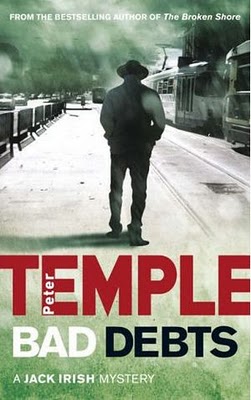
Peter Temple: Bad Debts (1996) A Jack Irish Mystery

Meet Jack Irish: some-time lawyer, part-time private eye, spare-time cabinet maker and full-time lover of strong coffee, swift horses and spirited women.

Bad Debts is the first in Australian crime writer Peter Temple’s Jack Irish series. Temple has won a lot of Australian prizes for his crime and thriller writing. I think it is the first time I read an Australian crime writer. I was very curious and looking forward to the novel and for a total of 50 pages I really enjoyed it.

It’s starts off well enough, quite sarcastic and humorous. Jack Irish seems a typical hardboiled private eye and debt collector. He used to be a lawyer but when his wife is killed he starts drinking and spends a year in total limbo. Sometime during that year he has to defend Danny McKillop, a drunk-driver, who killed a woman. The woman he killed, Anne Jeppeson, was an activist and pain in the neck for many people. The driver had no memory of either driving a car or hitting someone.

Ten years have gone by and all of a sudden Danny McKillop leaves messages on Jack’s answering machine. By the time Jack hears them McKillop has been shot by the police. Jack feels guilty. It seems to him as if he had let down McKillop a second time and he starts to investigate not only his death but also Anne Jeppeson’s death.

After interviewing a few people he finds out that there were and are a lot of strange things going on. People in high places are doing things they don’t want anyone to find out about. His investigation leads Jack deep into corruption and conspiracy and the farther he gets into these things, the more he endangers himself. The last third of the novel is very action-packed.

The beginning of the novel was humorous and I thought it might be one of the series I would like to explore further but after 20-50 pages, there were far too many things I didn’t like. Jack isn’t a lawyer anymore, he tries to make a living collecting debts, betting on horses and doing cabinets. All these different occupations take up time and pages which is very disruptive. On top of that I hate horse-racing stories. Not only do I despise horse-racing I also find it outrageously boring to read about it.

Another problem I had was the language. A large part of the novel consists of dialogue. Australian spoken language seems much closer to British English than to American English. I certainly didn’t mind that. But I did mind that most of the dialogue was composed of swearing and foul language. It was somewhat tiring after a while. And there is the love story. Maybe Jack has been mourning for ten years, but for us, who just got to know him, it’s odd to see him mourn on one page and jump at full speed into a love affair on the next one. And how do I have to picture a woman who is not good-looking but handsome?

I realized that I have a few first and occasionally second books in series at hand and decided to start to read my way through them. Peter Temple’s book was one of them. I’m sure the Jack Irish series has its merits, only I couldn’t find them.

Does anyone know the series? Or any other Australian crime novels/series?

Elsa Morante: La Storia – History (1974) Literature and War Readalong August 2011

History was written nearly 3 decades after Morante spent a year hiding from the Germans in remote farming villages in the mountains south of Rome. There she witnessed the full impact of the war and first formed the ambition to write an account of what history does when it reaches the realm of ordinary people struggling for life and bread.

La Storia aka History is the last WWII centered book of this readalong. It’s also the most ambitious, starting before the war and ending just a few years after. It describes in minute details how the schoolteacher Ida Mancuso, her two sons and the people to whom they are connected are affected by the war. La Storia looks in great detail into the impact of war on civilians. In telling this ordinary woman’s daily life we see how precariously civilians live during a war. The constant bombing, the fear, the loss of the houses or apartments, of friends and the jobs, the lack of food and clothes, rape and brutality, fear of being transpotred to a camp, all this together is part of everyday life. What civilians endure is no less harrowing than what happens on the battlefields.

Summarizing this vast canvas of a novel that is driven forward by ebullient storytelling would be quite a challenge, that is why I decided to highlight a few points.

History starts in 19** and ends …. 19**, but the core chapters focus on the years from 1941 to 1947. Before each chapter we find detailed accounts of all the important historical facts of those years. Reading this overpowered me and that was probably the aim. One horrible event follows after another and each and every single country participated in one awful event or the other. It’s a mad circle, a maelstrom that sweeps along everything and everyone and whose impact shapes, distorts and changes the life of normal people who are unable to escape this crazy frenzy.

Following the accounts of History’s furious rage, we read about the simple, childlike Ida, whose mother was Jewish. This fact fills her with constant anxiety all through the novel and even pushes her to do crazy and dangerous things. Ida is a widowed schoolteacher, the older of her boys, Nino, is a foolhardy opportunist, while the other one, Useppe, is the child she conceived when she was raped by a German soldier at the beginning of the war. In the early chapters of the novel Ida lives in modest circumstances but she has an apartment and enough food. When the war breaks out and finally comes to Rome, their house is bombed and she must flee to the countryside where she and Useppe, the little one, live in one room together with numerous other people.

Ida’s older son Nino first joins the fascist forces, later changes over to the partisans and finally becomes a criminal after the war. His “career” seems somewhat typical and I found that in creating a character like this Morante managed to capture a lot that is wrong in Italy. Opportunism and corruption are everywhere.

Focusing on Ida, we witness the ordeal of the “ordinary people”, how much they had to endure. The hunger is unspeakable. What they have to eat is hardly imaginable. Grass, cats, rats, anything. Being homeless and having no clothes is horrible. Having to fight or steal for just a little bit of bread is hard to imagine. It’s a truly harrowing account.

One of the most interesting details is the narrator. Who tells this story? To whom belongs this voice that is audible at any time, that speaks to us directly and from the heart of this novel?  Is it History speaking to us? It seems to be, as the way Morante describes people, animals and things seems to signify that everything is animated. So why not History itself? History is such a force, it seems as if it has become a being driven to destroy.

What I loved about this novel is that everyone has a voice. Useppe is as much a person as are his dogs Blitz or Bella. Their thoughts and feelings are rendered in great detail. I think in doing so she manages to emphasize that in a war everyone is equal, everyone is threatened. I also liked the detailed in the descriptions, the exuberant storytelling.

Despite all the positive aspects I also had a few problems with the novel, especially at the beginning. I didn’t like Ida. I know, it will sound mean, but she was too simple for me. She isn’t very introspective, she is almost a simpleton, still she is touching and the tragedies she endures moved me. I understand Morante’s choice for a character like this but I didn’t always enjoy it.

While reading this novel I found myself smiling a lot. Useppe’s and his dog’s thoughts are so charming in their naivety. The end of this novel moved me a lot. Without giving away too much, I can tell that it showed that there are far more victims in wars than winners, that wars still impact people long after they have ended and that history doesn’t spare anyone. There is no escaping this force that wreaks havoc in human lives.

Before closing I would like to ask a question of anyone who might have read this novel, now or at another point in time: Isn’t it dangerous to treat History like a being? Isn’t this blurring the fact that History isn’t an undefined, independent force but, in the end, it is people who harm other people?

Other reviews:

*****

History was the eight book in the Literature and War Readalong. The next one will be Tim O’Brien’s The Things They Carried. Discussion starts on Friday September 30, 2011 .