Madeleine St.John: The Women in Black (1993)

With the lightest touch and the most tender of comic instincts, Madeleine St John conjures a vanished summer of innocence. The Women In Black is a great novel, a lost Australian classic.

Madeleine St. John wasn’t on my initial list of authors for the Aussie Author Challenge but after one of Litlove’s (Tales From the Reading Room) comments I thought I’d like to read one of her books and picked The Women in Black. Coincidentally Litlove reviewed it recently as well as you can see here.

The Women in Black is Madeleine St. John’s first novel. She wrote it at the age of 52. It was followed by three other novels which, unlike the first, were not set in St. John’s native Sidney but in London where the author had been living since the 60s. The book is set in the 50s in Sidney and takes place to a large extent in a famous department store, just before the Christmas rush, on the floor of Cocktail Frocks and Model Gowns. It centers on a little group of interestingly different women, Patty, married to Frank (the brute), Mrs. Jacob, the mysterious, Fay, the thirtysomething single woman, Lisa aka Lesley the assistant (temporary) and Magda, the glamorous European refugee who has more elegance and style than all of them together.

Magda and Lisa are the characters where most of the other stories converge and are the indicators that this novel, as lovely, bubbly and playful as it seems, still is a satirical comedy of manners, depicting a society undergoing great change. One of those changes concerns the status of women. No longer only dependent housewives, this decade sees the first female university students who want more than just a husband and children.

When you have a confined environment like an office, a hotel, a shop or anything like this, a newcomer like Lisa, is sure to stir things up, no matter how kind and nice the person is. Lisa is a new type of Australian woman, one that has only recently emerged, more interested in books and studying than attracting a husband.

“A clever girl is the most wonderful thing in all creation you know: you must never forget that. People expect men to be clever. They expect girls to be stupid or at least silly, which very few girls really are, but most girls oblige them by acting like it. So you just go away and be as clever as ever you can: put their noses out of joint for them. It’s the best thing you could possibly do, you and all the clever girls in this city and the world.”

The World depicted in The Women in Black is gone. The importance for a woman to attract a man has considerably diminished, it isn’t exotic for a woman to study and the composite post-war society, mixing European refugees and born Australians, has certainly become more homogenous. At the time however it seems, Europe is as far as the moon and the ways of its people quite exotic which is a source of comedy for St. John.

“Do Russians count as Continentals?” she asked Myra. “Who are you thinking of?” asked Myra. “Oh, no one in particular,” said Fay. “I just wondered.” “Well, I suppose they do, ” said Myra. “But you know they’re not allowed out, Russians. You never really see any Russians, do you? They are all in Russia.” “I suppose you’re right, ” said Fay. “Still, if they were allowed out, they’d be Continentals, don’t you think?” “Oh yes, I reckon so, ” said Myra. “All them peoples are Continentals.”

This is a witty and cheerful novel in which each chapter is like a vignette and tells episodes of the one or the other woman’s story. As much as it depicts a change of values it shows that some things will always be of importance to women and much of this is reflected by the clothes and gowns sold at the department store. The power of dresses and fashion cannot be underestimated. A beautiful dress, sexy lingerie can become more than just a piece of garment, it can tie you down or free you.

Lisa stood gazing her fill. She was experiencing for the first time that particular species of love-at-first-sight which usually comes to a woman much earlier in her life, but which sooner or later comes to all: the sudden recognition that a particular frock is not merely pretty, would not merely suit one, but answers beyond these necessary attributes to ne’s deepest notions of oneself. It was her frock: it had been made, however unwittingly for her.

I enjoyed this a lot, and was reminded of my grand-mother who supplied Haute Couture dressmakers with haberdashery. I still have some of her elegant gloves and scarves, even some of her handbags and a black evening coat. It made me very nostalgic to read about the changes linked to clothes. Lisa’s mother sows a lot of her daughter’s clothes, alters them, mends them. Nowadays we just throw them away, buy something new. Only the most expensive Haute Couture dresses are still handmade.

As I said, it’s a cheerful novel that captures a changing society and a vanished world. It’s not free of social criticism but it manages to show that even this long-gone era with its antiquated beliefs had its charm. There are infuriating moments and people in the book, mostly men who repress women and the women who support them, but each negative character gets a chance to develop. The positive habits of one character are passed on to another one and all of them win something in the end. Lisa, for example is a reader and when she passes on her copy of Anna Karenina to Fay this isn’t only a symbol – shortly afterwards, she meets a nice Hungarian man – but reading literature is a new habit. There are many instances like this in the novel. Maybe at some other time I would have found this to be overly optimistic but it was exactly what I needed after my last readalong title.

If you want to spend a few moments with a cheerful and intelligent book, this is one you shouldn’t miss.

The Women in Black is my first contribution to the Aussie Author Challenge 2012.
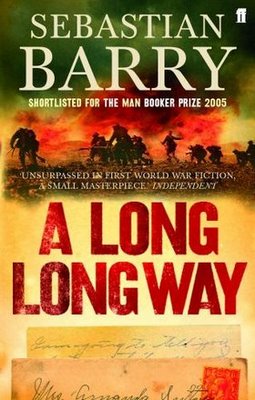
Sebastian Barry: A Long Long Way (2005) Literature and War Readalong February 2012

Sebastian Barry’s A Long Long Way is one of a few WWI novels told from an Irish perspective. Unlike How Many Miles to Babylon or many other WWI novels, its main theme isn’t class which was something I was glad for. Not that I think it wasn’t important but it has become one of the clichés of WWI literature. That and so many other elements. Luckily there aren’t all that many clichés in Barry’s novel.

Nineteen year-old Willie Dunne from Dublin volunteers in the early days of WWI. Like so many before or after him, he has no real reason, or they are at best quite vague and mostly personal. Maybe little Willie wants to prove himself and prove his father that he is worthy despite of his size. His father, a tall and imposing fellow, is a policeman. Something little Willie could never have become because he is barely taller than a midget. The army doesn’t care. They are in such great need of volunteers that they accept almost anyone.

We follow naive little Willie to Belgium where he spends his first months in the relative comfort of the rear camp, hardly seeing any fighting at all. Nothing really bad happens to little Willie and his company until one day, the soldiers see a yellow cloud hovering slowly over no-man’s-land. It takes them far too long to realize what that yellow cloud means, and only much too late, when many of them are already dying a cruel death or maimed for life, do they flee in horror. After this moment the novel takes a turn and becomes graphic and tragic and Willie loses his naivety at a breathtaking speed.

Although he sees many horrible things, it is only after his first leave to Ireland, that Willie is really affected. Not because he doesn’t fit in anymore – Barry doesn’t use this cliché either – but because Ireland is on the brink of the War of Independence and Willie, a compassionate man, is saddened to see the death of a young rebel and to realize that for the first time in his life, he doesn’t see things like his father.

Back in the trenches he tells the other Irish lads what he has seen at home. The newspapers write about it too and the British officers are aggressive and see them even more as cannon fodder than before. The longer the war lasts, the more intense the fighting in Ireland gets, the less the efforts and losses of the Irish are appreciated. In the end there are finally no more volunteers from Ireland. They do not want to fight for the enemy anymore and some would even gladly join the Germans. When Willie takes his second leave to Dublin, the aggression in the streets against his British uniform is open.

It is rare that I resent an author for his narrative technique but I do resent the way Barry wrote this novel. Furthermore I had a hard time with his style, I think it’s far from fluent and the overuse of adjectives at times was annoying. Just one example:

Now they rose up in the violent moonlight and entered bizarrely a huge field of high corn, the frail stems brushing gently against their faces, and because Willie was a small man, he had to grip the coat of the Sergeant-Major Moran in front or he would be lost, set adrift to wander for ever in this unexpected crop. The absurd bombs followed them religiously into the field, smashing all about the darkness, the stench of cordite and other chemicals obliterating the old dry smell of the corn.

As if the violent moonlight wasn’t enough, they have to enter the field bizarrely, followed religiously by absurd bombs? Admittedly, this was one of the worst passages but there were others, equally florid. This doesn’t explain why I resent him but it’s part of it. I felt tricked. This novel works like a trap door. You are lured into a devastated house which is bad enough but the moment you are inside, the carpet is pulled away from under you and the trap door opens. There is a building up of graphic scenes and an intensification of the tragedies that befall poor Willie that felt really mean. I was upset that the book had to end like it did, so absolutely depressing, without the tiniest little bit of hope or light. Don’t get me wrong, it’s not because the book describes graphic scenes, it’s because he intensifies them and accelerates it towards the end, when we do not see it coming anymore and, on top of that, has poor Willie experience one personal tragedy after the other.

With the exception of the dishonest structure, and an almost sadistic finishing off of the main character, the novel has a lot of elements that I thought well done. I haven’t read any WWI novel this eloquent on the use and the horrors of mustard gas. Nor any novel that showed the role of the priests so well. Father Buckley was my favourite character in this novel. A Catholic Priest with true compassion and a wide open heart. And I liked Barry’s choice of theme. His look at authority and its major representative, the father is very interesting. The father as a figure comes in many different forms, as the biological father, the King, the Priest. Coming to terms with authority and ultimately becoming a man and independent are important aspects. Little Willie isn’t a boy anymore at the end of the book, he is a man, with his own opinions, his own life. The book stays away from the usual criticism of high command but uncovers all sorts of hidden false authority.

A Long Long Way has been my second Sebastian Barry novel and I was also annoyed by the first. I just don’t like this type of artifice and manipulative writing that is so keen on effect.

I hope others have liked the book better. After all it has won many prizes. I’m looking forward to see what you thought.

Other reviews

Anna (Diary of an Eccentric)

Danielle (A Work in Progress)

Serena (Savvy Verse and Wit)

A Long Long Way is my second contribution to the War Through the Generations Challenge hosted by Anna and Serena.

*******

A Long Long Way was the second book in the Literature and War Readalong 2012. The next one will be Jean Giono’s Le grand troupeau – To the Slaughterhouse. Discussion starts on Friday March 30, 2012.

Robin McKinley: Chalice (2008)

Beekeeper Marisol has been chosen as the new Chalice, destined to stand beside the Master and mix the ceremonial brews that hold the Willowlands together. But the relationship between Chalice and Master has always been tumultuous, and the new Master is unlike any before him.

My favourite fantasy authors are Marion Zimmer Bradley, Julliet Marillier, Patricia McKillip, Charles de Lint and Neil Gaiman. I’m not such an avid fantasy reader but I think when it comes to genre writing, psychological crime and high fantasy are my favourites. Of course I was intrigued every time I saw Robin McKinley mentioned but what really pushed me to read her was when I saw the review of Chalice on BookRain’s blog and that she compared her to Julliet Marillier.

I wasn’t disappointed, Chalice is such a lovely book, one of the most beautiful fantasy novels I’ve ever read. It’s like the honeycombs it evokes, with every sentence fitting in its right place and making it a finely constructed whole.

Marisol the beekeeper and woodkeeper has become Chalice of the demesne of Willowsland. Never has there been a honey Chalice. And never has there been a Chalice who hasn’t been an apprentice before. The Chalice is the second most important person of the Circle, the entity who rules over the ritual part of the demesne, responsible for its spiritual and physical well-being.  At the head of the circle is the Master, followed by his Chalice.

Usually there is a bloodline for both Master and Chalice but in this case, the former Master and Chalice have died a violent death and since there was no heir, the next in line, the master’s brother, a Fire priest, had to be called back. He isn’t human anymore, his touch can burn a human to the bones, his face is black with red, flickering eyes.

Marisol, the Chalice and the Fire Priest are both unprepared and struggle to find their way in this highly ritualized environment. The Chalice studies as many books as she can find, looks up on ceremonies and meanings and at the same time invents new rituals, helped by her bees and the earthlines who speak to her.

Not everybody is happy about a pair like these two and so the Overlord, the political head of the demesne, wants the Master to leave and hand over his place to an outblood heir.

Marisol knows that this is the worst that could happen to the demesne. That would mean turmoil and chaos and she hopes it will never happen. But whether he can stay or not, will be decided in a duel.

What I loved so much about this book is the atmosphere. Sweet and floating, like the scent of beeswax candles. The descriptions are beautiful and following Marisol’s journey has something enchanting and almost hypnotic. The world building is exquisite. I was there in Willowsland the whole time. And Marisol is such a great character, so real. She is very insecure and has to find her way in an hostile environment but her strength and her love for her home guide her. I liked how she lived, on her own, outside of the Great House or the village, only with her bees whom she treats like pets. She learns about the tradition of Chalice but because she never underwent a proper training she dares to invent new ways which she combines with the tradition. Every Chalice mixes ritual cups but Marisol adds honey to hers. Even before she was Chalice she knew how to heal with honey, knew that every variety has its own properties.

Chalice is a magical story, a love story as well as the description of a land in chaos that is slowly brought back to peace by a heroine who can accept her weakness and trusts herself completely.

I’m going to read more of Robin McKinley. I’m not sure which one I will read next, maybe Beauty or Sunshine. Any recommendations? Which is your favourite Robin McKinley book?

Peter Stamm: On a Day Like This – An einem Tag wie diesem (2006)

Swiss author Peter Stamm was one of the discoveries of German Literature Month last November. I read and reviewed one of his short story collections In Strange Gardens and was very much looking forward to read one of his novels. I have finally managed to read On a Day Like This – An einem Tag wie diesem.

On a Day Like This tells the story of Andreas, a Swiss teacher who has been living in Paris for twenty years. He goes through the city and his own life like a visitor, never really belonging there nor to anyone. He changes his lovers, sometimes sees more than one woman at the same time. Whenever one of them wants more, he leaves them. He is like a spectator of his own life, someone who doesn’t fully participate. But “on a day like this” things change. He feels even more detached than he used to. His work as a teacher doesn’t make sense anymore. He doesn’t feel at home in Paris, doesn’t like his friends and he is filled by an incredible yearning for his home country and a woman he was once in love with, when he was barely twenty.

The fragile construction that his life has become finally falls apart completely when he goes to see a doctor because of a persistent cough. The doctor sees a shadow on his lung that could be anything, a scar or cancer. Too scared to wait for the result of some tests, Andreas, resigns from his job, sells his apartment and returns to Switzerland to find the woman he once loved.

I thought I knew how this was going to end but luckily I was wrong. It’s not a predictable story and the laconic tone doesn’t leave a lot of room for sentimentality. Like in his short stories, Stamm captures minute details of every day life. The struggle of someone who avoids relationships at any price but is filled with a deep longing to belong somewhere, to find meaning, resonates with us.

You can read this novel without being aware of the intertextuality, without knowing how much references and allusions to other works it contains but it’s still interesting to know them. The title is a reference to Georges Perec’s Un Home qui dort – A Man Asleep. The story of a young man, a bit like Bartleby who withdraws from life and only slowly finds his way back. One could say that Andreas has lived a life like that but has now woken up. Another reference is François Ozon’s movie Le temps qui reste.

But Andreas’ detachment is also reminiscent of Camus’ L’étrangerThe Outsider. Just like Meursault, Andreas doesn’t belong anywhere or to anyone, he is even an outsider in his own life, has never been capable of taking root but unlike Meursault, he wakes up and his life takes a turn.

Reading this novel had something uncanny. Andreas’ coldness is painful and it’s not easy to like him at first, but slowly, Stamm peels off layer after layer and we get a better feeling for his protagonist and why he became the way he was. There is pain and hurt and deep-rooted suspicion of anything “normal”, like families, love, career. Deep down, without knowing it, he was protesting and looking for something out of the ordinary, something more.

Stamm is a great observer, it’s the way he captures brief moments, tiny details, minutiae that make his books so special. There is the beauty of the fleeting moment, right next to the banality of everyday routine. I don’t think that this is his best novel and I preferred his short stories but there were so many wonderful scenes in this book that I still want to read his other novels too.

Hiromi Kawakami: Manazuru (2006)

Manazuru is the first novel by Hiromi Kawakami that is available in English. She has been one of Japan’s most celebrated novelists since her first short story came out in 1994. I have read another one of her novels a couple of years ago. Many of her books are available in German and in French. (If you love literature in translation, especially Japanese literature, and you are able to read German and/or French, you have much more choice. I have for example read Hotel Iris by Yôko Ogawa, that came out last year in English, in a French translation almost ten years ago.).

The first novel by Hiromi Kawakami that I read is called Herr Nakano und die Frauen (Mr Nakano and the Women.) It’s a wonderful novel. A lot of what I liked in Herr Nakano is present in Manazuru too, still I wonder why they chose this novel to introduce Kawakami to English-speaking readers. Mr Nakano would have been a much better choice as it is much more typical for her writing. There are supernatural or dreamlike elements in Manazuru which are not present in her other books and which reminded me more of Murakami.

Manazuru is not easy to describe. It’s a mysterious book, filled with a dreamlike mood, shifting realities. Something very soft and gentle pervades it.  Still it’s very realistic. The story is told by Kei, a young woman who lives with her daughter and her mother in an apartment in Tokio. The three women live a very peaceful live, they share many intimate moments, cooking and eating together, stitching and knitting. They treat each other kindly but each of them leads her own life, of which the others know nothing. Kei thinks a lot about her relationship to her daughter and how unique it is. How she doesn’t love anyone like her with so much awkwardness. She thinks about what it means to have a child, physically. To feel her emotions because they once shared a body.

Kei’s husband Rei has disappeared ten years ago. Although she has been in a happy relationship with a married man, she has never forgotten her husband. She wonders always where he has gone, why he left or what has happened to him. At the beginning of the novel she decides to travel to Manazuru, a little seaside town where Rei has disappeared. When she arrives she feels a strange presence. A woman follows her, a woman who seems to be a ghost, whose density changes constantly. Sometimes the woman is just a shadow, sometimes Kei can touch her. She thinks this woman knows what happened to Rei.

Kei takes many trips to Manazuru all through the novel. Sometimes with Momo, her daughter, mostly on her own. Whenever she arrives there, she is in a dreamlike state that brings her very close to Rei. During her last trip she finds another village that is like a ghost village. Cranes are sitting on the dilapidated roofs (Manazuru means crane btw..) The houses have been abandoned. She thinks about the fact that an empty house is at first just empty but then, after several years, it gets a life of its own. Ivy will grow inside. Weeds  and many other plants will take over. It’s a bit like Kei herself after Rei abandoned  her. At first there was emptiness and loneliness and then she became someone else.

I liked Manazuru a lot because of its mood and because of the importance of moods. Kei doesn’t so much analyze her feelings or thoughts as describe her moods. They shift ever so lightly, just a little bit. They have the subtlety of scents, the same fleetingness.

What I love in Kawakami’s writing in general is her ability to capture those intimate moments in which hardly anything happens or is said, those moments during which people are sitting together, without talking and it still feels intimate and meaningful.

Hiromi Kawakami is one of the best authors  to start with for someone who isn’t familiar with Japanese writing because she is such a gentle writer. Her books are lovely and even tragic elements are toned down. We know her characters will make it in the end, move on, find meaning and all that stays from a tragic event is a feeling of bitter-sweet regret but no despair.

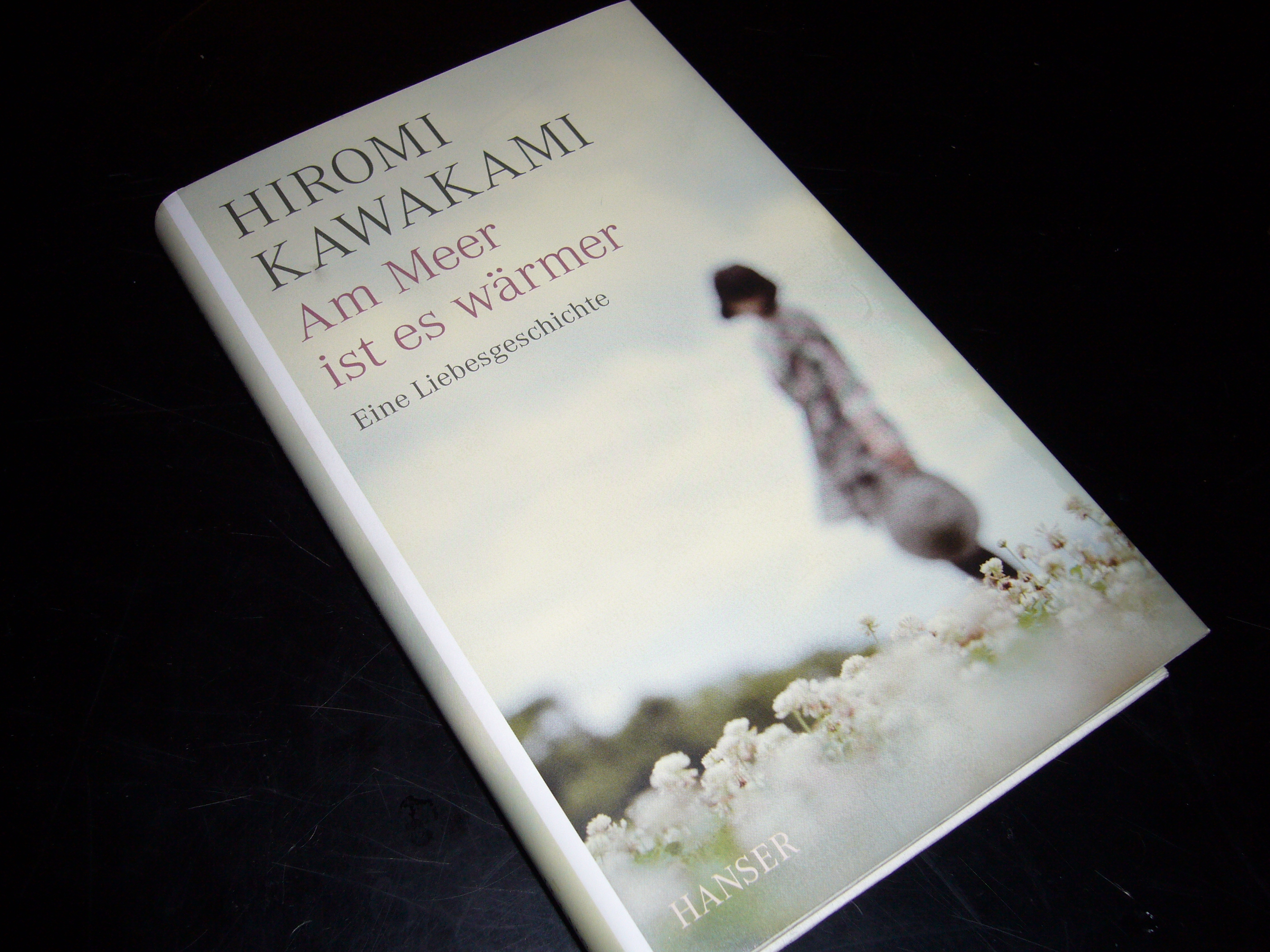
I read the book in German. I really love the cover. The woman is blurred, only the little flowers, (Immortelle, I think) at the bottom of the picture are in focus. It captures the mood of this novel much better than the English one in which the focus is on the woman.

Nina Bawden: The Birds on the Trees (1970)

The expulsion from school of their eldest son shatters the middle-class security of Maggie, a writer, and Charlie, a journalist. Since childhood, Toby has been diffident and self-absorbed, but the threat of drug taking and his refusal (or inability) to discuss his evident unhappiness, disturbs them sufficiently to seek professional help. Veering between private agony and public cheerfulness, Maggie and Charlie struggle to support their son and cope with the reactions- and advice- of friends and relatives. Noted for the acuity with which she reaches into the heart of relationships, Nina Bawden here excels in revealing the painful, intimate truths of a family in crisis. Toby’s situation is explored with great tenderness, while Maggie’s grief and self-recrimination are rigorously, if compassionately, observed. It is a novel that raises fundamental questions about parents and their children, and offers tentative hope but no tidy solutions.

Nina Bawden’s novel The Birds on the Trees was one of the so-called Lost Man Booker titles in 2010. These were books that would have been on the Man Booker short list in 1971 if the dates for the Prize hadn’t been moved. While reading about this, I encountered the expression Hampstead novel, a label I had never heard of before. It seems this label was used to describe a specific type of novel, not only set in Hampstead but focussing on leftist-liberal intellectuals of the middle-class. Margaret Dabble and Iris Murdoch were named as well. When I hear a description like that I have to fight the urge to yawn.  That does sound boring, doesn’t it? In any case, the fact that Bawden was nominated for the Lost Man Booker in 2010, with a novel that was, as critics wrote, so clearly a Hampstead novel, triggered a lot of more or less interesting response in the media and some referred to older articles. One article I read was particularly interesting because it looked at settings in British literature. If you are interested here is the link. The writer argues that to a certain extent you can deduce the themes and topics from the location of a book. It’s highly unlikely that you will find the same topics in a novel located in Peterborough as in a novel set in Wales. This may be very obvious for a British reader but for me it was highly enlightening.

Hampstead novel or not, The Birds on the Trees is the story of a family crisis. The family is an intellectual middle-class family. The mother is a writer, the father a journalist. The book opens in the past, when Toby, the oldest son, is barely five years old and runs away at Christmas. He is an odd little boy. Strangely quiet and polite for his age. The book then fast-forwards 13 years. Toby is 18 and has been expelled from school because of marijuana abuse. He has two younger siblings, 11-year-old Lucy and the 5-year-old Greg. The parents are shocked and horrified and have no clue what to do with their son. For Maggie, the mother, it’s clear, he has to go to Oxford, one way or another. Charlie, the father, would rather give him a break and let him figure out what he would like to do. But these are not the only two people with a strong opinion and some saying in the matter. Aunt Phoebe, the  domineering widowed sister of Charlie, meddles as well. And Maggie’s mother plays an important role too.

The structure and character portraits of this novel is what I liked best. It moves from one person to another, changing from first to third person narrative and gives the point of view and impressions of each character. The voices are very authentic, the dialogue rings true. Through all those inputs we see how much is really going on under the surface and how dysfunctional the family is.

Toby cannot stand it anymore at home after his expulsion and after having stayed at his grandparent’s home for a while, finally moves to London to live with an older friend. It seems he starts to use other drugs and when the parents go and get him, he is on the verge of a nervous breakdown and diagnosed with schizophrenic disorder. Electro shock is the chosen cure. I didn’t like this part of the story at all and had a problem to fully understand why Toby was called mentally ill. He seemed more aloof and detached than genuinely depressed or psychotic.

If Toby’s illness and the horrifying “cure” had been all this novel had to offer, I would have hated it, I’m sure, but there is so much more going on. It isn’t only well written but the different story lines and aspects are thought-provoking and captivating. Maggie, the mother, is by far the least appealing character. After a while she started to really get on my nerves. There is an instance in which she discusses with her husband whether it is OK to take the things that happen and turn them into a novel. This is a very important moment that could easily be missed. If I hadn’t done some research I wouldn’t have known that Nina Bawden told the story of her own family. Her son suffered from mental illness, abused drugs and finally killed himself in 1982. This may explain to some degree why the book is so flawed and at the same time so interesting. It seems as if she was in writing it, trying to answer the question of responsibility and at the same time imagining a positive outcome.

One of the core themes that I found to be extremely well executed is favouritism. Toby was the first child and remained, even after the others were born, very obviously the favourite. Although his little sister loves him, she and her younger brother start to believe that they might have been adopted. It seems the only explanation why Toby is always the center of attention.

While the end of the book and the description of the mental illness aren’t convincing, I still enjoyed this novel because it manages to capture insecurity and conflicting emotions at the heart of families so well. Some of the character portraits are great. With a few exceptions, there is hardly a conflict-free relationship in this family and the book illustrates them all. Depending on who talks to whom, the interaction triggers different aspects in the personality of the characters. One person who is quite insufferable in contact with someone may be quite charming the moment he or she speaks to someone else. Often people show only one part of their personality to someone and keep another part for someone else. Through the interior monologues and dialogues all the facets of the characters are wonderfully well shown. Maybe, as some journalists argued, the book didn’t deserve the Man Booker, being too flawed and too Hampsteadish, true enough, still I thought it was a great read.

Does anyone know Nina Bawden? Has she written other books that are worth reading?

Literature and War Readalong February 27 2012: A Long Long Way by Sebastian Barry

In last year’s readalong we also read a WWI novel from the Irish perspective. It was one of my favourites and since I’m fond of Irish literature, I thought it would be great to add another one this year. I wanted to read Sebastian Barry’s novel A Long Long Way since Danielle (A Work in Progress) first mentioned it. WWI has a special meaning for the Irish. They were neutral during WWII, so, clearly, WWI has another importance. There were reasons why they remained neutral during the second World war which are tied to their own history. While some men, like the character Willie Dunne in this novel, fought for the Allies, other forces in the home country were about to erupt and would lead to the Easter Rising. WWI, the Irish War of Independence, followed by the Irish Civil War, cost the Irish too many lives for them to risk being dragged into WWII as well. I’m certainly simplifying but in a nutshell this was one of the reasons.

Some of what I just mentioned is the topic of Barry’s novel.

Here are the first sentences

He was born in the dying days.

It was the withering end of 1896. He was called William after the long-dead Orange King, because his father took an interest in such distant matters. On top of that, an old great-uncle, William Cullen, was yet living in Wicklow, across the mountains as they used to say, where his father himself had been reared.

I have read Sebastian Barry’s award-winning The Secret Scripture three years ago and I was one of a very few who didn’t like it. It had nothing to do with the writing as such which is great and one of the reasons why A Long Long Way was shortlisted for the Man Booker Prize in 2005. The reasons why I didn’t like it were timing and implausibility. I had just read The Vanishing Act of Esme Lennox before and the theme is the same, only I liked O’Farrell’s novel much better as it didn’t rely on implausible coincidences. Despite this unfortunate encounter I’m really looking forward to A Long Long Way and hope that some of you will join me.

Have you read Sebastian Barry?

*******

The discussion starts on Monday, 27 February 2012.

Further information on the Literature and War Readalong 2012, including all the book blurbs, can be found here.