Alissa Walser: Mesmerized – Am Anfang war die Nacht Musik (2010)

untitled

I so wanted to love this book. I liked the premise, the first sentences were evocative and descriptive but then, a few pages later, I just couldn’t stand the style anymore. Admittedly, it’s artful but also quite lifeless and tedious. The whole book contains only indirect speech and a great majority of the sentences are only fragments. Very staccato and after a longer period of reading, very repetitive. I’ve read mostly positive reviews of this book on English blogs, but they were all based on the translation while I read the German original. Maybe it reads better in English? The German critics were either impressed with the style or they called it artificial.

The story as such, which is based on true events, is fascinating. It’s set in Vienna in 1777  and in Paris in 1784. Franz Anton Mesmer was one of the most famous doctors of his time. A controversial figure who invented a treatment method involving what he called “animal magnetism”, in which he applied magnets to his patients or applied some sort of energy therapy. Some of the cases were quite miraculous, the most famous being the cure of the blind musician Maria Theresia Paradis. Maria lost her sight at the age of five and it was never clear what caused it. Still she was an accomplished musician and protégée of the empress. Mesmer moves her away from her family and treats her in his hospital. After a few weeks the girl can see again. Unfortunately it affects her music. Seeing makes her less of an accomplished musician. Her parents and doctors come running and in the end, nobody really knows why, she loses her eyesight again and Mesmer is called a fraud. After these unhappy developments Mesmer flees to Paris where some see him as a charlatan, others think he’s a miraculous doctor.

The book clearly underlines that Mesmer has found a relationship between body and mind and in removing Maria from her family he indicates that the surroundings were toxic. Maria’s blindness has a lot in common with some of the hysterical symptoms Freud will describe later.

What I really liked in this book is how music and energy are paired. Nobody denies the effect of music, the wonder of it, despite the fact that you can neither touch nor see music, still most people around Mesmer, don’t believe in energy fields in the body. Mesmer is a musician as well and the bond he forms with Maria, a bond her parents and his wife equally fear and hate, is strong because they understand each other on a deeper level. They communicate through their love of music. His understanding of her personality is much more intuitive than rational and that may have been a reason why the therapy worked so well. Until the parents turned up and Maria was dragged in front of a critical public who was hoping she wasn’t cured.

There are tragic elements in the book. Many quacks tried to cure Maria before she was brought to Mesmer and some of the brutal treatments left scars on her. Even in 18th Century Austria there were a lot of physicians more interested in money than the cure of an ill person.

The translation of the title is a bit surprising. In German the book is called “In the beginning the night was music”, which is a very rich, lyrical and biblical sounding title.

If I had liked Alissa Walser’s style, which reminded me a bit of Elfriede Jelinek, I would have loved the book, but since I found it tiresome, I didn’t.

A few more positive reviews

TBM (50 Year Project) 

David (Follow the Thread)

Iris on Books

Here’s the author reading the beginning of the novel:
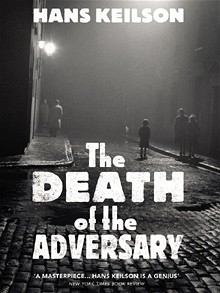
Literature and War Readalong November 29 2013 Meets German Literature Month: Death of the Adversary – Der Tod des Widersachers by Hans Keilson

Death of the Adversary

This months readalong title Death of the Adversary aka Der Tod des Widersachers by Hans Keilson is also part of German Literature Month. Keilson was an interesting figure. A German/Dutch novelist and psychiatrist who is most famous for his WWII novels. Born in 1909 in Germany, Keilson, who was Jewish, emigrated in 1936 to the Netherlands where he stayed until his death in 2011. During the war he was part of the Dutch Resistance. In his work he tried to analyse and illustrate the psychological, political and cultural aftermath of WWII.

Here is the book blurb

1930s Germany; the shadow of Nazism looms. Pictures of the new dictator, ‘B.’, fill magazines and newspapers. Our hero is ten when his world begins to change dramatically. Suddenly, the other children won’t let him join in their games. Later, he is refused a job on a shop-floor. Later still, he hears youths boasting of an attack on a Jewish cemetery. Both hypnotised and horrified by his enemy, our hero chronicles the fear, anger and defiance of everyday life under tyranny.

Written while Hans Keilson was in hiding during World War II, this novel is a powerful account of what he outlived. Painful, trenchant and streaked with dark humour The Death of the Adversary is a rediscovered masterpiece.

And the first sentences

For days and weeks now I have thought of nothhing but death. Though I am normally a late riser, I get up early every morning now, calm and uplifted, after a night of drealess sleep. I feel all my powers string and ready within me, as they have not been for a long time. I welcome the day which brings me once again the thought of death.

*******

The discussion starts on Friday, 29 November 2013.

Further information on the Literature and War Readalong 2013, including all the book blurbs, can be found here.

Vasily Grossman: Everything Flows (1961) Literature and War Readalong October 2013

Everything Flows

Would you inform on people to save your own life? Sign papers knowing very well it will send people to the Gulag? Would you? If you are like me, you are unable to answer this question. You will hope that you wouldn’t but how can you be sure. It didn’t take a lot for people to be sent to the camps. Anything would make the state suspect subversiveness.Some were sent because others signed a paper, some were sent because they didn’t sign papers. According to the afterword Grossman did precisely that, he signed a paper which served to arrest a group of doctors. He must have felt guilty all of his life, resented his own weakness. Exploring why people would do such a thing, is one of the themes in Everything Flows. It’s not always out of fear or cowardice.

A friend of Ivan Grigoryevich is responsible that he is sent to the Gulag for thirty years. He is released after Stalin’s death in 1953. At first he visits his cousin Nikolay, in Moscow. Nikolay is a scientist who has made a remarkable career, due to some extent to his betrayal of others. When he sees Ivan again, he’s incapable of showing compassion of listening to Ivan’s story. All he does is talk about his own hardships. How very cynical. No deprivations endured outside can be compared with what those in the camps had to go through. These are poignant scenes, which show the selfishness and faulty thinking of so many, the struggle between a bad conscience and the aim to refuse any responsibility. Ivan then moves on to Leningrad where he hopes to meet a former lover. He meets Anna Sergeyevna instead and shares a room with her and her little son. Her husband has been sent to a camp. She blames herself for having taken part in the Terror famine of 1932-3.

The story of Ivan is the only coherent storyline. It is interrupted by stories of other people and many non-fiction parts – on the terror against the Ukrainians, on Lenin and Stalin, on their terror regimes, on the way the Soviet Union worked. This made me wonder often whether Everything Flows can really be called a novel. Where is the borderline? How much non-fiction elements can a book contain and still be called fiction? Grossman didn’t see the publication of Everything Flows and it is possible he would have altered it, still, according to the afterword, it’s finished the way it is. He would not have removed the nonfiction parts, although it seems obvious that they were added to the manuscript later.

Until WWII Grossman was loyal to the Soviet state but after having witnessed the war, having been in Stalingrad, that changed completely. From then on he was focussing in his work on writing about everything as truthfully as possible, on not embellishing and buying into the state’s way of distorting the truth. This cost him almost everything and I’m surprised he was never sent to the Gulag himself. One of his most traumatic experiences was when his novel Life and Fate was confiscated. What further contributed to his critical view of the Soviet state was Stalin’s antisemitism.

In his best parts Everything Flows is an amazing testimony of compassion and humanity. In other parts it is a masterful depiction of the human condition and an open criticism of totalitarianism. Some of the non-fiction parts were a bit heavy going, as I was not familiar with many of the names and with Soviet history in general. I think he rendered the atmosphere of being unfree and the paranoia very well.

I’d like to read a biography of Grossman. He served 1000 days during WWII, was present in Stalingrad and his The Hell of Treblinka was the first eyewitness account and was used during the Nuremberg trials. Has anyone read the Gerrard’s biography The Life and Fate of Vasily Grossman or Grossman’s The Writer at War?

Other reviews

Andrew Blackman

Danielle (A Work in Progress)

Silver Seasons (Silver Threads)

*******

Everything Flows was the tenth book in the Literature and War Readalong 2013. The next is the WWII novel Death of the Adversary aka Der Tod des Widersachers by German writer Hans Keilson. Discussion starts on Friday 29 November, 2013. Further information on the Literature and War Readalong, including the book blurbs can be found here.

David Miller: Today (2011)

Today

August 1924. John Conrad arrives at his parents’ home on the outskirts of Canterbury, where family and friends are assembling for the bank holiday weekend. His crippled mother has been discharged from a nursing home, his brother drives down from London with wife and child. But as the guests converge, John’s father dies. Today follows the numb implications of sudden death: the surprise, the shock, the deep fissures in a family exposed through grief. But there is also laughter, fraud and theft; the continuation of life, all viewed through the eyes of Lilian Hallowes – John’s father’s secretary – never quite at the centre of things but always observing, the still point in a turning world. Today is a remarkable debut, an investigation of bereavement, family and Englishness, beautiful in its understatement and profound in its psychological acuity.

Has the question why an author chose a certain subject matter ever overshadowed your reading experience? In the case of Today that question certainly distracted me quite a bit. It’s not the first time that I’ve been asking myself this question and usually it means that I had a problem with the book. It happens mostly with books that are inspired by true events or real people, but I’ve been wondering in other cases as well.

The book starts with a dramatis personae that lists no less than 39 characters. In a novel of barely 160 pages that is a lot. Most of these characters  appear only very briefly, nonetheless, the point of view changes almost every time, sometimes even twice in one passage. That’s a lot of moving around. Despite of the great number of characters there are a few main protagonists. The most important person however, Joseph Conrad, is looming in the text but absent. We never get to see him directly. At the beginning he’s resting in his bedroom. He had an episode of something, what exactly isn’t entirely clear, but when he dies one day later, it’s obvious that he had a heart attack.

Joseph Conrad dies on the day of his youngest son’s birthday. Because of that birthday there are far more people in the house than usual. The relationships are tense and this sudden death on a day that was meant to be a day of celebrations is awkward at best.

This could have been a nervous book, with all this jumping around from one character to the next, but it’s actually very calm. I guess that’s because most of these people are shown during introspective moments. On the first day, when Conrad is resting, it rains endlessly, and the people walk around, thinking of their relationship with the famous author, or exploring how helpless they feel.

I liked reading this book, liked how it showed how disruptive and unsettling death is, but I couldn’t understand why this had to be the story of Conrad’s death. It could have been anyone. There is no real need for this story to be about a famous person to be poignant. On the very contrary. I would say, this would have been far better, if it hadn’t been about someone famous.

Because I wasn’t entirely sure what to make of this slim, lovely, but puzzling book, I looked for reviews and found two by professional critics. I must say that was enlightening for a few reasons. Both reviews were negative, and, in my opinion, overly so, but both reviews were also faulty and that in an embarrassing way. One reviewer said the book was set on Conrad’s birthday, while it was Conrad’s son’s birthday. That’s bad but the other error is really appalling. At the begging of the story, Conrad’s secretary, Lillian Hallowes finds a book on a train and starts to read it. The author isn’t named but the beginning of the book is quoted: “Except for the Malabar Caves – and they are twenty miles off – the city of Chandrapore presents nothing extraordinary.” It’s a quote from one of my favourite authors E.M.Forster, so I recognised it right away and knew from which novel it was taken. Even when you’re not familiar with his work, you’d probably assume it’s taken from a Passage to India. Not so our reviewer. He wrote that it was taken from Howard’s End. Call me narrow-minded, but I find that shameful, especially when you write such a negative review.

David Miller is the literary agent of some of the greats of British literature like Cynthia Ozick, Tim Parks, Magnus Mills, and others. Today is his first novel. It is a quiet, thoughtful book, with lovely passages. I wouldn’t say it’s a must-read but it’s nice and I enjoyed it. I’m interested to see where Miller goes from here. While Today has awkward elements, the writing is promising.

Gillian Flynn: Sharp Objects (2006)

Sharp Objects

When two girls are abducted and killed in Missouri, journalist Camille Preaker is sent back to her home town to report on the crimes. Long-haunted by a childhood tragedy and estranged from her mother for years, Camille suddenly finds herself installed once again in her family’s mansion, reacquainting herself with her distant mother and the half-sister she barely knows – a precocious 13-year-old who holds a disquieting grip on the town. As Camille works to uncover the truth about these violent crimes, she finds herself identifying with the young victims – a bit too strongly. Clues keep leading to dead ends, forcing Camille to unravel the psychological puzzle of her own past to get at the story. Dogged by her own demons, Camille will have to confront what happened to her years before if she wants to survive this homecoming.

I had a feeling I might like Gillian Flynn very much that’s why I decided not to start with her latest novel, Gone Girl, but with her first,Sharp Objects That I went out to get the second, Dark Places, right after finishing this might tell you how much I liked it. She’s an author to my taste, but I have to admit I had a few “Ew!” moments while reading it. She’s not one to shy away from describing very sick things. What I liked was the voice, the taut writing and the story as such. While I had a feeling where this was going, I was still captivated.

Two girls are abducted in Camille’s hometown. One was found dead, her teeth missing, the other is still being searched for. Camille is a journalist for a very unglamorous newspaper in Chicago and her boss thinks it might be a good idea to send her home to investigate and write a few articles that might help the paper get out of its slump and Camille to improve her career. Knowing Camille her boss may have thought that going back to the place that hurt her and face her demons might be a healing experience. It isn’t. Camille is badly equipped to deal with her past and exposing herself to her toxic family and diving deep into the shadow aspects of her hometown take their toll. The sharp objects of the title refer to many different things and one is tied to Camille’s illness. If you have seen the US cover, you know already what I’m talking about. Camille is a cutter, only she’s not happy with slicing her body, she carves words into it. Meaningful words.

Right after Camille’s arrival, the second girl is found. Her teeth are missing too. What a bizarre, yet gruesome crime. Slowly the book reveals the truth behind the crimes and the hidden secrets of Camille’s family.

I don’t read in order to find “likable characters”. Or to say it in other words – I don’t need to bond with characters at all, but I think, I liked Camille, and was, once more, surprised how many people who reviewed this mentioned how much they hated her. Why? I don’t get it. Or maybe I do. It is as if there were some mental afflictions people are more hostile towards. If you’d like to label Camille, I’d say she’s suffering from Borderline Personality Disorder, one of a few afflictions, which get a lot of negative reactions. I thought Flynn drew a very believable character and I was rooting for her. I was hoping she might be able to come out of all of this healthier and stronger.

Sharp Objects is gripping and compelling and does a few daring things, one of which is showing that perpetrators come in many different forms.

This is my fourth contribution to Carl’s RIP challenge. Don’t miss visiting the RIP review site for other Mystery/Crime/Thriller/Ghost/Dark Fantasy related reviews.

Literature and War Readalong October 28 2013: Everything Flows by Vasily Grossman

Everything Flows

I’m very late in announcing this month’s readalong title. Vasily Grossman’s Everything Flows isn’t a war novel per se. It’s a post war novel. I found it’s about time to have a look what state countries, which had participated in WWII, were left in after the war. Russia is decidedly one of the most interesting places when it comes to the post-war era and Grossman is famous for the way he captures this time. Like many other Russian authors Grossman’s novels were forbidden during the Soviet era. Everything Flows was written after his major work Life and Fate.  I have seen a few of his books reviewed on various blogs ( Silver Threads on Life and Fate –  A Work in Progress on Armenian Sketchbook –  Caravana de Recuerdos on Life and Fate) and the feedback was always more than favorable.

I’ll leave you with the b blurb and the first sentences.

Ivan Grigoryevich has been in the Gulag for thirty years. Released after Stalin’s death, he finds that the years of terror have imposed a collective moral slavery. He must struggle to find a place for himself in an unfamiliar world. Grossman tells the stories of those people entwined with Ivan’s fate: his cousin Nikolay, a scientist who never let his conscience interfere with his career, Pinegin, the informer who had Ivan sent to the camps and Anna

Here are the first sentences

The Khabarovsk express was due to arrive in Moscow by 9 a.m.. A young man in pyjamas scratched his shaggy head and looked out of the window into the half-light of the autumn morning. He yawned, turned to the people standing in the corridor with their soap boxes and towels and said, “Well, citizens, who’s last in line?”

I will be reading the German translation Alles fliesst. I have this idea that Russian works better translated into German.

Alles fliesst


*******

The discussion starts on Monday, 28 October 2013.

Further information on the Literature and War Readalong 2013, including all the book blurbs, can be found here.

Alexander Baron: There’s No Home (1950) Literature and War Readalong September 2013

There Is No Time

Alexander Baron was once known as the great British novelist of WWII, but since then he’s been somewhat forgotten. Three of his novels are “war novels”.  There’s No Home is one of them. For a novel about WWII it’s surprisingly peaceful and deals with a lesser known aspect of the war. When the allies invaded Sicily, and drove back the Germans to the Italian mainland, some of the troops were granted a few months of peace and quiet during which they lived among the Sicilian civilians.

There are different POV characters in the novel, but the main story focuses on Sgt Craddock. He’s the type of soldier liked by everyone, superiors and inferiors alike. He’s married with a little kid. Being away from home, first in combat and now in this eerie state of peace among the Sicilian civilians makes home seem like another world, a world far more foreign than Sicily. When he meets Graziella, falls in love with her and lives with her, almost as if they were husband and wife, only with far more openness and directness than he’s ever known with his wife, his own life in England moves farther and farther away.

The love story between Craddock and Graziella, is the only coherent story line, the rest is made of anecdotal episodes, either about civilian life or things that happen among the soldiers during the time in Sicily. The war and the fighting are far away, but eventually, they have to move on, go back to fighting and leave everything that has become dear to them.

It’s easy to see that Baron wrote from his own experience. Only someone who spent time in Italy, among Italians would be able to capture so many details, render such lifelike scenes. In the afterword we read that Baron was “adopted” by an Italian family while in Sicily, visited them often, ate with them. Most soldiers, not only those who had an Italian lover, formed close relationships with the population.

The book describes some of the absurdity of war, but it’s toned down. During this time of rest, the absurdity is felt the most in the treatment of deserters. It’s no coincidence that we have three deserters in this novel. A British, soldier, an Italian and a German one. Their treatment is very different.

I liked the way this book was written a great deal. It’s written in such a precise but effortless style, you barely notice you are reading, it felt much more like watching a movie. I appreciated that Baron chose a topic that may seem marginal to the war but that was interesting and rendered with great warmth. I suppose you could read his three war books like a trilogy, each showing another aspect of what Baron experienced during the war. After having read this novel on civilians and soldiers in repose, I’d like to read one of his other novels, From the City From the Plough, telling the story from the POV of an infantryman in combat.

Other reviews

You can find some quotes from the book on Danielle’s blog

Danielle (A Work in Progress)

*******

There’s No Home was the ninth book in the Literature and War Readalong 2013. The next is the post-war novel Everything Flows  by Russian writer Vasily Grossman. Discussion starts on Monday 28 October, 2013. Further information on the Literature and War Readalong, including the book blurbs can be found here.