Gabriel Chevallier: La Peur – Fear (1930) Literature and War Readalong June 2014

Fear

Most of the books we read for the Literature and War Readalong are historical novels, written by people who do not have any experience of war. But I always try to make sure to include at least one novel or memoir written by someone who had first-hand experience. Gabriel Chevallier’s Fear – La Peur is one of those. Like his narrator Jean Dartemont, Chevallier was a simple soldier during WWI. He served from 1914 to the end of the war. In 1915 he had a small break because he was wounded but was sent back to the front-line after his recovery. Reading his account it sounds like a miracle that anyone could survive this long under such circumstances. Given the title of this novel it may also come as a surprise that its author returned highly decorated. He was awarded the Croix de Guerre and the Chevalier de la Légion d’honneur.

Most of the time reading La Peur felt like reading a memoir and I suppose most of it is autobiographical. What drew me in from the beginning was the voice. I hope they were able to capture this unique and powerful voice in the English translation. A voice that mentions everything, denounces everything, and lets us get as close to the war in the trenches as possible without having been there.

The book hasn’t a plot as such, it’s more an episodic account of Dartemont’s experience of WWI and his thoughts. Not for one second does he think the war is noble, nor does he ever strive for glory. He sees right through most of the cowardly and sadistic officers and he speaks openly. Not always though. Sometimes he’s just too baffled to speak his mind like when an elderly man asks him on his leave whether they are having fun. Those at home think it’s all a great adventure, just like most of those who signed up early on.

Dartemont who was a student didn’t sign up for “gloire et patrie” (glory and homeland), he signed up because he wanted to see. He’s a very curious person, that’s probably why he never averts his eyes, no matter how scared he is. In the beginning he’s just like a participant observer. At first he’s far from the most intense fighting but once he’s seen his first battle, the first dead people and horribly wounded, fear is his constant companion.

I don’t think I’ve ever read anything quite like this. Not for one second are we led to believe that going to war is heroic. It might very well be one of the most openly anti-war books I’ve ever read. Free of any sentimentality, free of any attempt to make us swallow the bitter pill by telling some touching story. It’s just one man’s account of the most horrible things one can experience.

The parts that shocked me the most are not the gruesome descriptions of the wounded and the dead but those that show how utterly ill prepared most of the attacks were. And how incapable and idiotic most of the high command was. How can you expect to win a battle when the enemy is dug in and your soldiers are just running into open fire? No wonder there were some battles in which there were 50,000 to a 100,000 dead and wounded within two hours. All this led to the mutinies of 1917. Of course it wasn’t much better on the British side. Unfortunately many officers were not only useless but petty and sadistic, mean-spirited and small-minded, and managed to turn even times of rest into nightmares.

Seeing how scared Dartemont was all through the war, and how long he stayed in the trenches, I was wondering why he wasn’t shell-shocked. I think he must have had an extremely strong character. Unlike so many, he never looks away, not even when he’s scared. He’s always aware that any moment could be his last, that he could end up maimed for life from one second to the other. This extreme awareness, paired with a strong character, seems to have helped him stay sane through the madness.

As awful and detailed as many of the description were, I liked reading this, because I liked the narrator’s voice so much. Staying this matter of fact in such mayhem is admirable.

I’m not surprised this book went out of print in France when WWII broke out. It’s as powerful as it is subversive. Chevallier rips off the masks of all those who pretend war is noble.


Other reviews

 Guy (His Futile Preoccupations)

Judith (Reader in the Wilderness)

*******

Fear – La Peur is the sixth book in the Literature and War Readalong 2014. The next book is the WWI novel The Lie by Helen Dunmore. Discussion starts on Monday 28 July, 2014. Further information on the Literature and War Readalong 2014, including the book blurbs can be found here.
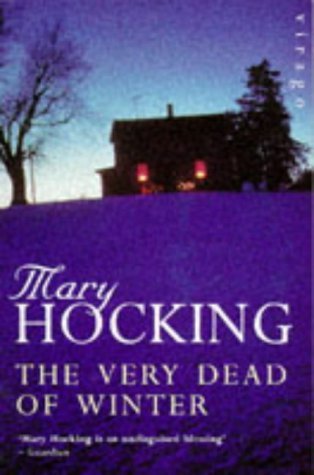
Mary Hocking: The Very Dead of Winter (1993)

The Very Dead of Winter

I’m so glad I came upon Heavenali’s Mary Hocking Month and discovered the brittle beauty of the novel The Very Dead of Winter and its cast of eccentric characters.With her wry humor and sharp eye for social comedy Mary Hocking can be firmly placed in the tradition of British women writers like Elizabeth Taylor, Barbara Pym, Susan Townsend Warner, Beryl Bainbridge and Muriel Spark.

Take a dysfunctional family, put them in a snowed in cottage at Christmas, with one of them slowly dying, and watch what will happen. I can guarantee you it will never be boring. The sisters Florence and Sophia used to spend their childhood holidays at the cottage. Now, in their sixties, they have come here for a special family reunion. Sophia is the owner of the cottage; Sophia’s sister Florence, her dying husband Konrad and their grown-up children Nicholas and Anita are guests.

What would be a testing moment for any family turns into a sometimes tragic, sometimes hilarious adventure. With the exception of Sophia and Konrad, these are some of the most selfish, narcissistic people I’ve ever come across in a novel. Florence is a master manipulator but she’s not very subtle, which leads to hilarious moments. Anita, her daughter, a child psychologist who doesn’t like children, has been under her thumb her whole life. Being with her mother is like being on a battle field when both parties are too tired to strike. They say the nastiest things in the world to each other but they can’t really fight openly.

“My mother is too big for me: She dwarfs everyone around her – except my father,” Anita shouted in to the wind. “There’s never any peace where she is, nowhere I can feel I am me. All my childhood I had to stay clenched tight, ready to parry thrusts from my mother.”

Nicholas isn’t any less dysfunctional he just handles it differently and doesn’t really communicate with any of them.

The book offers wonderful character portraits and an abundance of scenes I’m not likely to forget. In one instance, Florence decides to go to church in the middle of the night, right through the snowed in forest. What would be challenging during the day in summer turns into a dangerous expedition. Anita, although she’s terribly annoyed with her mother, feels obliged to go with her. Of course, it’s far too exhausting and Florence collapses in the middle of the woods. She’s a heavy woman and slender Anita isn’t capable of carrying her. Luckily they stumble over a half-frozen pony, and because she has no means to guide the animal, Anita takes drastic measures. I’m not going to reveal what she does. It’s nothing tragic, just wildly crazy.

Florence is a great character, she’s scheming and manipulative, driven by fear of abandonment, which makes her do foolish things. She lives in constant disappointment with everyone around her, always expecting them to serve her narcissistic purposes. She’s only interested in what people can be or do for her, but takes no interest in their personalities. She has no idea for example who her husband is, where he came from – he is German – or what his dreams and hopes are. Once it’s obvious he will die, filled with the horror of future loneliness, she clumsily tries to capture a widower who lives near by. The ensuing scenes are some of the funniest. Desperate as she is, she even thinks she can manipulate her grown-up children to come back to live with her. One of her favourite techniques is finding her own faults in everyone else.

“Dear God,” Florence said. “What has happened to me?”

Standing there, in the center of the room, it was as if she had come on stage to find herself in an unfamiliar play. She was, above all else, a performer, and to find that she had got the performance wrong was deeply disquieting.

I really liked The Very Dead of Winter are great deal. Not only for its wry humour and psychological insight, but also for some lovely descriptions. It’s not a flawless novel, there are a few instances of shifty point of view, but that didn’t diminish the experience one bit. I’ll certainly read more of Mary Hocking, might even re-read The Very Dead of Winter.

I leave you with two final quotes, one from the beginning of the novel, the other can be found towards the end:

The beginning of the journey had been enchanting. Porcelain blue sky and the sparkling white canopy transformed dingy streets into fantasies of unimaginable purity and, passing out of town, they came to broad fields where sunlight reflected the trellis of branches like veins across the snow.

She stood there a long time while the shadows crept towards her, deeps of blue from which a tree stump rose like the funnel of a sunken steamer. On the other side of the hedge, and between the bars of the gate, the sharpness of outline blurred into a mist of pink and grey shot through here and there with a shee of palest turquoise.

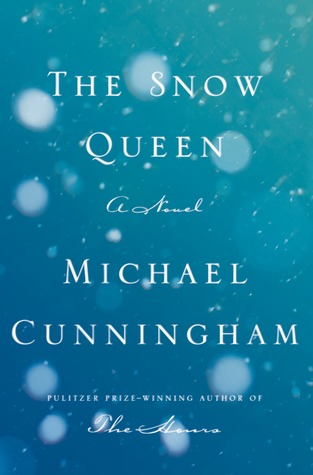
Michael Cunningham: The Snow Queen (2014)

The Snow Queen

Michael Cunningham’s luminous, compassionate new novel begins with a vision.

It’s November 2004. Barrett Meeks, having lost love yet again, is walking through Central Park when he is suddenly and inexplicably inspired to look up at the sky, where he sees a pale, translucent light that seems to regard him in a distinctly godlike way. Although Barrett doesn’t believe in visions – or in god, for that matter – he can’t deny what he’s seen.

At the same time, in the not-quite-gentrified Bushwick neighborhood of Brooklyn, Beth, who’s engaged to Barrett’s older brother ,Tyler, is dying of colon cancer. Beth, Tyler, and Barrett have cobbled together a more or less happy home. Tyler, a struggling musician with a drug problem, is trying and failing to write a wedding song for his wife-to-be – something that will be not merely a sentimental ballad but an enduring expression of eternal love.

Barrett, haunted by the light, turns unexpectedly to religion. Tyler grows increasingly convinced that only drugs can release his deepest creative powers. Beth tries to face mortality with as much courage and stoicism as she can summon.

One night, after having been dumped by his boyfriend via text message, Barrett is walking through Central Park when he sees a light. He’s pretty sure it’s of divine origin and looking down on him. He’s not the only one in his entourage who would benefit from divine intervention. He shares an apartment with his older bother Tyler, an unsuccessful musician with a drug problem, and his soon-to-be sister-in law Beth who has colon cancer. Both could do with some divine assistance.

The Snow Queen starts shortly before Christmas. It snows constantly and the images Cunningham creates are lovely and haunting. Tyler standing at the open window, while the snow swirls into the room full of old broken objects. Beth who wears only white and goes for a solitary walk. Liz and Andrew who do drugs until the early morning and stand on the top of the roof talking.

Barrett was once a wunderkind, someone who promised to be great one day. A scholar, a writer, someone who would leave a mark. Nowadays he’s happy to be a shop assistant in Beth’s and Liz’s vintage clothes shop. He doesn’t see himself as a failure when it comes to his career but he definitely sees himself as failure when it comes to love.

Tyler, the addict, struggles hard to write the perfect song for his wedding. He’s sure that a small bit of cocaine occasionally will help him. But occasionally is just an addict’s way of saying “I’ll stop soon”. And he always stops – until the next time, which comes invariably.

Liz is the oldest of the group of friends. She’s over fifty and still dating young men in their twenties. When they leave her for younger women she doesn’t care. It’s part of the plan, part of never settling.

We follow the four characters over the course of four years and see each of them come to terms with their life choices. They are drifters who have to learn that what they wanted in life might not have been the thing that would really make them happy.

I’m not sure what to think of this novel. I’ve read it in one sitting and some of the images are still vivid but it was also quite lame. I’ve read two of Cunningham’s novels A Home at the End of the World and The Hours. I loved both but this one left me puzzled. The writing is airy and precise, the images he creates are haunting but overall it’s so fluffy. And most of the time I felt like I’ve read something similar somewhere before. I even had a shock moment while working out, watching TV, and an episode of Sex and the City came on. A lot in this episode resembled The Snow Queen. I must say I like him better when he recycles Virginia Woolf. I also have no idea why he chose the title. Tyler get’s a snow splinter in his eye at the beginning but apart from that and the snow-heavy first chapters, there’s no link. Another possible inspiration might have been Jonathan Lethem’s Fortress of Solitude, with which it has more than one element in common.

With the exception of one critic most were raving about this book. I agree that the writing is lovely and the descriptions of addiction are extremely well done. Nonetheless, I need a bit more than a person seeing a light which is never explained and a couple of drifters accepting that life isn’t as grand as they thought it would be. Read it if you want to read an ode to resignation in a snowy setting.

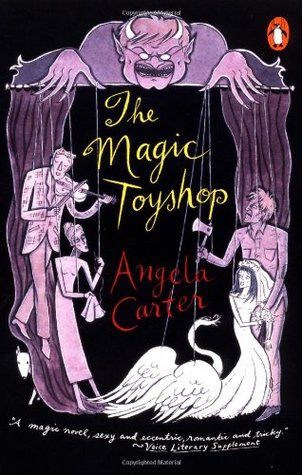
Angela Carter: The Magic Toyshop (1967)

The Magic Toyshop

I’m often tempted to skip the summary when reviewing a book, because, most of the time, the story as such doesn’t tell you a lot about a book. This is especially true in the case of Angela Carter. Her second novel The Magic Toyshop is no exception. It tells the story of a young girl, 15 year-old Melanie, who loses her parents the day after exploring the nightly parental garden in her mother’s wedding dress. She and her two siblings are then sent to her maternal Uncle Philip, a toy maker. At her uncle’s house she meets her Aunt Margaret and her aunt’s two brothers Finn and Francie. One is a painter, the other one a fiddler. It’s a very strange household. Creepy, joyless and fearful when her uncle is around; excentric and exuberant when he’s out. There’s a strange attraction between Finn and Melanie and one night, in the ruin of a magical garden, he kisses her. Melanie is confused by this because she doesn’t really fancy Finn. Additionally they have to hide their attraction because their uncle hates affection and emotions; he only lives for and through his toys and puppets. The grand finale is set in motion when Melanie has to play Leda in a cruel version of Leda and the Swan. Finn not only refuses to play along, but he takes revenge. Will the inhabitants of the sinister uncle’s house be able to free themselves or will they continue to be puppets in his hands?

A summary like this doesn’t tell you anything about the lush richness of the writing or what it feels like to enter an Angela Carter novel. Reading The Magic Toyshop is like entering an antiques shop or a shop with vintage clothes. You move from one beautiful garment to the next, from one arresting object to the following, only instead of objects and clothes you find sentences and images, allusions to fairy tales and myths, all woven into a shimmering tapestry. I felt like walking around in a stuffy room; in one corner I saw Bluebeard, in the next Red Riding Hood, and, over there, in a corridor, I spotted Dickens. Uncle Philip is like Bluebeard but he’s also a counter piece to the many bad stepmothers in fairy tales. He decidedly plays the role of a very bad step-father.  He’s an illustration of Carter’s play with gender clichés and tropes. Why does it always have to be the step mother who is vicious and vitriolic? In The Magic Toyshop the older women are positive, maternal figures. The older man is wicked and the younger are dreamy and wild.

The amazing thing in Carter’s writing is, that in spite of its complexity, it is very accessible and even entertaining. You can read The Magic Toyshop without being aware of the subtext, the allusions and references and still enjoy it. But, of course, she’s an author who makes you want to pick up books on her writing. It makes it so much richer, when you know what she is referring to or what she deconstructs.

Before I end this somewhat disjointed review (we have a heat wave currently and it’s hard to concentrate) I’d like to mention two more elements and maybe someone else can tell me how to interpret them:

Dirt – Dirt plays an important role in this novel. Melanie comes from a rich, elegant environment and everyone is clean at all times. Not so in Uncle Philip’s household where it’s hard to find warm water or soap and the people and their clothes are filthy. I remember from other stories that dirt is important but I’m not sure what meaning it has.

Incest – There’s open incest and incestuous moments in the novel. This is also a recurring theme.

The Magic Toyshop has been made into a movie which you can watch on YouTube. Angela Carter was fascinated by cinema and has twice contributed to the scripts of her own stories. This may be one of the reasons why anyone can enjoy her work – it’s always very visual.

This is my first review for Angela Carter week, co-hosted with Delia (Postcards from Asia).

PLEASE ADD YOUR OWN REVIEWS TO THE MR LINKY HERE

ACW badge 2-2

Some Plans: Spanish Literature – Japanese Literature and Mary Hocking

Japanese Literature Challenge

I’m not good at sticking to plans and projects these days. Especially not when I add reading lists to my intro posts. That jinxes it every time. Therefore, I’m not going to make the same mistake again and just let you know that I will take part in three events. Maybe these announcements will inspire the one or the other to join as well.

First up is Heavenali’s Mary Hocking Reading Month. I’d never heard of the author, nor was I familiar withHeavenali’s blog before I saw an announcement on Kaggy’s Bookish Ramblings. Browsing told me that Mary Hocking is right up my street and I decided, if I can get one of her many novels (many are out of print), I’ll join. So this is the only plan I’m sharing. I’ll be reading Mary Hocking’s The Very Dead of Winter.

The Very Dead of Winter

Here’s the blurb

This is a portrait of a family forced to confront the grievances of their shared past. In the very dead of winter they assemble at a remote country cottage enveloped in snow. Mary Hocking has also written “Good Daughters, Indifferent Heroes”, “Welcome Strangers” and “An Irrelevant Women”.

Should you want to join, there are quite a lot of used copies available. She’s written a lot of books, many of which have been published by Virago and are still in print. You can find a list on Heavenali’s blog.

spanish_speaking_countries_flags

July is Spanish Literature Month hosted by Richard (Caravana de Recuerdos) and Stu (Winstonsdad’s Blog). Two years ago, when they hosted the first Spanish Literature Month I had some wonderful plans and failed miserably. This year it should be different. I’ve been collecting books for the event, the general direction might be crime, but I’ll decide what I’ll read spontaneously.

Japanese Literature Challenge

Bellezza’s Japanese Literature Month 8 has started on the first of June and runs until the end of January 2015. On Bellezza’s blog you’ll find reading suggestions and links to the review site. This year I will read whatever I like, without taking into consideration whether or not the book has been translated into English. Hopefully I’ll be in the mood for something that has been widely transalated.

Will you participate in any of these events?

Literature and War Readalong June 27 2014: Fear aka La Peur by Gabriel Chevallier

Fear

Every year there is at least one book in the readalong I’m dreading. This year Gabriel Chevallier’s Fear –La Peur is one of them. Cheavllier called it explicitly an anti-war novel and at the same time his wish was to be as truthful as possible, to tell things as they were and to make those, who were not there understand what the war was like. His own experience as an infantryman made him especially qualified to write about the war.

In the French edition of the book is a foreword from 1951 and reading it, one could almost think thar Chevallier himself thought that he went too far. Probably it’s not surprising that the book went out of print when WWII broke out as it was considered bad for morale.

In any case, it’s one of the great French WWI classics. Another one of Chevallier’s novels, Clochemerle, was quite successful.

Here are the first sentences

The fire was already smouldering somewhere in the depths of Europe, but carefree France donned its summer costumes, straw hats and flannel trousers, and packed its bags for the holidays. There wasn’t a cloud in the sky – such an optimistic, bright blue sky. It was terribly hot and drought was the only possible worry. It would be so lovely out in the country side, or down by the sea. The scent of iced absinthe hung over the café terraces and gypsy orchestras played popular tunes from The Merry Widow which was then all the rage.

Some details and the blurb for those who want to join

Fear – La Peur by Gabriel Chevallier (France 1930)  WWI, Classic, Novel, 320 pages

It is 1915. Jean Dartemont is just a young man. He is not a rebel, but neither is he awed by authority and when he’s called up and given only the most rudimentary training, he refuses to follow his platoon. Instead, he is sent to Artois, where he experiences the relentless death and violence of the trenches. His reprieve finally comes when he is wounded, evacuated and hospitalised.

The nurses consider it their duty to stimulate the soldiers’ fighting spirit, and so ask Jean what he did at the front.

His reply?

‘I was afraid.’

First published in France in 1930, Fear is both graphic and clear-eyed in its depiction of the terrible experiences of soldiers during the First World War.

*******

The discussion starts on Friday, 27 June 2014.

Further information on the Literature and War Readalong 2014, including all the book blurbs, can be found here.

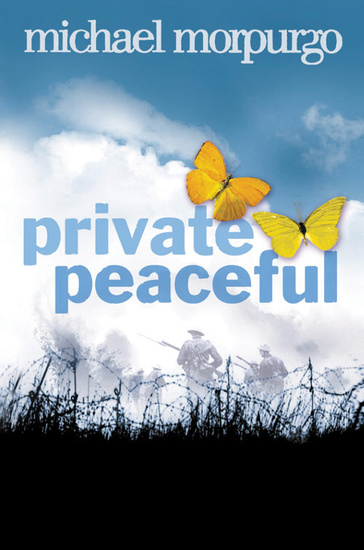
Michael Morpurgo: Private Peaceful (2003) Literature and War Readalong May 2014

Private Peaceful

British author Michael Morpurgo is one of the most appreciated writers for Children. He was the UK Children’s Laureate from 2003 to 2005 and Writer in Residence at the Savoy Hotel in 2007. He won many prizes for his fiction.

Tommo Peaceful is the narrator of Private Peaceful. He begins his story at five past ten in the evening, after everyone else has left him. He awaits the next day with anxiety but he doesn’t want any company or distraction. He wants to spend the night thinking about his life. The chapters are all given a specific time and each intro to the chapter describes briefly Tommo’s surroundings and his state of mind. After the intro Tommo tells us in flashbacks his story, from the idyllic childhood in the English countryside to the trenches of WWI.

Tommo is one of three boys. At the age of nine his father dies in an accident and Tommo feels responsible for his death. Although he and his older brother Charlie are very close, he never mentions what happened in the woods, the day their father dies. They have an older brother Big Joe who had Meningitis as a child. He can’t go to school and is easily agitated but they are still very fond of him.

Their father’s death marks a transition from a carefree life to a life of some hardship. They are at the mercy of the Colonel in whose cottage they live. The cottage is tied to a function and after the death of the father, who was the forester, they would have to leave. The Colonel’s estate is big and many people and families work for him and so Tommo’s mother is offered a position at the big house, and they can stay in the cottage.

The years go by and there is happiness and heartache in equal measures. When WWI breaks out, they don’t think they are affected. Tommo is only 16 and Charlie, who is two years older, doesn’t think of volunteering but in the end they are forced. Although Tommo is too young, he doesn’t want to abandon Charlie and pretends he’s older. Finally they are shipped to France together. From there they move on to Belgium and stay near Ypres for the following months.

They don’t see any action at first but eventually they come under heavy fire. From then on we get an impression of everything that was typical or important during WWI: trench warfare, mustard gas, rats, rain, mud, high numbers of casualties among men and horses, arbitrariness of orders, sadism of the high command, absurdity of it all . . . While it’s usually key to show but not tell, Morpurgo often tells but doesn’t show. He stays away from graphic descriptions or anything that you could call gruesome. We still get the horror because we see how it affects Tommo. Most of the time, we just don’t get to see what he sees. I think that’s a great way to go in a Children’s book.

What works particularly well in the book is the contrast between the childhood and teenage years and the war scenes. Morpurgo takes a lot of time to introduce us to his characters and to make us care for them. While some of the secondary characters are a bit stereotypical, the main characters Charlie and Tommo are well-developed. Their relationship is very close and they would give everything for each other.

As I wrote in the introduction to this month, I was particularly interested to see how a Children’s author would handle a WWI book from the point of view of a soldier. I think Michael Morpurgo did an admirable job. I’m sure, children will get a good impression for the particularities of WWI. And they will care for the characters and feel deeply about the end. For an adult reader who has read some very similar books for adults – Strange Meeting and How Many Miles to Babylon come to mind – it was not exactly a huge revelation, but in spite of that, I found the twist at the end harrowing.

Other reviews

Danielle (A Work in Progress)

 Judith (Reader in the Wilderness)

*******

Private Peaceful is the fifth book in the Literature and War Readalong 2014. The next book is the WWI novel Fear – La Peur by Gabriel Chevallier. Discussion starts on Friday 27 June, 2014. Further information on the Literature and War Readalong 2014, including the book blurbs can be found here.