Of all the possible movies based on A Christmas Carol I had to pick one of the more recent ones, the animated Disney version from 2009. I had already seen the one with Alistair Sims which is absolutely great and wanted to watch a modern one this time.
I suppose this intro has already told you what you wanted to know, namely whether I liked it or not. Obviously I didn’t and that’s actually quite sad because it had such a lot of potential. The beginning of this movie is stunning. It really gets you into a white Christmas mood, is atmospherical and appealing. I liked the way they showed the streets of London, up close and from above. The first half is equally good but as soon as the second spirit appears it wasn’t good anymore but extremely annoying. The second spirit is a jovial, bulky man, sitting on the top of a Christmas tree and laughing the most annoying laugh in movie history. It even made the cat run. I tell you, nothing makes that cat run once she is installed on my lap, on top of that, nothing usually scares her. Not even the Hoover. But that mad laugh did it. She fled to her basket behind the TV, far away from the speakers and half an hour later, when there was wild screaming and drama in the final moments of the movie, I had to go see what was happening as the poor little thing was having the mother of all nightmares and squeaking like a piglet.
The cat, I’m happy to report, has recovered but she is a bit grumpy.
I hope others were luckier in their choices or found a more kitty friendly version of A Christmas Carol. I would have watched Great Expectations but I have still 250 pages left to read and will not watch it before I finished the book.
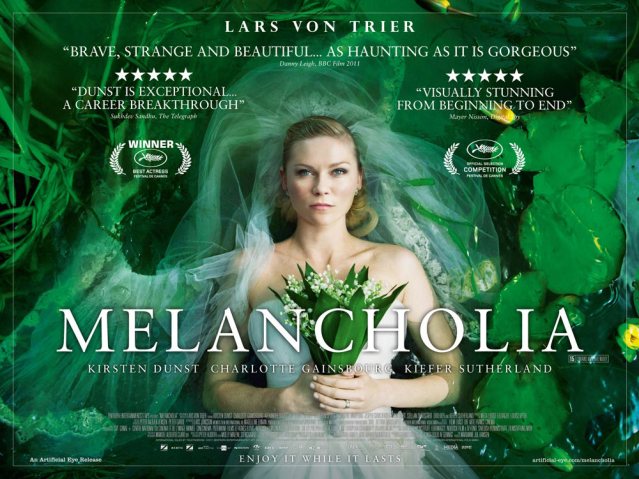
Melancholia is such a beautiful movie from the first moments on. It starts with a series of pictures accompanied by the music of Wagner’s Tristan and Isolde. The pictures look in many cases like taken from DeviantART. Others are either inspired by or show actual paintings. I spotted one by Breughel and the poster shows Kirsten Dunst as Ophelia which could have been inspired by Millais.
Kirsten Dunst’s character Justine is an Ophelia type woman in many regards. She is highly depressed. Smiling takes more energy than walking up a mountain. She has just gotten married to Michael (Alexander Skarsgård). They arrive two hours too late to their own wedding party which has been organized by Justine’s sister Claire (Charlotte Gaisnbourg). It is taking place in the grand estate of Claire’s husband (Kiefer Sutherland). It’s one of those stiff wedding parties in which everything is strictly organized in order to try to overshadow that nobody knows anyone and nobody is interested in anyone. But the perfect surface cracks very soon. Justine and Claire’s mother (Charlotte Rampling) isn’t one for pretending and her brutal honesty destroys what little festive spirit there is. From that moment on Justine is in free fall and not even the dreams of a lovely future that her husband tries to share with her can mend the damage. The only person who would have been able to help her is her unavailable father, a childish drunk (John Hurt).
The first part of the movie, Justine’s part, shows how she struggles, fails and finally destroys what little is left intact at the end. A more accurate depiction of severe depression and of a dysfunctional family I’ve rarely seen.
The second part is dedicated to Justine’s sister and her fear that the earth is going to be hit by the planet Melancholia. The blue planet has started to loom over the earth during the wedding party and sheds an eerie light on the garden and the surrounding forest. While the hard-headed Claire, who dreads nothing more than extinction, starts to unravel slowly when the planet comes closer, depressed Justine, who ultimately thinks that humanity would deserve destruction, becomes the strong one.
I know this isn’t a movie for everyone but I absolutely loved it. I think it’s one of Lars von Trier‘s best. It works as a whole and as a series of amazing pictures and scenes and ends in a stunning finale. The cast is great as well. I already liked Kirsten Dunst a lot in The Virgin Suicides, another of my favourite movies, but here she is simply amazing. The other actors do a great job as well, especially Charlotte Gainsbourg. I thought it was also interesting to see Stellan Skarsgård together with his son Alexander in the same movie.
Some of the scenes will haunt me for a long time. I particularly liked all the scenes that show Justine on her own when she leaves the party to look for some quiet and peace or when hardly any one is left in the early morning and those who remain seem to be in a tired floating and melancholy after-the-party mood.
I used to read a lot of African literature and watched a lot of documentaries as well but hardly any full-length movies at all. I had completely forgotten that Sembène Ousmane wasn’t only a great writer but also a highly acclaimed film director if Tom (Wuthering Expectations) hadn’t reminded me. I tried to find some of his movies and found the last film he made before his death.
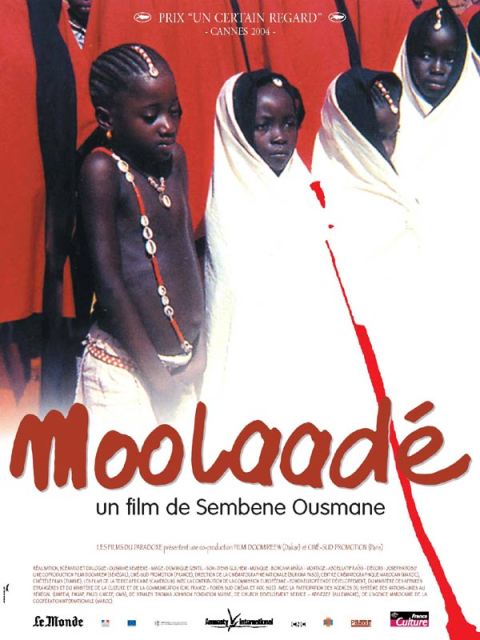
Moolaadé is an exciting movie because it offers such an awesome combination of different elements. It is life-affirming, optimistic, critical, humanist and very esthetic at the same time.
Moolaadé is a movie about female circumcision, tradition, change and the status of women in a polygamous, patriarchal society. One cannot watch this movie without being profoundly disturbed but it’s thought-provoking and not depressing at all.
One day, four little girls, seek refuge in the compound of Collé. She is the favourite and second wife of her husband. It is known that her daughter is the only girl in the whole village who hasn’t been circumcised. Her daughter is the fiancé of the eldest son of the village chief who has studied in Paris and is soon to come home. Collé knows that there will be conflict if she shelters the girls. In order to protect them she pronounces Moolaadé, magical protection. As long as one person grants another one Moolaadé the person cannot be touched or the consequences would be fatal. In order to show that Moolaadé is at work, a coloured rope is tied over the entrance of the compound.
The uproar in the village is incredible. They threaten Collé but to no avail until her husband returns and they force him to whip her in public until she revokes the Moolaadé. She remains steadfast and is, at the end, helped by an outsider, a travelling salesman.
Moolaadé shows what a trap circumcision is. The girls know how painful it is, even lethal and that many will never be able to give birth without Cesarean section. Sex will always be agony for them. Still the men do not want to marry a woman who isn’t “purified”. The girls are afraid that they will never find a husband but even more afraid to be maimed for life.
The way the movie shows how horrible circumcision is, is well-done. We don’t see anything but what we see is enough to illustrate it. The most problematic figures in the film are the women who perform the circumcision. They are truly scary.
The strength of the movie however isn’t only to show all the aspects, beliefs, traditions and conflicting interests related to circumcision but to show a way, a solution. The women decide to not accept the horrors done to their bodies anymore. In the movie it’s the act of one courageous woman, who decides to break with tradition, who triggers a wave of change.
It’s a disturbing movie but it’s optimistic as well. There are not only frustrating but a lot of comical moments too.
Western cinema, with a few exceptions seems to have forgotten that film making can be a means to trigger change, that there could be more to art than entertainment, that being engaged is an important value. Moolaadé reminded me of all this and much more.
It’s precisely movies like Moolaadé that I had in mind when I started the World Cinema Series. Movies that open a door to a world we hardly know. I liked it a lot and am pretty sure it will be one of my favourite movies this year.
The Palestinian widow Salma Zidane lives alone in a humble concrete house. Her son lives in the US, her daughter lives with her family in another village. She hardly sees anyone apart from an old man who already helped her father tend the lemon trees behind the house. The lemon grove she has inherited from her father is her only possession, her only possibility to make a living. The grove is 5o years old, the trees are lush and green, very healthy and produce an abundance of intense yellow fruit. Salma enjoys walking through the rows of trees, to tend to them, water them, pick the fruit, make lemonade or pickle them. For 50 years the lemon grove has been the pride and joy of her family.
But Eran Rikli’s movie Lemon Tree is not about joy, it’s about conflict, a conflict that breaks out when the Israeli Minister of Defense moves into the villa next to Salma’s grove. Salma lives on the West Bank, the grove is located directly on the Israeli border. And what is life-enhancing for one person, becomes a threat for another. Fences are erected, control posts installed, security cameras attached everywhere, military patrols scheduled. Still, that doesn’t seem enough. Terrorists could hide under the trees. Bombs could be thrown.
When the Secret Service decides to have the grove torn down, Salma seeks help. She finds a young, idealistic lawyer who wants to help her. It takes months and months, to fight for the trees. Meanwhile the Israelis have erected a huge fence all around the grove and Salma isn’t allowed to enter it anymore. She has to watch helplessly how the healthy trees are dying.
The movie doesn’t only focus on the conflict but looks into the different relationships of the people involved. The minister’s wife and Salma often look at each other through the fence, each wondering how the other woman lives. The grove and the decision to have it destroyed lead to a lot of tension in the marriage of the minister and his wife. On the other side of the fence, Salma and Ziad the lawyer develop a friendship that could become more, if there weren’t the watchful eyes of the ever-present Palestinian elders.
Lemon Tree is a very subtle movie that sheds light on one of the hot spots in the Middle East. It doesn’t give any easy answers nor blame excessively. Both parties are trapped, trapped in their cultures, their languages, their fears. The fences and walls that are erected are symbols of this imprisonment as much as the lemon trees are a symbol of freedom and beauty. In the end there is no win-win but a loss-loss situation.
I was very moved by this movie and to a large extent this is also thanks to the great actors. Hiam Abbass as Salma and Ali Suliman as Ziad are outstanding. It’s certainly not a cheerful movie but an important one.
At times bitter, at times beautiful, Everlasting Moments by Swedish filmmakerJan Troell is a movie like a painting. Filmed in sepia colored tones, it looks like one of those old photographs from the early 20th century. This is apt and artful at the same time as one of the major topics of the movie is photography. Photography as a means to capture moments, make them everlasting, but also photography as an art form and a source of hope in a bleak existence.
Based on a true story Everlasting Moments tells the story of Maria Larsson. She won a camera in a lottery, stored it somewhere in a cupboard and forgot all about it. Maria is a poor working woman, married to a brutal man, a drinker who hits her and their children. More than once she thinks of leaving him but after having asked the help of her father and been denied any, she slowly gives up. Her father tells her that in the eye of God it is a sin to leave your husband, no matter how he treats you.
Violence leads to her husband being arrested and when he is away, money gets scarce. She decides to sell the camera but Mr Pedersen, the owner of the camera shop, gives her some plates instead, and tells her to use it. What was it that made this gentle man realize that more than money, Maria needed something that would help her survive?
The only times in the movie in which Maria and her children lead a happy life is when the husband is in jail or enlists, when WWI breaks out. Unfortunately, every time, a few weeks after he has come back, she is pregnant again.
It is a slow movie, the shots are captivating, the music is in the background, quiet but underlines the pictures bu still it was hard to watch at times. The husband is so incredibly abusive and when Maria starts to make money with her shots, we do not understand why she stays with him. The same question is asked by her eldest daughter who narrates short parts.
I’m sure in an US movie, she would have left her husband and become a famous photographer. While stories like this do happen as well, the story of Maria Larsson, less grand, more quiet and hidden, is maybe more true to life.
Maria also finds solace in the friendship with Mr Pedersen. He sees the sadness in this woman, the potential and gives her the gift of an art form that will help her see beauty and make a little money. The actors, Maria Heiskanen as Maria, Mikael Persbrandt as her husband and Jesper Christensen as Mr Pedersen, are outstanding in their roles.
I read somewhere that Jan Troell was called a painterly director. This is an excellent expression but in this movie the shots often look like old photographs and are exquisite in all their details.
It was hard to watch how Maria’s man spoilt more than one moment but there was a lot of beauty in the movie. I found it particularly interesting to be reminded of how long it once took to take a picture. How careful you had to be, how complicated it was. Taking pictures was almost meditative, while now, it seems hundreds of images are taken in a very short time, and the process of really looking happens later, when they are sorted out.
James Sallis’ taut neo-noir novel Drive is nothing if not surprising. All the more so should you have seen the movie first and now want to read the novel. I had barely finished the book when I watched the movie and it was extremely interesting to see what and how they changed it. I don’t want to spoil the fun for those who have read the book first and have not seen the movie yet. I will just mention a few differences.
Sallis’ book is extremely well-crafted and has an interesting structure. I know I will read it again, just because of that. The story can be summarized in a few sentences. At the beginning of the book we see Driver in a pool of blood, three dead bodies next to him. How he got there and why will be revealed in bits and pieces during the novel. The story jumps backwards and forwards in time, only revealing a little in each chapter. The chapters can be read like short stories. They work on their own. This structure and the way information is given, only in the smallest of slices, exemplifies one of the main themes of the book.
Life sends us messages all the time – then sits around laughing over how we’re not gonna be able to figure them out.
Driver is a stunt driver for the movies. He is the best. Driving is what he knows best. His reputation is such that he is contacted by some criminals and hired as the driver for getaway cars in robberies. Driver is non-colloquial to the extent that even his delinquent bosses are stunned. Try to be more mono-syllabic and you’d be reduced to complete silence. Driver doesn’t want to know details. He drives. Period. And tells you that. In very short sentences.
Driver and many other people stay nameless all through the book which symbolizes a lot and mirrors an element of his childhood.
Mostly, when she spoke to him at all, she just called him boy. Need any help with the schoolwork, boy? Got enough clothes, boy? You like those little cans of tuna for lunch, right, boy? and crackers?
With a mother like that no wonder Driver never really attaches any meaning to his name or is much interested in elaborate conversation. This doesn’t mean he isn’t interested in people or relationships. He tries to be with people, he does contact people and hang out with them. He even takes care of some. Despite this lack in open communication, Driver’s interior life is far from empty. Passages like the one below are frequent in the novel.
Driver marvelled at the power of our collective dreams. Everything gone to hell, the two oft them become running dogs, and what do they do? They sit there watching a movie.
It’s rare that I’m this fascinated by a crime novel, this amazed by the writing. After having finished it, I could hardly wait to see the movie.
Maybe it’s lucky book and movie do not have a lot in common. Some story lines that are not very important in the book, have a major importance in the movie. The movie has nothing of the staccato rhythm of storytelling of the novel but delivers the story chronologically, leaving out everything about Drivers’ childhood and developing a major love story.
I didn’t mind those liberties at all because you can see book and movie as two separate things, one serving as a draft to the other. This is one of those movies I see myself re-watching many times. I absolutely loved it and one of the major reasons for that is the soundtrack. This is one of those glossy movies in which picture, story, actors and score form a tight whole and each part is perfect. Remove or change one thing and it would crumble. What I liked best was the extremely soulful, almost dreamlike atmosphere the soundtrack created, those beautiful pictures of the illuminated L.A. skyline at night and the surprisingly tender love story. I have often issues with the cast but it’s perfect in this movie. I couldn’t imagine a better Driver than Ryan Gosling or a better person for Irina than Carey Mulligan.
With a director like Nicolas Winding Refn (Valhalla Rising) it was to be expected that the movie would be visually compelling but not shy away from graphic scenes and strong violence.
You can watch this movie, see the differences with the book and still like it, and you can still admire the book as well.
Probably still under the influence of the movie, I haven’t done the book enough justice. If you want to read more focussed reviews, Guy reviewed it here (that’s the one that made me discover the book) and Max reviewed it here.
Thanks to the major success of this film the books by Sallis are now reissued. I’ve heard a lot of good things about Ghost of a Flea. The re-release is due in May 2012.
I realize this is awkward and a bit funny. I did already kick off my series last week but I never wrote a proper introduction because I didn’t think anyone would join. Meanwhile there have been two introductory posts, one by Novroz (Polychrome Interest) here and one by TBM (5o Year Project) here and quite a few people who said they would like to join us as well as you can see on the World Cinema Series Pages.
As a result, the World Cinema Series is now officially an event and you can sign up on the page which I will amend slightly, adding parts of this post.
Coincidentally Richard (Caravana de recuerdos) has started a Foreign Film Festival on his blog which is open to interested participants as well.
Just a few words on the “rules”, similarities and differences of our events.
I will, as I stated already, review up to two movies per month and add the review links to my page. The aim is to take a trip around the world in movies. This means I’m personally interested in movies that open a door to another culture. I wouldn’t review a Turkish crime movie that is set in the US. Not sure that exists but you get the idea. However I will review a German movie whose topic is Cambodia and I also plan on reviewing documentaries. But this is my interpretation. If you like fantasy movies and want to explore how different countries handle this in different ways, that’s a neat interpretation as well. All a participant has to do is link to my page and add a comment with the link to their review so I can add it. I will try to do an occasional wrap up post but nothing scheduled.
I’m glad if anyone has suggestions. I’m not very familiar with African filmmaking for example.
Richard’s Foreign Film Festival, in which I will participate as well, works a bit differently. Foreign is interpreted depending on your country of origin. No French movies for the French. You can sign up with Richard here and post links to your reviews on his blog. While I will just collect links, Richard will do a monthly wrap-up. The two projects are really two faces of the same medal. Movies can be entered on both sites.
What we decided off-line is that we will maybe organize the one or the other watchalong. The movies will be announced early on and we will post our reviews and discuss the movies on a set date. Suggestions are welcome.
At the end of the year I will give away a DVD to the person who has managed to cover the most countries. Old reviews are not considered as an entry.




 Beauty is a Sleeping Cat