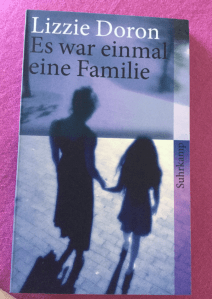
Once There Was A Family – Es war einmal eine Familie by Lizzie Doron – Israeli Literature – A Post a Day in May

Lizzie Doron is a prize-winning Israeli writer. In her work, she often uses autobiographical elements. She was born in Israel to a mother who was a Holocaust survivor. She lives in Tel Aviv. Her books have been translated into German, French, Italian but not English.

Once There Was A Family, as one would translate the Hebrew title Hajta po pa’am mischpacha, is set in Tel Aviv in the 90s. Elisabeth’s mother, Helena, has died. Elisabeth who has left the neighbourhood, in which she grew up as a teenager, returns to observe shiva in her mother’s apartment. During the seven days of the shiva, many people come to pay respect and keep her company. Some she still remembers, some are strangers. The seven days of the shiva are a journey of remembrance for Elisabeth. She dives deep into memories of her childhood, the neighbourhood, and its people.

Born in 1953, like the author, Elisabeth is second-generation, as the children of Holocaust survivors are called. She grew up alone with her mother in a neighbourhood predominantly inhabited by survivors of the Shoah. Everything turns around their memories. Everything is tainted by their memories. Sadness is everywhere. To the sadness of those who survived, often only physically, the sadness of recent wars is added. Many of the children Elisabeth grew up with die during the Six-Day war in 1963 and the Yom-Kippur war in 1973. Like the author, Elisabeth leaves the neighbourhood at eighteen, joins the army and later goes to live in a kibbutz.

I have never read a book like this before. I have read other Israeli authors, but they didn’t focus on the aftermath of the Holocaust. This book is so moving and sad, but never depressing. It allows us to enter a world, that is long lost but has left its mark on many who are still alive. There are so many books about the Holocaust, but not that many, I know of, which tell about the life in Israel, right after the war. There is no escaping the Holocaust. People feel close, because they went through the same. They differentiate each other, often calling others not by their surname but by the camp they have been in. There is one person called Itta Theresienstadt. They all have this in common – they seem to cling to the past. One of them says “I do not want to be well. I don’t want to sleep. I don’t want to forget.”

And it’s hard to forget as Elisabeth is reminded when the first guests come to the shiva. “One of them was small and scrawny, only bones and wrinkles, the second one tall and big. They stood in the door with crossed arms, as erect as possible, and in the candlelight, one could see the numbers on their arms”.

When there was a festivity in the past, many of the older people got annoyed. “Who are you going to invite? Your mother and father from Treblinka? Uncle Jisruel and aunt Mira from Majdanek? Your grandfather from Dachau?”

Sometimes, the memories are so overwhelming, the inhabitants of the neighbourhood, when asked where they live, still answer with the number of their barracks in Auschwitz, Dachau or Treblinka.

The longer the shiva goes on, the more Elisabeth remembers the good things; not everything was overshadowed by the pervading sadness. Because of the shared past, there was a connection that made them all feel like family. You could rely on your neighbours. They would always help. They would always care. Proof of that are the many flickering remembrance candles in everyone’s apartment.

There is tragedy too. Some cannot shake off the past and eventually choose to kill themselves.

One of the most poignant scenes comes towards the end of the book. Elisabeth remembers the day when she went to the hospital with her mother. The doctor insisted he needed to know something about the family history to diagnose her properly. What illnesses were there in the in the family? Elisabeth tells him that she doesn’t know. “They all died young and healthy.”

“Maybe there are family members you could ask,” the doctor insists. “Oh yes”, Elisabeth says, “of course, we could hold a seance.” The doctor does absolutely not understand why she is so unhelpful and finally gets a social worker who scolds him. “It’s a second-generation case, doctor.”

This last scene is so important because it shows that even in Israel, some might have forgotten that whole families, several generations of them, were wiped out.

I don’t understand why this or other books by Lizzie Doron haven’t been translated into English. It’s a massive omission. This book is so beautiful and important that everyone should be able to read it. Especially if they are interested in the Holocaust and Israel.

In later books, Lizzie Doron focusses more on the relationship between Israelis and Palestinians. I’m very keen on reading them as well.

Here’s a very short video in which she talks about how she experiences the lockdown in Tel Aviv and her fear of dictatorship.
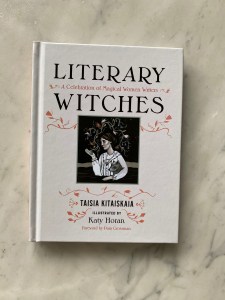
Literary Witches by Taisia Kitaiskaia and Katy Horan – A Collection of Magical Women Writers – A Post a Day in May

Taisia Kitaiskaia’s Literary Witches – A Collection of Magical Women Writers, illustrated by Katy Horan, is similar to We Are Artists, the book I wrote about two days ago. Only this time, it’s not women artists but writers from around the world that are celebrated.

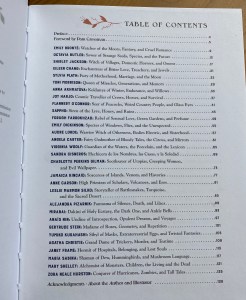
In thirty chapters, Kitaiskaia and Horan pay homage to as many writers. Some like Emily Brontë, Sylvia Plath, Virginia Woolf, Agatha Christie, and Toni Morrison are well known. Others, like Iranian poet Forugh Farrokhzad or Argentinian poet Alejandra Pizarnik, might be a little less familiar. Or, at least, I didn’t know them. The wide range allows many readers to discover new names.

Here is the Table of Contents.

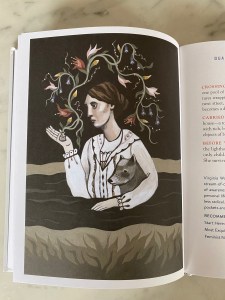
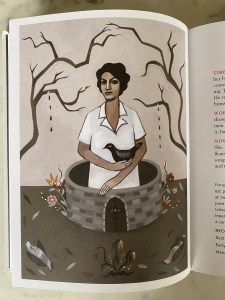
The biggest difference between this and We Are Artists is the way it is presented. The biographies are only one paragraph long and not seven pages like in the book about artists. The illustrations also depict the women and something that symbolizes their writing.

Additionally to the biographical paragraph, you find, on the same page, three fictional paragraphs, inspired by the authors. You could call them flash fiction pieces. They are dreamlike explorations of the writer’s consciousness.

What I liked best are the illustrations. I think Katy Horan is terrific. And I also find the biographical paragraphs useful, especially because there’s also a list of the most important works of the authors.

To give you a better idea I’ve chosen three chapters that should help illustrate the book.

Virginia Woolf’s chapter

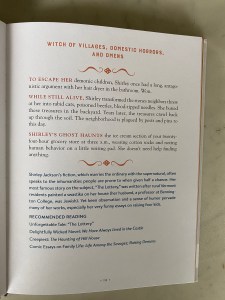
And Shirley Jackson

And Iranian poet Forugh Farrokhzad

Literary Witches was published in 2017 and I think I’ve had it since then. I pick it up quite frequently as I like it very much. It’s not the kind of book that I read from beginning to end, more one that I browse.

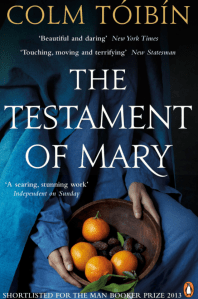
The Testament of Mary by Colm Toíbín – An Irish Novella – A Post a Day in May

I remember how intrigued I was when Colm Toíbín’s novella The Testament of Mary, based on his own play, came out in 2012. I love it when authors give historical, fictional or mythical characters a voice. Even though, I was so keen on reading it, it languished on my piles for so many years. Finally, thanks to my project A Post a Day in May, I’ve read it and loved it. It’s beautiful and daring. Engaging and thought-provoking.

The book is set many years, decades even after the crucifixion. Mary lives alone, in isolation in a house in Ephesus. She has two guardians who visit frequently. They ask her many questions about the past, about Jesus. She doesn’t talk. She keeps her memories, of which she has many, to herself.

I remember everything. Memory fills my body as much as blood and bones.

She has reason not to talk to these men because they have an agenda. They want to make sure that her memories and what she says about them corresponds to their truth. They are about to write the history of Jesus and their view, their interpretation of what happened differ completely from Mary’s.

It’s never said who these two men are, but as Toíbín mentions in an article, it could be St. Paul and St. John. It’s not important. What is important is what they wrote and that is the story we are familiar with.

Mary’s story is completely different. It’s a story of loss and grief for a son, who had lost his way. A son who attracted misfits, criminals, and fanatics and had to pay a terrible prize for the turmoil he and his followers created. She speaks about several of the most famous elements of the story of Jesus. Lazarus, the wedding at Cana, the walking on water. All these things she hasn’t witnessed and doubts. What she saw is a man who barely recognizes her, who has become a stranger, but a stranger she still loves deeply. While she hasn’t seen his “miracles”, she’s seen the crucifixion and has been traumatized by it. And then she tells us something very surprising – she wasn’t there when they took him off the cross. She didn’t witness his resurrection. She fled because she knew they would come after her and after other members of the family, friends, and followers.

In Ephesus, she also remembers the days when she was a practicing Jew. The Sabbaths she liked so much. Nowadays, she prays to the goddess Artemis.

I lived mostly in silence, but somehow the wildness that was in the very air, the air in which the dead had been brought back to life and water changed into wine and the very waves of the sea made calm by a man walking on water, this great disturbance in the world made its way like creeping mist or dampness into the two or three rooms I inhabited.

I loved this book. Loved the tone and mood. Mary’s sorrow, grief, and trauma are beautifully described. I was surprised to read her interpretation of things. It’s against everything that we know from the testaments. Jesus is described like a rebel but not exactly like a rebel with a cause. More like an outlaw. I like that Toíbín gave Mary her humanity back, looked at what happened through the eyes of a mother who had to witness her son being crucified. The crucifixion is described in detail. No gratuitous violence but still explicit.

I wonder what practicing Christians, especially Catholics, think about this book. I haven’t found a lot online. I was raised a Catholic but since I’m anti-clerical, I left the church a long time ago. I was surprised that I found some elements disturbing. The story of Lazarus, for example, reads like a creepy zombie story. I even found this book sacrilegious in places. Even if he might not have been the son of God, I always think of Jesus as supremely good. In the end, it looks like Toíbín wants to say the religion only exists because of the interpretation of the facts by those who wrote it down.

This is a short book and, still, one could write pages and pages about it. I hope I could do this complex book justice. It’s so beautiful and engaging.

Hetty Dorval by Ethel Wilson – A Canadian Novella – A Post a Day in May

Hetty Dorval is Canadian author Ethel Wilson’s first novel, or novella. It was published in 1947. I came across this book on Heavenali’s blog who reviewed the Persephone edition.

The book, which is mostly set in British Columbia, tells the story of how Frankie Burnaby fell under the spell of a mysterious stranger, Hetty Dorval. The story, told in first person by Frankie herself, begins when young Frankie, an impressionable schoolgirl, meets the elegant, beautiful, and charismatic Hetty Dorval. Mrs Dorval has bought a cottage, far off any other houses, and lives there alone with a housekeeper. Hetty who tells Frankie that she doesn’t really like people visiting her, nonetheless, invites Frankie to her house, where she gives her tea and sings for her. Before Frankie leaves, Hetty makes her promise, not to tell anyone. It won’t take long until loyal Frankie gets in trouble because of this. Her parents find out and forbid her to ever visit Hetty again. They won’t tell her why but it’s clear that Hetty has a reputation.

After this initial meeting ends so abruptly, Frankie doesn’t see Hetty anymore and shortly after, Hetty moves away. But that’s not the last Frankie or the reader have heard of Mrs Dorval. Over the next years, Frankie and Hetty will cross paths several times. Every time, Frankie is a little older and every time, she sees more clearly what kind of person Hetty Dorval is. Soon there’s nothing left of the early enchantment but total disillusion.

Hetty Dorval is a short novel. It is flawed but that didn’t diminish my enjoyment. Hetty is a fascinating character. She’s a free spirit but, sadly, also painfully narcissistic. I enjoyed seeing how Frankie’s perception of her changes over the years.

What I liked the most about this short book (just over 100 pages) were the descriptions of the landscape. Most of the story takes place in British Colombia, at the confluence of the Fraser and Thompson rivers. Young Frankie is often on horseback and explores her surroundings. I had another picture of Canada in my mind. Not one where sage-covered hills abound. The way Ethel Wilson describes it is so beautiful.

Here’s a short quote that illustrates this. It’s taken form the end of the book. Hetty is speaking.

“Do you remember that mare I had in Lytton? Juniper? Wasn’t she a beauty? Sometimes when the moon was full I used to saddle Juniper and ride at night down to the Bridge, and across, and up to the Lillooet road and off into the hills. And Frankie, it was so queer and beautiful and like nothing else. Though there was nothing round you but the hills and the sage, all very still except for the sound of the river, you felt life in everything and in the moon too. All the shapes different at night. And such stars. And once in the moonlight the geese going over. I remember the shadows the moonlight made on the ground, great round sage-bushes all changed at night into something alive, and everything else silver. And once or twice the northern lights – yes, really. And the coyotes baying in the hills to the moon – all together, do you remember, Frankie, such queer high yelling as they made, on, and on, and on?” (p.105)

What also seems worth mentioning is Ethel Wilson’s knack for ominous sentences. I can’t explain this in detail as it would ruin the book but in one case, she uses it to foreshadow and in another to hint at a possible tragedy in a character’s life. The result is uncanny.

Overall this was a unique and enjoyable reading experience.

Mrs Gaskell and Me by Nell Stevens (2018)

I’m not sure where I came across a review of Nell Stevens’ charming book but I’m so glad I did. It’s been a while since I’ve enjoyed a book as much and as unreservedly as this one.

Mrs Gaskell and Me – Two Women, Two Love Stories, Two Centuries Apart is a unique genre blend between memoir and fictionalised biography. The memoir tells us of Nell Stevens’ struggle to write her PhD on Elizabeth Gaskell and her tumultuous love story with a guy called Max. The fictionalised parts are Nell’s attempt to imagine a possible love story between Victorian writer Elizabeth Gaskell and Eduard Norton. Gaskell and Norton met in Rome. Gaskell’s Charlotte Brontë biography was just being published and she had fled Manchester to avoid the complications the publication might bring. She assumed, and later found out she’d been correct, that many people would disagree with her and even threaten to sue her for libel.

The book moves back and forth between chapters based on Nell’s life and chapters based on Elizabeth Gaskells’. Sometimes when books alternate like this, one has favourite sections but, in this case, I liked them both a great deal. I enjoyed reading about Gaskell’s time in  Rome, the people she met, the conversations she had. I know Nell Stevens took a lot of liberties but since I’m not that familiar with Gaskell’s life, I didn’t mind. From what I know, I’d say what Stevens imagined might not have happened like this, but it sounded plausible. She didn’t invent an affair but the story of two soulmates. Under other circumstances, at another time, they might have become lovers. Norton also fascinates Gaskell because he is American. America is her dreamscape, so to speak. A place that she imagines often and hopes to see some day. Meeting a soul mate is something that can have a deep impact; in Gaskell’s case, the impact was deepened further because they met abroad. Rome transformed and inspired her. Rome as a special place for writers and artists at the time, is the central theme of Nell’s PhD.

Having worked on a PhD myself, I recognized so many of the struggles. Finding a theme, keeping motivated. It’s so well described. Add to that, in Nell’s case, a complex love story. Max, like Gaskell’s Eduard Norton, is from the US. They met in Boston and while Nell knew immediately, she wanted to be with Max, he initially hesitates. The ups and downs of their story complicate the work on her thesis even more.

I loved this book for many reasons. I enjoy books about writers and literature. I enjoy memoir and the combination of the two works very well. I could relate to the way Nell Stevens tried to get inside of Gaskell’s head. She wrote those parts in the second person, as if she was addressing her. I remember battling with a paper on Voltaire’s Zadig. It was laborious and frustrating. Like Nell, I was very fond of my subject and while our professor told us to refrain from using biographical material for the interpretation of texts – especially of that era – reading about Voltaire’s life, discovering a kindred spirit, helped me. After a while, I felt I really knew him. At some point, I started a conversation with him in my head and funny enough that gave me an entry point to the analysis of Zadig.

Academic writing, love, the meeting of kindred spirits, and the importance of travel, are but some of the main themes.

Whether you’re a fan of Gaskell and like books about writers, or whether you enjoy memoir, there’s a huge chance, you might enjoy this book. It’s engaging, quirky, interesting, and at times very moving. Mrs Gaskell and Me, is Nell Steven’s second book. Her first, Bleaker House, about how she tried to write a novel, is also a memoir. I’m certain, I’ll read that too eventually.


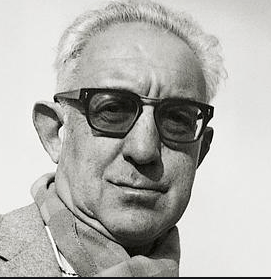
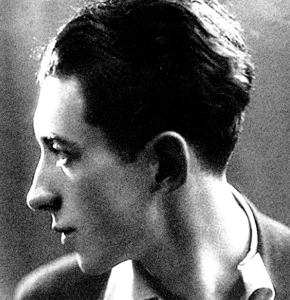
André de Richaud – The Author Who Inspired Camus to Become a Writer

Albert Camus said that André de Richaud’s novel La douleur  – The pain – inspired him to become a writer. When it came out in 1930, it created a scandal. The author was just twenty-three years old and had sent his manuscript to the Jury of the Prix du premier roman of the Revue Hebdomadaire. The jury was so shocked but impressed by the writing, that nobody won the price that year. While they considered La douleur too shocking for publication, it was clearly the best book. Despite the risk of a potential scandal, Bernard Grasset published the novel anyway that year, as he liked it so much.

Even though he entered the literary scene making such an impression and even though people like Camus and Cocteau praised him, de Richaud never got the fame or recognition he deserved. He went on to write more novels, short stories, plays, and poems but without any success. At the age of fifty-one, prematurely aged, he moved into a nursing home where he died of tuberculosis in 1968. He wrote his final work, the autobiographical novella Je ne suis pas mort – I am not dead, in 1965, after having found his own obituary that someone posted erroneously in a newspaper.

You’re certainly curious to find out now why La douleur was such a scandalous book. What was particularly scandalous was the combination of several themes that were taboo at the time. The love between French women and German prisoners of war, incest, and female sexuality.

La douleur is set during WWI, in the village of Althen-des-Paluds, in the Comtat region in the South of France, very far from the trenches. In the village, like in so many other French villages, there are only women, old men, and children, until the day when three German prisoners of war arrive.

Thérèse Delombre has lost her husband six months ago. Since then she’s been living alone with her small son. Thérèse Delombre suffers intensely. Not so much because she misses her husband, but because the loss leaves her sexually frustrated. She can’t think of anything else, can’t sleep. While it isn’t explicit, it’s obvious that her relationship with her son has an incestuous undertone. He sleeps in her bed, they touch constantly. She’s jealous whenever he makes a friend, especially a female friend. And when she catches the kids playing doctor’s games in the attic, she freaks out. This changes when she meets the German prisoner Otto and begins an affair with him. She neglects her son and throws herself into this love affair, unaware that people have noticed and disapprove.

Even for a contemporary reader some of the passages are very outspoken but not explicit. There isn’t any description of any of the sexual encounters, but the longing is described in an explicit way.

The book is courageous and interesting because of these themes but what made me really love it is the writing. De Richaud is a stunning writer. His descriptions are so lyrical I read many passages several times just because they were so beautiful. He also manages to give us a feeling of what it was like to be in one of those villages far from the trenches, but still so deeply affected by the war.

It’s tragic to know that the book is based on de Richaud’s own childhood. He was traumatised by his mother’s affair with an enemy.

What I find even more tragic is that de Richaud has hardly been translated. La douleur has been translated into German for the first time in 2019. I don’t think that an English translation of this exists. It’s a shame. People would love it and those interested in Camus would appreciate reading it even more.

This was such a haunting book. I will certainly read more of de Richaud’s work.


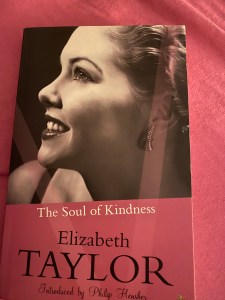
Elizabeth Taylor: The Soul of Kindness (1964)

Published in 1964, The Soul of Kindness is one of Elizabeth Taylor’s later novels. It’s the seventh novel by her that I’ve read and since I want to read everything she has written, it won’t be my last. I have to be honest though – if this had been my first, I might not have been so keen to carry on. While most other novels have one, or two central characters, this is more of an ensemble piece. It says in the foreword that it is one of three novels that don’t centre on a main character. The other two being In A Summer Season and The Wedding Group, both of which I haven’t read yet. This may sound as if I didn’t like it – that’s’ not the case but I think it works better when you know her writing already and read it as part of her oeuvre. If not, you might feel a bit let down by the lack of plot and its feeling a bit disjointed at times, especially since the blurb tells us this is Flora’s story. I suppose that was a marketing decision, as it isn’t her story, not in a traditional way that is. She’s more like the central figure among a group of people. But she’s definitely “the Soul of Kindness” the ironic title alludes to.

When the book opens, we see her as a shining bride, all eyes on her. She’s the belle of the ball. While people do admire her and many think highly of her, nobody does so as much as she does herself. Right away she is presented as attractive and nice, but also too fond of herself and a little ridiculous.

“Here I am!” Flora called to Richard as she went downstairs. For a second, Meg felt disloyalty. It occurred to her of a sudden that Flora was always saying that, and that it was in the tone of one giving a lovely present. She was bestowing herself.

Most of the central characters of this novel, are present at the wedding. Especially those whose lives Flora wants to improve. Among those unlucky ones are Meg, her best friend, Kit, Meg’s brother, and Percy and Ba, her father in law and his mistress. They are unlucky because Flora might be well meaning but she’s so self-centred, her attempts to help leads to smaller and bigger catastrophes. To help another person one has to be able to see them for what they are and that’s something Flora is incapable of.

While there isn’t really a plot, and after these initial scenes, not even a main character, the book still offers a lot. There are so many astutely observed character portraits, small vignettes, and scenes, some of which quite funny, that it’s a joy to read. I was particularly fond of Elizabeth Taylor’s use of atmospheric descriptions to convey a mood.

Here’s a very melancholic passage. We see Mrs Secretan, Flora’s mother, who was wishing so much for Flora to marry well, but never thought what it would mean for her, as a widow, that her daughter would move out.

The air smelt autumnal. In no time there would be thick evening mist coming up from the water, a complete silence from the towing-path, and the river rising; perhaps floods. And Flora would be settled in London and never to come here again, except as a guest.

I made all the plans, Mrs Secretan thought; down to the last detail. But I forgot this, I forgot myself and the future. I particularly overlooked this evening. She read the letter through again, telling herself that Flora had meant well, meant very well, poor girl. In fact she had always meant well. That intention had been seen clearly, lying behind some of her biggest mistakes.

This passage shows us, quite clearly that even her mother doesn’t think of Flora as kind and good, but merely as well-meaning with fatal consequences.

And here’s a funny passage in which Mrs Secretan, encouraged by her son-in-law, thinks about travelling. It captures both characters, of Flora and her mother so well.

To Flora’s astonishment she (her mother) was quite seriously weighing the pros and cons – of Hellenic tours (‘might be too scholarly’), India (‘but I dare say it is spoiled, now that it doesn’t belong to us’), the Holy Land for Christmas.

‘Yes, I might plump for the Holy Land for Christmas,’ she had told Flora, who had been deeply shocked. At Christmas! she had thought in dismay. So what shall we do? Christmas had always been a sacred time, with cherished customs, not one for taking oneself off to the Holy Land.

Flora is so oblivious of other people and their needs that she’s pretty much the only happy character in this novel. All the others strive for something or someone they can’t attain. Or, because of Flora, they start to strive for something that’s not attainable, risking their contentment for a mirage.

In The Soul of Kindness, like in all of her novels, Elizabeth Taylor excels at creating well-rounded, believable characters. Their relationships are complex and at times complicated. Nothing is as simple as Flora perceives it. Not even her own husband Richard. He’s very much in love with his wife, because of her beauty, but knows that she’s too self-centred to be clever. No wonder he’s attracted to his unhappy neighbour. This relationship triggers Flora’s jealousy and we see, she can be perceptive when she feels threatened.

In the foreword, Flora is called demonic, which I find a total exaggeration. I don’t think she’s as bad as we’re initially led to believe. Yes, she’s self-centred, oblivious, and puts in motion some things that go terribly wrong, but she’s the glue that holds all these people together. Without her, this particular group of people and their relationships wouldn’t exist. And that’s not a little thing. It’s a gift to attract interesting people and to bring them together. I would, if I had to judge her, call her very imperfect, but neither demonic nor mean. That’s why, ultimately, she’s liked and forgiven.

There’s a lot to enjoy in this novel but I don’t think it’s as good as others. I believe it doesn’t succeed at being the portrait of one central character like Angel for example, but that’s how the beginning reads. All the initial chapters place Flora at the centre but this cohesion eventually fizzles out. As if Elizabeth Taylor had realized too late that Flora wasn’t a big enough character to carry a whole story. I could be totally wrong, of course, as critics have called this one of her, if not her best book.

Since this is one of three “group stories” I hope I will like the other two In A Summer Season and The Marriage Group more.

Here’s another take on this novel by Jacqui.