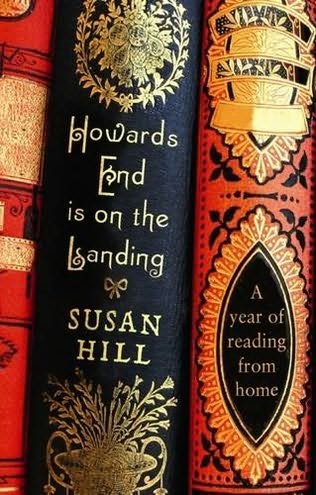
Susan Hill: Howards End is on the Landing (2009) A Bookish Memoir

Early one autumn afternoon in pursuit of an elusive book on her shelves, Susan Hill encountered dozens of others that she had never read, or forgotten she owned, or wanted to read for a second time. The discovery inspired her to embark on a year-long voyage through her books, forsaking new purchases in order to get to know her own collection again. A book which is left on a shelf for a decade is a dead thing, but it is also a chrysalis, packed with the potential to burst into new life. Wandering through her house that day, Hill’s eyes were opened to how much of that life was stored in her home, neglected for years. Howard’s End is on the Landing charts the journey of one of the nation’s most accomplished authors as she revisits the conversations, libraries and bookshelves of the past that have informed a lifetime of reading and writing.

I can’t tell you exactly how long it took to read this book. An evening? Two? Certainly not longer. I devoured it. What is more fascinating to read than a bookish memoir? And written by a writer. On top of that Howards End is on the Landing also contains some information on Strange Meeting, the first book I chose for my Literature and War Readalong.

Shouldn’t we all stop buying books from time to time and first read what is at hand, on our own shelves? This is exactly what Susan Hill did for a whole year. During this year she discovered and rediscovered a lot of books and writers, was reminded of many memories that are linked to books and writing and chose her own personal canon of 40 books.

It is an extremely interesting and entertaining and at times frankly puzzling book. Susan Hill doesn’t read Canadian or Australian literature. Why not? Too foreign. She thinks Joyce, Proust and a few others are unreadable. Are they? There were bits and pieces of information like this that did surprise me. But she is honest. She isn’t pretending for one second. It is obvious that this is the book of a reader, it is nothing like Francine Prose’s outstanding Reading Like a Writer, it is only about personal choices and tastes. There are whole chapters dedicated to her favourite female writers: Barbara Pym, Anita Brookner, Virginia Woolf, Penelope Fitzgerald and Iris Murdoch.  She has met quite many of the writers she mentions and tells anecdotes that are interesting too.

One whole chapter is dedicated to diaries, another one to picture books, one to things that fall out of books, another one is dedicated to annotations in books and  she muses over short stories (not her favourite form).

Sebald gets a whole chapter which surprised me after what she said about Proust and Joyce and others. I’m glad I am already reading his Austerlitz or I would have to rush and get one of his books. She really makes him sound appealing. I agree with her, there is no writer like Sebald.

His subject matter is extraordinary, unpredictable and odd – he seems to collect the unusual and be interested in the outlandish, but, through his eyes, even the ordinary and prosaic becomes somehow strange. Everything he sees, everywhere he goes, every person he meets, all are filtered through some curious lens of his own devising.

Something that I liked is her evaluating some of the classics and giving advice with which one of their novels one should start. One should read Hardy’s The Mayor of Casterbridge and not start with Tess of the d’Urbervilles or Jude the Obscure. Sounds sensible.

If she had two choose among the ghost stories she knows, she would choose M.R. James’ O Whistle and I’ll Come to You and Edith Wharton’s  Mr Jones. Given that it’s a genre in which she excels, I take her word for it.

When it comes to short stories in general she likes John McGahern, William Trevor and Katherine Mansfield.

Travel books are also covered and here it is Patrick Leigh Fermor who gets a special mention. He is also mentioned in her chapter on editing books, something she has also been doing for quite a while. Fermor is one of her authors.

One chapter I enjoyed particularly was the one on diaries. I would have liked to start all the books mentioned right away and have never heard of some the authors she loves to read and reread. Namely the Reverend Francis Kilvert and Frances Partridge. But she also loves Virginia Woolf’s A Writer’s Diary and, surprisingly (as she doesn’t like his novels at all), The Journal of Sir Walter Scott.

All in all I highly recommend this book. It’s very colloquial and reading it feels like talking to a good friend about the books and stories he or she likes. I found a lot of books I’m looking forward to reading now, especially those that are waiting on my shelves. In this sense it is an inspiring book that put me in the mood to concentrate more on the books I already have and not acquire so many news ones.

Out of the list of 40 novels she indicates, I chose to reproduce a list of the novels written by women that she thinks to be among the best. I chose only the women because a) they are not as numerous and b) I would like to read more female authors this year and c) you should still have a reason to read her memoir.

I read and reviewed Carson McCullers and read To the Lighthouse as I have read all the novels by Virginia Woolf (except Voyage Out). The Rector’s Daughter and The Blue Flower are those I am most curious about.

Which ones of these novels do you know and like?

The Ballad of the Sad Café by Carson McCullers

The Last September by Elizabeth Bowen

Middlemarch by George Eliott

The Blue Flower by Penelope Fitzgerald

To the Lightouse by Virginia Woolf

The House of Mirth by Edith Wharton

The Rector’s Daughter by F.M Mayor

The Pursuit of Love by Nancy Mitford

The Bell by Iris Murdoch

Family and Friends by Anita Brookner

The Finn Family Moomintroll by Tove Jansson

Jenn Ashworth: A Kind of Intimacy (2009) A Very Noir Character Study

Annie is morbidly obese, lonely and hopeful. She narrates her own increasingly bizarre attempts to ingratiate herself with her new neighbours, learn from past mistakes and achieve a “”certain kind of intimacy”” with the boy next door. Though Annie struggles to repress a murky history of violence, secrets and sexual mishaps her past is never too far behind her, finally shattering her denial in a compelling and bloody climax. A quirky and darkly comic debut – giving readers a glimpse of a clumsy young woman who has too much in common with the rest of us to be written off as a monster.

I discovered A Kind of Intimacy thanks to a review on Danielle’s blog. It was also among her top 12 of 2010 and it was also one of the favourite reads of Guy Savage who also reviewed it.

I already jokingly “said” to Danielle in a comment that her top 2010 might become my top 2011 and,  yes, this book is certainly a candidate as it is astonishingly good. Very dark, absolutely fascinating, engrossing, and very well executed. While starting it I had forgotten Jenn Ashworth was compared to Ruth Rendell but the association immediately occurred to me as well.

A Kind of Intimacy is told by the main protagonist, obese, deluded Annie herself. She is what you call an unreliable narrator. The reader feels that something is wrong from the beginning, too many hints and little details tear apart the picture of perfection that Annie wants to draw for our and her own sake. These interfering details, as I would call them, make this a creepy read. Uncanny and creepy. It is not so much that we judge Annie as that we wish to never meet someone like her as she seems capable of doing really harmful things.

At the beginning of the novel Annie moves into a new neighbourhood. One of the first people she meets is Neil who has a natural capacity for being kind, which proves to be fatal in this relationship, as Annie doesn’t see things the way they are but the way she wants them to be. Unknown of Neil or anyone else, she is convinced, he is her soul-mate and the only thing that needs doing is getting rid of Lucy, his skinny and pretty girlfriend.

What starts like a comedy soon develops into something much darker. Bits and pieces of Annie’s past are revealed slowly. A miserable childhood, an odd marriage, a baby girl who seems to have disappeared and some really dodgy things Annie does to try to get “A Kind of Intimacy” despite her being revoltingly obese. The further you read the more you will hope to never meet anyone like Annie.

As deluded and extreme as she may seem, Annie is a character I am all too familiar with which added another dimension to my reading. However odd this may seem, I have met more than one Annie in my life. They were not always as dangerous and they were always male… Call me Neil… It’s really scary what some people can interpret into your tiniest actions.

I read somewhere that Jenn Ashworth was criticized for chosing an obese woman as her protagonist… I see Annie as a distortion, a caricature and as such the obesity did work for me. Unlike one critic I read, I did feel sorry for Annie. All through the web of lies and deceptions we catch glimpses of a very lonely and hurt soul.

Jenn Ashworth is a gifted writer. If you have ever tried to write yourself you will know that voice and point of view are always very challenging. Annie’s voice does sound so right. There is not one wrong note in this symphony of lies and self-deception. A Kind of Intimacy is one of the best character studies I have ever read. Fascinating, creepy and compulsively readable. I am sure this book will appeal to readers of crime and general fiction alike.

Just one aside, Jenn Ashworth won a prize for Best Blog Content in 2008. Here is the link to her site.

Meg Rosoff: What I Was (2007) A Very Poetical Novel

The narrator of Carnegie Medal winner Rosoff’s latest and perhaps most perfect novel is a 16-year-old boy who has been expelled from two boarding schools and finds himself dumped in a third, near the Suffolk coast. The school is all arbitrary rules, pretentious tradition and routine bullying. But on the beach nearby the boy finds a fisherman’s hut occupied by beautiful, competent Finn, who is everything he wishes he could be himself: athletic, self-sufficient, able, free. The relationship that follows becomes an escape and an obsession, pure and transporting, and a turning point in a life remembered by the narrator at the age of 100. It makes us fall in love not only with Finn but also with the Suffolk coast, the land, the sky and the sea passionately described in airy and crystalline prose. It’s already a classic.

I wasn’t aware that I was reading a YA novel when I started Meg Rosoff’s hauntingly beautiful novel What I Was. It tells the story of a teenage boy but apart from that I don’t see why it is classified as YA. It is very lyrical, poetical and even mysterious. Rosoff creates a wonderful world, her descriptions are very atmospheric.

The novel takes place in 1962. Hilary is an old man now and looks back on his time at St. Oswalds boarding school.  It is the third school in a very short time. He doesn’t really fit in, he hates the place, he doesn’t like the people. The description  of the place had an almost gothic feel.

When Hilary meets Finn, his life changes. What follows is one of the most subtle descriptions and meditations on falling in love. Rosoff manages to show the complexity of the feeling in a masterful way. Don’t we always wish to a certain extent to be like the one we fall in love with? Isn’t the one we love not often an idealized version of our selves, a better part of ourself?

Finn lives all alone in a little fisherman’s hut, near the sea. His sole companion is his little grey cat. Finn is independent, strong, adept at many things. He is everything that Hilary is not. And very beautiful. Hilary is touched by Finn’s beauty in a very profound and even painful way. He compares himself and thinks that this is how he would like to look, how he would like to be. There is also a great transformative power in this kind of love. Through his feelings Hilary becomes every day a little more like Finn.

The fisherman’s hut is located in a very precarious position, threatened to be flooded at all times. Storms are a great danger to it. But it is also a very cozy little hut. Finn has a fire going all the time, he makes tea for them, cooks dinner. Finn likes to read and is interested in history. Through him Hilary discovers a lot he didn’t know.

The description of the landscape and the weather has also a very gothic feel. The sea is wild and seems to devour the land, the winds are howling, the storm is raging. At times I felt reminded of Jonathan Coe’s The House of Sleep, one of my all-time favourites. And once you know the story has a twist, even more so. I wasn’t surprised by the twist, I thought it was pretty obvious from the start but that didn’t dampen the reading experience. I truly liked this book and might very well pick up another one of her novels soon.

Has anyone read this one or another one of her books?

Should anyone want to know more about Meg Rosoff here is her website and blog.

Bookish Christmas Memory: Mrs Dalloway

This post is my contribution to the Virtual Advent Tour. A big “Thank you” to Kailana from The Written World and Marg from Adventures of an Intrepid Reader for organising it. It is already day 22 and many interesting, touching and informative posts have been written so far. Mostly family memories, but also a few of another kind.

Christmas has always been a special and a very quiet holiday  for me. When I was very little, we spent the Christmas season in Paris, with my father’s family. My mother’s side is dispersed all over Europe, there was never a possibility or a will for a big gathering. Later, when I grew older, and family politics made it impossible to have one joint meeting, we mostly stayed at home. Due to these circumstances Christmas was always a time of intensified reading and watching of old movies on TV.

Books that I have read during a certain season, on a holiday, somewhere abroad, a special period of my life, have always seemed to stay more intensely in my mind than others. I have a mental treasure trunk full of cherished book memories of this kind.

The last Christmas I spent with my parents, when still living with them, at age 19, is, in retrospect, one of the most enchanted ones. I already studied at the university but had no worries, lived in great comfort and was looked after. No illness, no precarious financial situation, no major burn-out, nothing of the kind, that all happened later. All I had to do, is come out of my room and join my parents for lunch and dinner. With hindsight, that Christmas seems like frozen in time, like a scenery in a snow globe and when I look at it, I see a young girl, curled up in an old wicker chair, holding a book with a greenish cover and reading it with utter enchantment.

That year, someone had offered me my first Virginia Woolf novel. It was Mrs. Dalloway. I will never forget that novel and especially not my favourite scene in it. This scene comes to my mind the very instant when I think of Christmas. Invariably since that time my mind wanders spontaneously along the following trail: Christmas, Mrs. Dalloway and off into a string of associations that are all tied to one particular episode in the book: Mrs Dalloway buying flowers at a flower shop. My memory of this scene is intense and sensual. I remember Mrs Dalloway entering a cool shop, an intense green scent of freshly cut flowers pervades the air and the odor of some sweet smelling blossoms seems to linger all over the place. I cannot remember what flowers she bought, I remember semi-darkness and this almost sparkling scent.

I often remember one particular scene from the novels I liked best. Everything else slowly sinks into oblivion but that one scene, with all the associations and meanings it represents to me, stays ingrained in my mind. I don’t know if others feel like this about books.

I have never read Mrs Dalloway again, I am afraid of what I might find. Maybe my memory has adorned it over the years with elements entirely my own. I fear disenchantment. I have read Michael Cunningham’s The Hours, the novel that is dedicated entirely to Virginia Woolf and Mrs Dalloway, and have seen the movie that is based on it. The novel is wonderful and the movie is one of the best I know, especially because of Philip Glass’ music. It has acoustic qualities that are corresponding to the flower shop scene’s visual ones; they are light, fresh and green.

It may be odd to tie Christmas to one distant reading experience but I love the memory.

I haven’t made many Christmas plans for this year apart from dinner with friends. I was toying with the idea to read Elizabeth Gaskell’ s Cranford or maybe Michael Chabon’s Wonder Boys. I have seen the movie during another Christmas season and found it wonderful. I like books and movies about writers and it is the only movie in which I liked Michael Douglas.

Does anyone else have any speacial Christmas reading memories or plans?

Don’t forget to visit the other stops today.


Jennie Walker: 24 for 3 (2008) A Novel by Poet Charles Boyle

24 for 3

Friday: as a Test match between England and India begins, a woman’s attention is torn between her husband’s insistence on explaining the rules of cricket, her lover’s preference for mystery, and the worrying disappearance of her sixteen-year-old stepson. By Tuesday night the outcome of the match will become clear – but whatever happens, the lives of the players will be changed forever. 24 for 3 is a funny and moving story about love, family, and whether or not one should always play by the rules.

24 for 3 is the first novel by poet Charles Boyle, written under the pen-name Jennie Walker. It is a very short novel, rather a novella. Crispy, clean prose, undoubtedly the work of a poet. Wonderful language. It’s a tricky little book as well. Tricky in many ways. Tricky because it didn’t find a publisher at first and Boyle published it himself and founded at the same time his own publishing house CB Editions. After he published it, he got a contract from Bloomsbury that’s why we can now read it in a brand-new outfit.

But it is tricky in many other ways. And quirky. You think it is a very small little book and that you can just gulp it down but you are wrong. This little treasure forces you to slow down and pay attention. Once it has made sure that you are focused it will enchant you completely. On barely more than 130 pages we get to read a linear novel, that can be read as such but, when paying really close attention, we realize what an ingenious composition it has. It consists of paragraphs which, in a lot of cases, can be read individually and work as poems, hint fiction and observations. Marvellous. Cricket serves as the backdrop on which a family history unfolds, a very rich tapestry of unusual relationships and non-traditional family life. And adultery. The narrator lives together with her husband, Alan, her step-son Selwyn and the former au-pair Agnieszka who has been staying with them for almost ten years. The woman who tells the story is drawn between her husband and her lover, a loss-adjuster. Surprsingly as this may seem, they are not at the heart of her emotional life. This place is occupied by her love for her step-son who disappears during the beginning of the five-day cricket test match. He ran off to stay with her lover.

The story is profound but I particularly apprecaited the style and would like to give you a few examples:

His face is lined; he looks older than Alan although in fact is younger. He has lived in cities and survived on little sleep. (s. 73)

Or this one that reads like a poem:

“What are you thinking about?”

“Love”

“In general, or in particular?”

“In particular. You?”

“Ants. Oh, and hanging, shooting, poison.”

“Are you asking me to choose?” (s. 49)

Towards the end there are two pages which consist of 8 paragraphs that all begin with the words “We used to play…” and are allusions to lost joy, childhood, change, futility and memories.

And here is the narrator thinking about her two men and the choice she will be forced to make:

Me, I am married to a caring, conscientious man who rearranges cookery books by the light of the moon, and I rush away into the arms of a man who wears yellow Wellington boots and whose job – and possibly whose life too, if  I cared to investigate further – reeks of doom, disaster, things gone awry.

Since this is a multilayered novel, allusions abound. I am sure many readers will understand these:

“Is that okay?”

It appears to be so. Indeed, Selwyn is safe, Agnieszka has not been raped, no rash crime of passion has been committed, no one has thrown him- or herself under the train. But it is not okay. (s.105)

There are many more great passages and sentences, as a matter of fact, one is tempted to quote the whole book. And then there is cricket. For those who like the game this will add additional charm, for those who don’t care about it, it’s another symbolical subtext to explore.

Apart from being a poet, an editor and a novelist Charles Boyle is also blogging at Son of a Book.

I came across 24 for 3 while browsing the site of the Swiss editor Unionsverlag who is dedicated to publish a very exquisite choice of translated books. I had to order the English original right away.

What English (or other) editors, apart from Peirene Press, do you know who publish only translated books?

Fünf Tage. Ein Spiel is the German title, its literal translation would be “Five days. One game”.

Fünf Tage. Ein Spiel

Elizabeth Taylor: Mrs Palfrey at the Claremont (1971)

On a rainy Sunday in January, the recently widowed Mrs Palfrey arrives at the Claremont Hotel where she will spend her remaining days. Her fellow residents are magnificently eccentric and endlessly curious, living off crumbs of affection and snippets of gossip. Together, upper lips stiffened, they fight off their twin enemies: boredom and the Grim Reaper. Then one day Mrs Palfrey strikes up an unexpected friendship with Ludo, a handsome young writer, and learns that even the old can fall in love …

I am not that easily moved but Mrs Palfrey at the Claremont moved me a lot. What a touching story. Elizabeth Taylor is really a wonderful writer. Her style is so exquisite. I am really annoyed with myself as I read it much too fast. This should be savoured sentence by sentence. I think I will have to re-read it. I loved the style of Blaming too but I didn’t care for the characters. I found them so unkind. This is quite different. Mrs Palfrey is really a darling. But the other characters, even the embittered ones, are still endearing. They are all very eccentric and put up a front. They know exactly that the Claremont, that has seen better days, much like they have, will be their last chance at a little bit of freedom. After the Claremont comes the hospital and ultimately death. Their boredom and the way they try to grasp every little bit of excitement is described so well.

I don’t think hotels like this still exist and if so the people who live there must maybe even be richer than those described. The elderly women and the only old man at the Claremont are very well off. And lonely. No one visits them, they have become a burden to their families.

When Mrs Palfrey falls in the streets and handsome Ludo, an aspiring writer, kindly comes to her rescue she takes the opportunity and asks him to be a  stand-in for her own grandson who doesn’t visit her.

The other people at the hotel envy her immediately and she becomes quite a success thanks to Ludo. Their relationship is very special and Mrs Palfrey even develops a little crush. Ludo uses her as the model for his novel that he calls after something Mrs Palfrey said: “We aren’t allowed to die here”. He does have a bit of a bad conscience to exploit her like this but he does like her too and enjoys spending time with her. She is nothing like his own mother who couldn’t care less about him.

The novel is full of bon mots that are like little pearls on a necklace. Some are used by the narrator, some by the protagonists. Some are pretty, many are funny, like this one, uttered by Ludo during his first dinner with Mrs Palfrey: “I have never enjoyed myself more with my clothes on”. Here is what the narrator says about Mrs Palfrey: “She would have made a distinguished-looking man, sometimes, wearing evening dress, looked like some famous general in drag.” This may sound unkind but Elizabeth Taylor isn’t unkind, she really likes her characters, their crankiness and eccentricities.

I truly enjoyed this novel, it’s sad, funny, bitter-sweet and beautiful. And thought-provoking. After all, none of us is spared old age, let alone the grim reaper. And some of us may have old parents or grandparents. Maybe we really should visit more often.

I would like to watch the movie and attached the trailer for you.

Has anyone seen it? Joan Plowright is a wonderful actress and seems perfect in this role.

Elizabeth Taylor: Blaming (1976)

When Amy’s husband dies on holiday in Istanbul, she is supported by the kindly but rather slovenly Martha, a young American novelist who lives in London. Upon their return to England, Amy is ungratefully reluctant to maintain their friendship, but the skeins of their existence seem inextricably linked as grief gives way to resilience and again to tragedy. Reversals of fortune and a compelling cast of characters, including Ernie, ex-sailor turned housekeeper, and Amy’s wonderfully precocious granddaughters, add spice to a novel that delights even as it unveils the most uncomfortable human emotions.

Blaming was my first Elizabeth Taylor novel. I read a recommendation on amazon a few months back and was very interested to read it. It is Elizabeth Taylor’s last novel. She wrote it while she was dying of cancer and it was published posthumously. This got me thinking quite a bit. To think that someone who knows his own death is approaching rapidly would write such a depressing novel makes me very sad. From a stylistic point of view this is a fascinating book. She is an accomplished writer and I truly admire her art. Her descriptions of places, actions and people ring true. There is an episode in which Martha and Amy are having dinner. Amy waits for Martha to eat but she keeps on talking and puts her fork down again and again. Such an exasperating habit that I have watched many times in people. The world Elizabeth Taylor creates is a very desolate one. There is hardly any person in this book that likes any of the others. Amy is by far the worst. She seems very judgmental of people and most of the time she doesn’t even register them. Her grief is intense but more because she has lost comfort and company than because she seems to miss her husband. I got the impression that she uses everybody and found her very boring. Towards the end she seems to develop a certain consciousness of her failings. Hence the blaming. But she is not the only one who fails. They all fail each other one way or the other.

Elizabeth Taylor ‘s daughter wrote an afterword in which she said she liked this and other novels because of the sense of humour. Especially also in the depiction of the granddaughters. Now that is something that eludes me. I did not think it was funny in any way. Those two girls, especially Isobel, are the most obnoxious fictional children I have ever come across. Unfortunately they seem very realistic.

I don’t necessarily mind reading something sad but this seems such a restrained world and apart from the American Martha and the factotum Ernie, they are  uninteresting people.

Since I often read as a writer and not only as a reader I would probably read another one of her books some day.

Just a quote to illustrate why:

Back along the suburban streets with the admired privet hedges, the houses with their bowed and bayed windows, the skeleton laburnums which in spring would give such pleasure. Gardens were all in darkness now, but television lit up rooms, or shadows passed behind drawn curtains. Sometimes light sprang up in bedrooms.

Any suggestions for another of her novels? Did I pick the dreariest one?