Literature and War Readalong April 29 2011: The Winter of the World by Carol Ann Lee

Carol Ann Lee’s novel The Winter of the World that has the same title as a collection of WWI poems, is the last novel in the readalong to be dedicated to WWI. I discovered the novel on Danielle’s blog and thought it would be a good addition to the 11 I had already chosen.

Carol Ann Lee has written mostly nonfiction books before. The Winter of the World is her second novel. This is what can be found on her amazon page.

Carol has written two novels: ‘Come Back To Me’ which is semi-autobiographical, and ‘The Winter of the World’ – about the Unknown Warrior – which received rave reviews when it was published in France last year. Le Monde ended their review: ‘Finally, here is a writer who understands the subtleties of the soul.’ The book was nominated for two major awards in France, but has yet to find a UK publisher (one commented that it was a beautiful story and compared her writing to Ian McEwan, but said it was simply ‘too patriotic’) although it has been published in America by Harper Collins.

Sounds intriguing. The French title is La rafale des tambours.

Among her nonfiction books are One of our Own: The Life and Death of Myra Hindley, Anne Frank’s Story, The Hidden Life of Otto Frank and Witness: The Story of David Smith Chief Prosecution Witness in the Moors Murders Case.

Should you want to read along you might want to get started a little earlier as the novel has a bit over 300 pages, however the discussion will start late in the month, on Friday 29.

Literature and War Readalong March Wrap up: The Return of the Soldier

For one reason or the other I had a feeling I knew exactly what this novel was going to be about but I was very wrong. I think that with the exception of Danielle who read The Return of the Soldier for the second time we were all more or less surprised by the book.

When you expect to read a novel about a shell-shocked soldier you don’t necessarily expect to see Freudian theories at work and much less you expect this book to be about a choice, a decision that will change all the lives involved considerably.

What did strike me most in this readalong are the differences between the reviews that have been written which underlines what I wrote in my post where I said this book could be read in many different ways. While I concentrated on summarizing the plot and comparing the symbolical meaning of the three women, trying to link them to Freudian theories, Bookaroundthecorner and Danielle focused on a core theme of the book which is the choice. In her post Bookaroundthecorner points out the following:

The ending is what we call in French a “choix cornélien”, a “Cornelian choice”. The term comes from the French playwright Corneille (17th C). In his plays, the characters must always make a choice between passion and duty, between happiness and what is right. Here, Margaret and Jenny face a Cornelian choice: to cure or not to cure Chris. To cure him is to allow him to be a soldier and be sent to the trenches again, to lead him to a highly probable death.

Anna (Diary of an Eccentric) pointed out that what she liked the most about the book was the fact how it didn’t just give easy answers but encouraged you to think about the characters and their motivations. She also mentioned how life changing the death of Chris’ father was, a fact I must have overlooked completely. Anna also wrote that she felt we never really get to know Kitty and Margaret due to the first person narrative and that she would have liked to hear more about Chris, about what happened to him in the trenches. Although I did appreciate the book’s subtle use of war scenes through the means of Jenny’s nightmares, I expected it to be more from Chris’ point of view as well.

Danielle made an interesting comparison to Tess of the d’Urbervilles

Much like the letter that was shoved under the carpet rather than just under the door in Tess of the D’Urbervilles, letters that should have found their recipient but did not meant an entirely different ending for the two lovers until this unusual meeting.

Danielle also mentions that in the introduction West was quoted saying that a novel should have no empty sentences. This struck me as well, when I read it and I think I can agree with Danielle on the fact that this novel really is a fine example of this.

In all the posts and discussions, the treatment of the classes was mentioned. Apart from Kevin, no one really felt like understanding Kitty. I must admit, I felt an intense dislike and think the others shared this more or less. Of course, Kevin is right in pointing out that she is a product of her upbringing and the society she lives in.

What struck me as very interesting is that Kevin perceived the book as non-feminist. I think I disagree but understand very well how one could come to this conclusion. I believe she deliberately created a weak and vain character like Kitty to criticize the passivity of certain women, especially those who had everything, money, looks, status.

I found the treatment of the war very interesting although it was extremely toned down or rather, because it was so toned down and blended into the story. As a final word I’d like to quote Verlyn Klinkenborg.

It is certainly necessary to read The Return of the Soldier as a way of analyzing the experience of war from the civilian side. But it is also imperative to read this novel as West’s means of analyzing the experience of being female. At the age of twenty-four, West is holding up disparate versions of a woman’s experience and waiting to see which one crashes to the floor. (From the Introduction to The Modern Library Edition, p.xx )

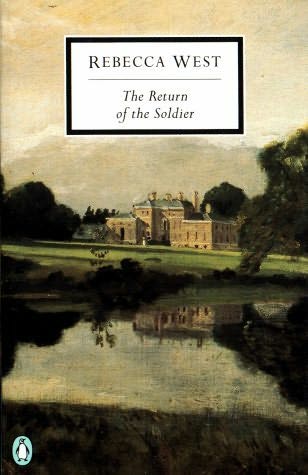
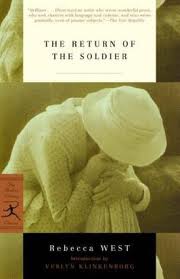
I don’t know if you have noticed the different book covers. I think this is the one I like the most.

Rebecca West: The Return of the Soldier (1918) Literature and War Readalong March

The soldier returns from the front to the three women who love him. His wife, Kitty, with her cold, moonlight beauty, and his devoted cousin Jenny wait in their exquisite home on the crest of the Harrow-weald. Margaret Allington, his first and long-forgotten love, is nearby in the dreary suburb of Wealdstone. But the soldier is shell-shocked and can only remember the Margaret he loved fifteen years before, when he was a young man and she an inn-keeper’s daughter. His cousin he remembers only as a childhood playmate; his wife he remembers not at all. The women have a choice – to leave him where he wishes to be, or to ‘cure’ him. It is Margaret who reveals a love so great that she can make the final sacrifice.

The Return of the Soldier is unusual because it has been written by a woman and during the war. But it is also unusual in its treatment of the war. Although a tale that takes place on the home-front, the horrors of the war in the trenches shine through constantly.

The novel is a first person narrative,  told by Jenny, Chris’s cousin. It opens on a domestic scene showing Kitty, Chris’ wife and Jenny together in the nursery. We learn immediately that the child who lived there is dead and we also learn a lot about the very different characters of these two women. Kitty is not easily alarmed even though they haven’t heard from Chris for weeks. The very first paragraph shows that she treats the war lightly, does maybe not take it very seriously at all, rather like some adventure, while Jenny is aware of the dangers.

“Ah, don’t begin to fuss!” wailed Kitty. “If a woman began to worry in these days because her husband hadn’t written to her for a fortnight—! Besides, if he’d been anywhere interesting, anywhere where the fighting was really hot, he’d have found some way of telling me instead f just leaving it as “Somewhere in France. He’ll be alright.”

Jenny will tell us later what a very shallow woman Kitty is. Appearances is all that is important to her.

Now, why did Kitty, who was the falsest thing on earth, who was in tune with every kind of falsity, by merely suffering somehow remind us pf reality?

The initial scene is almost idyllic as the house and its surroundings are so lovely and Jenny cannot help but think of how much Chris must miss his life there. Rebecca West is excellent when she describes the surroundings. She chooses words like a painter who tries to get every little shade of what he paints right. Her writing is nuanced and poetical.

The house lies on the crest of Harrowweald, and from its windows the eye drops to miles of emerald pastureland lying wet and brilliant under a westward line of sleek hills blue with distance and distant woods, while nearer it ranges the suave decorum of the lawn and the Lebanon cedar whose branches are like darkness made palpable, and the minatory gauntness of the topmost pines in the wood that breaks downward, its bare boughs a close texture of browns and purples, from the pond on the hill’s edge.

Of the two women, Jenny is the one that brings the war into the novel through her worrying. It is deeply rooted in her consciousness as well as in her subconscious. Her feelings for her cousin are so intense, the identification is total at times and she seems to be the one experiencing the battlefield. Through Jenny we get a clear picture of how much was known on the home-front. In the movie theaters they were shown black and white footage of the front line. To be like Kitty, unaware of the real dangers, you had to be really determined to keep them away from you.

Of late I had had had dreams about him. By night I saw Chris running across the brown rottenness of No Man’s Land, starting back here because he rod upon a hand, not even looking there because of the awfulness of an unburied head, and not till my dream was packed full of horror did I see him pitch forward on his knees as he reached safety—it was that. For on the war-films I have seen men slip down as softly from the trench parapet, and none but the grimmer philosopher would say that they reached safety by their fall.

Into the initial idyll breaks a shabby and elderly looking woman. She is badly dressed and seems of the lowest social class. Both women feel revolted and when they hear why she has come they are quite shocked. Margaret has come to inform them that Chris has been is in a hospital in France and suffers from severe shell-shock. He is amnesic and has eradicated the last 15 years of his memory, believing to still have a relationship with Margaret. The reactions of the two women towards this member of the lower classes is quite disturbing. They almost react as if she was contaminating the house.

Soon after this conversation, Chris is brought back and has indeed lost every memory of his wife and barely recognizes his cousin who is now fifteen years older.

In what follows we see how each of the three women reacts so differently, how each wishes and longs for other things. We learn also about the relationship Chris had with Margaret and why he broke it off and what happened to her after he left her. Despite all this there is no sign of his recovering his memory and finally a doctor is called. At first he isn’t successful but he points out that there may have been a reason why Chris repressed the memory of his marriage. It is only after Margaret suggests to show Chris something that will trigger a strong emotion – in this case things that belonged to the dead child – that he will be able to regain his memory. I the moments before he is shown the baby’s things Jenny is suddenly painfully aware of what a recovery truly means. Should he recover, he will have to go back to the front. In sharp contrast to this, Kitty doesn’t care. She wants her husband to recognize her again, that’s all she cares about. Once the recovery has happened, it’s Jenny again who states clearly what will be.

He walked not loose limbed like a boy, as he had done that very afternoon, but with the soldier’s thread upon the heel. It recalled to me that, bad as we were, we were yet not the worst circumstance of his return. When he dad lifted the yoke of our embraces from his shoulders he would go back to that flooded trench in Flanders under that sky more full of flying death than clouds, to that No Man’s Land where bullets fall like rain on the rotting faces of the dead.

I found it very interesting that The Return of the Soldier can be read in many different ways. Considering the theme of the readalong, I focused on the way she treated WWI but that is not the only topic in this novel. One could also explore the psychological theories or the sociological dimension.

I think The Return of the Soldier is an incredibly subtle and artful novel. The war and it’s horrors are like threads that are woven into the fabric of the story. As a journalist Rebecca West was interested and did report on the war but she was also very interested in Freud’s theories, some of which she has applied in the novel. I think to make of Chris a shell-shocked soldier suffering from amnesia which was not realistic, shows us that she wanted this to be taken symbolically. The psychologist Glen Clifford kindly and eloquently pointed out in a comment on my introductory post that PTSD is characterized by the incapability to forget and amnesia is a very unlikely occurrence.

The three women all symbolize something else and represent different levels of consciousness. Kitty, the wife he has forgotten is the symbol of all the forces that contribute and maintain the class system and the war. She is a typical representative of the British upper class, of those who decide to send  thousands of young men to a certain death. Those who don’t care what is going on “over there”. She symbolizes the unconscious. Margaret on the other hand stands for the working classes, simplicity, those who have to endure what others force upon them. That seems to be pretty much how Chris feels as well. She may be read as the subconscious. Jenny is by far the most intriguing. She moves back and forth between the different levels of consciousness with a capability of seeing things clearly. She is his cousin but thinks and feels rather like a lover. She seems the most authentic, the most emotional, the one who feels what either Kitty or Chris should feel, namely the horror and despair caused by this horrible war and the sadness about the loss of the little boy. It may very well be that the death of the child drove the spouses apart.

I would like to say thanks to Ann Norton from the International Rebecca West Society, for pointing me towards a new critical edition by Bernard Schweizer and Charles Thorne. It contains invaluable material and background information to the book. If you want to have a look at the content here’s the link to the broadview press.

Ann Norton wrote the introduction to the Barnes and Noble Library of Essential Reading Edition.

I am really curious to read what others have to say about this complex novel, be it in a review or in comments.

Other reviews:

Anna (Diary of an Eccentric)

Bookaroundthecorner

Danielle (A Work in Progress)

*****

The Return of the Soldier was the third book in the Literature and War Readalong. The next one will be Carol Ann Lee’s The Winter of the World. Discussion starts on Friday April 29, 2011 .

Araminta Hall: everything and nothing (2011) Social Realism and Psychological Suspense

Ruth and Christian are – just – holding their marriage together, after Christian’s disastrous affair a year ago. But chaos beckons, and when the family are suddenly left without any childcare, Agatha comes into their lives to solve all their problems. But Agatha is not as perfect as she seems and her love for the children masks a deeper secret.

I read a review of this book on Lizzy’s Literary Life and something told me I might like it. And I did. It was one of those super fast reads, a book that I could hardly put down. Really riveting. The only complaint I have is that this is labelled as a psychological thriller. Although there is a part of it reminiscent of Ruth Rendell, it is like a background story and not really very gripping. At least not for me. Still I consider this to be a real page-turner for the simple reason that it captures chaotic family life in so much detail and explores some of the questions and problems parents who work full-time would face. I often enjoy descriptions of domestic life although I don’t live anything that is even remotely comparable.

Ruth and Christian both not only work full-time but overtime many days of the week. They both have careers that seem to absorb all of their energy and when they come home in the evening they face total chaos. The place is dirty, sticky and disorderly, the little girl is screaming constantly and throws one temper tantrum after the other. The little boy, at three, still doesn’t eat properly and drinks from a bottle. The nights are nightmares too. Ruth and Christian fight and when they finally go to bed, the girl starts to scream again. She always wakes at midnight and never goes back to sleep.

At the beginning of the novel Ruth knows she isn’t capable of going on like this. She needs a new nanny. And in comes Agatha. We know from the start that something is wrong with her. She lives in daydreams and lies to her employers and to herself constantly. Something bad has happened in her past, a trauma that she cannot overcome and tries to repress with her imagination.

Family life improves considerably after she has started working for Ruth and Christian. She is super organized and makes Ruth feel deficient. To make things worse, Christian accidentally meets the woman he has had an affair with and starts seeing her for drinks.

Something bad, coming from Agatha, is lurking in the background and we know things will go very awry. But as said, this is completely toned down. I was fascinated by Ruth. Christian was not particularly interesting. Just one of those guys who thinks he has the right to have an affair when his wife is pregnant for the second time and is not that much into him during that time.  Ruth shows every sign of a severe depression and what I found interesting is the fact that this did not start right after she had the first baby but several months later. As if the bubble of enchantment that the little baby brought burst suddenly. From that moment on she struggles. I could feel the exhaustion of that woman and I know that this is very realistic. Women around me have mentioned it. If you are unlucky and have a baby that doesn’t sleep well and you need to go to work every morning… Ruth is a journalist and her work is very demanding. There is always someone waiting to jump into her position should she show signs of weakness.

I also hear the type of questioning very often that Ruth utters. Is it OK to work full-time and have children? Is it OK to have someone else looking after them? I think in the book the problem isn’t only that Ruth works full-time but that both work overtime and that she tries for too long to cope with everything else as well. She is afraid that having a nanny means defeat. And she thinks that women like Nigella Lawson are an example for the fact that it is possible to have and do it all yourself.

There is a strange fascination in seeing people at their most vulnerable, when their masks are down. That’s what made this book so riveting for me. And I think the questions it asks are very important.

I would be curious to hear from anyone who has read it.

This was Araminta Hall’s first novel. I really wouldn’t mind reading the next one too.

Literature and War Readalong March 25 2011: The Return of the Soldier by Rebecca West

There is still plenty of time for anyone who wants to join the Literature and War Redalong this month to get a copy of Rebecca West’s The Return of the Soldier. It is only 90 pages long which makes it all the more feasible. If all those of you who expressed an interest in this book will read along we might be quite a crowd. We will see. There are at least two different paperback editions available. I got the one from The Modern Library with an introduction by Verly Klinkenborg. The other one is a Virago edition with an afterword by Sadie Jones.

Rebecca West’s book is unique as it was published in 1918, before the war had ended. She tells the story of a returning soldier who suffers from shell-shock. I am particularly interested in this topic and curious to compare her handling of it with Pat Barker’s Regeneration trilogy which is for me still one of the greatest books on WWI, shell-shock and the development of the new medical discipline, psychiatry.

I was very surprised to find out that The Return of the Soldier that seems so well-known in the English-speaking world has not been translated into German. The only two of her books that made it into German are Black Lamb and Grey Falcon and The Fountain Overflows.

Rebecca West was only 24 when she wrote this novel but already an acclaimed journalist and women’s rights activist. This isn’t an account of the front line but purely a story that takes place on the home front.

Shell-shock is extremely typical for most WWI accounts. It seems as if there had never been so many cases of shell-shock in any war as in WWI. Psychologists state that one of the reasons for this lies in the trench warfare. Being in the trenches for such a long time infused the soldiers with a deep feeling of helplessness that makes shell-shock much more probable than any othe type of warfare. The moment the soldiers were allowed to leave the trenches and move about shell-shock was far less frequent.

Here is the link to the Rebecca West Society if you want to find out more about the author, upcoming conferences and events.

The Return of the Soldier has also been made into a movie.

Ruth Rendell: The Tree of Hands (1984)

Once, when Benet was about fourteen, she and her mother had been alone in a train carriage and Mopsa had tried to stab her with a carving knife. It was some time since Benet had seen her mad mother. So when Mopsa arrived at the airport, looking drab and colourless in a dowdy grey suit, Benet tried not to hate her. But the tragic death of a child begins a chain of deception, kidnap and murder. Domestic dramas exploding into deaths and murders …threads are drawn tightly together in a lethal last pattern.

I read and reviewed A Judgment in Stone last year and have mentioned how much I liked it. It was one of my favourite reads of 2010. On one of the comment thread’s Guy Savage suggested another book by Ruth Rendell, The Tree of Hands, and that is how I discovered this novel.

I have to emphasize once more what a great writer Ruth Rendell is. This book is different from A Judgment in Stone but also very engrossing. After having read The Tree of Hands I can also see why A Kind of Intimacy was compared to Rendell’s books. The description of the streets and their inhabitants shows a lot of parallels plus the people are equally deranged.

In the Tree of Hands the stories of at least 6 people are interwoven but it is skillfully done and they are all linked together in a logical way. The novel works like those rows of domino stones that have been set up in order to see them fall one by one. The falling down of the first stone makes the others follow. One action in the novel triggers another action and they are all equally fatal and catastrophic.

I was a bit wary at the beginning as Mopsa, Benet’s mother, is said to have a mental illness. Using mental illness as an explanation for a crime is often insufferable to me. But fortunately Mopsa is just the first domino stone. Being totally irresponsible she steals a child without ever thinking of the consequences but then she leaves and lets all the other people deal with the aftermath of his kidnapping.

The book really has a chain reaction at its core and one bad decision leads to another. And it also describes quite a lot of negative, selfish and frankly bad people. What struck me, even though Mopsa is mentally ill and on top of that clearly not a good person, she is by far less deranged than some of the other nasty characters in this book.

One of the main stories is the story of Benet, a young mother and extremely successful writer who lives in a beautiful house in Hampstead. At the beginning of the book her mentally ill and very unstable mother, Mopsa, comes to visit her and her little boy, James. Benet is a very loving mother and James is the most important person in her live.

The second main story revolves around another young mother, Carol, her son Jason and her young boyfriend Barry. Carol is a superficial and unrestrained woman with a flaming temper. At the age of 28 she is already a widow and has three children from different men. Two have been taken away, only the smallest, Jason, is living with her and Barry.

At first the two strands of the story run in parallel until a tragedy happens and Mopsa steals Jason.

I am tempted to write a lot more as there are a few aspects that I find interesting but unfortunately it isn’t possible, it would spoil too much. I can however say that the novel also explores the concept of parenthood and if someone who loves a child dearly might not be a better parent than a biological parent.

Something that struck me in this book is the overuse of the sedative Valium. This dates the book. Surely nowadays people in novels don’t pop pills like sweets and they might not use benzodiazepines as often anymore. This constant use of downers and alcohol is of course symbolical and just underlines that the people in the novel do not want to face any problems or consequences of their actions.

Ruth Rendell’s writing is suspenseful, her characterizations are psychologically plausible and the descriptions of different social milieus spot-on. Do I have to mention that I will certainly read another Ruth Rendell or Barbara Vine very soon?

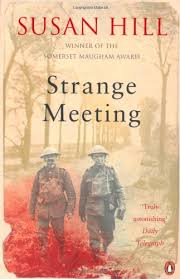
Susan Hill: Strange Meeting (1971) Literature and War Readalong January


John Hilliard, a young subaltern returning to the Western Front after a brief period of sick leave back in England, finds his battalion tragically altered. His commanding officer finds escape in alcohol, there is a new adjutant and even Hilliard’s batman has been killed. But there is David Barton. As yet untouched and unsullied by war, radiating charm and common sense, forever writing long letters to his family. Theirs is a strange meeting and a strange relationship: the coming together of opposites in the summer lull before the inevitable storm.

Strange Meeting, is set in the English countryside and the trenches in France, at the beginning of WWI. The book is divided into three parts. The first is written from John Hilliard’s point of view, the second mostly from David Barton’s and the third could be called the combined one. At the heart of the story is the juxtaposition of two very different themes; the intense and emotionally intimate friendship between John Hilliard and David Barton on the one hand, and the horrors of WWI on the other. The following quotes taken from page 158 illustrate this perfectly well:

“But they (the Germans) must know we are up to something.”

“Oh yes, though that fact is never obvious to High Command, whose faith in the Element of Surprise in the attack is really very touching and quite unshakeable.”

And a few lines later:

“Has it always been like that? Has it always been so easy for you to love people? To get on with them, to bring them out, say the right things at the right time? Have you always made friends as you’ve done out here?”

Whoever is familiar with novels or movies on wars knows that one of these two will die. It is the aim of books and movies on war to show an individual, to pick one person out of an anonymous number and to tell his story. As horrible as it is for us to know that in some offensives – especially in the early WWI ones – far over 100 000 young men were killed in less than an afternoon and millions died senselessly during the course of this war, we still need to be told an individual’s story and not only a huge number, to be touched emotionally. From the beginning of the novel until its end, the shadow of death hangs over these two young people and this is what makes it so touching. We know, one of them is doomed. It’s like a Greek tragedy.

Hilliard and Barton meet in France, during the first summer of WWI, in a bombed out village, away from the trenches and the front line. Hillard has just returned from a short sick leave to England. He is shocked to find his company reduced to a fraction. His commanding officer is drinking and seems to have lost his faith completely.

We lost three quarters of the Battalion in a day and a half. Getting on for two dozen officers. Mayor Gadney, young Parkinson, Ward – all the best. Half of them went because we didn’t get an order telling us the second push was cancelled. They just went on. You were well out of it. I’m glad you were out of it.

But Hilliard’s stay in England was horrible too. He couldn’t sleep, had no one to talk too. He showed signs of  shell-shock, only not enough to not return. The mindless cheerfulness of the people around him who had no idea what it was like to be in the trenches was unbearable. They did neither realize how useless the losses were, nor how futile the missions. The newspapers only gave a purified version and people everywhere were convinced, the war would be over by Christmas. Hilliard was suffering from this feeling of isolation and haunted by the images and smells that were stuck in his mind. He found the smell of roses revolting, the sweetness reminded him of the smell of dead bodies. He would have liked to talk to his sister, the only person from his family he felt close to, but finds her estranged. She is about to get married and he doesn’t approve of her choice until he realizes, there is really no one else left, most other young men are dying in France.

When he returns to France and finds out that most of the men of his company are dead, he also hears that there is a new guy that he will share his quarters with.  They don’t meet directly at first, instead we follow Hilliard into the room that they will share and discover Barton through his things.

The lettering (on the valise) was upright and plain and clear, done in black ink. The leather of the valise still shone, the buckles were not yet tarnished. There was a tortoise-shell backed hairbrush and comb and a slab of chocolat Meunier. A copy of The Turn of the Screw and of the complete works by Thomas Browne, and one of the Psalms, bound in navy morocco. Hilliard reached out a hand towards it, hesitated, drew his hands back.

This passage tells us such a lot in a few words. The new guy is still untarnished, naive, it seems he has prepared himself for a summer camp. Hilliard resents this at first but when he finally meets Barton and gets to know him, he understands that Barton would always have packed the same things, no matter where he would have gone. His belongings mirror his being and how he always tries to see the sunny side of things and make the best of it. Hilliard has never met anyone like Barton. He is cheerful, easygoing, open, direct and very communicative. Even though he is reluctant at first, Hilliard is swiped away by Barton’s exuberance. For the first time in his life he starts to open up to another person and speaks about himself and his feelings.

Part II is mostly told from Barton’s point of view and consists in large parts of letters home to his family. Barton writers the longest letters Hilliard has ever seen. This strikes him as his family sends expensive parcels but short, polite and distant notes.

The two friends are not at the front yet, Barton will still have to find out what life in the trenches is like but he already sees someone killed and feels responsible for the man’s death.

There is something all the men hate about this place. Now, I can sense it myself. Something old and bad and dead, a smell a feeling you get as you walk across the street. It is not simply the bodies lying all about us, and the fact that the guns are firing, it is something else, something…

Part III is set in the trenches and we see a considerably changed and disillusioned Barton who has been sent on a reconnaissance mission on which he has seen people get killed. They know by now that High Command prepares for a big offensive. Since most of these are high in losses their morale is low. Being the new guy,  Barton is sent on several reconnaissance missions without Hilliard who goes almost crazy when he imagines Barton might get hurt or killed. When the offensive finally begins the two friends are separated in the chaos and one of them dies.

Strange Meeting does an incredible job at rendering what it was like to be in France in the summer of 1914. It captures the difference between the relative luxury encountered by the companies who wait off the front line and the ugliness and ordeal of the trenches. Susan Hill describes all the details that we can also find in history books, memoirs and letters. She describes various elements that were typical for WWI, the futility and high losses of the offensives, the chaotic and bad planning, the underestimation of the situation and possible duration of the war. The trenches are rendered accurately. Once they are there we read about the constant shelling, the noise, the rats, the mud, the dirt, the stink, the wetness and the cold.

As accurately as she renders the dreary trenches and the sadness and futility of it all, it is not surprising to read the following in her afterword:

Yet I have not told the whole truth, for although I have accounted for my obsession with the First World War, I am still sometimes troubled by thoughts of those two young men of whom I became so very fond while I was writing about them and who stand for thousands upon thousands of others, so full of youth, strength and bright promise, who were slaughtered in a war perhaps more futile and meaningless than any other in history. I wrote the novel in memory of them and in tribute to them. But I hope it is not thought of only as a novel whose “subject is the war and the pity of war”, for, more than anything else it is about human love.

Srange Meeting is indeed a novel about friendship, much more than about the war. The war serves as a backdrop and an explanation for this very intimate exchange. In civilian life, men were not this close, opening up would have taken much longer. Strange Meeting excels in rendering the intensity of the feelings of two people for one another and the tragedy of their fate. As strange as this may seem, although the description of their feelings for each other can only be called love and Barton does also tell Hilliard that he loves him, I never had the feeling they were gay. Apparently Susan Hill has been asked if Hilliard and Barton did have a physical relationship and she denied this. As said this never occurred to me either. It is really about emotional love. It is sad that we immediately have to think that there must be some sexual attraction involved as soon as two people have very strong feelings for each other.

I read somewhere that it wasn’t possible to say if Strange Meeting had been written by a man or a woman. I would contradict this. I think we can feel that it was  written by a woman. This is mostly due to Barton’s narrative voice and the nature of their conversations. They constantly ask each other how they feel, speak out everything, clarify, share their emotions.

I think Strange Meeting is  a beautiful novel about a unique and fateful meeting that took place during one of the darkest moments of European history.

What did you think?

Other reviews:

Anna (Diary of an Eccentric)

Danielle (A Work in Progress)

*****

Strange Meeting was the first book in the Literature and War Readalong. The next one will be Jennifer Johnston’s How Many Miles to Babylon. Discussion starts on Friday February 25, 2011 .