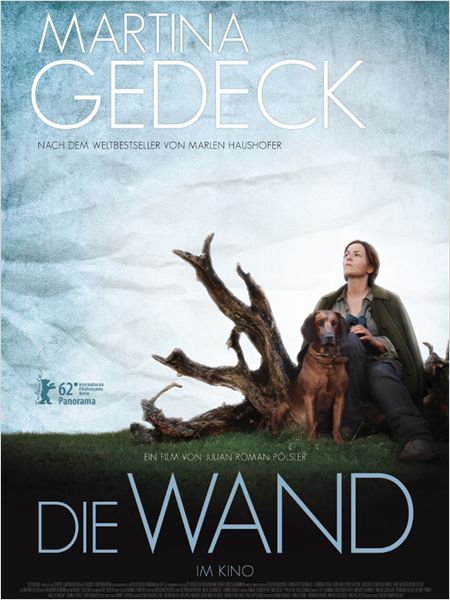
The Wall – Die Wand (2012) World Cinema Series – Austria

Die Wand

Reading Marlen Haushofer’s Die WandThe Wall was one of the most profound reading experiences I’ve ever had. Weeks after I finished it I was still haunted by the story and urged everyone to read it as well. Over ten  years later the book is still in my mind as if I’ve read it yesterday. The story of a woman who is invited to a lodge in the Austrian forest and finds herself cut off from the world by an invisible wall made an incredible impression on me.

At the beginning of the story the narrator’s friends go back to the village just after their arrival. When they do not return, she goes to bed. When she wakes she expects to find them but they have not returned. She decides to walk to the village and find out what has happened. On the way she dashes into an invisible wall. She will find out later that the wall forms a circle around her and a relatively large forest and mountain area. The few people she sees outside of the wall look frozen in time. Obviously they are dead.

It is immediately clear to her that there is no escaping her condition and that, with the exception of a few animals – a dog, a cow and a cat – , she is completely alone. At first this is so overwhelming, that she thinks of killing herself but then, feeling responsible for the animals, she pulls herself together. After a time of adjusting, learning to survive, hunting, gathering and planting, she becomes self-sufficient. She even loves to be alone with her animals and so close to nature. She becomes one with the nature around her.

One day she feels that something is wrong. At first it’s just a hunch, then she finds signs. She might not be alone after all.

Marlen Haushofer did an amazing job at showing us that being alone may not be the worst. The end of the book is harrowing.

When I saw that The Wall has been made into a movie, starring one of my favourite actresses, Martina Gedeck, I had to watch it.

The Wall is an amazing film and Martina Gedeck does an astonishing job. She’s almost the only actor in this film and most of it is narration.

The movie is as harrowing as the book, maybe even more so. Plus it adds spectacular images of the Austrian mountain region.

The book and the movie explore the human condition and the curse it harbours. Humans are not only the only beings to be aware of death but they are also the only ones capable of evil. Book and movie say a lot about the relationship between humans and animals. The profound friendship that can arise, as much as the horror of having to kill animals if you want to survive.

While I loved the film, I think it’s not easy to watch if you’re not familiar with the book and not a very literary person as there isn’t much action but a lot of narration instead. The protagonist tells at the beginning of the film that she writes down everything that has happened to her in order to stay sane and so we see everything and hear the voice describe her thoughts and feelings at the same time.

As I said, it’s a harrowing book and some of the very sad things that happen affected me even more when I watched the movie. Still it’s excellent, very philosophical and profound.

I found an English trailer which puzzled me a bit. It’s not dubbed. It seems the movie is available in two version, one in which Martina Gedeck speaks in German and one in which she speaks English. I think they chose this approach as a subtitled version would be very tiring as she speaks almost constantly.

The book will be reissued this summer. Unfortunately with a really awful cover. I find it sad that they used a cover like this and that’s why I would like to emphasise that The Wall is a classic of Austrian literature, not some dystopian YA novel. (As you know, I personally like YA literature, but I think there is a huge difference between this literary novel and a YA novel.)

Don’t miss watching this stunning film or reading the book.

The review is part of the World Cinema Series 2013 and Foreign Film Festival 2013.
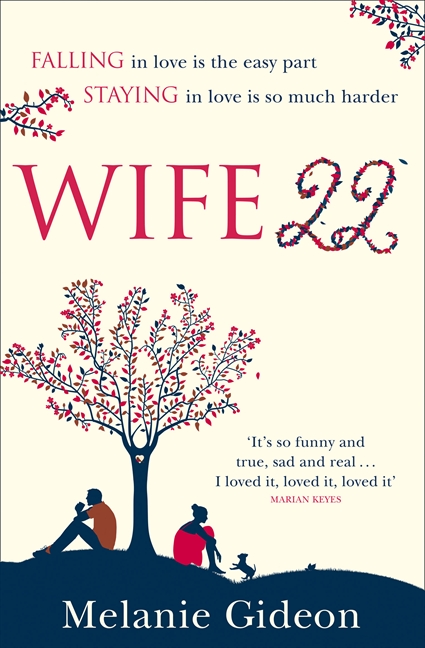
Melanie Gideon: Wife 22 (2012)

9780007425501

Maybe it was because I was about to turn the same age my mother was when I lost her. Maybe it was because my husband and I were running out of things to say to each other. But when the online study called “Marriage in the 21st Century” showed up in my inbox, I had no idea it would change my life. It wasn’t long before I was assigned both a pseudonym (Wife 22) and a caseworker (Researcher 101). And, just like that, I found myself answering questions. Before the study, I was Alice Buckle: wife and mother, drama teacher and Facebook chatter, downloader of memories and Googler of solutions. But these days, I’m also Wife 22. And somehow, my correspondence with Researcher 101 has taken an unexpectedly personal turn. Soon, I’ll have to make a decision—one that will affect my family, my marriage, my whole life. But at the moment, I’m too busy answering questions. As it turns out, confession can be a very powerful aphrodisiac.

Sometimes you read a book but are not in the mood to write a proper review. Either because it didn’t live up to your expectations or because you waited too long and can’t do it anymore as it’s getting blurred. Still you’d like to write about it as it might be just the thing for someone else. Wife 22 is one of those books.

I’m not going to summarize the novel, the blurb will tell you enough of the story.

My final thoughts

I bought Wife 22 on a whim after having read the first few pages on amazon and thought it was really funny. I’ve never read a novel in which the way many people live these days was portrayed like this. The main characters constantly check their Facebook accounts, use google to look up everything, which is on their mind, their ailments, their hobbies. We learn a lot about the main character from seeing her google “hooded eyes”, “marital crisis”, and similar topics and in reading the answers to the questionnaire. Quite an original approach.

I quite enjoyed the first 150 pages. It reads like a mix between Love Virtually and the diary of an older Bridget Jones. The main character is endearing but the end underwhelmed me big time. If you are just looking for an entertaining, witty and very topical look at married life, this may just be your thing and possibly you’ll like the ending. (Let’s put it like that – I was waiting for something a bit wilder.) Personally I think it’s one of those books you can read but don’t have too, still, the right reader will love it.

A tip –  should you want to read it – the questions of the fictional questionnaire are at the back of the book. Many readers didn’t notice that. It’s fun to just read the answers and wonder what the question was but occasionally it reads like a riddle.

Melanie Gideon is the author of the memoir The Slippery Year: How One Woman Found Happiness in Everyday Life in which she writes about many of the topics raised in Wife 22 focussing on her own life.

Have you read Wife 22 or Melanie Gideon’s memoir?

Fumiko Enchi: Masks – Onnamen inaudita (1958)

Masks

Mieko Togano, a highly cultivated, seemingly serene, but frustrated and bitter woman in her fifties, manipulates for her own bizarre purposes the relationship between her widowed daughter-in-law and that woman’s two suitors.

I just finished Fumiko Enchi’s Masks. Enchi was one of the most important Japanese women writers of the so-called Shōwa period (reign of Emperor Hirohito). The role of Japanese women was an important aspect of her work. Most of her figures are still old-fashioned, very obedient, even subservient figures. Nevertheless they try to fight their oppressors, sometimes, like in Masks, using rather unusual methods.

Masks is a mysterious novel. Looking at Masks superficially you could call it the tale of a vengeance. It’s a dark, mean, unfathomable story. The German edition I’ve read even calls it a crime story. A very unconventional crime story. Although nobody commits a murder, I was reminded of the work of Boileau-Narcejac, notably The Fiends – Diaboliques.

Mieko is a widow and a famous poet. She lives together with her equally widowed daughter-in-law, the beautiful, young Yasuko. Ibuki, one of Yasuko’s suitors, suspects the relationship to be sexual. The two women are very close. Yasuko pretends, she wants to break free but doesn’t make any attempts to change her situation.

Yasuko continues her late husbands studies of possession and necromancy. The two women, together with Ibuki and Mikame, form a literary and spiritualistic circle. Ibuki, a professor of literature, and Mikame, a doctor who dedicates his free time to anthropological research, are both specialized in the belief in ghosts and possessions.

Both men are attracted to Yasuko and feel as if they were under a spell. The mysterious thing however is that it’s not Yasuko who cast the spell but her mother-in-law Mieko.

Later in the book we learn a lot about Mieko’s tragic life and how badly she had been treated by her late husband. Her role as dependent wife who was at the mercy of a cruel man, turned her into a vindictive woman. The only man she really loved was her son Aiko, Yasuko’s late husband but he died on mount Fuji.

The story of her vengeance is pretty uncanny and the end is more than a little surprising. Both men are used like puppets and one of them pays a considerable prize for getting too close.

The novel bears great similarity with a black and white painting on which just a few, small details are highlighted in colour. The story and the people are black and white, with some shades of grey, while the descriptions of nature stand out in a most descriptive and colorful way.

What I loved about this book was the combination of many different aspects. It combines dark erotic elements, beautiful small descriptions of nature, a fascinating story and a complex symbolism. Many aspects of traditional Japanese culture like the No-Masks, the Tale of Prince Genji, the firefly festival and many more, build an interesting backdrop.

Masks is a haunting book, full of mystery, darkness, beauty and with an ending worthy of a psychological thriller. I’d recommend it to anyone who likes Boileau-Narcejac, as well as to the fans of Yoko Ogawa.

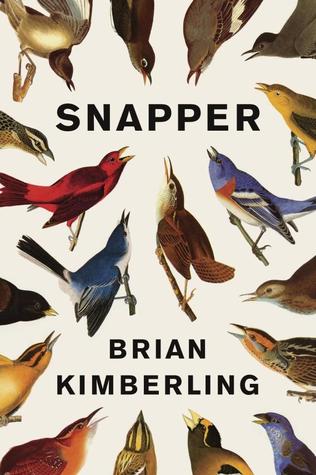
Brian Kimberling: Snapper (2013)

Snapper

Nathan Lochmueller studies birds, earning just enough money to live on. He drives a glitter-festooned truck, the Gypsy Moth, and he is in love with Lola, a woman so free-spirited and mysterious she can break a man’s heart with a sigh or a shrug. Around them swirls a remarkable cast of characters: the proprietor of Fast Eddie’s Burgers & Beer, the genius behind “Thong Thursdays”; Uncle Dart, a Texan who brings his swagger to Indiana with profound and nearly devastating results; a snapping turtle with a taste for thumbs; a German shepherd who howls backup vocals; and the very charismatic state of Indiana itself. And at the center of it all is Nathan, creeping through the forest to observe the birds he loves and coming to terms with the accidental turns his life has taken.

Snapper was one of the books I took to Morocco with me. I ended up not reading that much. It was impossible. I read on the plane and a little bit in the evenings but that was about it and the only book I could properly concentrate on during those moments was Catching Fire. I started Snapper but reading about Indiana in a country like Morocco seemed weird. As soon as I was back I continued reading and finished it in one sitting.

Snapper is one of those books that needs reviews as the blurb is misleading and might attract the wrong people while those who would enjoy it don’t even think about getting it. A quick look at the us amazon site confirmed this.

Snapper reads more like a series of vignettes and episodes than like a novel. Most of the times I had a feeling I was reading a memoir in the vein of Midnight in the Garden of Good and Evil. Once past the surprise to find a very unusual novel I enjoyed reading it a great deal as the voice is wonderful. It’s not as hilarious as the jacket cover promises but it’s amusing.

The stories all take place during the narrator’s childhood and early adulthood and end when he meets his future wife and becomes a father.

The book is as much about Indiana as it is about the narrator. The chapters jump back and forth in time, some characters like Lola the woman he’s in love with and Shane his best friend return, others only play a role in one story.

Nathan studies birds, that’s why he spends a lot of time outdoors. But even as a kid he loved to be outdoors and we get a lot of great descriptions of the flora and fauna of the place. What makes it funny is that Kimberling lets Nathan link the wonderful outdoors with criticism of poaching, carrying guns and many other topics. The stories he tells are funny anecdotes, descriptive evocations of a place but there is always a deeper meaning there as well.

I enjoyed Snapper a great deal. I think it is a wonderful book, entertaining, witty and told by a very endearing narrator with an original voice. Just don’t expect a traditional novel.

Here’s an example to illustrate Nathan’s voice

I doubt anyone outside Southern Indiana knows what a stripper pit is. They don’t exist anywhere else. This is sometimes embarrassing for me in conversations, if I say I spent many happy adolescent hours there. People think I’m talking about Thong Thursday’s at Fast Eddie’s. The British Broadcasting Corporation once sent a reporter by boat to Eansville to investigate the wild ways of the inhabitants – the kind of thing they used to do in “deepest Africa”, I think. We are Hoosiers after all.

On a technical level a stripper pit is what remains of a bituminous coal mine, but strip mining is not like other mining. Picture vast granite cliffs with coniferous trees, deep lakes of calm cerulean blue – imagine a majestic Norwegian fjord somehow misplaced among rolling cornfields -that is what a stripper pit looks like. At the bottom of those lakes you’ll find old refrigerators and stolen cars and bags of kittens. It is Southern Indiana.

Thanks a lot to Pantheon and Schocken Books for a review copy.

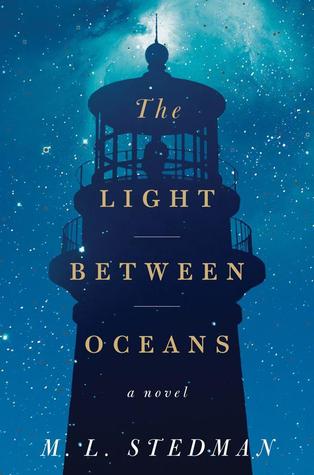
M.L.Stedman: The Light Between Oceans (2012)

The Light Between Oceans

A boat washes up on the shore of a remote lighthouse keeper’s island. It holds a dead man – and a crying baby. The only two islanders, Tom and his wife Izzy, are about to make a devastating decision.

They break the rules and follow their hearts. What happens next will break yours.

Last week I went to a book shop and saw a neatly arranged table with the titles of the long list of the Women’s Prize for Fiction. I read most blurbs and browsed a few books and finally ended up buying The Light Between Oceans.

Tom and Izzy live on an island off the Australian coast, near Point Partageuse. Tom is haunted by memories of WWI. The things he saw, the men he killed. He was reluctant at first to let Izzy come closer, didn’t want to take this young lively woman with him on a forlorn island. While he loved being a lighthouse keeper, didn’t mind the loneliness and how barren the island was, he was not so sure it would be the right place for a woman. But Izzy loved him and wanted to follow him.

Their first months on the island are bliss but when Izzy loses her first baby things start to darken. When a boat with a dead man and a little baby are washed ashore, Izzy has just miscarried for the third time. Seeing the tiny infant makes her loose perspective and she convinces Tom that it is the right thing to keep the child. Of course it isn’t the right thing and the tragedy is programmed. The book has a handful of main protagonists and it’s amazing to watch one after the other make bad decisions.

I have to tell you right away, I didn’t like this book. To some extent I even hated it. It’s sentimental, melodramatic, mawkish… I’m maybe the only one as most people loved it. I was wondering why on earth this was on the Women’s Prize for Fiction long list. The writing is quite artless. I expected something more sophisticated. There is nothing stylish or special about it. It’s the type of book Jodi Picoult could have written, only I’d say she would have done a better job. The exploration of a moral dilemma, what is right, what is wrong, make this a book many book clubs will love to discuss.

I have this habit that I must finish books and it annoys me often. On the other hand, even this book improved on the last 150 pages. The first choice they make is to keep the baby but later Tom and Izzy and a few other people make other choices and some of those are much more interesting.

What made me hate the book was Izzy and the way everyone spoke about and to the baby: “Sweet thing”, “Sweetheart”, “Little one”, “Darling”…. Every character in this book is constantly cooing over the child. That got on my nerves big time.

What I liked was how she evoked this lonely lighthouse. We get a really good feel for what it must be like to be a lighthouse keeper, to be confined to an island for 3 – 6 months without any contact with the outside world.

While I hated Izzy, I really liked her husband Tom. The portrayal of a man who has survived the trenches of WWI but never manages to shake this experience was well done.

The only thing that was very positive is the fact that M.L.Stedman made me understand Izzy in the end despite the fact that I hated her big time.

It was very interesting to see my reaction. Usually – and contrary to many readers – I don’t love or hate characters in books. The things I love are descriptions, style, atmosphere, mood. The experience to hate a character was unsettling. I wonder what it says about me that I reacted so strongly. The idea that someone thinks it’s OK to steal  someone else’s child and keeps on saying it’s for the child’s good, made me so angry. I thought it was a very violent act. 

If you like books which explore moral dilemmas and choices, you might like this. It’s certainly a book that can generate interesting discussions.

Halfway through the novel I noticed that it consists almost exclusively of scenes. No wonder the film rights have already been sold.

Has anyone else read this book? Did you like it?

A Day in Lion Feuchtwanger’s Life – On Klaus Modick’s Sunset (2011)

Sunset

Apologies for using this misleading title. Sunset is the German title but, unfortunately, it hasn’t been translated yet.

Klaus Modick is a German author whose books regularly win prizes. He is also well-known as a translator of English and American books. John O’Hara and Nathanael West are a few of the authors he has translated. He wrote his PhD on the Jewish German writer Lion Feuchtwanger and frequently returns to him in his writing.

Sunset tells about one day in Lion Feuchtwanger’s life. Using flashbacks and memory tags, we are given insight into his life, an era and his lifelong friendship with Bertolt Brecht.

It’s a day in 1956. Feuchtwanger is alone in his home in Pacific Palisades. His wife is out of the house for the day. In the early morning he receives a telegram. Feuchtwanger is the last of the great German authors who is still living in California. During the war a lot of them stayed here. The Manns, Brecht, Werfel, Baum… Feuchtwanger was the most successful one, the one who made the most money. His house in Pacific Palisades is a huge villa. Unlike most others he doesn’t want to return to Germany. He thinks of his home country, of his childhood, he misses using the language and the snow and many other things but he loves the US and the Germany he once knew, is gone anyway.

The telegram he receives informs him of Brecht’s death. What a shock. Not only does he lose his best and maybe only friend, he is reminded of his own mortality. He is 16 years older than Brecht, it should have been him first.

The book then moves back in time and describes how the two met in Germany, how Feuchtwanger became the young Brecht’s mentor, how he knew immediately that he met a genius.

The beauty of the language struck me from the very first sentence. Modick uses images sparingly but to great effect.

In the inner courtyard the roses wither in tired opulence. It almost looks as if they were bleeding to death.

or

The smell of paper and dust wafts through the open door of the salon. The ink of the night trickles from the east into the fog.

Modick uses one day in the life of Feuchtwanger to unfold a whole life, exploring various different aspects and themes. Feuchtwanger’s books are infused with stories from his life. The daughter who died barely one year old, things people say, characters, such a lot is taken from his life.

He loves the US but like so many others he is scrutinized by the McCarthy government, suspected to sympathize with Stalin.

An early memory haunts him on the afternoon of the telegram. As a child, on an excursion with the whole family, Lion fell into a swamp. He was scared of drowning, cried for help but nobody came to his assistance, neither his parents, nor any of his eight siblings. They only laughed. This episode points to a recurring theme in Feuchtwanger’s life – being ridiculed. People like Thomas Mann and many others envied him his whole life and tried to mask this with mockery.

The friendship with Brecht is peculiar. They are so different but influence each other. Brecht has ideas, Feuchtwanger money and discipline. They often work together. They share a passion for women; both are adulterous men.

Towards the end of his life, writing is what keeps Feuchtwanger going. He writes one long novel after the other. After his prostate operation there is not much more left, he thinks. Passion is gone. And now Brecht is dead. But he doesn’t despair. He works out, works hard on his novels, enjoys life, loves the US and still hopes for citizenship.

Modick let’s us experience the way Feuchtwanger wrote – collecting ideas, noting down dreams, fleeting thoughts, images, symbols – nothing is lost, everything kept in notebooks. It takes a long time until he captures the perfect sentence, the perfect description. He approaches his work slowly, using information, memories, dreams.

Modick is a translator. It isn’t surprising that language is important in the book.Feuchtwanger mediates on language. On how you can translate things but they still don’t mean the same . The German word “Eisblume” which haunts him on this afternoon is a good example. In English “Eisblume” means “frost pattern” but literally “Eisblume” means “flower of ice”. A world of difference.

Modick paints the portrait of an interesting man. Successful and proud of it, yet modest and incredibly kind and generous. Without Feuchtwanger’s money many an author would have suffered greatly. Yet most of them didn’t even know the money came from him.

I have been fascinated since years by the German writers who escaped Germany and fled to California. The names in the novel are illustrious. Not only the German ones. Feuchtwanger knew them all, the actors, film makers, studio bosses. The German authors were all hoping to make money in Hollywood but that didn’t happen for most. Brecht and many others failed. Feuchtwanger regularly sold the movie rights to his books but they were hardly ever made into movies.

Feuchtwanger was a passionate collector of books. He first collected books when he was still in Germany but those were confiscated and probably burned by the Nazis. In his French exile he started another collection, most got lost when he fled. Finally in the US he started again and when he died he owned far over 30,000 books.

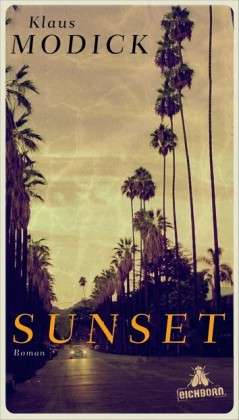
Sunset is a wonderful title for a book which describes the evening of the life of a writer and an era which is long gone. It is infused with the fading light of a dying sun, sinking slowly into the ocean. The title is perfect and so is the German cover with its sepia photo.

Modick is compared to authors like Grass, Lenz and Walser, it’s easy to see why. It is a real shame he hasn’t been translated.

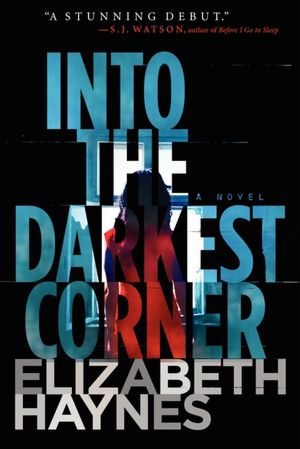
Elizabeth Haynes: Into the Darkest Corner (2011)

Into_the_Darkest_Corner

I just finished Elizabeth Haynes’ first novel Into the Darkest Corner and for once I can see why it was such a success. It’s gripping, interesting and exceptionally well crafted.

Usually I’m not keen on books which contain so many chapters and follow two different timelines but maybe that was just because I haven’t seen it done this well before. Elizabeth Haynes manages to cut the storyline without ending on a cliffhanger but still keeping the reader interested. It’s a page turner but not one that manipulates and forces you to rush through but one that allows you to read at a steady pace.

The novel starts with the transcript of a court room scene, switches to 2001 where a murder is committed and then moves to 2003 – 2005, adding a second timeline 2007/2008.

At the beginning of the novel, in 2003, 24 year-old Cathy lives in Lancaster and is a real party animal. She is out every night, drinks far too much, wakes up with strangers, and repeats the very same thing the next day. On one of these nights out she meets the dashingly handsome Lee. Soon she is in a relationship with him and at first it seems to be very good for her. She doesn’t go out as much anymore, drinks a bit less. Unfortunately Lee is very possessive, domineering and plays odd games. What is even more unfortunate is the fact that nobody believes Cathy. The Lee  the world sees is kind and loving. Nobody knows what a master manipulator he is.

In 2007 Cathy lives in London. She suffers from OCD and panic attacks. She spends almost all of her free time checking her door, her windows, drinking tea at specific times, made a specific way, avoids places and colours. It’s her anxiety and her panic attacks which trigger the OCD, the more she’s afraid, the more she needs checking. When Stuart, a psychologist, moves in, it’s obvious for him right away that Cathy suffers from PTSD. It will take all of his patience and understanding to get to know her and help her.

What happened to Cathy? How did she become like this? Will she be able to heal? These are some of the fascinating questions the book asks and answers. The description of panic attacks and OCD is amazingly realistic. I’ve never seen this described so well.

We know early on that Lee is in prison and that he will be set free soon. When this happens, the book turns from a psychological study into a fast paced thriller with a great ending.

As far as thrillers go Elizabeth Haynes has done everything right. Main story, back story and side stories form an organic whole. I was for example wondering for far over 100 pages why on earth Cathy was behaving in such a self-destructive way even before she meets Lee and was pleasantly surprised that this question is answered later in the book.

If you are looking for a gripping thriller, you might enjoy this. If you are interested in OCD and PTSD and how they can be treated, you might like this a great deal as well. I feel I need to mention that the book is quite violent in places.