“This book has scarred me for life” or On the Negative Impact of Books

When I was younger I believed that books could change your life. To the good or the bad. My belief in the power of the word was almost infinite.

I suppose this belief in the power of books lies behind censorship, banned and burned books and the like. I also suppose that each of the parties banning, burning or forbidding books have different reasons. I personally think very little of banning books. I still belive in their power though.

While reading Nick Hornby’s House Keeping vs The Dirt I was reminded of this when he mentioned he bought Georges Bernanos’ book Journal d’un curé de campagne or The Diary of a Country Priest due to a negative amazon review. He posted the review but the way he wrote about it made me think, he made it up. Being the curious person I am, I checked and to my amazement there it was. On amazon.co.uk

1.0 out of 5 stars Dont read this book, 17 July 2003
By A Customer

This book has had an enormous impact on my life. Having had to read it as part of my French A level course (in French!)it left me psychologically scarred. Grinding through each passage was like torture, making me weep with frustration and leaving me with a long-burning and deep-felt resentment against my French teacher and the A level exam board. This resulted in a low grade for my French lit paper, which offset a decent language paper, resulting in a ‘C’ which wasn’t good enough for my chosen university. So I had to switch from French to business studies, so changing the course of my life. To say I detest this book is an understatement. So he’s dying, but the main protagonist is a drearily introspective little creep. The pace is crawling and the whole vibe simply turgid.

Is he really serious? I don’t know but it made me think of books that had a negative impact in my life and I found three. One was a one of my parents’ books. A short story collection with illustrations by Japanese painter Hokusai. I think it was relatively valuable and I was forbidden to touch it. Like Bluebeard’s wives,  I disregarded the interdiction and opened the book. Finding the book with wide open pages  – I had run off to hide – told my parents later that I had been at it. I don’t think I was punished. It wasn’t necessary as the drawings had terrified me enough. The ghostly figures haunted me in my dreams. Mind you, the drawings, not the text. I was too small for reading.

But what about the written word? What about stories? Have there been books that had a huge impact? Yes, I would say so. I have read two books as a young teenager that had a profound impact. I think they managed to take away my innocence forever. Maybe it was about time. The world isn’t a perfect place and there are a lot of bad things happening, the sooner you face it, the better. While I know why the first one had such a negative impact, I’m not so sure about the second anymore.

Choderlos de Laclos’ famous epistolary novel Les liaisons dangereuses or Dangerous Liaisons (1782)  was the book bomb that blew up in my young girl’s life. Before reading it I had thought that people fell in and out of love, unfortuntely often not at the same time which could cause great heartache but that was about the most negative I was aware of. That someone could pretend to be in love, to manipulate and deceive in order to achieve something was a concept that was utterly new to me. New and deeply shocking. I remember I was really depressed and became quite mistrustful. There is also a make-believe friendship in the book which meant you couldn’t even trust friends. Once your eyes are open you start to see and my teenage self became aware of similar things happening around me. In the end I was glad I had read Les liaisons dangereuses. Better to learn from a book than through pain and heartache. I must add as well that I loved this book. I was shocked and depressed but also fascinated and amazed by the story.

The second book was not a novel but a philosophical text by Julien Offroy de La Mettrie. The idea that we are just machines acting and reacting, not much different from a robot, as he described it in Machine Man – L’homme machine (1747) – depressed me incredibly. After having read it, life felt quite pointless for a while and I had to come to the conclusion that he was maybe just plain wrong, before I could enjoy it again.

I wonder if it’s a pure coincidence that all the examples which had a negative impact on my life are from the 18th century? And three of the four examples are French books.

Luckily some books have had a very positive impact but that will be the topic of another post.

Have you ever read a book which had a major impact? And what do you think about banning books?

Dangerous Liaisons (Penguin Classics)

Suzanne Collins: The Hunger Games (2008)

I bought The Hunger Games long before even part II and III were out but never read it. Too much hype. Not that there is less of it now but I’d like to watch the movie and figured, I should read the book before. I finished it in barely two sittings and even spent one night dreaming of it.

I went through a few different phases while reading it and finally I had to admit that a lot of the problems I had with the book were entirely mine and resulted in some misconceptions. Sometimes we expect something from a book or a movie that isn’t there. I’m not the only one, I saw this reflected in a few of the reviews I’ve read so far. This isn’t a poetical fantasy story, nor a subtle YA coming-of-age novel. The Hunger Games is a dystopian adventure/action story. Following the logic of adventure and action movies and books, there isn’t a lot of introspection. Switching from Virginia Woolf’s world of characters with a rich inner life, I felt a bit lost at first but once I saw the book like a new take on an old theme, namely gladiators in a dystopian setting, I started to enjoy the ride.

A modern-day gladiator novel is pretty much what The Hunger Games is. When you’ve learned Latin in school you are familiar with the expression “Panem et Circenses” meaning “Bread and Games/Circuses”. The story plays in a distant future, in America, in the country of Panem. There are a lot of other elements taken from roman history: the Capitol, some of the names like Octavia, …

The 24 tributes of the 12 districts of Panem, 12 boys and 12 girls are sent into an arena where they fight against each other until there is only one survivor left. The games are not only shown on TV but they must be watched. The questions the book could have asked but only brushes is “Would you kill to survive?” and “How does it affect you to be forced to witness killing on a regular basis?” or “Are these killings murder?”.  The book can lead to this type of discussion but it doesn’t really look into those questions at all.

Katniss, the main character, volunteers in order to save her sister. She prays that her best friend Gale isn’t going to be sent in with her. Since there can only be one survivor it would mean she might have to kill her best friend. The boy chosen instead, Peeta, isn’t a much better choice as he saved her life once. She can only hope that either she or Peeta will be killed by someone else before the last fight.

The arena is a vast landscape with forests and lakes, bushes and caves. The game masters can change the weather, they can send wild animals, ice and storm, fire and frost. This adds to the difficulties. Only those who are skilled in all sorts of survival techniques, those who know how to hunt and hide will make it.

It is a quick read and I was captivated, not so much because I wanted to find out who will survive, no, there was no suspense in that department. It’s pretty clear from the start but it isn’t clear how they will survive. And I was interested to see whether Katniss would have to kill someone as well. And if and how it would affect her.

The Hunger Games is a page-turner, exploiting and re-inventing the gladiator theme, with some surprising ideas thrown in but I still have a few reservations.

Did there have to be a love story and did it have to play such an important role? I’m not going into details as that would be a major spoiler.

And the writing? That was a problem. I’m not a native English speaker and can be more tolerant occasionally but nothing could make me miss the fact that it’s not very well written. There is a constant use of present tense, hardly any subordinate clauses, a very limited vocabulary and a lot of repetition. I’d like to emphasize here that this isn’t typical for YA novels or dystopian novels. I’ve read several that were very well written.

As I haven’t read Battle Royale, I can’t compare but the violence in The Hunger Games is minor. Nothing very shocking. It’s more the thought that they are so easily ready to kill each other that is shocking.

I think, if you know what to expect, you will enjoy this novel as it is fast-paced, captivating and I personally liked the main characters. Just don’t expect anything poetical or introspective. The emphasis is on action not on ideas or feelings.

Will I read the next one? I have already started.

If you would like to read other reviews here is the link to Iris’ very interesting post. She has included a huge number of other reviews.

Ferdinand von Schirach: Crime – Verbrechen (2009)

Are they true? Are they not? The discussion of Ferdinand von Schirach ‘s stories circled to a large extent around these questions  in Germany  and what the respective answers might mean. For the book. For life. And human nature in general. In English speaking countries there is no emphasis on whether they are based on true cases or not. People admire the crisp, precise, unadorned prose, the philosophical background, the look into human depravity, into guilt, gruesome crime and its possible punishment. They are seen as literature and not as true crime accounts. I find this interesting. In this faz interview von Schirach says that all the cases happened and are true. A lot has been changed to guarantee anonymity of the people involved but other than that, this is what happened. Does it matter? Maybe not.

Von Schirach is a famous German defence lawyer. His grandfather Baldur von Schirach was even more famous. He was one of the Nazi criminals convicted in Nuremberg.

The stories in Crime – Verbrechen are astonishing. Some are shocking, some made me laugh, some are puzzling, others thought-provoking, even very touching at times. Often the person who sets out to commit a crime isn’t the person the lawyer in the story will have to defend. Somewhere along the line, the roles are reversed. The initial victim can become the perpetrator. This happens especially in those cases in which silly small-time-crooks inadvertently attack a “big fish”. Some of those stories are hilarious.

But there are stories in which a lot of pain and cruelty pushes a person over the edge. As von Schirach writes in the introduction, this is what the stories are about; the tipping point. We are all, as he says, walking on thin ice, but not all of us make it to the other side. The moment when the ice crashes, is the moment he is interested in.

Punishment is one of the key themes of all of those stories and surprisingly, for various reasons, not many of the delinquents get sentenced. The book, being written by a defence lawyer, gives a lot of insight into the German criminal system, comparing it to other systems, showing how it has changed over time, how it has become more just but much more complicated as well.

I cannot write all that much about the individual stories as that would spoil the fun of discovering what happened. I’m glad I discovered the review of the book on Lizzy’s blog last year.

Some of the stories are gruesome but the majority is just absolutely fascinating and thought-provoking. Many give insight into the German society, it’s problems and challenges; many illustrate that some people are just born unlucky.

Crime was von Schirach’s first book. It was an immense success in Germany and translated into 30 languages. One of the stories of the collection have been made into a movie Glück – Bliss by none other than Dorries Dörrie. It’s in the cinemas in Germany right now.

Another short story collection Guilt – Schuld and a novel Der Fall Collini have followed. Guilt just came out in English.

Der Fall Collini which Die Welt calls a”cristal clear story of disconcerting amorality” will certainly be translated very soon. I want to read both, Schuld and Der Fall Collini. And watch the movie.

Have you read von Schirach or heard about him?

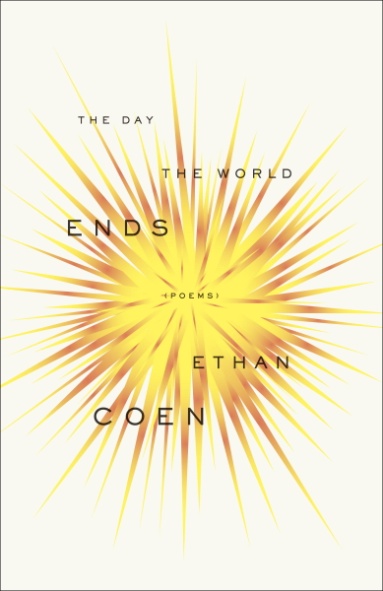
Giveaway Winner – The Day the World Ends – A Collection of Poems by Ethan Coen

As promised, I’ve drawn the winner of the poetry collection The Day the World Ends courtesy of Crown Publishing.

random org. list generator has decided. The winner is

Guy Savage (His Futile Preoccupations)

Congratulations, Guy.

Pease send me your address via beautyisasleepingcat@gmail.com

William Trevor: My House in Umbria (1991) Novella and Movie

My House in Umbria is one of two longer novellas contained in the book Two Lives. The other one is called Reading Turgenev. I’ve had the book for a while and since Mel u’s Irish Short Story Week has been prolonged, I decided to read it now. William Trevor is one of those authors I always wanted to read more of.

My House in Umbria is a surprisingly somber and complex novella. As lovely as the setting is, a villa located near Siena, there are some dark undercurrents, nasty secrets and a back story unlike any other to discover.

The story is told in the very unique voice of Mrs. Emily Delahunty. Delahunty is one of a few names she has chosen for herself. She is a romance novelist with a more than troubled past. Sold by her parents as a child, abused by her step-father and later abandoned by a lover and stranded in a hotel in Africa where she meets Quinty. Quinty isn’t any less mysterious or adventurous than Emily and this strange couple forms an interesting alliance. At the beginning of the story they live in the afore-mentioned villa in Umbria. Surprisingly Emily’s novels have brought money and fame and she lives a comfortable life. She is haunted by the past but her incredible imagination helps her to flee to nicer places whenever the clouds get to dark. And there is always alcohol as well, to help circumnavigate the roughest cliffs.

At the beginning of the story she boards a train to Milano. The wagon she is sitting in is blown up and most of the passengers die. Only Emily, a young German man who loses his girlfriend, an old general who loses his daughter and Aimée a little American  girl whose whole family dies, survive.

After a stay at a hospital, Emily invites the three people to stay with her in her house in Umbria. The calm and peacefulness of the country-side, the beauty of the house, will help them recover, she hopes.

These four highly traumatized and maimed people share some moments of great intimacy, – reminiscent of the group in Enchanted April – until the day Aimee’s uncle announces that he will come and fetch the girl.

What follows is equally sad and dramatic and what little peace these wounded  people  have acquired is shattered for good. The idea that a man she has never seen before and who seems distant and unlikable, comes to get the girl who still suffers from amnesia is particularly painful for the three other victims.

Mrs Delahunty sounds like an unreliable narrator for most of the book but she isn’t. Some of the things she tells sound unbelievable but they turn out to be true, only, she mixes things she imagines with things that happened. She has a a habit of inventing back stories for each and every person she meets. It’s not surprising she has become a novelist. Hearing her we think she would have had what it takes to write great literature, yet she chose to write romances as a means to escape the memory of her past. Not only was she abused but it seems that before discovering that she is a writer, she was an escort girl in Africa.

It’s not often that I watch a movie based on a book right after having finished the book but I watched My House in Umbria the day after finishing Trevor’s novella.

I really enjoyed how the movie brings to life the great character of Mrs Delahunty. Maggie Smith is amazing in this role. They way she plays this very kind, vulnerable and sad woman is touching and funny at the same time. The movie changed the ending completely but stayed true to the rest of the story. It underlines and enhances the characters and episodes in the novella and I would say I liked it even better. Others may prefer the darker novella; I liked the way the movie interpreted some facts and changed a few others. In any case they work extremely well together. What the movie offers, apart from great acting, is enchanting pictures of a beautiful landscape and some truly comical moments when the worlds of Mrs Delahunty and Aimée’s uncle clash. It’s one of my favourite movies so far this year. But don’t get me wrong, the book is excellent as well.

It’s rare that a main character in a book is so memorable but I’m beginning to think that creating great characters is one of William Trevor’s strengths.


Nina Sankovitch: Tolstoy and the Purple Chair (2011) A Memoir

Tolstoy and the Purple Chair is a memoir I’ve been eying for a while until I finally bought it. The subtitle – My Year Of Magical Reading – obviously an allusion to Joan Didion’s memoir – annoyed me a bit but I liked the idea behind the book.

After the early death of her beloved sister, Nina tries for several years to overcome her grief and feelings of guilt when she finally comes up with a cunning idea. Reading has always been important for her and her family. Reading instructs and entertains but it can console and give hope as well. That’s how she decided that she would read one novel per day for a whole year and write about it on her blog Read All Day.

Tolstoy and the Purple Chair tells the story of that year, interweaving it with memories and stories of her family and herself. Not all the 365 books she has read in one year are described or mentioned but she writes in detail about a few which were especially meaningful. She summarizes them briefly and writes why they were important, what memories they triggered, how they helped her heal.

The list of all the 365 books can be found at the end of Tolstoy and the Purple Chair and on her blog. They don’t follow any specific order. One book led to the next and many were recommendations from family and friends and later from readers of the blog.

While I expected slightly more, I still liked reading the book. I liked her infectious enthusiasm. Each book is a world to discover and she tackles the ambitious goal with a lot of energy and passion.

Some of the books are so important because they help her explore her story or the story of her family. Harry Mulisch’s The Assault is one of them and so is Schlink’s Self’s Deception. But there are many more.

Crime novels are among her and her family’s favourite books, each member loves another writer. Nina thinks that what she loves best about them is the fact that they re-establish order. Things make sense in crime novels.

The parts in the book I enjoyed the most weren’t only those about books but those in which she describes the many little joys life has to offer. A meal with friends, a sunset, a newly planted tree, a lilac bush and the many cherished memories of her sister that make it easier to let go of her grief.

As was to be expected with a book like this I ended up with a list of books I’d like to read now.

Muriel Barbery’s The Elegance of the Hedgehog – L’élégance du hérisson

Nadine Gordimer’s Burger’s Daughter

Harry Mulisch’s The Assault

Adam Phillips and Barbara Taylor’s On Kindness

Kevin Canty Where the Money Goes

Chris Cleave Little Bee

Chimamanda Ngozi Adichie The Thing Around Your Neck

While I wouldn’t say it’s an absolute must-read, it’s a nice way to spend a few hours. I liked her voice and her stories. Just be prepared, if you don’t have as much time at hand, you might end up being a bit envious.

I have a fondness for this type of project. It doesn’t even have to be reading a book per day. There are some other 365 and similar projects like that I enjoyed reading about. Many are based on blogs or turn into blogs like the famous Julie and Julia.

Have you read about any interesting projects or self-experiments like this? And what about the books on my list, have you read any of them?

The Winner of the Muriel Spark E-Book Giveaway – The Hothouse by the East River

One week has passed and it’s time to announce the winner of the Muriel Spark e-book giveaway The Hothouse by the East River courtesy of Open Road Media.

I drew the winner via random.org list generator.

The lucky winner is Nadine (Carpediemblogger)

Enjoy!

This e-book is one of eight of Muriel Spark’s novels that have just been released.

There is still enough time to read something for Simon’s (Stuck in A Book) and Harriet’s (Harriet Devine’s Blog) Muriel Spark Week from April 23 – 29.