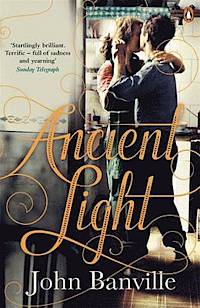
John Banville: Ancient Light (2012)

Ancient Light

‘Billy Gray was my best friend and I fell in love with his mother.’

In a small town in 1950s Ireland a fifteen-year-old boy has illicit meetings with a thirty-five-year-old woman – in the back of her car on sunny mornings, and in a rundown cottage in the country on rain-soaked afternoons. Unsure why she has chosen him, he becomes obsessed and tormented by this first love. Half a century later, actor Alexander Cleave – grieving for the recent loss of his daughter – recalls these trysts, trying to make sense of the boy he was and of the needs and frailties of the human heart.

It’s been a while since I last read John Banville. Ancient Light is his latest work. I didn’t know when I started it that it’s part of a trilogy, or rather one part of a triptych, Shroud and Eclipse being the other two parts. Luckily they can be read independently, but I’m sure it would be interesting to read them chronologically.

Alexander Cleave, whose story is told in Eclipse, is an aging stage actor. In Ancient Light he spends his days in an attic room, writing about his first love, Mrs Gray. He had an affair with the mother of his best friend Billy when he was only a boy of fifteen. Mrs Gray was a woman of 33. The way he remembers it, she seduced him in the pantry of the family home. Later they meet in the car and in an abandoned cottage where they spend long rainy afternoons. The affair lasts a few months and ends in disaster.

Alexander Cleave is a tormented soul. His daughter Cass committed suicide ten years ago and his acting career ended in an undignified way. His memories are more important than his present life and remembering Mrs Gray seems to be his escape route. But does he really remember it correctly? Did it start in spring or was it autumn? When did he see Mrs Gray for the first time?

The book is an exploration of memory and how it works, of how we distort even the smallest things and only when we compare our memories with the memory of others do we realize that things were very different.

All his life Alex wondered what became of Mrs Gray. While he writes down what he remembers, he gets a phone call from th US and is hired for a movie. It’s the first time ever that someone wants him in  a movie. He’s to play the part of Axel Vander, a mysterious dead critic. (His story is described in Shroud). From the moment when he gets the phone call until the end of the book the story moves between the story of his affair and the present.

Thanks to Billie Striker, one of the people working for the film crew, who acts like  some sort of private detective, Cleave finally finds out what happened to Mrs Gray and realizes that a lot of what he remembers was quite different and that he distorted a lot of the truth, misinterpreted facts and combined them to a story that was quite different from what really happened.

Banville is famous for his use of language. It is rare that I need a dictionary when I read an English book but I did in this case. A few of the amazon reviewers also mention that they had to use a dictionary, so it’s not due to the fact that English isn’t my native language but because Banville puts a lot of effort into finding specific words. His descriptions are detailed, lyrical, poetic and accurate. Many passages are very beautiful but it’s not easy reading. In the best passages, you are carried along by the beauty of the thoughts and descriptions and enjoy the way he writes, in  the bad parts it’s like walking in a bog. You hardly make any progress.

The story of the affair and the uncovering of what really happened was truly marvellous. Banville at his best. But the parts on the movie making were quite annoying. I hate artifice and there was a lot of that in these passages, beginning with the names. Banville writes his crime novels under the pseudonym of Benjamin Black, so very obviously he is fond of alliteration. I’m not. We find names like Marci Meriwether, Dawn Davenport, Toby Taggart and many more in this novel. They all belong to the people who are part of the movie crew. I found this quite heavyhanded. There are other elements I didn’t care for that much.

Overall I loved parts and passages of this novel, while other parts and other passages were quite artificial and annoying. This is very much Banville, he likes these games of mirrors and already in a very early scene there is  the evocation of a mirror image, when young Alex sees the naked Mrs Gray accidentally in a mirror.

One of my favorite scenes describes how Alexander confesses his affair to a priest called “Father Priest”. This is an amazingly humorous scene, the way the priest tries to find out what exactly Alex has done. The priest is sleazy and it’s obvious he wants detailed descriptions. This early passage addresses the moral aspects of the story. While Mrs Gray may very well have taken advantage of Alex’s youth, the priest is far more immoral.

What dampened the beautiful parts somewhat is the fact that young Alex is an extremely unlikable character. I’ve rarely read such a heartless description of an affair, such self-indulgent and self-centered behavior.

Banville writes beautifully and I liked how he explores memory. I truly liked the revelations at the end of the story as well. It wasn’t what I had expected at all. But I didn’t like the characters and I didn’t always care for the many artificial elements like alliterations, mirror images . Clearly, when Banville won the Booker Prize the jury didn’t have “readable” in mind.
“The term literay fiction has been invented to torment people like me” – John Updike

P1030189

I can only speak for myself but I feel pretty much the same as Updike and mostly agree with the full quote below which is taken from an interview with Lev Grossman in Time magazine in 2006 (you can find the whole interview here)

I think America is an increasingly book-free country. In the world of my boyhood, there were books everywhere. Your piano teacher had books, and there were lending libraries everywhere–your department store had a lending library. Books are still bought, and you see them being read in airplanes, but it’s a last resort, isn’t it? And the category of “literary fiction” has sprung up recently to torment people like me who just set out to write books, and if anybody wanted to read them, terrific, the more the merrier. But now, no, I’m a genre writer of a sort. I write literary fiction, which is like spy fiction or chick lit. I was hoping to talk to America, like Walt Whitman, you know? Address it and describe it to itself.

I have seen quite a few debates circling around the questions about the end of literature and/or what “literature and literary fiction” means. Is it so-called literary fiction that is about to end? The modernist novel? Surely nobody can say that story telling will end? And what is literary fiction anyway? Isn’t that an absurd expression? For me, being a French/German native speaker the term “literary fiction” is an oddity. In French and German it is much more pragmatic. Literature is pretty much the same as what English-speaking people call literary fiction. If you want to be precise you can add “demanding”, “challenging” or “sophisticated”  or to describe the opposite “entertainment”. Or you can add a school or movement like “nouveau roman” which already excludes “genre”. But that seems to be a continental European perception.

Lately I came across a term I found even more absurd “literary genre”.  It was used for books like Jamie Ford’s Hotel on the Corner of Bitter and Sweet. In German we would call that “gehobene Unterhaltungsliteratur” , meaning sophisticated entertainment literature. It’s a term used to tell the interlocutor that you’re not exactly reading trash, but nothing too demanding either.

In his extremely interesting book Writing 21st Century Fiction (I’ll need to review that some day), literary agent and writer Donal Maass argues that “literary genre” is the thing of the moment. I’d say it’s nothing new, it’s just another word for bestseller or mainstream fiction. Because being slightly more literary than the average genre novel, without being crime/fantasy or romance,  but accessible and well constructed, has always been the recipe for bestsellers.

In any case, literature is still alive and kicking, whether genre or literary. What seems to be dying is the patience of the reader, hence the popularity of so-called “readable” fiction, which means a lot of different things like simple sentences, short paragraphs, many chapters etc. Probably one of the many legacies of TV and other newer media that can be asborbed quickly. It’s no surprise that a lot of the current bestellers have been written by MFA graduates. They are well-constructed, have a stronger emphasis on metaphors and similes and take the short attention span of the reader into consideration.

Do you agree with Updike? Do you think literature is dying? And what about the terms literary fiction and literary genre?

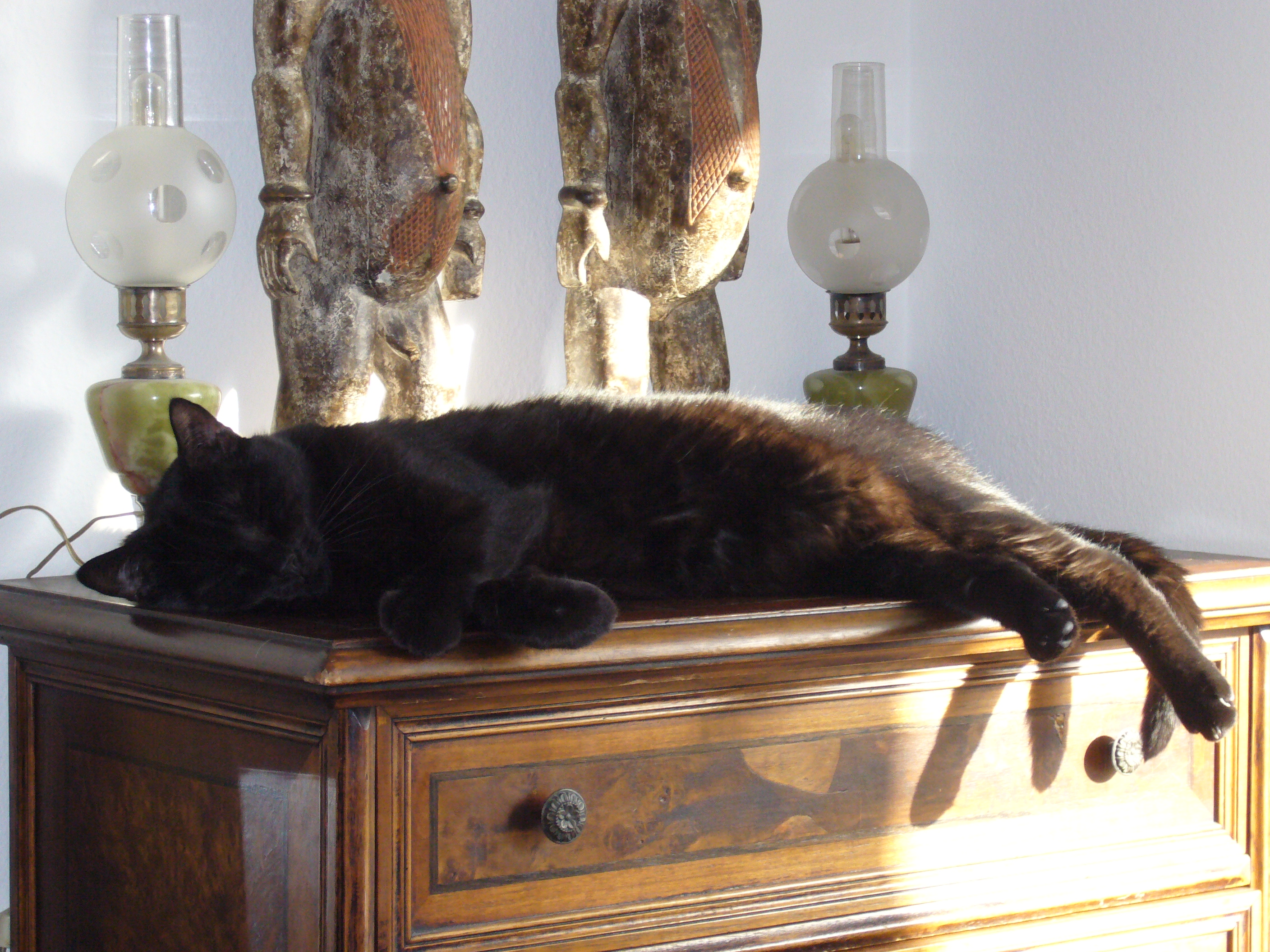
My cat, as you can see,  couldn’t care less. Maybe he has a point.

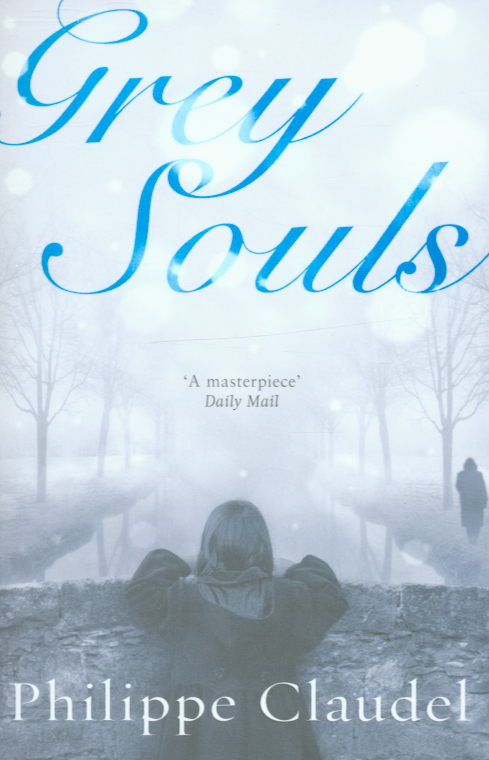
Literature and War Readalong August 30 2013: Grey Souls by Philippe Claudel

Grey Souls

I wanted to read Philippe Claudel since years and looking for a WWI novel I came across his Grey SoulsLes âmes grises. Like most of his other books the novel has been translated into 25 languages and was generally liked by readers and critics. From what I know so far, the war is not predominant in the novel. It’s more like the starting point to a crime which is solved much later. From some of the reviews I got that it’s quite heavy and brooding.

Here is the blurb

This is ostensibly a detective story, about a crime that is committed in 1917, and solved 20 years later. The location is a small town in Northern France. The war is still being fought in the trenches, within sight and sound of the town, but the men of the town have been spared the slaughter because they are needed in the local factory. One freezing cold morning in the dead of winter, a beautiful ten year old girl, one of three daughters of the local innkeeper, is found strangled and dumped in the canal. Suspicion falls on two deserters who are picked up near the town. Their interrogation and sentencing is brutal and swift.

Twenty years later, the narrator, a local policeman, puts together what actually happened. On the night the deserters were arrested and interrogated, he was sitting by the bedside of his dying wife. He believes that justice was not done and wants to set the record straight. But the death of the child was not the only crime committed in the town during those weeks.

The first sentences:

I don’t really know where to start. It’s quite difficult. All this time that has gone by, which words will never bring back, the faces too, and the smiles, the wounds. Still I need to try to say it. Say what’s been bothering me for twenty years. The remorse and the big questions. I have to cut open the mystery with a knife, just like a belly, and sink my hands in, even if that’s not going to change a thing.

The book has been made into a movie but I don’t know whether it’s available in English

*******

The discussion starts on Friday, 30 August 2013.

Further information on the Literature and War Readalong 2013, including all the book blurbs, can be found here.

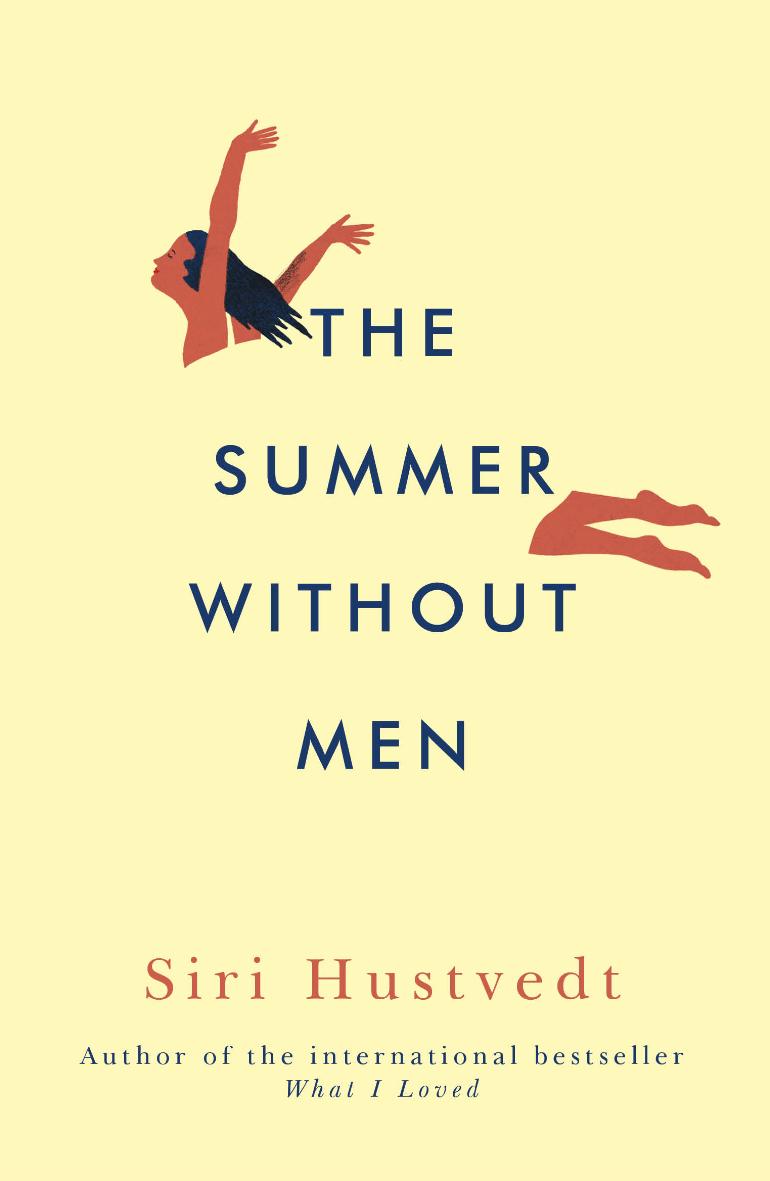
Siri Hustvedt: The Summer Without Men (2011)

The Summer Without Men

I’ve read three of Hustvedt’s novels so far, The Blindfold, The Enchantment of Lily Dahl, What I Loved, the memoir The Shaking Woman and some of the essays in A Plea for Eros. The novels are among my favourites, the essays are thought-provoking and so was her memoir. After finishing The Summer Without Men all I can do is wonder – What happened to Siri Hustvedt?

Not every writer is an academic, I’d say among the great it’s probably a minority and when you read a book like The Summer Without Men, it becomes apparent, that there may be a good reason. The intellectual baggage can enrich a book but it can also turn into a hindrance and in this case, what meager story Hustvedt had, she pumped up with theory. Derrida, Kierkegaard, Samuel Johnson, Jane Austen, and many more are mentioned and interpreted by Mia, the main protagonist. That could have been done well, but here it felt like a lecture. And to some extent it felt like she was talking down to the reader. Readers with no knowledge whatsoever of the theories and people behind them, will feel alienated, the others slightly bored as there are only snippets. The history of gender theory is an especially pertinent example. Everyone who’s ever been interested in that, will know as much as Mia but reading about it as if she’d just invented the wheel is jarring.

These were the theoretical parts of the novel. The novel has also a more story driven part. Funny enough however that read like pure chick lit for women over 50.

Mia, a 54-year-old poet is left by her husband a 65-year-old for a woman who is 20 years younger than Mia and French (yes it’s very original). Her reaction is intense. She has a psychotic episode and ends in a psychiatric hospital. That beginnning, I must say, was powerful and the pain, shock and horror behind it was palpable. After this Mia decides to spend her summer in Minnesota where her elderly mother lives in a nursing home. She meets the Swans, a group of elderly friends, Lola, her 20 something neighbour with two kids, and a group of pubescent girls who take a poetry course with her. If you think of the triad virgin-mother-crone then you are spot on as the whole story is meant to illustrate the various stages of womanhood. Some of this is arresting, some of it, notably the description of bullying among the very young, is touching, but overall it was nothing new.

Chosing a very intellectual protagonist would allow that theory is included, but that should have been done in a more subtle way. On top of that Mia often talks directly to the reader, which feels artificial.

It’s the first time, while reading this, that I noticed how bland Hustvedt’s writing is. Hustvedt uses only the most common words and the most simple sentence structures.  Her strength lies in her ideas, but they must be wrapped up better.

I wonder why this book has received such a lot of very good reviews by critics. Were they afraid they would come across as not savvy if they criticized it? I suspect so.

The end was a let down as well. In essence the book consists of parts which I’ve seen done better elsewhere. There are excellent YA books on bullying, amazing books about being a middle-aged woman like Lisa Moore’s February, and a few who look at old age, loss and grief.

As for the title, it’s not well-chosen. The Summer Without My Husband would have captured it far better.

I’ve still got Sorrows of an American here, but I think that is far better than this one. Hustvedt used to be a writer whose every book I bought without even thinking about it. That has changed radically.

Assia Djebar: Children of the New World – Les enfants du nouveau monde (1977) Literature and War Readalong July 2013

Children of The New World

Assia Djebar’s novel Children of the New World – Les enfants du nouveau monde is set during the Algerian War of Independence or Algerian Revolution which lasted from 1954 – 1962. If you are not familiar with this war wikipedia gives a short overview. It was a so-called decolonization war between France and Algeria. The war was fought in many different ways, guerrilla warfare, maquis fighting, terrorism and extensive use of torture on both sides.

The war in Algeria is still controversial in France. While it is meanwhile called “a war” and not only a “pacification intervention” – or whatever euphemism was chosen at the time – many of the aspects of the war are still not spoken about openly. One of them being the “interrogation techniques”.

It was a complex war that ripped apart the Algerian society. I think Assia Djebar showed this well in her novel. She chose to write Children of the New World as a series of vignettes, each with the name of a protagonist as title. Upon closer inspection we see that these are not individual stories but that each is a piece of a puzzle forming a kaleidoscopic canvas, which is apt and nails the Algerian society of the time. This was a society that resembles a broken pot, still held together at the seams, but the cracks showed and covered it like spiderwebs, ready to burst at any moment.

I have read the one or the other critique of this book stating it wasn’t really about the war, which puzzles me no end. The war is everywhere in this book, in every page. Every relationship is influenced or distorted by it. Neither love nor parenthood, nor friendship, nor anything else is free of the war’s influence.

We don’t see the fighting, that takes place outside of the city, in  the mountains, but the people see burning farms from afar, they see bombs fall and at the opening of the book, one falls on a house in the city, killing and old woman.

The book also shows how hostile this society was and how it was almost impossible to make a difference between enemies and allies. There were so many good and bad people on both sides. Not every Algerian was for the Algerian cause, not every French person was against it and many on both sides were against the use of torture and violence.

I have never read about any war in which torture was used this extensively. This becomes clear in the book too, although, mercifully, we find no descriptions, but we hear of people who don’t survive interrogations, of others who hear them scream in their own cells.

As said, the war is omnipresent in this book but Djebar transcends it and gives us more than just a society at war with itself and its oppressor. It shows a traditional society undergoing change and what this change means, notably for its women. I loved the many different descriptions of women’s lives. The diversity is amazing and in its best parts Djebar’s writing is as detailed as a documentary.

This was Assia Djebars third novel and it’s said that it’s not her best. I suppose that is correct as there are many structural problems. Djebar makes intense use of analepses , still I got the impression there were a lot of time-breaks that were not entirely wanted.

I’m curious and want to read another of her novels some day. She’s an interesting writer, with a raw unpolished force that I found quite refreshing.

For those of you interested in movies on the Algerian war – here’s a list that will also guide you to some of my reviews.

Other reviews

Danielle (A Work in Progress)


*******

Children of the New World – Les enfants du nouveau monde was the seventh book in the Literature and War Readalong 2013. The next is the WWI novel Grey Souls aka Les âmes grises by French writer Philippe Claudel . Discussion starts on Friday 30 August, 2013. Further information on the Literature and War Readalong, including the book blurbs can be found here.

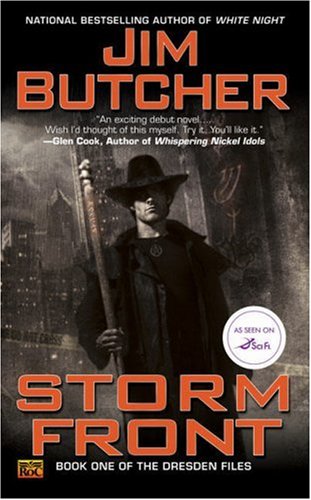
Jim Butcher: Strom Front (2000) Book One of the Dresden Files

aa-stormfront

I didn’t see this coming. A while back I reviewed Simon R. Green’s Something From the Nightside. A so-called Paranormal-Noir or Paranormal hard-boiled detective novel. I enjoyed Green’s book although I knew that his Nightside novels  were often compared to Jim Butcher’s Dresden Files and that most people thought Butcher’s series was superior. I was very keen on trying Storm Front, the first Book of the Dresden Files and see what I would think. I was convinced I would like the Dresden Files much better.  Well . . .  I didn’t. And that for a simple reason: I found it too silly. It’s not without merits, I can see the appeal because, even more than Green’s Nightside novels, this is classic hardboiled detective terrain. Only the detective is a wizard. Even that would be OK but the magic that is used in this book did just not work for me. Dresden often conjures up things, and casts spells, and to do so he uses some fake Latin which was really painful to read. Ventas! Fuego! Scorpis!  . . .  Most of it sounded like some kind of Esperanto. I can’t help it but I’ve had a classic upbringing, I had to learn Latin and some old Greek at school, sloppy fake Latin conjuring is just not going to do it for me. I see that part of it is meant as a parody (or at least I hope so) but that didn’t make it any better.

The story as such was interesting enough. Harry is called by the police to help in the investigation of a grisly double murder. Two people have literally been turned inside out and it is obvious that the perpetrator used powerful black magic. At the same time Harry is  hired to look into the disappearance of someone’s husband who has been dabbling in magic.

In typical hardboiled style, women are after Harry, he gets beaten up more than once, the mob takes an interest in him, the Council of the white mages suspects he is the killer and so on and so forth. Some of it is quite amusing. Harry has a ghostly assistant who resides in a skull and who likes to chase girls. Some of the repartee with clients, journalists, police is amusing too.

Some people complained that Green squeezed the same amount of story that takes up 350 pages in the Dresden Files into barely 200 pages. I must say, I liked the condensed  approach much better. After I finished Something From the Nightside, I felt compelled to read the next in the series. I don’t think I’m going to read Book Two of the Dresden Files.

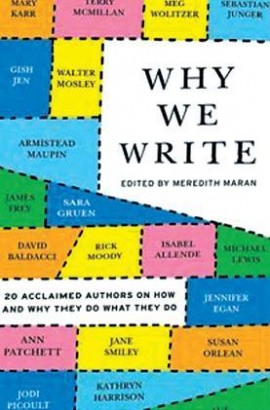
Why We Write – 20 Acclaimed Authors on Why and How They Do What They Do

Why we Write

Twenty of America’s bestselling authors share tricks, tips and secrets of the successful writing life. Anyone who’s ever sat down to write a novel or even a story knows how exhilarating and heart breaking writing can be. So what makes writers stick with it? In Why We Write, twenty well-known authors candidly share what keeps them going and what they love most and least about their vocation. Includes answers from authors such as Jennifer Egan, Jodi Picoult, David Baldacci, Ann Patchett, Sue Grafton and James Frey.

Meredith Maran has asked 20 highly acclaimed writers how and why they write. The outcome is an entertaining, thought-provoking and insightful collection of essays by today’s most successful writers. While many of the authors collected here are not among my favourites – I’m even pretty  sure that I will never read them – it was still interesting to read about their routines and techniques, and how they felt about what they were doing.

Each chapter opens with a quote from the author’s latest work. This is followed by a brief introduction written by Maran and a section containing important dates and a list of publications. After this the author writes about his or her vocation, the way he writes, what it means for him to write. The best part however is the end of each chapter in which the author provides advice. Not all of these contributions are equally interesting, but since they were all written by the authors themselves it was still fascinating.

The chapters I liked best were the ones written by Jennifer Egan, Mary Karr, Terry McMillan, Sue Grafton, Ann Patchett, Sara Gruen and Walter Mosley.

There is always a debate whether or not you should write an outline for a novel and I wasn’t surprised to read that Jody Picoult sketches everything in advance, tailoring every scene. I was astonished to find out how much Walter Mosley has written. I always thought he was a crime writer only but, no, he has written Science fiction, non-fiction and even Erotica.

Some of these essays are very open. Baldacci, for example, knows exactly that he will never win a Pulitzer and admits in all honesty that he is paid to deliver often and quickly and that this doesn’t allow polished writing.

There were some interesting bits about movie deals too. Did you know that a writer sells his book twice? First he gets money for the film rights and later, when the movie is shot, he will get another, bigger portion. Selling the film rights seems not to signify that there will be a movie.

Jennifer Egan’s essay may be the most interesting one because she speaks so openly about how painful it can be to write. She had panic attacks and severe depression during the writing of some of her books. Contrary to what most people think, her favourite book, the one she thinks is her best is not A Visit from the Goon Squad but Look at Me.

I’ll leave you with a few quotes from the “advice” sections:

Meg Wolitzer

Writing that is effective is like a concentrate, a bouillon cube. You’re not just choosing a random day and writing about that. You pick ordinary moments and magnify them-as if they’re freeze-dried, so the reader can add water.

Jennifer Egan

You can only write regularly if you’re willing to write badly. You can’t write regularly and well. One should accept bad writing as a way of priming the pump, a warm-up exercise that allows you to write well.

Sue Grafton

There are no secrets and there are no shortcuts. As an aspiring writer, what you need to know is that learning to write is self-taught, and learning to write well takes years.

Kathryn Harrison

At the end of each workday, leave yourself a page marker, an instruction that tells you where to start the next morning, so you’re oriented immediately when you sit down at your desk.

Sebastian Junger

Don’t dump lazy sentences on your readers. If you do, they’ll walk away and turn on the TV. You have to earn your paycheck by earning your reader’s attention.

Mary Karr

Any idiot can publish a book. But if you want to write a good book, you’re going to have to set the bar higher than the marketplace’s. Which shouldn’t be too hard.

Walter Mosley

Don’t expect to write a first draft like a book you read and loved. What you don’t see when you read published book is the twenty or thirty drafts that happened before it got published.

Why We Write is surprisingly rich, a book you can pick up again and again and you’ll always find something interesting. Even the authors I would normally not read had something valuable to offer. I loved to see how different every writer’s personality is and how this shined through in what they wrote. There are well-behaved writers, caustic ones, matter of fact ones, highly inspired people and some irreverent ones like Mary Karr.