Frank Herbert: Dune (1965) Book III The Prophet

It is Saturday once again and time for the third and last Dune readalong post. I’m so glad I participated despite the initial feeling of “What have I gotten myself into?”. I can still not say, I loved Dune, that would be a lie but I can say I loved the readalong. It was a great experience, the dedication and the discussions were great and I’m looking forward to the next readalong. The readalong is hosted by Carl V from Stainless Steel Droppings,  The Little Red Reviewer and Grace from Books without any Pictures. This weeks questions have been sent by Grace. Here are the other links.

What is your reaction to finally learning the identity of Princess Irulan?  Do you think that her convention added to the story?

I wanted to “meet” her from the beginning and was very intrigued by her character. The parts quoted from her manuals and books stand out style wise. I was not surprised that she was the Emperor’s daughter but saddened about the plans they had for her. She strikes me as too special to be handled like some goods.

Were you satisfied with the ending?  For those reading for the first time, was it what you expected?

I still don’t think it feels like a standalone novel. For me the story is just about to start, I also think that this third part felt rushed. There were some fastworwarding moments that did not feel right to me. Comparing it to the first parts, there were much more things that were just mentioned but we did not see them happen.

On both Arrakis and Salusa Secundus, ecology plays a major role in shaping both characters and the story itself.  Was this convincing?  Do you think that Paul would have gone through with his threat to destroy the spice, knowing what it would mean for Arrakis?

I thought that it was very well done how ecology and characters of the different cultures were interwoven and for me this was the special appeal of Dune. I’m fascinated how surroundings influence and form cultures or how one thing that is meaningful because it is scare in one place, becomes unimportant in another to an extent that it isn’t even appreciated anymore.

There certainly is a possibility that Paul would destroy the spice but I’m sure he will find a solution not to do it. Someone who gets married to a woman for purely political reasons doesn’t strike me as someone who will give up a pricey resource.

Both Leto and Paul made their decisions on marriage for political reasons.  Do you agree with their choices?

This ties back to answer no. 1. I found this quite horrible, horrible for the concubine and, in Paul’s case. also for the future wife and I have also a feeling that this will not work and this is also why I thought the book ended at an awkward moment. I can’t imagine that Paul will use the Princess Irulan purely for breeding or, I hope, she will not let him do that to her.

What was your favorite part in this section of the book?

I enjoyed it when they rode the worms. I was fascinated by these creatures the whole time and thought it showed so well to what extent the Fremen are capable of mastering their hostile surroundings.

One of the things I noticed in the discussions last week was Herbert’s use of the word “jihad.”  What do you think of Herbert’s message about religion and politics?

I said it in the last posts and the discussion that I found the use of the word jihad problematic but I also found the use of the word messiah problematic and I can’t see Paul as a Messiah figure. He has some superior mental faculties but that isn’t enough for me to see a saviour figure in him. What Herbert does, is mix a lot of elements from all sorts of religions, it is a real religious hodgepodge what he offers.  I am not sure what he wants to tell us with this. That all religions are equal? That the elements are interchangeable? The religious world he created has no new elements, that’s for sure. Maybe the most striking is that he created a world in which everything is tied to politics and religion. And politics and religion are once more tied together, something the West has overcome. There is no laicism on Dune, their political system is far from secular which will always be problematic.

Writers in Paris – Literary Lives in the City of Light by David Burke (2008)

No city has attracted so much literary talent, launched so many illustrious careers, or produced such a wealth of enduring literature as Paris. From the 15th century through the 20th, poets, novelists, and playwrights, famed for both their work and their lives, were shaped by this enchanting place. From natives such as Molière, Genet, and Anaïs Nin to expats like Henry Miller, Samuel Beckett, and Gertrude Stein, author David Burke follows hundreds of writers through Paris’ labyrinthine streets, inviting readers on his grand tour.

Writers in Paris may very well be one of the most enjoyable and interesting books I own, one that you can browse, open at random, read from beginning to end or backwards, it will always be great. I don’t even know where to begin to give you a good impression, it is so full of fantastic details.

Burke organised the book by “regions”, so to speak, “The Literary Left Bank”, “The River and Islands”, “The Literary Right Bank”…

What I like best is that you can either follow the traces of an author, be it a Parisian or an expat, or you can find information on books set in Paris, and read about the places described in novels. Each chapter is divided in sub chapters and Burke will indicate who lived in what street, quote excerpts of letters and diary entries, passages of novels and poems.

In the case of Rainer Maria Rilke, Burke, describes the streets and places where the writer lived

On a first stay in Paris during 1902 and 1903, Rainer Maria Rilke lived in a shabby student room at No. 11 rue Toullier, between rue Soufflot and rue Cujas. The house is still there, neat, cream-colored, with weathered shutters. The Prague-born poet was twenty-six years old when he arrived, unquestionably gifted, but emotionally and artistically immature. To him Paris was a sinister place.

But Burke also explores the streets evoked in The Notebooks of Malte Laurids Brigge. Or he describes, where Rilke found inspiration for one of his most famous poems, The Panther, namely at the Jardin des Plantes.

There are many authors mentioned in the book, some famous like Rilke, Balzac, Sartre, Orwell, Hemingway and others who are less well-known like Lautréamont (One sub chapter is called “Lautréamont and Maldoror on rue Vivienne”). Some writers are named repeatedly because they either moved about Paris quite a lot or because their books are set in different streets, different arrondissements.

One sub chapter is dedicated to “The Noble Houses of the Faubourg Saint-Germain”. In this chapter you can find long paragraphs on Proust’s The Guermantes Way or on Edith Wharton’s stay in Paris. But also Edgar Allan Poe’s detective story is set here.

During two years I had an apartment at the Place de la Contrescarpe where Hemingway had his first home in Paris. He describes that stay in A Moveable Feast. I was curious to see who else had lived there at a certain point in time. It seems that François Villon roamed the premises in the 15th century, Mme Vauquer, one of Balzac’s characters, lives here, James Joyce and Valérie Larbaud had an apartment close by. The side streets of the rue Mouffetard, which leads to the Place de la Contrescarpe, are described in great detail in Orwell’s Down and Out in Paris and London. I found this particularly interesting as Emma’s has recently reviewed it (here is the review) and I hadn’t even known before reading her review that Orwell also stayed in Paris for quite a long time.

The river Seine and the islands also play quite an important role in many a book like in Zola’s L‘Oeuvre.  Here is a scene in which the mad painter drags Christine to the river bank.

There he stopped again, his gaze fixed upon the island riding forever at anchor in the Seine, cradling the heart of Paris through which its blood has pulsed for centuries as its suburbs have gone on spreading themselves over the surrounding plain. His face lit up, as with an inward flame, and his eyes were aglow as, with a broad sweeping gesture, he said, “Look! Look at that!”

Other famous writers who have more than one entry are Colette, Proust, Céline, Victor Hugo, Edgar Allan Poe, George Sand, Anaïs Nin and Arthur Miller.

Writers in Paris also contains quite a lot of black and white photos of writers and places, houses and streets.

Here is the homepage of the book with table of contents, lists of authors and some photos.

This is another contribution to  Book Bath‘s and Thyme for Tea‘s event Paris in July.

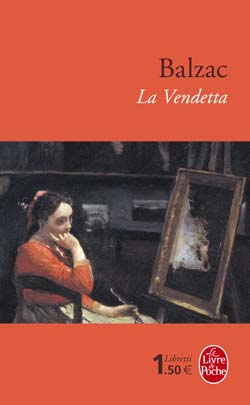
Balzac: La Vendetta (1830)

I read La Vendetta as part of a mini-readalong together with Danielle and Emma. It was Danielle’s idea to read it for  Book Bath‘s and Thyme for Tea‘s event Paris in July.

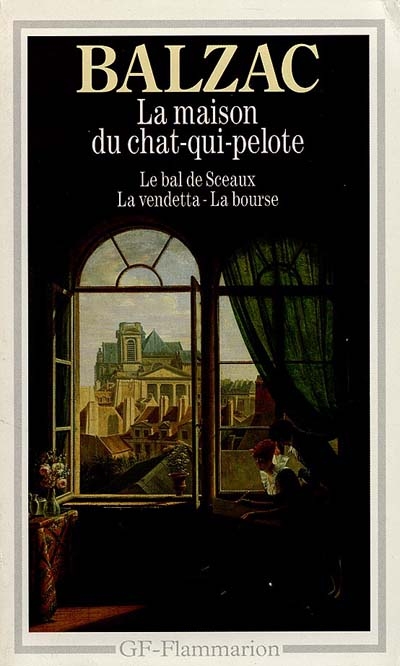
You can find different English versions of the novella or, if you read in French, you will find it in the collection La Maison du chat-qui-pelote or as a stand alone.

La Vendetta is one of Balzac’s earlier stories and part of the so-called Scènes de la vie privée. It is an interesting story for various reasons. On the one hand because it reflects some of the themes that were fashionable in the literature of the time but also because we can already see some of Balzac’s key themes emerge. I would say this novella is still rooted in romanticism with only a touch of realism.

The central story is the story of two families, the Piombos and the Portas,  who are connected by their mutual hatred. We learn at the beginning that after the Portas killed almost the whole family of the Piombos, the old Piombo killed the whole Porta family with the exception of a son, Luigi.

As Balzac tells us, the Corsicans are a fierce people and take revenge, or vendetta, as they call it, seriously. It is almost a religion for them. There will be no mercy or forgiveness ever. It’s a blood feud that can cost each and every member of a family his or her life.

After seeing their family so drastically decimated, Bartholoméo Piombo decides to leave Corsica and look for assistance by Bonaparte in Paris.  He has to learn an important lesson before being accepted in Paris. He must acknowledge that there will be no more vendetta. In Paris justice is not a personal matter but part of an official legal system.

After the first scene in which Bartholoméo is introduced the book fast forwards some ten years and focuses on the daughter of the family, Ginevra. The young woman is taking painting classes with a famous painter. She is quite skilled and produces many a good copy of existing pieces of art. The girls taking these calsses are a composite group. Some are of aristocratic background, some are nouveaux riches. There are many petty rivalries that are influenced by their families political orientation

Ginevra is a beautiful and cherished young woman. She is already 25 years old but has never fallen in love. She thinks that she will never leave her family and go on living a peaceful life at the side of her elderly parents. Destiny has other plans and one afternoon, while painting, she discovers a young soldier, who has been hidden by the painter. The young man is no other than Luigi Porta. It is a time of great turmoil, Napoléon has been overthrown for the second time and all those who followed him are in grave danger. Luigi has endured a lot, he was part of the Berezina campaign, he fought at Waterloo.

The two young people fall in love and Ginevra wants to get married but her father doesn’t want to accept this. His reasons go far beyond the fact that the young man is a Porta. He doesn’t want to lose his daughter. He doesn’t even care that this refusal might lead to a tragedy. When he finally realizes that he has made a mistake, it is too late.

I can’t really say I liked La Vendetta. Should you know Merimée’s Mateo Falcone, a novella on a similar theme, written just one year prior to La Vendetta, you will know why. Mérimée’s novella is accomplished and renders life and customs of Corsica without falling into the trap of stereotypes. Unfortunately this isn’t the case here. Balzac doesn’t do the Corsican people justice. He probably chose the theme because it was fashionable and I think what he really wanted to write about is the jealous possessiveness of a father. Bartholoméo Piombo isn’t the only selfish father in Balzac’s books. There are many others. This is why I could at least appreciate parts of the story. Another typical Balzac theme is the artist. Balzac was fascinated by painters and regularly evokes them in his stories. I found it sad that Ginevra who seems to have been very talented wasn’t encouraged to paint anything else but copies and in the end this speeded up the economical downfall of the young couple. This element is certainly realistic. There weren’t many accepted female painters in the early 19th century. Still it saddened me to see that young girls with talent had to paint mediocre works.

La Vendetta isn’t a bad novella but it isn’t Balzac at his most original. We see a few glimpses of the future master, but he isn’t there yet.

I’m curious to read what Emma and Danielle think.

Here are the links:

Danielle (A Work in Progress)

Emma (Book Around the Corner)

Paris – A Movie by Cédric Klapisch (2008)

I watched this movie as part of Book Bath‘s and Thyme for Tea‘s event Paris in July.

Paris is an absolutely charming movie and I’m sure it will appeal to many people because it combines a good story with interesting character portraits, wonderful pictures of Paris and a great cast (Juliette Binoche, Mélanie Laurent, Fabrice Luchini, Albert Dupontel and Romain Duris). I feel really homesick now.  All the places to which I used to go while I lived in Paris can be seen: La Place de La Sorbonne, the Jardin du Palais Royal, the Bibliothèque Nationale. But we also see Ménilmontant where I used to live briefly after I had finished school.

Paris tells one main story, different smaller side stories branch out from it. The people of the main and the side story are only connected because they live in the same town and their paths cross but they don’t get to know each other. Parallel storylines don’t always work well but in this movie they complete each other and the outcome is nicely rounded. The movie has really only one flaw, a brief “All-you-need-is-love”-moment towards the end of the film. Watching this short part was like biting on a lump of sugar in an otherwise tasty cake.

The central characters are Pierre (Romain Duris) and Élise (Juliette Binoche). Pierre is a professional dancer whose best friend is his older sister Élise, a fortysomething divorcée with two kids. At the beginning of the movie Pierre is diagnosed with a serious heart disease that means his career as a dancer has come to an end. He is condemned to stay in his apartment and watch life go by. This offers a great opportunity to have him observe people, one of them is the beautiful Laetitia (Mélanie Laurent). Whenever Pierre is alone, walking the streets of Paris, mourning his career, contemplating his possible death, his reflections are accompanied by the music of Erik Satie. I liked that touch a lot.

Élise doesn’t belive in love anymore. She has been disappointed, doesn’t want to risk falling in love. When she goes shopping for her brother to the street market, near where he lives, she meets one of the vendors (Albert Dupontel) and there seems, from the beginning, a possibility for something between them.

Roland Verneuil (Fabrice Luchini) is an elderly professor of history. His story was for me the most touching. We learn about it because he falls in love with one of his students, Laetitia who lives in an apartment vis-à-vis of Pierre’s flat and he watches her. Verneuil is insecure but at the same time there is a lot of passion in him that has been stored away for a long time. Falling in love with a student reawakens him and brings out a very different person. There is nothing sleazy in this older man falling in love with a young woman. Unfortunately the beautiful Laetitia is one of those good-looking women who enjoys not only to play with men but who also likes to inflict pain. A nasty piece of work.

I loved the melancholy end of the movie. We  know from the start that there isn’t a lot of hope for Pierre. He needs a transplant and he may or may not survive the surgery. The last scene shows him travel through Paris in a taxi, on his way to the hospital.

Paris is a beautiful and touching movie and a homage to a city. I liked it even better than Paris, Je t’aime which isn’t bad at all either.

Frank Herbert: Dune (1965) Book II Muad’Dib

It’s time for the second Dune readalong post. The readalong is hosted by Carl V from Stainless Steel Droppings,  The Little Red Reviewer and (slight change of the initial three) Grace from Books without any Pictures. This weeks questions have been sent by Redhead (The Little Red Reviewer). Check out the other links here.

I’m happy to report that I liked part II much better. There is far less dialogue and if there is, it is an exchange between two people and not purely an instruction of the reader.

Was Liet’s identity a surprise?  Who do you think he really works for?

I’m not totally sure about this question. I thought he died? I thought since he was a Fremen he also secretly worked for them.

What do you think of the Fremen culture?  Is this a culture you think you’d enjoy spending some time with?

They sound like a very proud and interesting people and reminded me a bit of the Tuareg or any other desert dwelling nomads. A lot of Dune is inspired by North African culture. But since I like rain and plants more than anything else in the world and as appealing as I think some of it sounds, thanks but no thanks, I wouldn’t want to live with them. Furthermore I’m not into duelling. A fierce fighting people isn’t the kind I would want to spend time with. One aspect that I liked is their patient attempt to re-green the desert. Their elaborate plans sounded very convincing.

What do you think of Count Fenring’s unusual verbal mannerisms?  

I found it quite annoying and was trying to imagine how it would sound. I’m not sure what Herbert wants to tell us with this?

This is a far future empire with very little in the way of computerization. Information is often passed down orally, and schools (such as the Mentats and the Bene Gesserit) have formed to train young people in memorization and information processing.  What are you thoughts on a scifi story that is very “low-tech”?  Does that sound like a feasible future? A ridiculous one?

This is precisely the reason why I thought from the beginning that it really is a bit of a sci-fi/fantasy blend. Considering the fact that resources are limited on earth, and very likely on other planets as well, low-tech seems a more viable way to go. These people are advanced in other ways. The mental faculties are far more developed and this would be something to wish for. Unfortunately, humans stay humans, and will, even with low-tech support only , try to exploit others. At least that’s how it is on Dune.

If you found the beginning of the book tough to get into, do you find that you’re having an easier time with the middle portion, now that all the “set-up” is complete?

Yes, it is far easier, as I said in the intro, there is much less dialogue in this part and finally people seem to talk to each other. At least to a certain extent. In part I the dialogue was meant for the reader to understand life on Dune, which is a highly artificial way of getting information across. Since a lot is “set-up” now, he did let go of this. The reading was more fluent and there was quite a bit of action. I liked the part when Paul and his mother are on their own. That part was quite gripping.

The center portion of the book is still pretty dialog heavy, but what I’ve noticed is the subtlety of the dialog. Things left unsaid are often more important than things that are said.  What do you think of that as a stylistic choice? does it make the dialog more interesting? less interesting? 

Any change in the dialogue form was a welcome change for me. I appreciate it much more the way it is handled here but it is still far from realistic. And whenever the parts are centered on the Baron, the dialogue is still heavy (meaning too much and artificial).

Dune was written in the 60’s. Does it feel dated to you? How does it compare, writing style-wise, to more contemporary science fiction you’ve read?

I don’t know any new science fiction. It doesn’t feel dated, no. Maybe the strong Arabic element is dated. I have a feeling a contemporary writer wouldn’t use a word like jihad and would try to be more inventive in terms of cultural elements and not just pick from existing cultures.

If you’ve never read this book before, where do you think the storyline is headed?

I’m really not sure. I start to have a feeling that we will be left with a lot of open questions at the end of Part III. It’s epic, so that seems logical. I wonder if we will even get introduced to the Princess Irulan. I would like to read something about her. But – should anyone wonder – I will not go on reading this series. The moment I close part III, that’s it for me.

Quiet Corners of Paris – Paris au Calme by Jean-Christophe Napias (2006)

Quiet Corners of Paris: Unexpected Hideaways, Secret Courtyards, Hidden Gardens

This is one of those books you will appreciate once you know Paris a bit better. When you visit for the first time you want to see the famous places but as soon as you have seen them and get tired of fellow tourists you might enjoy following the tips that you can find in a book like Quiet Corners of Paris – Unexpected Hideaways, Secret Courtyards, Hidden Gardens (you can open it by clicking on the photo).

I think there aren’t many things as magical as being in a big city with all the commotion and traffic, enter a passage, go through a door and find yourself in another world, almost outside of time, like a character in a fantasy novel. Many cities have places like this but they are hard to find.

Quiet Corners of Paris is informative and contains a number of lovely photographs. It’s a small book, rectangular in shape with nice glossy paper.

The book is structured along the different Arrondissements, starting with the first and ending with the 20th. Each arrondissement has other things to offer.

You will find some less well-known museums like the Musée Zadkine, Musée de la Vie Romantique, La Maison Balzac or the Musée Bourdelle, but also a great number of enchanted looking places like the Place Dauphine, the Hôtels du Marais, the Village Saint-Paul.

Parks are also mentioned, you will find the Jardin du Luxembourg and the Parc Monceau as well as the Buttes-Chaumont.

In any case it is a lovely book and will help you discover a hidden side of Paris that is as charming or even more so than the big Boulevards and Avenues.

This is a contribution to Book Bath‘s and Thyme for Tea‘s event Paris In July.

Colette: La Chatte – The Cat (1933)

I’m so pleased that I actually found a picture of the old 60s paperback of La Chatte that I bought second-hand a few years ago. These old Le Livre de Poche editions have such an incredible charm.

The book is available in English as Gigi and The Cat which is very misleading as Gigi is an independent story in its own right as much as The Cat and pairing them like this sounds as if that was the book’s title. I realised this when reading the review of the two books on Literary Relish’s blog.

Reading tastes change, at least mine do, but some authors will always remain favourites. One of those authors who is special to me and has always been is Colette. She is such an accomplished writer, a masterful stylist, a great storyteller and a psychologist of superior order. She can take a story that looks simple and nondescript and turn it into a complex piece of writing, revealing the numerous layers of motives and motivations behind actions. Her descriptions of people and settings are some of the best I have read. Her vocabulary is selected and she tried to find the exact and appropriate expression at any moment. Still there is no superfluous word or unnecessary adornment in her writing.

La Chatte is no exception. It has a subject to which I relate but it is far more than the story of a relationship between a man and his cat. It is a subtle analysis of love versus passion, of marriage versus celibacy, of childhood and growing up, of change and permanence. The story also captures the dynamics of disenchantment following the recognition that one’s object of desire is flawed.

The story is simple and can be told in a few words. Childhood friends Alain and Camille are going to be married. The lively and insensitive Camille is looking forward to her new life but Alain, who has to leave behind his beloved cat and the home of a happy childhood, is not as joyful as the bride. The relationship he has with the Chartreux cat Saha is very intense and emotional. They share rituals and habits and are deeply attached to each other. The cat doesn’t like Camille and the young woman thinks her future husband is slightly silly when it comes to the animal.

The newlyweds are meant to live at the old house with its splendid garden but at first they move to a friend’s apartment while Paul’s old rooms and the family home are being transformed into a bigger apartment for them.

Paul cannot adjust to his new life and sneaks off to his parents’ house frequently. Whenever he returns the cats looks thinner and thinner. She misses him and doesn’t eat anymore. Finally he takes her with him to his new home. To make things easier for the cat and his wife, Alain tries to teach her the cat’s ways but Camille couldn’t care less.

What unfolds is a story of jealousy and hatred between Camille and Saha. It is an uneven fight, shocking at times. Most of it happens behind Alain’s back but in the end, after something horrible has occurred, he notices what is going on. Camille’s reactions to the cat and the way she treats her opens an escape route for Alain and tells him a lot about his wife that he hadn’t seen before.

I really liked Alain who is a dreamer and so unprepared  for married life. He is an only child of very rich parents and the beautiful family home is stately and imposing and so is the old garden. One of Alain’s and the cat’s biggest joys is sitting quietly on a chair, watching birds, smelling the flowers and do nothing else but contemplate their surroundings.

One wonders what motivated Alain to get married in the first place. He was so content before, enjoying a life of leisure.  He shares everything with the cat apart from a sexual relationship which seems the only reason why he let Camille sweep him away into marriage. He realizes that he doesn’t need to be married to get what he needs. He can always have girl-friends.

The deep affection he and the cat have for each other is very touching. Colette loved cats but I think the cat could be replaced by a friend or a brother, a sister, anyone with whom one wouldn’t have a sexual relationship. I think Colette also shows that love in its purest form can come from many sources.

La Chatte is a novel full of beautiful descriptions and the tension that slowly builds up between the two rivals makes this a very engrossing read.

I read Colette’s novel as a contribution to Book Bath‘s and Thyme for Tea‘s event Paris In July.