
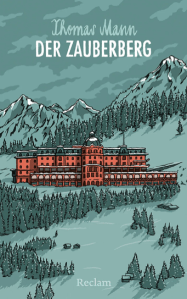
Time – Boredom – Madness
Thomas Mann said that The Magic Mountain was first and foremost a “Zeitroman”, a novel about time. Time in a double sense. First about historical time and then about the perception of time. There are many passages about time, most of which are written from the point of view of Hans Castorp. The longer he stays at the sanatorium, the more his perception and experience of time change. We all know how time can fly when we do something interesting and almost grind to a halt when we’re bored. Looking back over these periods of time we notice that those stretches of time have the opposite quality now. Periods of time in which we did a lot seem to have lasted longer when we look back, while those in which life is repetitive seem very short. The novel mirrors this in its structure. The first half narrates roughly a year while the second half stretches over the course of six years. The title, “Magic Mountain” also alludes to this near magical quality of time.
During his first weeks and months everything that is offered to the patients is of great interest to Hans and keeps him fully occupied. But the more he’s familiar with the routine and the distractions that are offered, the more he tries to occupy his mind otherwise and find additional ways to pass time. He’s suddenly very interested in biology, anatomy, and botany. Long passages are dedicated to these topics. Apparently, many readers find these passages boring but I thoroughly enjoyed them.
Boredom seems to be something many of the patients are afflicted by and so they try to find all sorts of distractions. Many sneak off during the lying cure and go to Davos to have drinks, play games, and meet other people. I mentioned the affairs they are having, and I would assume many of those are also just a way to pass the endless time. Others, like Clawdia Chauchat, leave when they have had enough and travel either home or to other places but always return after a certain time.
The sanatorium offers distractions like presentations by Dr. Krokowski about various topics; then there are concerts, and festivities at Christmas or during the carnival season. The carnival episode is one of the funniest and craziest in the book and it made me think that possibly “Narrenberg”, The Fools’ Mountain or Mad Mountain might have been a better title. There is this sense of madness and craziness throughout the novel and towards the end, it seems to intensify and can barely be contained. Two characters are introduced late in the novel, Mynheer Peperkorn and a young girl who says to be a medium. Each of them, in their own way, contribute to the intensification of wackiness. Settembrini who is always the voice of reason in the novel and who feels responsible for Hans, warns him about both.
There is always this sense of the sanatorium being outside of the real world which contributes to these feelings of alienation and madness. Hans Castorp identifies strongly with the world “up there” and wants nothing to do with the world he left behind. While Settembrini also stays at the sanatorium during the first chapters, he moves down to Davos later because he cannot afford to stay at the Berhof any longer. That’s where he meets Naphta who is also ill but not rich enough for the Berghof. This may be one of the reasons why Settembrini isn’t affected by the folly that comes with prolonged stay at the Berghof. He’s also still in contact with the world outside as he’s working on a book. He has a keen interest in what is going on in the world and tells Hans about it and warns that a catastrophe is coming.
When Hans has been at the sanatorium for many years, everyone seems to become more restless, more bored and people throw themselves on all sorts of hobbies. Collecting stamps, trying every chocolate available, listening to music, and participating in seances.
Things accelerate and finally the big clash comes – the war breaks out. Everyone has to leave and those young enough like Hans Castorp are sent to the front.
Final Thoughts
I read a lot but unfortunately many of the books are gone from my memory by the end of the year. That said, I’m not likely to forget this book. It’s so unusual and wild. And I absolutely love the way Mann writes. His sarcasm and wit are unparalleled. I hope it comes through in the translations. It would be sad if it didn’t.
As funny as the beginning is, there’s always a sense of unease. We see all these people from all over the world, Germany, Russia, France, Italy, South America, Poland. . . . and we know, only a few years later, sitting together peacefully will no longer be possible.
I highly recommend this book to anyone who loves Mann, to those who want to read one of the great novels of German literature, but also to those who love books about microcosms of society as we find them in hotel novels. In many ways, The Magic Mountain is like an exaggeration of the hotel novel. Hotel novels wouldn’t have such an appeal if they were not also novels with memorable characters and The Magic Mountain certainly offers many such characters.
If you’ve read it, which was your favourite episode or element? I thought that one of the strongest was Hans Castorp’s skiing expedition, one of the funniest when he explores Clawdia’s painting. But there are also tragic parts that are very affecting, especially the end. I won’t mention these episodes so as not to spoil the book any further.
In October, I was tempted to go to the “Berghof, or rather hotel Schatzalp as it’s called, for a few days. Schatzalp opened as a luxury sanatorium in 1900, but has been a hotel since 1953. In the end, I couldn’t go but maybe next year.
 Beauty is a Sleeping Cat
I’ve really appreciated all your posts on this novel Caroline. It’s made the prospect of it a lot less intimidating – thank you.
How wonderful to go to the hotel – I hope you make it next year!
I’m glad it’s helpful.
I really think I might go. The reviews are a bit mixed though. We will see. I could just visit and stay somewhere else.
So interesting to read your responses to this book – you make me want to go back and read it again!
I’m ver glad to hear that. I was told about this documentary on Twitter and watched it yesterday. It’s outstanding and will make you want to read it even more.
Definitely keen to give it another try, especially after your thoughtful series. I think the time aspect is what stays with me most, that feeling of the days dragging and the years zipping by…
Thank you for your kind words.
I think it might win a second time around. But first I have to read Buddenbrooks. I loved Dr Faustus when I read it. Hardly ever see that reviewed.
I enjoyed reading your series, Caroline – it was a good idea to go into more depth on different aspects of the book, which offers so much to chew on. I agree about that skiing expedition being a wonderful episode – I really felt the drama and anxiety about whether he would make it back, as well as having the sense that it was about his own journey of self-discovery, and all the while he’s contemplating the nature of existence up there on the mountaintop. It’s an incredibly difficult scene to pull off, but Mann did it brilliantly.
Thank you, Andrew. I was not able to write one post only. It’s such an intriguing novel.
That snow scene was something else. It was masterful. I had a friend who almost died like that. Plus he was covered in meters of snow.
Pingback: Best Books I Read 2025 | Beauty is a Sleeping Cat