
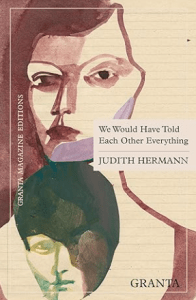
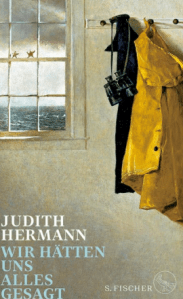
We all have authors whose every book we read. For me, Judith Hermann is one of those authors. She’s best known for her short stories but has also written novels and now, finally, her long awaited first memoir. Or rather a series of lectures on life and writing that reads like a memoir. We Would Have Told Each Other Everything will be published in English next April. Two of her short story collections, Summer House, Later and Nothing but Ghosts are available in English. Her third short story collection Lettipark, a book of five connected stories, Alice, and her two novels Aller Liebe Anfang (Tony just let me know this and Letti Park were translated) and Daheim don’t seem to have been published in English.
Hermann is a bit of a phenomenon. Her first short story collection, Summer House, Later, which came out in 1998, was published to high acclaim. Critics and readers adored it. Nobody had written quite like her before. She seemed to capture the lifestyle and mood of a whole generation – the generation of those who were in their twenties in the late 90s. She wrote about things other people didn’t write about. Young people hanging out, travelling, doing nothing, just living their life. Most of the stories are set in Berlin, Judith Hermann’s hometown. I loved that book so much, found myself in so many of the stories and have been a loyal reader ever since. Sadly, even though I liked almost everything she has written, I found, like many of her critics and readers, that she was never able to achieve again what she had achieved in her first book. Some critics were already harsh when the first book came out. Over the years the criticism got worse. I never really understood why the reviews were at times so harsh, even cruel. When her first novel came out, one critic wrote she couldn’t write and had nothing to tell. In the memoir Judith Hermann addresses this review and what she has to say is very interesting. In many ways, her response to this reproach lies at the heart of these lectures.
Judith Hermann has never spoken much about her life, her childhood, or where her inspiration came from. Her answers to certain questions were always evasive. The book explores in detail why this was the case and it also investigates what is autobiographical and how she transforms what she has experienced and turns it into literature. At the beginning of the book, she describes how she ran into her psychoanalyst, late one night in Berlin. She discovered this psychoanalyst through a friend who went to see him and then spontaneously decided to go to see him as well. It seems the friend’s therapy was already over when she began to see the therapist, nonetheless, she never told her friend, Ada, that she went to see him too. We learn that this was rather typical of her. She hardly ever spoke to people or told them anything about herself or her childhood. The more we read about her past, the better we understand why she was silent. The trauma of two world wars, mental illness, emotional abuse, were all part of her difficult childhood.
All her stories are inspired by her life, but nothing is recognizable as such. That is because of her writing technique. She writes draft, after draft, after draft, erasing every time what is closest to what happened to get to a deeper meaning and truth. Very similarly, her psychoanalyst taught her to write down a dream and then write it down again the next day and once more on day three. The thing that would be missing, would be the most essential element of the dream, the element because of which the dream was dreamt, so to speak. Talking about her writing she says that in the end she sometimes no longer knows what really happened and what didn’t.
When she read the criticism I mentioned before, she agreed with the critic. Yes, she really didn’t have anything to tell because she couldn’t really tell what was important.
A large part of the book is dedicated to her friendship with Ada and the group of friends that surrounded Ada. Many of these scenes reminded me of some of her stories. She spent a lot of time with these friends. They spent whole summers together in the house near the sea that belongs to Judith Hermann’s family. These scenes are so wonderfully evocative. The friendships she has with these people, particularly with Ada, are very intense. They experience so much together yet they don’t really talk. This chosen family, she says, showed a very familiar lack of words and speechlessness to her own.
The last part of the book is set during Corona and the early lockdowns. During that time, she moved to the countryside and made a new friend, Jon. They spent a lot of time together but this time, her silences aren’t easily accepted, almost cost her this new friendship. And that’s where the title comes from. There’s a moment during which she would have told Jon everything about her life. It doesn’t happen but she will tell him later why she is so evasive.
Many of the things she describes in this book are relatable to anyone who has suffered (childhood) trauma. So often, one can’t find a way out of silence. It’s often the whole purpose of a therapy to be able to finally tell someone everything.
I’m not entirely sure I managed to capture how much I loved this book. But I did. It will make my end of year best of. It was one of those books I didn’t want to end. She achieves something quite magical – she lets us know a lot about herself and her writing process, but she also allows us to discover ourselves more deeply. Just like she does in her best stories.
The German title of this book is interesting. During these lectures she mostly uses the word “erzählen” – “to tell a story”. For the title, however, she uses “sagen” – “to tell”. This shows, in my opinion, that she’s come full circle. She used to tell stories but left out most of what really happened in her life. Through the new friendship with Jon, and in writing these lectures, she breaks the silence and speaks about the things behind the stories. I wonder if there will be another novel or book of stories from her. In some ways it would make sense if this was her last book. I hope not though.
For those who don’t want to wait for the publication of the English book there is either a part or even the whole translation by Katy Derbyshire on the Granta website here.
 Beauty is a Sleeping Cat
I’ll get to this when I find a copy that won’t break the bank! By the way, ‘Aller Liebe Anfang’ has been translated into English as ‘Where Love Begins’ by Margaret Dembo.
Thanks for letting me know. I’ll edit that. It didn’t come up in my searches. Weird.
I hate to say it, but I think she’s also done ‘Letti Park!’ (2018, The Clerkenwell Press’).
My google skills are rubbish.
I’m so pleased you’ve reviewed and enjoyed this book, which I read in German and reviewed earlier this year. I’ve also enjoyed her other books and think it’s partly her elegant style which kind of captivates one as a reader. Here, too, it was the account of her upbringing I loved, and her struggle to articulate that, and to put things which lay beneath onto the page. I find myself reading a lot of memoir at the moment, so this book really spoke to me. I’m so pleased too that you mentioned the extract in the Granta Deutschland as that’s where I discovered this book.
How nice to know you liked it too and like her other writing as well. I never understood the criticism of her writing style. I think it’s wonderful.
I read a lot of memoir too at the moment but this stood out. It was so captivating. Her family history is unbelievable. It must have been so tough.
This sounds wonderful. I’m so interested in how she found silences in her chosen family similar to that of her birth family. I’ve never read this author but you’ve absolutely convinced me to give her a try.
I’m glad to hear that. Her first short story collection is amazing and it might be a good starting point before reading this. But you could also read only this. I loved it so much.
Wonderful review, Caroline! I read ‘Summerhouse, Later’ after you recommended it, and I loved it. Unfortunately, haven’t read another Hermann since. Hoping to read Nothing But Ghosts one of these days. So nice to know that she has come out with her memoir and it is wonderful! Can’t wait to read it when the English translation comes out! Thanks for sharing your thoughts 😊
Thank you, Vishy. Nothing But Ghosts is wonderful too. I also liked Lettipark which has apparently also been translated. It will be interesting to then see what she writes about some of the stories. This book is really amazing. I just mentioned a tiny snippet. It is very rich and multilayered.
Glad to know that Lettipark is translated too. Can’t wait for her memoir to come out in English. Hoping to start Nothing But Ghosts tomorrow 😊
That’s great news. I’m looking forward to a refresher. 😊
I enjoyed reading your review of this one, Caroline. I was going to say that someone else had also recommended this book to me, but then I remembered it was you 🙂 My memory is worse than your google skills.
I found the part about her writing technique fascinating, with those multiple drafts each getting further from the actual events but closer to a deeper truth, and how that mirrors the process of writing down dreams and looking for the missing piece.
Thanks, Andrew. Yeah my memory has been playing a few tricks on me lately too. Double challenge 😊
I think you’d like this book. It’s so rich. She has a lot to say about memory and writing. And parts are just enjoyable. Others are tough to read. I’m not much of a reread er but might reread this one. Tell me what you think should you read it.
Pingback: German Literature Month XIV Author Index – Lizzy’s Literary Life (Volume 2)