The Canadian Book Challenge 6

I was hoping to find a Canadian Literature Challenge. These days I’m very interested in literature written in English outside of the UK and the US. The Canadian Book Challenge seemed just the thing I was looking for. I came across the challenge on Gavin’s blog Page 247.

The host is John Mutford from The Book Mine Set. His blog is dedicated to Canadian literature. If you are interested here’s the sign up post with all the details you need to know. In theory the idea is to read 13 books. It sounds like a lot but interpreting what John writes I would say it doesn’t seem as if you must reach that number. Aim for it, if you read less, it’s not the end of the world, if you read more, all the better.

I have a lot of Canadian literature on my book piles and have read quite a few authors in the past. Authors writing in English and in French. I asked and if you’d like to join, you can choose books written in English or French as long as the author or the topic is Canadian.

I know that I usually do not stick to my book lists but I still keep on making them. Possible choices for this challenge are

A Map of Glass by Jane Urquhart. Urquhart isn’t an easy writer but she is a fascinating one who writes beautifully.

Margaret Atwood’s Lady Oracle. Atwood is another immensely fascinating author I have meant to return to. I loved Cat’s Eye and Surfacing and some of her short stories.

The Birth House by Amy McKay. I haven’t read this author yet but everyone who read this novel was impressed.

The Stone Angel by Margaret Laurence is a book I discovered not too long ago on Danielle’s blog (A Work in Progress). It sounded like another Canadian must-read.

I would like to read the one or the other novel by Nancy Huston and some other Canadian authors writing in French.  Since I recently discovered Louise Penny’s Canadian crime series, I’ll certainly read one of those as well.

Are you joining? Do you have any Canadian literature suggestions?

Alvaro Mutis: Amirbar (1990) The Fifth Adventure of Maqroll

And if you want to change your life – for the better – and have never read the Colombian novelist Alvaro Mutis, you owe it to yourself to get acquainted with The Adventures and Misadventures of Maqroll. A collection of seven novellas that can be read at a run or singly, it features the greatest rainbow-chaser since Quixote, but a lot sexier and ravenous for both learning and love, not to mention fantastical, doomed schemes to make a pile of loot.

Alvaro Mutis is a Colombian author who lives in Mexico. He is famous for his stories about Maqroll the Gaviero (the Lookout). The Adventures and Misadventures of Maqroll – Empresas y tribulaciones de Maqroll el Gaviero is composed of seven novels and novellas which can be read as a whole or individually. Each tome is around 120 pages long and they seem to vary greatly in style and narrative technique. Some are like diary entries, others are letters, still others contain more straightforward story telling.  I’ve had  the novella Amirbar, part 5 of Maqroll’s story, on my book piles since years and never got around to reading it. Richard’s (Caravana de recuerdos) and Stu’s (Winstonsdad’s BlogSpanish Literature Month seemed like the perfect time.

Reading Amirbar was an amazing experience. While Mutis is compared to Conrad – although he himself calls Dickens his greatest influence – I felt he was much more like a Latin American Blaise Cendrars. Amirbar reminded me of Cendrars’ amazing book L’or – Gold but is still a very distinct book. It has also something of the Tales from the Thousand and One Nights.

All the Maqroll stories are told by a narrator who works for some big corporate company and meets his friend Maqroll in different countries and cities at different times. Maqroll is a mariner and adventurer who travels the world without ever settling down for long. The sea is his chosen home and when he is at land it’s only to make business, most of it either illegal or highly adventurous. Whenever he meets his friend, the narrator, he tells him all of the stories that have happened in the meantime. When they do not meet, he writes long and winding letters all containing fantastic stories as well.

At the beginning of Amirbar, Maqroll and the narrator are in the US. Maqroll is ill and almost dying, he has contracted some tropical fever. The narrator takes care of him and sends him to live with his brother in California for a while. It is there that Maqroll tells them the story of Amirbar – a gold mine.

This is how the novel begins (translation taken from the English version)

Los dias mas insolitos de mi vida los pase en Amirbar” nos cuenta Maqroll el Gaviero. En Amirbar deje  jirones de mi alma y buena parte de la energiaque encendio mi juventud. De  alli descendi tal vez mas sereno, no se, pero cansaado ya para siempre. Lo que uno despues ha sido un sobrevivir en la terca aventura de cada dia. Poca cosa. Ni siquiera el oceano ha logrado restituirme esa vocacion de soñar despierto que agote en Amirbar a cambio de nada.

I spent the strangest days of my life in Amirbar. In Amirbar I left shreds of my soul and most of the energy that fired my youth. Perhaps I came down from there more serene, I don’t know, but I was everlasting weary too. What has happened to me since then has been a matter of simply surviving each day’s difficulties. Trivialities. Not even the ocean could give back to me my vocation for dreaming with my eyes open; I used that up in Amirbar and received nothing in return.”

Maqroll is driven by the urge to find gold, not so much because of its monetary value as we understand but because it symbolizes much more to him. It’s an obsession, a magical metal, something that calls for him from the entrails of the earth in which it is buried. The mine is in the Colombian Andes. He first discovers another one but has to flee it when they find a grave with people who have been murdered by some sort of Military Junta. Finding the skeletons puts them in grave danger. The next mine he explores is Amirbar. The wind in the tunnels systems of the mine seems to have a voice and what it is calling is the word “A-mir-bar” which has a special meaning for Maqroll.

One of the traits of Maqroll is that he has a lover wherever he is. In Amirbar it is Antonia who gets unhealthily attached to him. The relationship between Maqroll and Antonia is one of many small side stories in the book, one of many stories which turn into a desaster. Another important trait is Maqroll’s love of books. He is always reading. Most of the books he reads are obscure historical texts. He loves to immerse himself in another era and read about people who are long gone.

As fantastic as some of the stories sound they are infused with a high dose of realism. Set in a corrupt country, some of the characters are arrested, the gold is confiscated more than once and those who help Maqroll end up in prison and are tortured.

You can easily read Amirbar or any other story on its own but one thing is for sure, it will very probably make you want to read them all. I’ve read a few reviews since I started the book and it seems Amirbar isn’t even the best of the stories. In Maqroll Mutis has created some sort of alter ego, a character who feels so real that in his real life Mutis speaks about him with his friends as if he really existed.

Amirbar is a wonderful book, full of life, stories and tales. Reading it is an adventure in itself. I think it would be an excellent introduction to Latin American literature because despite of its complexity and exuberant story telling it is a very accessible, entertaining book.

Amirbar is a contribution Richard’s and Stu’s Spanish Literature Month.

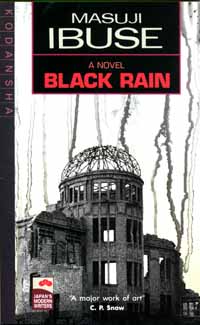
Literature and War Readalong July 30 2012: Black Rain – Kuroi Ame by Masuji Ibuse

When I saw Black Rain mentioned by Gary (The Parrish Lantern) on Rise’s blog (in lieu of a field guide) last year, I knew I wanted to include this book in this year’s readalong. Last year we read Marguerite Duras’ Hiroshima Mon Amour and I’m really curious to find out how this horrible event will be treated by a Japanese author. John Hersey’s Hiroshima and Ibuse’s Black Rain are said to be the most important novels on the horror of Hiroshima.

Here are the first sentences

For several years past, Shigematsu Shizuma, of the village of Kobatake, had been aware of his niece Yasuko as a weight on his mind. What was worse, he had a presentiment that the weight was going to remain with him, unspeakably oppressive, for still more years to come.

*******

The discussion starts on Monday, 30 July 2012.

Further information on the Literature and War Readalong 2012, including all the book blurbs, can be found here.

On Jacques-Pierre Amette’s Le Lac d’Or, Léo Malet’s New Mysteries of Paris and Eugène Sue’s Mysteries of Paris

Unfortunately there is no English translation of Amette’s excellent crime novel Le Lac d’Or whose title is the name of a Chinese restaurant that is an important refuge for the main character in this book and aptly indicates the setting, Chinatown in Paris. Only one of Amette’s numerous books – the Goncourt Prize winning  Brecht’s Lover  or La Maîtresse de Brecht – has been translated so far.

It’s a pity as Le Lac d’Or (2008) is a great read and it’s no wonder he has been compared to Léo Malet and Georges Simenon. Like Malet’s Fog on the Tolbiac BridgeBrouillard au Pont de Tolbiac, Amette’s novel is deeply rooted in the 13th Arrondissment. Place d’Italy, Pont de Tolbiac, Chinatown. It’s not one of my favourite arrondissements but it’s a part of Paris nonetheless. In any case, the 13th is one of those arrondissements that hasn’t any tourist appeal. It is an area with many atypically high buildings, concrete passageways, bridges and as said before, Paris’ Chinatown. But not even Chinatown is very picturesque.

At the heart of the novel is police inspector Barbey who has to investigate the murder of a prostitute. Chloë wasn’t a simple prostitute, she was a police informant and his ex lover. Why they split is not clear as they seem to have been made for each other, what is clear however is that the separation still hurts him, even some years later.

At the time of her murder Chloë was informing on a group of gangsters who regularly rented a few rooms in a hotel in the 13th. They have plenty of reasons why they would want Chloë dead. Reasons and opportunity.

The ending is not what one would expect but it isn’t completely surprising either. Amette’s strength is the description of a lesser known Paris and his likable but sad and exhausted inspector. There were a few interesting bits on the murder of a prostitute and that people think far less in terms of victim when the person who has been murdered was a prostitute. The most important aspect however is that this book is rooted in a tradition that started with Eugène Sue’s Mysteries of Paris.

The book put me in the mood to read some of the Léo Malet titles I haven’t read yet, one of which the afore-mentioned Brouillard sur le Pont de Tolbiac – Fog on the Tolbiac Bridge. Or Eugène Sue. Malet followed Eugène Sue’s famous Les mystère de ParisMysteries of Paris, calling his series the “new mysteries of Paris”. Each of his short and taut books is dedicated to another Parisian arrondissement.  I liked all of those I read. He captures the places well, the stories are interesting, the tone is unique.

If you look for a Paris-set series in English, then I’ve heard that Cara Black is quite good but I haven’t tried her yet. I think she also changes arrondissements from one book to the other.

Have you read Léo Malet or Eugène Sue? Or Amette’s Brecht’s Lover?

This post is my first contribution to Karen’s and Tamaras‘s event Paris in July.