Madame de Lafayette: The Princesse de Monpensier – La Princesse de Montpensier (1662)

The Princess of Montpensier

I’m not a re-reader but I have read Mme de Lafayette’s La Princesse de Clèves at least four times. It is my favourite novel. For its style as well as for the story. There is something in the way Mme de Lafyette describes feelings that touches me profoundly. She wasn’t a very prolific writer. Before publishing La Princesse de Clèves (1678) she published La Princesse de Montpensier (1662) anonymously and later La Comtesse de Tende. Zaïde (1670/71) was published shortly after La Princesse de Montpensier. Although Zaïde was published under a pseudonym, it seems to be sure that it was also written by Mme de Lafayette.

Generally I’m not so much into the literature of the 19th century, I often feel that earlier writers, especially some of the French ones, are far more modern and original. This is certainly the case of Mme de Lafayette. Until a few days ago I had not read anything else by her but I bought a book called Nouvelles galantes du XVIIè siècle (it contains stories by Mme de Lafayette, Saint-Réal, Du Plaisir and Catherine Bernard) and finally read La Princesse de Montpensier.

It is a short novella but it’s as wonderful and as astonishing as her masterpiece. Her style is flawless, it is pure perfection. I particularly like her use of the passé simple and the indirect speech. The language is as fresh as a newly cut rose, it hasn’t aged one day.

Mme de Lafayette was an innovator. Before her most of the baroque novels, like d’Urfés L’Astrée, were thousands of pages long. To be this concise and precise like she was, was unheard of before. She was also one of the first to write historical fiction. The people in her books did exist, however the story is invented.

La Princesse de Montpensier is set during a very tumultuous period of French history. It starts 1566,  during the civil war in which Catholics and Protestants fought a bloody battle, and ends in 1572 at the time of the horrible massacre of the Nuit de La Saint-Barthélemy or The St.-Bartholomew’s Day Massacre.

La Princesse de Montpensier and the Duc the Guise are secretly in love with each other. They are very young and hope to get married but for political reasons her family decides otherwise and marries her to the Prince de Montpensier. This is a great tragedy for the princess. She doesn’t love her husband and when conflict breaks out she is glad to see him go to war. Montpensier leaves the Comte the Chabannes with her, not knowing how much in love the Comte already is with the princess as well.

This is a time in which women do hardly ever choose their husbands and adultery is very common. The princess is an extremely beautiful woman and it isn’t surprising that there are many men falling for her. She fights them all off until the day when she sees the Duc de Guise again. A qui pro quo and the intense jealousy of her husband accelerate the story. The end is somewhat unexpected and tragic.

I was thinking of Kleist while reading this novella and saw once more how much German changed while French has pretty much stayed the same since the 17th Century. La Princess de Montpensier is 150 years older than Kleist’s The Duel but it feels so much more modern.

I really loved this story and will soon read La Comtesse de Tende as well. I cannot believe that this was only 50 pages long, it feels as if I had read a novel, it is so rich. The five main protagonists are all equally well developed. All five of them are hurt and we feel for all of them. We know the society is to blame for their tragedy but Mme de Lafayette wouldn’t be Mme de Lafayette if she didn’t pick one particular person and blame her.

Still, if you have never read anything by her, I would recommend to start with The Princesse de Clèves but this little book is very beautiful as well.

I would love to watch Bertrand Tavernier’s movie La Princesse de Montpensier. Has anyone seen it?

Epigonism and Lack of Fair play Among Book Bloggers

I have never in 1 year and 5 months of book blogging felt the urge to remove someone from my bloggroll because they were not playing fair.

But there is a first time in everything and that’s why today I had to remove a blogger’s name from the roll.

Said blogger has been writing posts for a long time and should know about book blogging fairness.

If you see something on another persons blog and you like it… You say so. You may also spread the word. If you like it so much that you feel you have to copy it… You say so and give credit.

If you don’t, you don’t play fair.

The only consolation I have is the fact that epigonism is a very unattractive trait.

No matter how many visitors and hits you get at the end of the day you lose your integrity. There is a lack of generosity in this type of behaviour that is very off putting.

I cannot change other people but I can try to be different that’s why

I wish that

I may  never feel inspired by someone’s idea and copy it without giving proper credit

I may never review a book without revealing on whose blog I discovered it

I may never be non-supportive if someone does something out of the ordinary

I may never be jealous of another blogger’s achievement

And the most important thing of all is

I wish that

I may never forget why I blog – to connect


Fyodor Dostoevsky: Poor People/Poor Folk – Бедные люди [Bednye lyudi] (1846)

Presented as a series of letters between the humble copying-clerk Devushkin and a distant relative of his, the young Varenka, Poor People brings to the fore the underclass of St Petersburg, who live at the margins of society in the most appalling conditions and abject poverty. As Devushkin tries to help Varenka improve her plight by selling anything he can, he is reduced to even more desperate circumstances and seeks refuge in alcohol, looking on helplessly as the object of his impossible love is taken away from him.

Poor People – or Poor Folk, depending on the translation – was Dostoevsky’s first novel. Published in 1846 it was highly acclaimed by fellow writers and critics alike. At only 24 Dostoevsky became a literary celebrity. It is generally not considered to be his best book, his masterpieces were still to come, but it already contains many of the elements that made Dostoevsky famous.

I must admit this was not an easy read. The style is simple and descriptive but the story was unsettling and depressing and it did ring unbearably true.

Poor People is an epistolary novel set in St.Petersburg among the very poor. The letters are exchanged between a young orphaned woman, Varenka,  and an elderly distant relative, the copy-clerk Devushkin, who loves her very much.

Those two poor people live very close to each other but have to hide their friendship as it could be misunderstood. The descriptions of Varenka’s past, how her parents died and mean people pretended to take care of her while in reality there was only abuse, are paired with Devushkin’s descriptions of the way he is living. Although he is very poor himself he tries to help the fragile young woman and sends her what little money he has. In order to save money he left his old apartment after his landlady died and moved into another place. In this apartment he lives with a great number of equally poor people together in close quarters. He really only occupies a little corner of the kitchen that is separated from the rest by a piece of fabric.

He doesn’t even mind living like this at first as he can see Varenka’s windows from his room but after a while it gets harder for him. In their letters they try to comfort each other and describe in great detail how they live. The tone is very emotional, there isn’t much they hold back. On some days they are cheerful and will write about nice things they have seen or experienced but on most other days they are in despair and very sad. Varenka is often ill and can’t work while Devushkin has a hard time to hide his poverty at work. His clothes are shabby and would need mending, he loses his buttons, his shoes have holes and the soles are coming off. The poorer they get, the worse they are treated by others, also from those who are as poor as they are.

As if matters were not bad enough, Devushkin spends what little money he has on alcohol. He invariably pays his escapades with fear and shame. One misfortune follows another as they have little or no means to prevent them.

Varenka is a very intelligent young woman. Unlike Devushkin she is educated and likes to read. She loves Pushkin and Gogol. In some of the letters and a little notebook that she sends to Devushkin, she describes her childhood. These are wonderful passages that capture the life in the country, the changing of the seasons. She describes with great detail how golden the autumn was in the country, how wonderful winter could be because they would sit around a fire and tell stories. These passages show how masterful a writer Dostoevsky is.

Devushkin on the other hand tells her what he sees when he goes out in Petersburg. It makes him sad to see beautiful rich women and to know how arbitrary it is to be either born poor or rich.

One of the themes of the novel is the arbitrariness of poverty and how prejudiced the rich are. They treat the poor as if they were contagious. On the other hand they like to see them because it makes them feel superior. For that very same reason they  like to give them alms. The lack of privacy makes matters worse. Living with so many or being stuffed into a tiny office space with many other clerks exposes you constantly to the prying of others.

It seems as if one should never undergo a certain level of poverty, once you fall below there is no getting up anymore. There are numerous little stories of other poor people who fall ill and of children who die because no medicine is available.

Devushkin and Varenka are amazing characters. Despite their destitution they always think of each other first and if they receive just a little bit of money from somewhere they will give to those who have even less.

Reading this in winter, when the days are getting shorter and it is getting colder was really not easy. It’s depressing and sad. I thought of a documentary that I watched not long ago about Russian pensioners and some of those people lived in the same dirty, shabby and unhealthy tiny apartments. I remember one old woman, sitting in a box-like room, crying all through the interview. She had hardly any food, no heating, her clothes were rags. And this in Europe in 2011.

I didn’t enjoy reading this but on the other hand I felt very bad for thinking like this. Those who live under such conditions cannot just decide to walk away from them. Who am I to want to shelter myself from reading about such things?

I accidentally landed in a slum once, in Fort-de-France, Martinique. I felt really miserable, not because I thought it was dangerous, (maybe it was, no clue) but because it felt like prying. By walking between the shacks I could see into the homes of these people, they had no windows or doors and I felt like a voyeur. I was then asked angrily what the heck I thought I was doing but they understood, that I had lost my way and once they realized it wasn’t curiosity, they were very helpful.

It is really in bad taste but apparently it is part of many a guided tour in Brazil to pay a visit to the favelas.

I have read a few of Dostoevsky’s books, Crime and Punishment, The Gambler, Memoirs from the House of the Dead, with the exception of the last, they didn’t seem this depressing and I liked them very much.

I still got White Nights, Notes From Underground and The Brothers Karamazov to read. But not just yet.

I didn’t include any quotes as I’ve read this in a German translation. I like the German cover a lot.

The Winners of the Giveaway of The Sorrows of Young Werther

Thanks to Music Box Films two people will soon be able to read The Sorrows of Young Werther, Goethe’s famous first novel.

The movie Young Goethe in Love,that has just been released by Music Box Films and can be watched in cinemas in the US right now, is based on the novel and Goethe’s own story.

The winners of our giveaway are

Michelle from booksandboston and

Professor Batty from Flippism is the Key

Happy reading to both of you!

Please send me your address via beautyisasleepingcat at gmail dot com

http://www.youtube.com/watch?v=rh12UDNNM2g

Alexandra Johnson: A Brief History of Diaries – From Pepys to Blogs (2011)

I regularly find interesting non-fiction (and fiction) book reviews on Tom’s blog A Common Reader. I don’t always get to read the books right away which is a pity. There were two exceptions recently however,  A Brief History of Diaries that I have just finished (here is Tom’s review) and David Bellos’ Is That a Fish in Your Ear? which I’m still reading (Tom’s review is here).

A Brief History of Diaries is exactly what the title indicates, a short but nevertheless interesting overview of the tradition of journal keeping. Alexandra Johnson won the PEN award for Hidden Writer which I bought earlier this year and will be reading very soon as well.

I’m very interested in this topic as I’ve been keeping a diary since the age of 11. I don’t know how many thousand pages I’ve written because I do not read them very often anymore. This has reasons which would fill a few posts but I’d like to leave the stage to Johnson’s book for the time being.

The book is divided into 5 chapters. The first is dedicated to the innovators, the very first people who kept a diary. The apothecary Luca Landucci is among them. If you’d like to read an eyewitness account of the burning of Savonarola, this is the place to go. John Dee and Samuel Pepys can be found in this chapter as well. I think if you would like to know more about 17th century London, including the great fire, Pepys is the source to consult.

Chapter 2 is one I’m personally less interested in, its focus are the Travel and Explorer Diaries. I’m familiar with Ibn Battuta’s diary because it’s an early source for cultural anthropologists. Johnson included in this chapter Western pioneer travel diaries which sound very interesting.

Chapter 3 gives an overview of the diaries of artists and writers. I found many I would like to read or at least browse. Sonya Tolstoy, about whom Johnson writes extensively in Hidden Writer, is mentioned as well as Katherine Mansfield, Virginia Woolf, Sylvia Plath and May Sarton. The appeal of these diaries is to see how some sketches, little incidents, ideas are later incorporated into novels. We can follow the seed and watch it grow into a plant.

Chapter 4 is dedicated to war diaries. Those of the poets of WWI are mentioned (Sassoon, Owen, Graves) as well as the two famous WWII diaries by Anne Frank and Etty Hillesum. I wasn’t aware that there are two Anne Frank diaries. It’s interesting because the two diaries show the emergence of a writer. The first is just the diary of a child noting all that happens but later, she rewrote the diary. Her father seems to have thought it best to publish the early original first. The full unabridged version was only published in 1997. A war diary I’d never heard of before but which I would love to read is Mary Chestnut’s Civil War diary.

Chapter 5 is about digital diaries. I do not consider my blog like a diary at all and I would never use an online diary. I’m a fan of handwriting and have always been. I choose my pens and ink carefully. Choosing a new diary is a big ritual. So I was far less interested in this chapter and it’s also very brief.

This book is, as it states in the title, only an introduction, but it’s very well done and the bibliography at the end of the book is valuable.

I like reading diaries and have quite a collection. There are quite a few I haven’t read yet but I am looking forward to reading them. A major reading project next year, should actually be dedicated to diaries and memoirs. I’d like to read the diaries of May Sarton soon but I also got one by Cesare Pavese and just bought the first volume of the Journal of the brothers Goncourt. Of those I have read so far the one I liked the most was the one by Katherine Mansfield and those by German writer Brigitte Reimann.

Do you like reading diaries? Which were the diaries you liked the most?

Last Hurrah – Wednesdays are Wunderbar – US Only Giveaway of The Sorrows of Young Werther

Although German Literature Month is over, Wednesdays are Wunderbar has a last installment. During German Literature Month we were contacted by Music Box Films to make us aware of the German movie Young Goethe in Love which is currently shown in US theaters. The movie is based on Goethe’s early years and his first novel The Sorrows of Young Werther.

You can find the details for the movie here Young Goethe in Love.

To get you in the mood for the film, we are able to give away three copies of Goethe’s famous heartbreaking novel in the Vintage Classics Edition, courtesy of Music Box Films.

A major work of German romanticism in a translation that is acknowledged as the definitive English language version. The Vintage Classics edition also includes NOVELLA, Goethe’s poetic vision of an idyllic pastoral society.

If you would like to win one of the books, please levae a comment on this or Lizzy’s blog. Lizzy and I will collect all the entrants on both of our blogs and then draw the winners.

The giveaway is US only. The winners will be announced on Sunday 11 December – 18.00 European time.

http://www.youtube.com/watch?v=rh12UDNNM2g

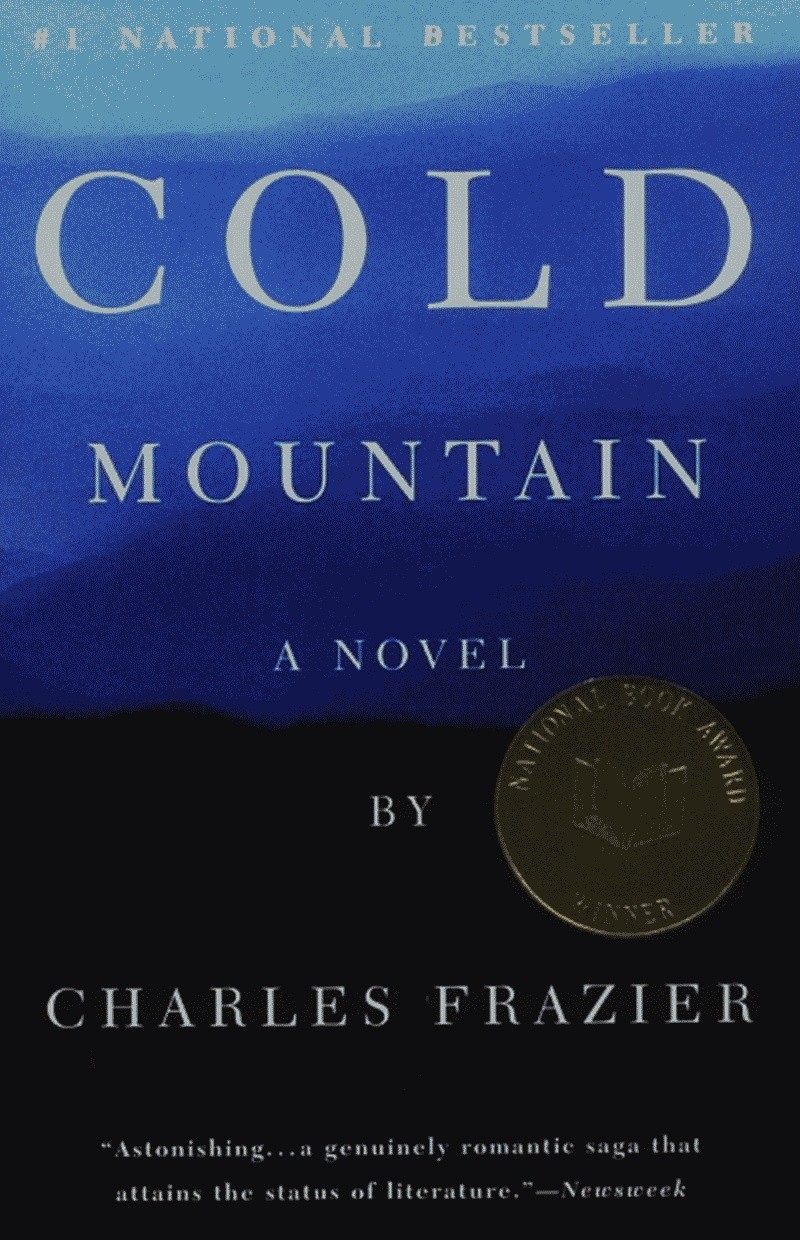
Literature and War Readalong December 30 2011: Cold Mountain by Charles Frazier

While I’m busy collecting the titles for next year’s Literature and War Readalong I should not forget to make you aware that there is still one more book on the list for 2011. Initially I had chosen two books on the US Civil War but German Literature Month made me remove The Killer Angels from the list.

This year’s last readalong title is Charles Frazier’s Cold Mountain. I’ve watched the movie a while back but don’t remember all that much apart from a stunning cinematography. I’ve heard a lot of good things about the novel and especially the friendship between the two women is said to be very compelling so I’m really looking forward to reading it and find out if I will like it or not. For some reason I think it’s a particularly good choice for December.

For those who have no idea what it’s all about and whether or not it’s worth joining here’s the blurb.

Charles Frazier’s debut novel, Cold Mountain, is the story of a very long walk. In the waning months of the Civil War, a wounded Confederate veteran named Inman gets up from his hospital bed and begins the long journey back to his home in the remote hills of North Carolina. Along the way he meets rogues and outlaws, Good Samaritans and vigilantes, people who help and others who hinder, but through it all Inman’s aim is true: his one goal is to return to Cold Mountain and to Ada, the woman he left behind. The object of his affection, meanwhile, has problems of her own. Raised in the rarified air of Charleston society, Ada was brought to the backwoods of Cold Mountain by her father, a preacher who came to the country for his health. Even after her father’s death, Ada remains there, partly to wait for Inman, but partly because she senses her destiny lies not in the city but in the North Carolina Blue Ridge.