Literature and War Readalong September 2012: Peace by Richard Bausch

This year’s readalong is a chance for me to read some of the great novelists and authors I hadn’t had an opportunity to read before. Since I’ve first read something about Richard Bausch he was on my list of authors I must read. He is quite famous as a short story writer, his work has appeared in numerous collections and magazines. Peace (2008) is set in Italy during WWII. This isn’t a tale of the home front but from the point of view of American soldiers. It is towards the end of the war, in 1944. Critics called it one of the best books they’ve ever read. A.L. Kennedy called it, lean, compact, layered, darkly humorous, unflinching and lyrical.

Here are the first sentences

They went on anyway, putting one foot in front of the other, holding their carbines barrel down to keep the water out, trying, in their misery and confusion – and their exhaustion – to remain watchful. This was the fourth straight day of rain – a windless, freezing downpour without any slight variation of itself.

*******

The discussion starts on Friday, 28 September 2012.

Further information on the Literature and War Readalong 2012, including all the book blurbs, can be found here.

Aharon Applefeld: The Story of a Life – Sippur chajim (1999) Literature and War Readalong August 2012

In his memoir The Story of a Life acclaimed author Aharon Applefeld tells the story of his childhood and how he came to be a writer. He starts by describing his earliest memories, the beauty he experienced, the love he received from his parents and grandparents. Most prominent in his memories is his last summer holiday as a child of five when he and his parents visited the grand parents in the Carpathians. Little Aharon’s parents are quiet people. They don’t talk a lot and Aharon learns early just to observe, be in the moment and absorb everything around him, the light, the scents, nature. These sensory memories will haunt him all his life. But this idyllic summer is the last peaceful moment of his childhood. Hitler comes to power, war breaks out. At first the family lives in a ghetto, later on they are transported to the camps. Both his parents are killed, his mother right at the beginning of the war. After having lost his father as well, Aharon escapes into the forest where he lives for years until he joins others. Together they first walk from the Ukraine to Italy and from there to Palestine, their new home.

The memoir is a book of a rare beauty. It taps into the deepest recesses of the soul where vague and sensory memories are stored. Because he was a child and a taciturn child at that, he is lacking words for what has happened to him. This makes this memoir so amazing, it’s like watching someone feel around, probe and slowly approach the right words to convey what it was like. Fleeting memories and strong impressions are mixed. Some people, some stories stand out but a lot is just like shadows on the wall.

The loss of his mother tongue leads to further fragmentation. In his family they spoke three different languages, on his long escape to Italy and from there to Palestine, there are more languages spoken and when he finally arrives in Palestine he has to let go of all of them and learn a new one, Hebrew. This is all painful.

I’ve read all sorts of WWII accounts and novels but they never focussed on orphaned children. It’s hard to imagine what it means to lose your parents, your home, your mother tongue. And Palestine wasn’t as welcoming as one would think. Especially not when you felt you wanted to talk about what happened and later to write about it.

Applefeld had to overcome an incredible amount of obstacles before becoming the writer he is today. He had to dig out his memories from where they were buried, find the right words, find the right language. He had to fight hostility too. Every single one of his books is an attempt to capture what happened to him and how it felt.

The Story of a Life is in part exactly that, the story of one man’s life, but more than that it’s a meditation on language and how to put into words, make palpable what is just a fleeting sensory impression. No wonder the cold, the wind, the rain are things which catapult him back to the war years. The war, he writes, is stored in his body, his bones. Because he was so little at the time, lacking the ability to fully comprehend and put into words what happened, the memoir and most of his novels, it seems, are more like a search, a quest almost for what once was, an attempt at conjuring up what was lost.

This is a book I can highly recommend even to those who are tired of reading about WWII and the Holocaust. It is a rich, inspiring and very meditative book about life and how to tell one’s story.

Other reviews

Danielle (A Work in Progress)

Judith (Reader in the Wilderness)


*******

The Story of A Life was the eighth book in the Literature and War Readalong 2012. The next one will be Richard Bausch: Peace. Discussion starts on Friday 28 September, 2012.

Literature and War Readalong August 31 2012: The Story of a Life – Sippur chajim by Aharon Appelfeld

I haven’t read a lot of literature written by Israeli authors which is one more reason why I was keen on including Aharon Applefeld’s The Story of a Life – Sippur chajim. But that’s not the only reason. The Literature and War Readalong is also an opportunity for me to read some highly acclaimed authors I haven’t read before. The first time I read something about Aharon Applefeld I was surprised to find out that some poeple think he is one of the finest writers alive. An exquisite writer with a sense for language and style.

The Story of a Life is a literary memoir, one of my very favourite genres. At the outbreak of WWII Aharon Appelfeld was living in Romania with his parents, middle-class Jews. His memoir tells about a boy coming-of age during one of the worst periods in history. Applefeld had to endure a lot – the loss of his mother, the ghetto, escape, traversing many countries – until he found a new home in Israel. The book tells this story. If the whole book reads like the quote below I think we are in for a treat.

Here are the first sentences

At what point does my memory begin? It sometimes seems to me as if it only began at four, when we set off for the first time, Mother, Father and I, for a vacation into the heart of the shadowy, moist forests of the Carpathians. But I sometimes think that memory began to bud from within me before that, in my room, next to the double-glazed window that was decorated with paper flowers. Snow is falling and fleecy soft flakes are coming down from the sky with a sound so faint you cannot hear it. For hours I sit and gaze in wonder, until I merge with the white flow and drift to sleep.

*******

The discussion starts on Friay, 31 August 2012.

Further information on the Literature and War Readalong 2012, including all the book blurbs, can be found here.

Masuji Ibuse: Black Rain – Kuroi Ame (1969) Literature and War Readalong July 2012

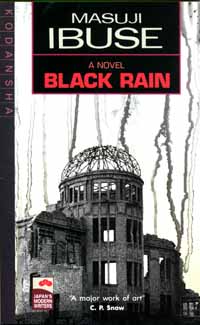
Reading Masuji Ibuse’s Black Rain was an intense experience. Beautiful and horrifying. In all honesty though I have to say the horror prevailed and I have to contradict those who say it’s not depressing. For sure, Ibuse isn’t a manipulative writer, he doesn’t strive for emotional reactions in his readers, but still, I couldn’t help being affected by what I read as no amount of toning down – something Ibuse has been accused of – can minimize the atrocity of what people had to endure on August 6 1945, in Hiroshima and the days and months that followed the bombing.

I think one hast to call Black Rain a documentary style novel. In order to write the book Ibuse has used real diaries and notes of victims and incorporated them in his book. Additionally the descriptions are so detailed and often matter-of-fact that the book reads in parts like a non-fiction account.

The main story is the story of Shigematsu Shizuma’s niece Yasuko. She would like to get married but a marriage is endangered as there are rumours that she got in the Black Rain after the bombing of Hiroshima and suffers of radiation sickness. Shigematsu himself is afflicted by a mild form of radiation sickness which he tries to fight by eating as healthily as possible and with mild exercise and a lot of rest. At the beginning of the novel which starts a few months after the bombing, Yasuko shows no signs of sickness at all. In order to help his niece and to prove that she didn’t get in the Black Rain and is not ill, Shigematsu starts transcribing his niece’s and his own diary covering the days before and after the bombing. The diaries are meticulous and incredibly detailed accounts of those days. The novel moves back and forth between the diary entries of August 5 – 15 and the present in which the entries are copied.

I have seen pictures of Hiroshima and read a few things but never anything like this book which was absolutely overwhelming in its details and the way it captured human suffering. The descriptions always move back and forth between individual and collective experiences. There were descriptions of people who had only mild burns and some whose whole body was an open wound. Some died in agony, some in grotesque positions. There were descriptions which showed how some people afflicted by radiation sickness a few days or weeks later died suddenly while others agonized for months. Towards the end there is a real account of a doctor who served in the infantry and was almost directly under the bomb when it exploded. It was unbearable to read about the suffering he went through.

I was surprised to see what an important element food is in the book. We read detailed accounts of what food was available during the war, how it was prepared and how they had to substitute a lot. Food is also one of the major elements in a successful treatment of radiation sickness. It was fascinating and sad to read.

What shocked me more than anything else, more than the descriptions of the wounded humans and animals and the ensuing total chaos, was the utter helplessness which was expressed in the way how they spoke about the bomb. They had no clue what had happened. They knew it was something unheard of,  never used before, but they didn’t know anything specific. What were the effects? Were burns the only thing or would there be more to come later? How did you treat radiation sickness? Days later they find out what had hit them.

“The name of the bomb had already undergone a number of changes, from the initial “new weapon” through “new-type bomb” to “special high-capacity bomb.” That day I learned for he first time to call it an “atomic bomb”.

The confusion and helplessness of the people is terribly sad. Even more when you read how they started to realize that even people who were not in Hiroshima on August 6, but part of rescue teams who came later, all died. This meant that each and every person who had been in Hiroshima on the 6th or came later would have to wait, sometimes for months, to be sure they were not affected by radiation.

After having read all this you will probably wonder why I called this book “beautiful”. I thought it was beautiful because the way Ibuse describes the Japanese culture, Japanese sensibilities, the descriptions of the food, the habits, some customs and many details of things we are not familiar with is full of beautiful moments like this description of Shigematsu’s childhood.

As a boy, Shigematsu had seldom come to the flat rock to play, but he had often been to play under the ginkgo tree at Kotaro’s place. When the frosts came and the ginkgo tree began to shed its leaves, the roof of Kotaro’s house would be transformed into a yellow roof, smothered with dead leaves. Whenever a breeze sprang up, they would pour down from the eaves in a yellow waterfall, and when it eddied they would swirl up into the air – up and up to twice, three times the height of the roof – then descend in yellow whirlpools onto the road up the slope and onto the oak grove.

Of course the same culture which had such a lot of beauty was also trapped in a destructive system of total obedience which is mentioned more than once in the novel. It takes a masterful writer to be able to convey so much insight into a culture and render a tragedy the way he did it. While Black Rain was not an easy book to read and has to be absorbed in small doses, I think it’s an outstanding book.  Without ever accusing anything or anyone Ibuse shows drastically that in the case of Hiroshima the end didn’t justify the means.

Other reviews

Danielle (A Work in Progress)

Judith (Reader in the Wilderness)

Rise (in lieu of a field guide)

Older reviews

Mel U (The Reading Life)

Gary (The Parrish Lantern)

The review is my first contribution to Bellezza’s Japanese Literature Challenge 6.

*******

Black Rain was the seventh book in the Literature and War Readalong 2012. The next one will be Aaron Applefeld: The Story of a Life – Sippur chajim. Discussion starts on Friday August 31, 2012.

Len Deighton: Bomber (1970) Literature and War Readalong June 2012

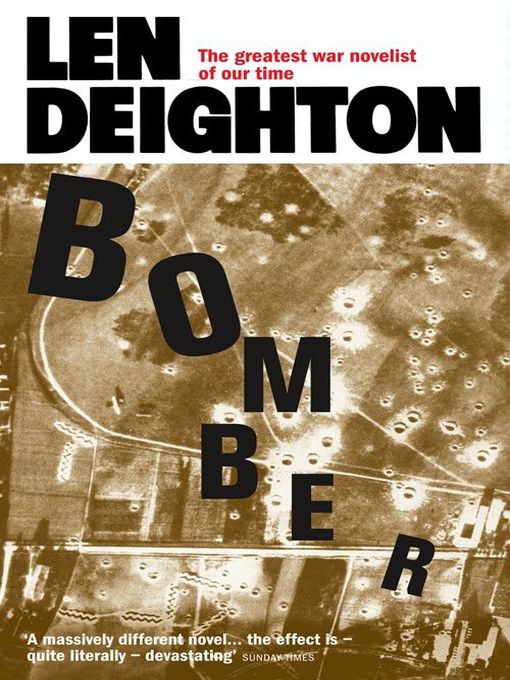
It is very rare that I abandon a book. Often I regret this persistence when I finish it anyway and have to find out that it simply isn’t good. Sometimes I’m incredibly glad I went on. Len Deighton’s Bomber was one of those. I struggled badly for 150 pages and the idea to have to go on for another 400 seemed daunting. But it was worth the effort, it really was and looking back, I have to say, how lucky this was part of my readalong or I would have given up and missed out greatly. Bomber is amazing. It’s maybe not refined and highly literary but it’s a huge achievement. Not only because it is extremely accurate and detailed but also because it’s very engaging and admirably well constructed.

Bomber is an epic. A book with a huge cast and numerous different settings and story lines. Deighton really needed 150 pages to set the scene and introduce everyone, including the different aircraft. That part was really challenging to read as there were so many names and one had to try to constantly picture a map to see where they were located. Once the set up was done, the story moved on nicely, all the different story lines were tied together, the characters had become more than just names but people with a story.

Bomber tells the story of a bombing raid that takes place on June 31st 1943. Deigthon deliberately chose a date that doesn’t exist, knowing well that his book felt so realistic and authentic that people would always end up assuming it was non-fiction.

The 31st is a full moon night and all the crews get ready for a night of bombing and fighting. The target is the city of Krefeld in Germany. The planes take off from Warley Fen, head towards Krefeld and have to try to not get shot down before they have dropped the bomb. But before they can drop a bomb

First the PFF Mosquito aircraft will mark the target with red markers. Their gear is much more accurate than anything we have, so their reds are what the Finders must look for. The Finders will put long sticks of flares over the reds. Mixed in with the Finder aircraft there are Supporters – and these are mostly crews on their first couple of trips – who are carrying only high-explosive bombs. That’s because incendiaries could be mistaken for red markers.

What you just read is part of the instruction the pilots receive before flying off. But this part is more than that, it points towards the core of the book because the tragedy of the story has it’s source in the fact that, due to many unlucky circumstances, the markers were dropped on the wrong targets and what was bombed was the small city of Altgarten. No factories, no strategic points, just civilian buildings.

The first third of the book, sets the scene, the next third describes a lot of action and how the mistake happened and the last third is describing the drama in the air and on the ground in a very graphic way. I had to swallow hard a lot of times.

What I liked is that Deighton described a wide range of German characters, from the fanatic Nazi to the likable soldier. The portraits are nuanced and we get a feel for the diversity of the people.

The British crews are equally diverse but for other reasons. There are also Canadians and Australians, upper class and lower class men, married guys and womanizers, men who just do their duty, cowards and heroes.

In the death scenes Deighton’s sympathies clearly lie with the German civilians and the British bomber crews. Each part has one or two main characters and a lot of secondary characters and the fate of the main characters is equally sad in all the parts. I cannot go into too much detail, if you want to read it, you want to find out for yourself who will survive and who will die.

I’ve read a few harrowing accounts in the past and the one or the other book has depressed me incredibly. Bomber didn’t depress me but it brought a few tears to my eyes, a thing that rarely if ever happens to me unless something sad happens to an animal.

Bomber offers an interesting mix of emotional story telling, accuracy and numbers. We are informed of everything. How many people were involved, how many died, how many were injured, how many bombs hit target, how many were jettisoned, how many missed or didn’t go off and so on and so forth. At the end of the book were also informed about each and every surviving character’s future. It’s as if Deighton wanted to answer each and every question someone reading his novel might have.

If you ever wondered what it is like to be in a city which is bombed, this book will bring you close to this experience. If you ever wondered what it is like to be in plane on a bombing raid, this book will allow you to experience this as well.  In any case, if you are interested in WWII and how it was fought in the air, this is the book you should read.

If you’d like to find out a few things about Deigthon and his other books don’t miss visiting the Deighton Dossier. It is a site dedicated to Deigthon’s work and it is done with a lot of passion.

Other reviews (I’m somewhat doubtful that there will be any)

*******

Bomber was the sixth book in the Literature and War Readalong 2012. The next one will be Masuji Ibuse’s Black Rain. Discussion starts on Monday July 30, 2012.

Harry Mulisch: The Assault – De Aanslag (1982)

The execution of a collaborator and Nazi retaliation on the family of twelve-year-old Anton Steenwijk have lasting repercussions in Anton’s life as he learns, through chance encounters, the truth of one harrowing night. 

Harry Mulisch is an author I have wanted to read for a long time. I know he is said to be one of the most important Dutch writers.  The Assault – De Aanslag is one of his most acclaimed novels and since it isn’t as long as The Discovery of Heaven, which I’d like to read sooner or later as well, I thought it’s a good starting point.

The book is told in a prologue and 5 sequences, each set in another year, 1945, 1952, 1956, 1966, 1981.

During the course of one single night, in the famine winter 45, just before the end of the war, the life of Anton Steenwijk, a twelve year-old boy, is changed forever.

The prologue describes the location. We get to know that the Steenwijk’s live in Haarlem, in a detached house, part of a housing project with three other houses. They are small but stately houses. At the beginning of sequence one, the family sits together in the darkened dining room, the only room they still inhabit in the icy cold apartment. Anton is reading, his older brother Peter is doing his home work, the mother spools wool and the father is trying to instruct them. A peaceful moment and despite the hunger Anton is enjoying it.

When they hear shots outside in the street, the peaceful moment is interrupted brutally. Looking out of the window they see that someone has been shot down in front of a neighbour’s house and immediately after this the neighbours come out and drag the man to the front of  Steenwijk’s house. Peter is the only one to react. He runs out and discovers that the man is a well-known police inspector and Nazi collaborator. He tries to drag the man away but before he gets very far, a group of Nazis approaches.

We learn later, that in those days, whenever a Nazi or a collaborateur was shot dead, the Nazis would severely punish those living in the houses close by.

This is exactly what happens. At the end of the night Anton’s parents and brother are shot and the house is destroyed. Anton is brought to his aunt and uncle who live in Amsterdam.

How do you go on living after something like this? How do you cope?

Each of the subsequent scenes shows us Anton at another point in his life. There is no conscious coping at first. It is as if he was numb and had forgotten everything right after it happened. His feeling for time is distorted. Whenever he thinks of that night he doesn’t feel much and thinks it’s much longer ago than it really is. Still the event seems to be guiding him in all of his choices and it is impossible to leave it behind for good. It is as if a secret force was at work and pushing him towards people who will help him uncover what happened really.

Survivor’s guilt may be an important theme but morality and fate or destiny are even much more important. While it was a pure coincidence that the dead man was shot in front of Korteweg’s house, Korteweg’s chose to drag him and leave him in front of Steenwijk’s house. Why? And if those who committed the assault had known that almost a whole family would be erased, would they still have done what they did? All these questions that Anton will start to ask many years later will be answered in the novel.

The book explores the question whether it is morally acceptable to commit a crime which will have severe consequences for others, in order to prevent bigger crimes and it explores also how people live with a trauma and repression. It shows in a very subtle way that although you may not be conscious of it, the trauma still lingers and wants to be acknowledged and express itself. It will find ways to make you pay attention. Pretty much like the elements in a dream which will return as long as you have not resolved some interior conflicts. The trauma can even make you choose a profession and it expresses itself in illness and accidents.

The way Mulisch shows the complexity and symbolism in which our subconscious tries to get our attention is amazing. What is equally wonderful is how evocative and expressive his descriptions are. When we open that book, we sit there with the family in the darkened room. We see the flickering lamp, feel the rough wool of an old pullover on our skin, the hunger churning in our bellies.

I didn’t like all of the parts equally well but one thing is for sure, part I 1945, is an amazing piece of literature and as a whole it is well worth reading.

I have read Harry Mulisch for Iris Dutch Literature Month. If you’d like to discover more Dutch books, make sure to visit her blog.

Has anyone read this or another of Mulisch’s book?

Nigel Balchin: Darkness Falls From the Air (1942) Literature and War Readalong May 2012

With ostentatious lack of concern, Bill Sarratt, his wife and her lover spend the war wining and dining expensively, occasionally sauntering out into the Blitz with cheerful remarks about the shattered night-life of London’s West End. But beneath the false insouciance lies the real strain of a war that has firmly wrapped them all in its embrace. Wit may crackle at the same pace as buildings burn, but personal tragedy lurks appallingly close at hand.

I have always wondered how people lived during the Blitz. How they coped with the fear, the chaos, the exhaustion and lack of sleep. I have seen a couple of movies set during WWII. Something that struck me more than once was the depiction of the Londoners during the Blitz. More than one movie showed them dancing or dining all through an air raid. Almost as if nothing was happening. I always wondered if this could have been the case. And what about the air raids that went on during the whole night? How would you cope with that? A lot of the questions I had have been answered by Darkness Falls From the Air. While I’m sure Blachin took some liberties and may have exaggerated, I think it still manges to give a good impression. It is one of the rare books that has been written during the Blitz which makes it especially interesting. Balchin worked as a psychologist for the British War Office and later as Deputy Scientific Advisor to the Army Council. Both occupations can be felt throughout the novel.

What I liked is how the main characters’ personal story, their marriage, work life and the war are interwoven.

In the beginning of the novel, the air raids aren’t as frequent at night and whenever a bomb falls down somewhere, Bill and his wife Marcia go and watch because it’s to a certain extent exciting. They do not feel threatened at all. They dine in underground restaurants and sleep in their own apartment. But the longer the war lasts, the more precarious the situation gets. People start to live in the tube and Marcia and Bill move to a hotel as their apartment house has no shelter. They still go out and dine underground and walk around the city to see the damage but it starts to become a bit less carefree. What gets to Stephen the most is the lack of sleep.

The day raids were dying down now. I suppose the pace was too hot to last. But to make up for it the nights were getting rougher than ever. The chief difficulty was to get enough sleep to keep going. Everybody was turning up at the office looking half asleep and sour as hell. I think it was this which led up to my row with Lennox. Lord knows there were enough reasons for quarreling with Lennox even if you were sleeping eight hours a night. When you got dow to an average of about three the thing was a certainty.

The narrator of Darkness Falls From the Air, Bill Sarrat, is a public servant. He must be one of the most cynical characters I’ve ever encountered in a novel. I didn’t expect this to be an amusing book but it was. Grim but funny. Passages like the one below illustrate what type a of person Sarrat is. He has an acute sense of the times he’s living in but at the same time he evades self-pity because he ultimately doesn’t take himself too seriously.

I’d decided that, what with work and Marcia and one thing and another, I was getting out of touch with the war. So I got out an atlas and Whitacker’s Almanack and so on and studied the war. That took about ten minutes. Then I tried forecasting the next bits. The last time Ted and I did that was at the beginning of the year. Ted put down that Germany would invade Switzerland, and that Japan would have a crack at Burma. I said that Germany would attack Hungary and Rumania and that Turkey would join up with us. The next morning Russia invaded Finland. An experience like that takes the heat out of you as a prophet.

The book follows three different narratives. The first is the marriage between Bill and Marcia which becomes more and more dysfunctional the longer the war goes on and the deeper Marcia entangles herself in her love affair with Stephen. The second story line centers on the depiction of life during the Blitz. The third narrative strand evolves around Bill’s occupation as a Civil Servant. The absurdity of the bureaucracy stands in stark contrast to the urgency of the matters they deal with. While “there is a war on”, they spend hours and days in useless meetings. Half of the staff is unprepared while others try to sabotage great projects out of sheer jealousy or incompetence. These parts reminded me so much of corporate life where people who have no clue will add tons of comments, questions and words of caution to a well prepared concepts just to pretend to be involved and competent. Additionally nobody wants to take a decision and those who work and think are the one’s seeing the useless people being promoted because they are in the way and no one knows how to deal with them otherwise. All this is captured by Balchin and these elements made this a very amusing book.

Blachin was, as I have mentioned, working as a psychologist and that shows in the parts dedicated to the love triangle. While I could have slapped Marcia and her vain lover Stephen, the discussions, the back and forth and Bill’s analysis of the whole story rang remarkably true.

While Darkness Falls From the Air has been called the novel of the Blitz, which it certainly is, it’s an amazing analysis of bureaucracy and a hopeless marriage. This was my first Balchin and I’m glad I discovered this author on Guy’s blog. It isn’t a flawless novel, it could have done with some editing but the voice and the tone are unique and the grim sense of  humour appealed to me a lot.

Other reviews

Danielle (A Work in Progress)

*******

Darkness Falls From the Air was the fifth book in the Literature and War Readalong 2012. The next one will be Bomber by Len Deighton. Discussion starts on Friday June 29, 2012.