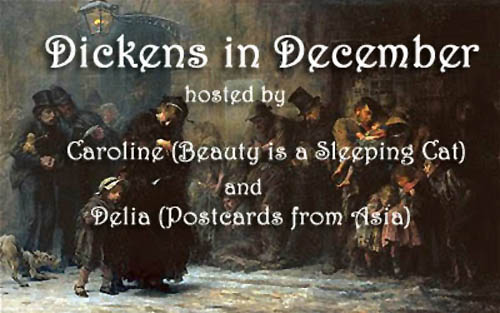
It’s already December and time that we start reading our Dickens novels and watch some movies based on his books. The detailed plan of this month can be found in the Introductory and Sing up Post. I’m co-hosting this event together with Delia (Postcards from Asia). Don’t miss to visit her blog as well.
The most important date to keep in mind is December 21 as that is the date for our A Christmas Carol readalong.
I have already started Great Expectations and really like it so far.
I will re-watch the movie Great Expectations (1998) starring Gwyneth Paltrow as I loved it but I would also like to watch one of the many versions of A Christmas Carol. The one from 1935 can been watched on YouTube.
Do you have a favorite movie version of A Christmas Carol? Let me know. I have a hard time choosing the one I should see.
As you know, this year marked the 200th birthday of Charles Dickens. When I reviewed The Dickens Dictionary this summer Delia (Postcards from Asia) had the wonderful idea to dedicate the last month of the year to Dickens and celebrate him in different ways. We decided we will read and review one or several of his novels in December, host a readalong and a watchalong and at least two giveaways. Because Christmas isn’t far, it seemed a good idea to choose A Christmas Carol as our readalong title. It’s a short novel and online copies are available for free. The readalong will take place on Friday 21 December. We will send out questions one week in advance, you can either use those or just post a review.
The weekend of 14/15 December is dedicated to movies based on Dickens’ novels. You are free to choose whatever you like, just post your review either on Saturday or Sunday.
I hope that many will feel tempted to join us. I’m really looking forward to this. I had a list of authors I wanted to read for the first time this year and Dickens was one of them. I’ve only read A Christmas Carol so far. I decided that I will read Great Expectations and re-watch the movie starring Gwyneth Paltrow.
Here is the detailed program of the event
Book reviews – You can choose any Dickens book you like, even books inspired by his work like Lynn Shepherd’s Tom-All-Alone’s are an option. Non-fiction on Dickens is welcome too. We will collect and add all your reviews on a page dedicated to the event. Date: 1 December – end of month.
Watchalong: You can choose any movie based on a Dickens novel. Date: 9 – 15 December
Giveaway: There will be two giveaways during 16-21 December. One will be on this, the other one on Delia’s blog.
Readalong: We decided to read A Christmas Carol. We will send a couple of questions to those who participate. If you don’t like that approach, just post a review or your impressions and join the discussion. Date: Friday 21 December
Wrap up post: At the end of the month, the event will be wrapped up and a post containing all the links of the participants will be posted on our blogs.
Please consider joining Delia and me.
Anyone who wants to join, please grab a badge and sign up in the comment form. Tell us whether you will also read along, so we can send you the questions. There is no need to tell us which books and movies you will choose but you can do so in an intro post.
I would like to thank Delia for the idea, for co-hosting and for the lovely badge which she has designed. The title of the event is inspired by Roof Beam Reader’s Austen in August.
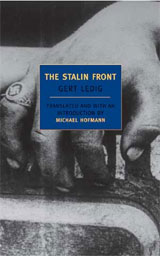
In this novel Ledig depicts the atrocities of the Eastern Front. The fact that he is so explicit about the horrors and destruction is, according to Sebald, the reason why Ledig was forgotten and only rediscovered thanks to Sebald’s lectures and later book.
Here’s what is written about the book on the nyrb site
Gert Ledig (1921–1999) was born in Leipzig and grew up in Vienna. At the age of eighteen he volunteered for the army and was wounded at the battle of Leningrad in 1942. He reworked his experiences during the war in this novel Die Stalinorgel (1955). Sent back home, he trained as a naval engineer and was caught in several air raids. The experience never left him and led to the writing of Vergeltung (Payback) (1956). The novel’s reissue in Germany in 1999 heralded a much publicized rediscovery of the author’s work there.
Here are the first sentences
Prologue
The Lance-Coropral couldn’t turn in his grave because he didn’t have one. Some three versts from Podrova, forty versts south of Leningrad, he had been caught in a salvo of rockets, been thrown up in the air and with severed hands and head dangling, been impaled on the skeletal branches of what once had been a tree.
I hope that some of the participants of this year’s German Literature Month will join us. As you can deduce from the first lines – this is a very graphic novel.
*******
The discussion starts on Friday, 30 November 2012.
Further information on the Literature and War Readalong 2012, including all the book blurbs, can be found here.
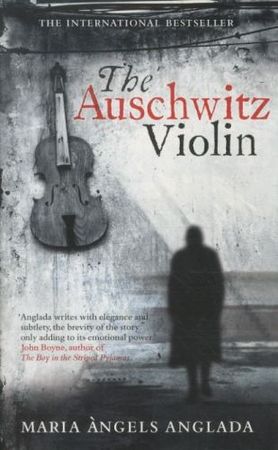
Is there anything that would make life in a concentration camp bearable? Anything that could make it worth living? Is it justified that talent will help you survive? And if you do, how can you go on living? Maria Àngels Anglada’s short and powerful novel The Auschwitz Violin – El violí d’Auschwitz asks precisely these questions.
When Climent, a famous violinist, is invited to Krakow in 1991 for a concert, he meets the elderly Polish violinist Regina who plays on an exquisite violin. He is intrigued, he thinks he should know the luthier but, as he is told, he doesn’t. He is curious and she is keen to share the story of the beautiful instrument. The violin has been made by Daniel, Regina’s uncle, a luthier who was sent to Auschwitz. Regina was only a small girl then. She had lost her parents in the ghetto but was saved and spent the war with a non-Jewish family who let her pass as their daughter.
Daniel who is still a young man, is only saved and not exterminated right away with many others because he pretends to be a carpenter. He helps to build a greenhouse for the sadistic and despotic camp Commander and later, when the commander finds out that he is a luthier, he is ordered to build a violin for him. Another captive, Bronislaw, will have to play on it during one of the dinners the Commander gives for other Nazis. Both their lives depend on Daniel’s success. If he wasn’t such a talented and passionate luthier, he wouldn’t stand a chance to make such a delicate instrument, with hands that are rough and split from the cold and material that is far from perfect.
Working on the violin changes everything for Daniel. It isn’t only a means to survive, like helping with the greenhouse was, but it gives sense to his days, makes a human being out of him again.
The way his workshop in Poland is described and how he makes the new violin, with so much care and love, infuses this book with beauty, despite the horrors which are evoked as well.
Every chapter begins with a quote from a historical official document in which life in the camp is rendered in a statistical and factual manner. There are reports about shootings, about medical experiments and other atrocities. This adds another layer to the book, echoes the horrors Daniel has to endure and stands in stark contrast to the beauty he experiences while remembering his old life and crafting the violin.
When the instrument is finished, Bronislaw, the violinist, plays Corelli’s Sonata “La Folia” on it. Schindler, a passing figure in the novel, tells someone about Bronislaw and he is freed and brought to Sweden.
It’s a beautifully written book but a bit light at times. I don’t know if working on an instrument would really have transformed the days at the camp like this.
The idea that two people can better their lives, maybe even save it, because of their talents struck me as cruel but realistic. It’s certainly true that those with special talents had a higher chance to live longer or even survive. What does that say about us humans.? Do we always need a reason to help? Talent, looks, frailty, illness, as long as there is something different and special. The thought made me shudder because it’s at the core of so much injustice in this world, not only in the concentration camps.
Since Corelli’s Sonata “La Folia” is so important in the book, I attached a recording. It’s a very haunting piece.
The Auschwitz Violin manages to capture the horror’s of the concentration camps without being horrifying. I think Anglada wanted to tell us that there can be beauty in the most horrible places. I hope that’s true.
Last week I wrote about chapters 4 – 6 of Neil Gaiman’s The Graveyard Book, this week we have read the final chapters 7 and 8.
It was obvious that the man Jack would be back and also that he would be part of the final episodes. What wasn’t entirely clear but was revealed in the final chapters was why he was after Bod’s family. This is where The Graveyard Book turns almost into a Greek tragedy. In order to prevent something that is predicted, the man Jack commits a crime but, as is the case in the Greek tragedies, fails and the murder itself sets in motion his own undoing. Ironic really.
The final confrontation with the man Jack was something I expected and I wasn’t too surprised, still there are many surprises in the final chapters. I was wondering from the beginning how the book would end in terms of Bod’s development and future. Would he forever stay with his ghost family and friends? Would he start to follow Silas on his trips? Would Miss Lupescu show him how to become like her?All these were possibilities and I was keen on finding out which solution Gaiman had chosen. The end isn’t exactly like I expected it. I thought it was almost a bit sad. I know, I’m allowed to, as this is a readalong post, still, I don’t feel like spoiling the book, so I won’t say more.
There is something I like about Neil Gaiman’s books and stories and that is that he often provides a lot of information on how he his novels and stories came to be, what inspired him, where he wrote them.
As I said in my first post, The Graveyard Book is strongly influenced by The Jungle Book but one of the very first inspirations came, as he writes, from watching his then two year-old son riding his tricycle between the graves of a cemetery. He finally started the book with chapter four and if his daughter hadn’t wanted to know what would happen next, he would have stopped there. Tori Amos is one of the people he mentions in the Acknowledgment section. He also adds some lines from her song Graveyard. I can only assume it inspired him too. It’s a very short piece. You can listen to it on YouTube.
I’m not sure which will be my next Gaiman. I guess either Coraline or American Gods.
I read The Graveyard Book for Carl’s readalong which is part of R.I.P. VII. If you want to read what other’s thought, don’t miss visiting Carl’s blog for the other reviews.
I’m glad to report that I’m still enjoying the book a lot. The structure is less episodic now, some elements return and we already know that the man Jack who killed Bod’s whole family is still around and hasn’t given up. Bod meets new people in these chapters and one of the most important is a witch. She may be one of my favourite characters and the relationship between the two is quite touching. But there is more. The story of the witch illustrates that there is a very interesting historical dimension to this book which could be overread but it’s present and very well done. The witch is in a part of the graveyard where people lie who have no gravestones, because they were suicides or otherwise cast out by the church. In a place in which gravestones play such a prominent role, to be without one, is like being bereft of your identity. The witch is very sad about this fact and Bod, who is a truly goodhearted little boy, tries to buy her a tombstone. Unfortunately this very nice thought brings not only a lot of trouble but at the end of the whole undertaking, the man Jack is informed that the little baby he couldn’t kill has turned into a boy and is still alive.
An element which didn’t strike me at first is how the many inhabitants of the graveyard are often presented. Gaiman gives us the inscriptions of their headstones like in this example “Majella Godspeed, Spinster of his Parish, 1791 – 1870, Lost to All but Memory”. When you’ve read half a dozen of these the effect is quite uncanny. It looks as if all that is left of us is our name, our dates, and -when we are lucky – an inscription that is poetical and wise and not one that is unintentionally funny.
In these chapters Bod gets into trouble more than once and what is sad is the fact that it is always when he tries to help others. But we do also discover another side of Bod. He has truly become a person who is able to move between the living and the dead and to use their respective talents. One of the scenes I enjoyed the most is when he uses his skills to haunt two particularly nasty children.
I’m looking forward to reading the rest now which will probably be this afternoon. It’s cool outside and rainy, the perfect weather for a book like this.
I’m reading The Graveyard Book for Carl’s readalong which is part of R.I.P. VII. If you want to read other’s thoughts, don’t miss visiting Carl’s blog for the other reviews.
There was a hand in the darkness, and it held a knife.
The knife had a handle of polished black bone, and a blade finer and sharper than any razor. If it sliced you, you might not even know you had been cut, not immediately.
From the very first lines we are drawn into the story of the little boy Nobody Owens and the man Jack who kills his whole family at the beginning of Gaiman’s novel The Graveyard Book. We don’t know why the man Jack kills the little boy’s family, all we know is that he isn’t happy he didn’t get the little boy as well. While he was killing Nobody’s parents and brother, the baby escapes through the door, down a hill and into the graveyard.
Mrs and Mr Owens see the little boy and Mrs Owens, although she is a ghost, feels an intense, until now unfulfilled longing and wants to keep the baby for herself. At first there is debate. The other ghosts are not sure it is a good idea. How will she feed him? How will she take care of him? But when the man Jack arrives at the graveyard door and they become aware the baby is in great danger, they agree to protect him and keep him in the graveyard. Luckily Silas, who isn’t really a ghost but no real human either, can move between their and our world and is capable to provide food for the little boy.
In the subsequent chapters the boy who the ghosts have baptised Nobody Owens is introduced to the ways of the living and the dead. He learns to read and write, is taught history and other things, makes friends with a little girl, is abducted by ghouls.
The story as such, which is inspired by Kipling’s The Jungle Book, is not that special but the way it is told is fantastic. More than a writer Gaiman is a story-teller. He is a very musical writer with an ear for language and it’s not surprising his books work well as audio books. The sentences have a hypnotic quality, they draw you in, captivate you by their sound and their meaning alike.
What I thought was particularly great is that we know the man Jack will turn up again. We know his story isn’t over. And we don’t want it to be over. We want to find out why he killed Nobody’s family and what he will do to access the graveyard. The inhabitants of the cemetery may not be corporeal but they still have power. They were able to protect Nobody once, will they be capable to do it again?
I can’t tell you how much I like this novel. It’s wonderful, it feels as if Gaiman when he writes is connected to the very source of story telling itself. In an introduction to a short story collection Gaiman wrote that he thinks the only proof a story is well written is when the readers ask the question “What happened next?”. Gaiman certainly achieved this and much more.
I’ve bought The Graveyard Book a couple of years ago but never read it. I’m so glad it is part of this year’s R.I.P. hosted by Carl. 38 people have signed up to read along. If you want to read what other’s thought of the first 3 chapters, don’t miss visiting Carl’s blog for the other reviews.




 Beauty is a Sleeping Cat