Spanish Literature Month – July 2012

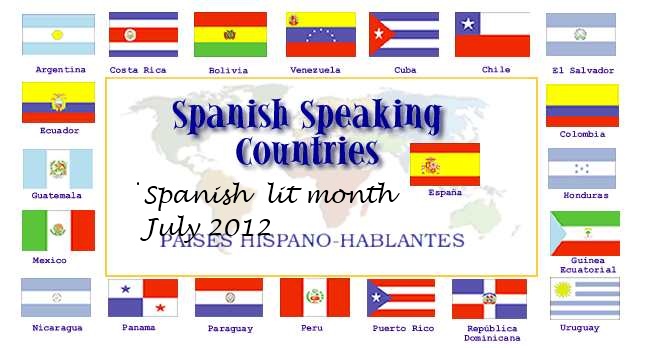
There have been requests last year and then a rumour started to spread and now it’s official: July is Spanish Literature Month. Stu (Winstonsdad’s Blog) and Richard (Caravana de recuerdos) who co-host this event have organized a watchalong (Carlos Saura) and two readalongs (Juan Carlos Onetti A Brief Life and Enrique Vila-Matas Bartleby and Co.) but if you cannot make them you are free to choose whatever you like. If you want to join, just leave a comment at one of the two blogs. Here’s Stu’s intro post and here the one by Richard.
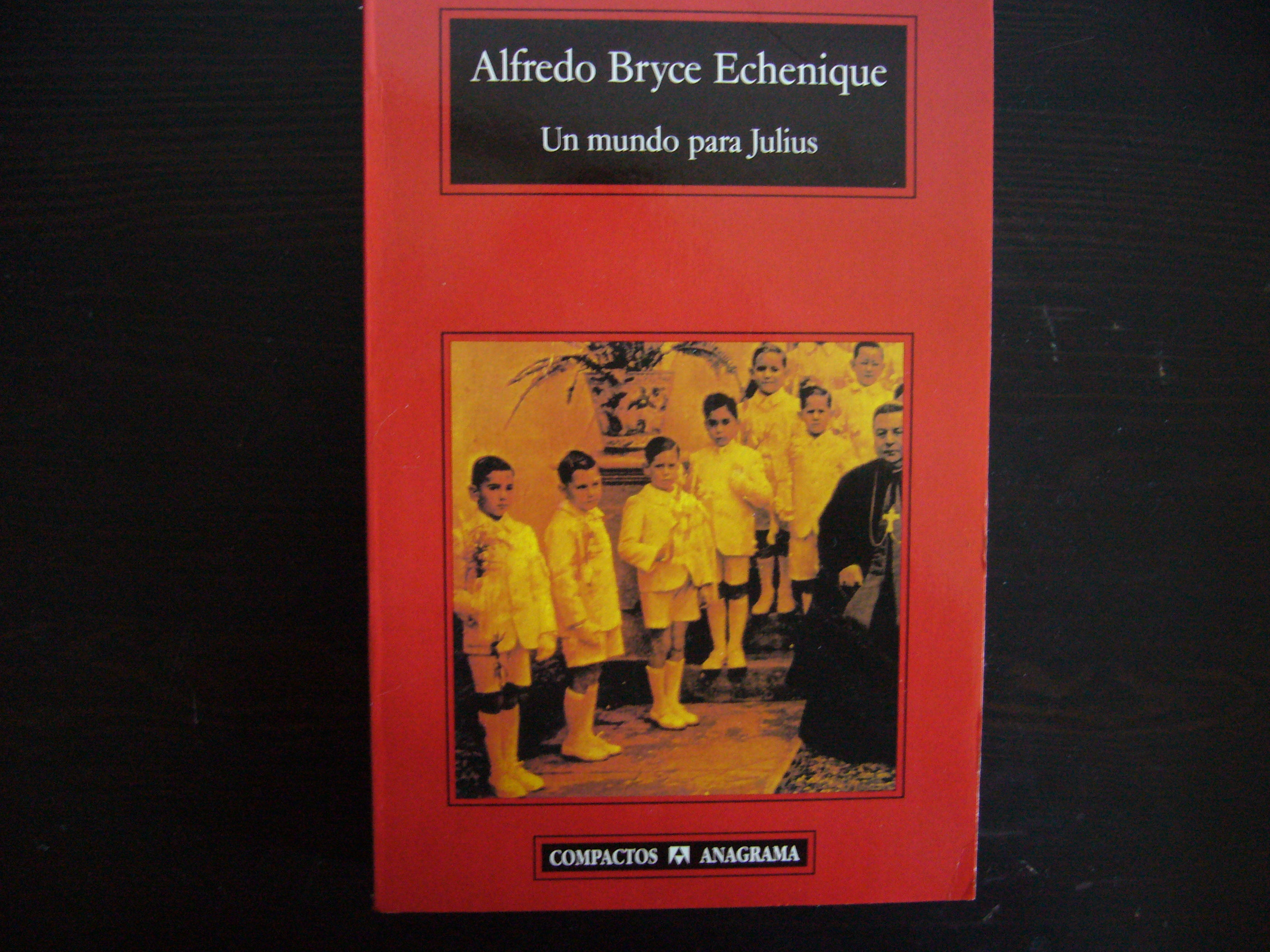
As you can see I have an idea what I would like to read. Since I may not be able to read a lot, I want at least to read one of the books I have in Spanish. A few years back I bought Un mundo para Julius by Peruvian writer Alfredo Bryce Echenique. I like books about the end of an era. They are usually lyrical, nostalgic and melancholic. This seems to be no exception.

It has been translated into English as A World for Julius.

Julius was born in a mansion on Salaverry Avenue, directly across from the old San Felipe Hippodrome.” Life-size Disney characters and cowboy movie heroes romp across the walls of his nursery. Out in the carriage house, his great-grandfather’s ornate, moldering carriage takes him on imaginary adventures. But Julius’s father is dead, and his beautiful young mother passes through her children’s lives like an ephemeral shooting star. Despite the soft shelter of family and money, hard realities overshadow Julius’s expanding world, just as the rugged Andes loom over his home in Lima. This lyrical, richly textured novel, first published in 1970 as Un mundo para Julius, opens new territory in Latin American literature with its focus on the social elite of Peru. A member of that elite, Bryce Echenique incisively charts the decline of an influential, centuries-old aristocratic family who becomes nouveaux riches with the invasion of foreign capital in the 1950s. A World for Julius, his first novel, marks the first appearance in English of this important Peruvian writer, whose Latin American postmodern fiction has won critical acclaim throughout the Spanish-speaking world.

I may end up reading something less challenging in terms of pages. Two authors I like a lot are Almudena Grandes from Spain and Maria Luisa Bombal from Chile. I still have some of their books I have not read.

Product Details

The crime novels by Teresa Solana A Not So Perfect Crime and A Shortcut to Paradise are possible choices as well.

Or another Peruvian author. I just recently got Vargas Llosa’s Death in the Andes – Lituma en los Andes.

Set in an isolated, run down community in the Peruvian Andes, Vargas Llosa’s riveting novel tells the story of a series of mysterious disappearances involving the Shining Path guerrillas and a local couple performing cannibalistic sacrifices with strange similarities to the Dionysian rituals of ancient Greece. Part-detective novel and part-political allegory, it offers a panoramic view of Peruvian society; not only of the current political violence and social upheaval, but also of the country’s past, and its connection to Indian culture and to pre-Hispanic mysticism.

I have read Juan Carlos Onetti before and liked him very much. To make sure that I really read at least something, I will join the readalong of A Brief Life. The details can be found on Richard’s and Stu’s blog.

I could suggest some other books but I think Stu and Richard are doing a great job at pointing out books you should discover.

Are you joining as well? What are you going to read? Do you have favourites of Latin American and Spanish literature?

Charlotte Wood: The Submerged Cathedral (2004)

Australian author Charlotte Wood’s lyrical novel The Submerged Cathedral caught me unawares. Reading it felt at times like daydreaming. It has a hypnotic and very gentle quality that isn’t easy to put into words. It is highly symbolical and complex but still down to earth. The voice and choice of themes are so unusual, I’m really glad I discovered it on Kim’s blog last year (here).

The novel has four parts, each dedicated to a year – 1963, 1964, 1975, 1984 – covering twenty years in the lives of Jocelyn and Martin.

In part I Jocelyn and Martin meet and fall deeply in love. It’s the 60s and concubinage is far from being accepted. Jocelyn who already turned down one man, doesn’t want to get married but she wants to live with Martin. When they meet she is working as a copy editor and proofreading the manuscript of The Complete Illustrated Encyclopedia of Australia. The parts which speak the most to Jocelyn are those dedicated to the flora of Australia. The beauty and mystery of all these plants that are unique to this part of the world are a major theme. While reading about them Jocelyn becomes aware of them and decides she would love to create a garden, a garden unlike the English garden her mother used to have. Hers should be a garden with Australian plants only.

Martin is a doctor, a doctor who is much more of a healer than a surgeon. He can almost feel what is wrong with people before they tell him and knows what they need to recover. He is very taken with Jocelyn and her idea and wants to help her build the garden.

The time they spend together in his house is idyllic. They sit on the porch, talk about their plans, go swimming. It’s peaceful and harmonious until the day Ellen, Jocelyn’s older sister, announces she will come back to Australia. She has been living in London with her husband and her daughter. Her husband’s violence is driving her away.

Why the strong and courageous Jocelyn who doesn’t even fear to be a social outcast, lets her sister take over her life and dictate her every move, is hard to understand for anyone who has never been entangled in a dysfunctional family system. I know what this is like and although I read with shock how the beauty is crushed and the relationship between Martin and Jocelyn is put to a test it doesn’t pass, I could relate. It made me gasp and infuriated me but I felt that Jocelyn couldn’t act any other way under those circumstances. At the end of part I a tragedy happens after which Jocelyn leaves Martin.

The next three parts of the novel follow them in their journey from grief to healing and beyond. Jocelyn chooses to follow Ellen to London. Martin joins a convent. All through the novel the themes of love, religion, nature and gardens are undergoing different variations.

What I liked so much about this book is the way it is written. It has the capacity to draw you in. It speaks to your emotions much more than your intellect. I felt like a spectator who was captivated and then became part of the story because Charlotte Wood really shows everything, she doesn’t tell a lot. We don’t only think that Ellen’s sister is destructive, abusive and a liar, we experience it. This is amazingly artful. It’s also never said why Martin joins a convent but we learn to understand. The same goes for the description of the Australian flora and Jocelyn’s urge to create a garden that guides and haunts her until she finally gets the opportunity to follow her dream.

I would love to visit Australia because it is so unique, because it has landscapes and plants and animals that you find nowhere else in the world. If you share this fascination, you will love this book. It is a hymn to the beauty of that continent but it is also a hymn to love. Pure unconditional love. Last but not least it has  a religious theme that is as important as the nature element. The gardens of the Bible are mentioned and alluded to, Eden and Gethsemane. Antonement and pilgrimage are other key themes. While Martin tries to make sense as a recluse, Jocelyn is living like a pilgrim.

The Submerged Cathedral is a very subtle novel, very alluring and despite its gentleness very powerful. It seems to have been created in a timeless zone.

Part III in which Jocelyn travels through Europe with a garden architect has the appeal of a travel novel. They stay in France and Spain and while visiting Parque Güell in Barcelona, Jocelyn has a vision. The title The Submerged Cathedral refers to Debussy’s La cathedral engloutie. Seeing Gaudí’s Sagrada Familia reminds her of this piece of music. When she sees Gaudí’s church, everything is tied together; her idea of an Australian garden, the organic forms of Gaudí’s work, the dryness of the Spanish earth. Her journey is fulfilled and she returns to Australia.

I liked this book a lot. It’s beautiful and heartbreaking. Several tragedies happen between these pages that each made me put the book aside for a while. But there were equally passages of great beauty that also made me put the book aside. I wanted those pages to linger just a little while longer.

I would like to read more of Charlotte Wood’s books but they are not available outside of Australia at the moment. Animal People sounded like a novel I would love. Here is the link to her website if you’d like to explore.

The Submerged Cathedral is my second contribution to the Aussie Author Challenge 2012.

Here is a wonderful and very subtle analysis of the novel which I found on Nike Sulway’s blog Lost for Words: The Submerged Cathedral.

Dutch Literature Month and Beryl Bainbridge Week in June

If it hadn’t been for Iris’ Dutch Literature Month last year, maybe Lizzy and I wouldn’t even have thought of organizing a German Literature Month. Who knows, in any case I enjoyed Dutch Literature Month last year and I’m glad Iris is hosting it again in June. Needless to say that I am joining. Details can be found here.

I have a few plans for this year.

One book I would like to read is Hedwig’s Journey by Frederik van Eeden. I’ve got a copy from Holland Park Press and it sounded very good. The first translation has been published in 1902. This edition is a revised new translation.

Sample passages and a long description of the book can be found on the editor’s page. Here’s what makes me want to read it.

Outwardly, Hedwig is a typical girl growing up in a well-to-do family in a sleepy provincial town. Inwardly, she feels things very deeply and has a strong sense of self, and can all of a sudden feel very depressed.
‘It was the afternoon, between four and five o’clock, that she recalled with most dislike; …, and the worst of all the first day of the week in the middle of winter.’

The second possibility is The Tea Lords by Hella Haasse. Iris will host a readalong of this classic and although I don’t think I will join, I wanted to let you know, just in case you might be interested. Here is the blurb:

Rudolf leaves his comfortable origins in Delft by ship for Java to help run the family’s estates there. He moves from plantation to plantation, attempting to understand the ways of the local peoples, their version of Islam and their relationship to their land. On a visit to the capital, Jakarta, he falls in love with a teenage girl, Jenny, who he courts surreptitiously via his sister, with grave consequences for the reality of their relationships. Eventually they marry, and make a hard colonist-couple’s life theirs, bear, lose and raise children, before Jenny on her visit to the home country discovers all the comforts of which she has been deprived in Java. Back at the plantation homestead, as the back-breaking work of establishing and maintaining business takes its toll on Rudolf, Jenny becomes estranged from him, and the bitter resentments of relatives eat at her until a terrible solution is achieved.

I have many other books on my piles. I might read another Cees Nooteboom this year, I still have a few I haven’t read yet.

If you are looking for suggestions for Dutch Literature Month here is a post I did last year Dutch Literature Recommendations.

*******

There is another event I wanted to make you aware of and that is Beryl Bainbridge Week hosted by Gaskella from June 18 – 24. I already left a hasty comment saying I will be too busy to join but I have still got three unread copies which makes me think I can’t let this week pass without attempting to read at least one. I discovered Beryl Bainbridge last year on Guy’s blog and read The Dressmaker which I found excellent. The three books I still got on my piles are

The Bottle Factory Outing

An Awfully Big Adventure

The Girl in the Polka Dot Dress

How about you? Do you have your Dutch Literature choices ready? Are you in for Beryl Bainbridge Week?

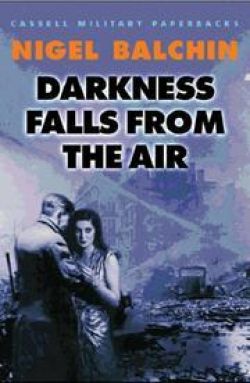
Literature and War Readalong May 28 2012: Darkness Falls From the Air by Nigel Balchin

I had never heard of Nigel Balchin before reading a few intriguing reviews on Guy’s blog (herehere and here). When I looked him up and saw he wrote a novel – Darkness Falls From the Air – which is called the “classic novel of the London Blitz” and written during the Blitz in 1942, I was keen on including it this year. Balchin seems one of those authors hardly anyone knows anymore but those who rediscover him are usually enthusiastic. It even seems that he is Patrick McGrath’s favourite novelist.

After having read about the bombing of Coventry written by a contemporary writer it will be interesting to see how someone handles the Blitz who has actually experienced it.

Here are the first sentences

I stopped at about seven. There was too much stuff on my desk to have a chance of getting clear that night, and I was tired of it. I felt pretty guilty coming downstairs, and had to tell myself  that this was the first time this week that I had stopped before eight.

Two French officers were just coming in the front door as I went out, and I did the bowing and waving act that I always do to them. It struck me as odd that they should still be around – unless they had decided to stay on in England and fight with us.

*******

The discussion starts on Monday, 28 May 2012.

Further information on the Literature and War Readalong 2012, including all the book blurbs, can be found here.

The Winner of the Muriel Spark E-Book Giveaway – The Hothouse by the East River

One week has passed and it’s time to announce the winner of the Muriel Spark e-book giveaway The Hothouse by the East River courtesy of Open Road Media.

I drew the winner via random.org list generator.

The lucky winner is Nadine (Carpediemblogger)

Enjoy!

This e-book is one of eight of Muriel Spark’s novels that have just been released.

There is still enough time to read something for Simon’s (Stuck in A Book) and Harriet’s (Harriet Devine’s Blog) Muriel Spark Week from April 23 – 29.

Muriel Spark E-Book Giveaway – The Hothouse by the East River

The poll has decided and the second e-book I’m giving away courtesy of Open Road Media is Muriel Sparks The Hothouse by the East River.

This book is one of eight of Muriel Spark’s novels that have just been released.

Here is what is said about the book

Touched by madness and haunted by a secret past, Paul and Elsa’s relationship reveals that there can be no normality for people who witnessed the worst of war

In 1970s New York, Paul and Elsa are like many other well-off middle-aged couples, worrying over their apartment and psychoanalyst bills by day, and meeting friends at restaurants by night. But this is not an ordinary couple with ordinary neuroses, as becomes clear when Paul convinces himself that Elsa’s shadow always points in the wrong direction. As Paul and Elsa’s involvement in World War II espionage begins to surface, the glitz and glamor of their lives is revealed to be nothing more than illusion.

The Hothouse by the East River is a delirious satire of superficial urban life in the shadow of one of modern history’s great horrors.

This ebook features an illustrated biography of Muriel Spark including rare photos and never-before-seen documents from the author’s archive at the National Library of Scotland.


If you win this giveaway you are still in time to join Muriel Spark week, hosted by Simon (Stuck in A Book) and Harriet (Harriet Devine’s Blog), which is taking place from April 23 – 29

*******

If you would like to win this e-book, just leave a comment. The giveaway  winner will be announced next Tuesday, April 10 2012.

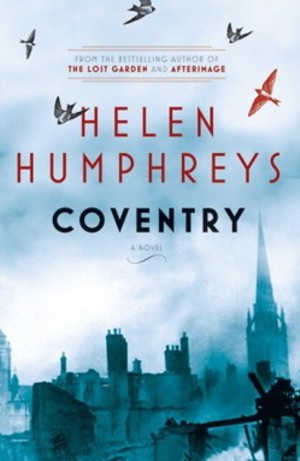
Literature and War Readalong April 30 2012: Coventry by Helen Humphreys

With last month’s book we have left WWI behind us and move on to WWII. The first of the WWII books is Helen Humphreys’ novel Coventry. I thought this would be my first novel by this author but I have read another one before, The Lost Garden, a wonderfully lyrical coming-of-age story which I liked a lot. With this in mind I’m keen on reading Coventry. Helen Humphreys is British but she lives in Ontario, Canada. Helen Humphreys has won several prizes, she is the author of 4 novels, one book of narrative non-fiction and four collections of poetry. I have a weakness for poets who write novels or novelists who write poetry because the writing is usually far above the average.

On the back cover of the novel it says that Coventry is “a memorial to the terrible losses of wartime, and a celebration of remembrance, determination and resilience.” The book tells the story of two women and moves back and forth between 1919 and the night of the 14 November 1940.

Here are the first sentences

The swallow arcs and dives above the cathedral. Harriet March watches it flicker through the darkness ahead of her as she walks along the cobblestones towards the church. The bird moves in the night air with all the swiftness of sudden feeling, and Harriet stops at the base of the ladder, tracking the flight of the lone swallow as it shivers up the length of the church spire.

*******

The discussion starts on Monday, 30 April 2012.

Further information on the Literature and War Readalong 2012, including all the book blurbs, can be found here.