Literature and War Readalong March 28 2013: The Heat of the Day by Elizabeth Bowen

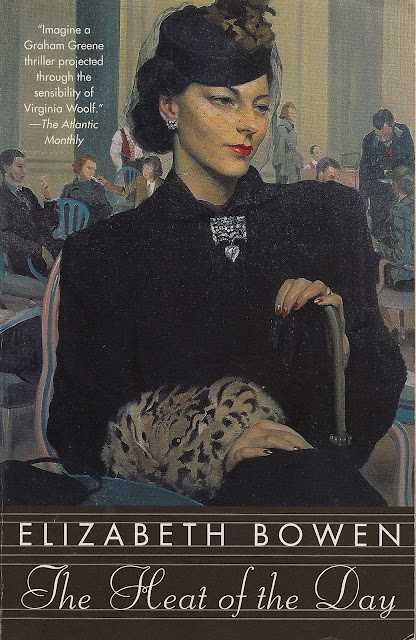
The Heat of The Day

March is Elizabeth Bowen month for me. I’m reading her short stories and Victoria Glendinning’s Bowen biography. It’s time to get to one of her novels and I’m looking forward to reading The Heat of the Day. In the foreword to her biography Glendinning writes

She is to be spoken of in the same breath as Virginia Woolf, on whom much more breath has been expended. She shares much of Virginia Woolf’s perception and sensibility: but Elizabeth Bowen’s perception and sensibility are more incisive, less confined, more at home in the world as well as in world’s elsewhere.

The Heat of the Day is set in London in September 1942. It’s called “a noir” which isn’t exactly a genre I would have expected from Elizabeth Bowen but she has a knack for the mysterious and less obvious which, I’m sure, will make this a great read.

Here are the first sentences

That Sunday, from six o’clock in the evening, it was a Viennese orchestra that played. The season was late for an outdoor concert; already leaves were drifting on to the grass stage – here and there one turned over, crepitating as though in the act of dying, and during the music some more fell.

*******

The discussion starts on Thursday, 28 March 2013.

Further information on the Literature and War Readalong 2013, including all the book blurbs, can be found here.

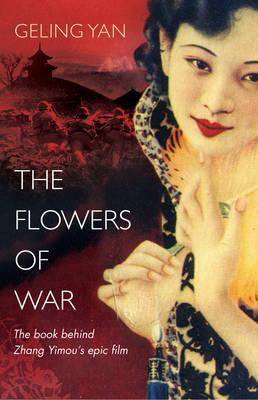
Literature and War Readalong Februay 28 2013: The Flowers of War – Jingling Shisan Chai by Geling Yan

The Flowers of War

It has been a while since I’ve last read a Chinese novel. Over the years it has become a literature I have learned to appreciate a lot and it was about time to return to it. Geling Yan is a well-known novelist in China. She has written short stories, scripts, essays and novels. Many of her books have been made into movies. The Flowers of War – Jingling Shisan Chai is no exception. The Flowers of War is based on one of the most horrible events which have taken place during war-time – the notorious Nanking/Nanjing Massacre in which Japanese troops slaughtered Chinese civilians. It has been estimated that 250.000 to 300.000 people have been killed. It is sometimes also called The Rape of Nanking. The story of this book is narrated from the point of view of Shujuan a 13 year-old schoolgirl. Together with a group of other girls she hides in the compound of an American church.

Here are the first sentences

Shujuan woke with a start. The next thing she knew, she was standing beside her bed. At first she thought it was the absence of gunfire that had woken her. The artillery that had been thundering for days had suddenly fallen silent.

For those who can’t get the book or do prefer to watch the movie, feel free to review the film starring Christian Bale.

*******

The discussion starts on Thursday, 28 February 2013.

Further information on the Literature and War Readalong 2013, including all the book blurbs, can be found here.

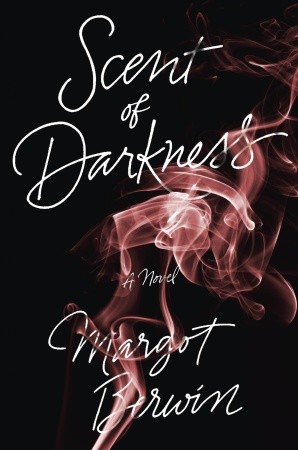
Margot Berwin: Scent of Darkness (2013)

Scent-of-Darkness-by-Margot-Berwin

In her best-selling debut, Hothouse Flower and the Nine Plants of Desire, Margot Berwin brought us to the rain forests of Mexico—to a land of shamans, spirit animals, and snake charmers—in the search for nine rare and valuable plants. Now, with her hotly anticipated second novel, Berwin takes us somewhere darker: deep into the bayous of Louisiana, to a world of fortune-tellers, soothsayers, and potent elixirs. Scent of Darkness is a magical, seductive story about the power of scent, and about what happens when a perfume renders a young woman irresistible.

Margot Berwin’s novel Scent of Darkness is her second book. It just came out in the US and I’m glad Random House offered me a copy as I hadn’t even heard of the author before and the description sounded extremely appealing. Her first novel Hothouse Flower and the Nine Plants of Desire was a huge success and has been translated into 19 languages. I certainly want to read this now as well. Scent of Darkness reminded me a bit of  Sarah Addison Allen’s Garden Spells.

Scent of Darkness is pure escapism, a very sensual book that evokes the magic of perfumes and scents. I really like novels about perfumes but that wouldn’t have made me love the book. What I loved is that it is set in New Orleans. I’m aware that it’s the New Orleans tourists have in mind, and maybe quite different from the real city which is also one – if not the one – with the highest crime rate in the US. I guess there is more to New Orleans than Victorian houses with lace-patterned ironwork balconies, the French Quarter, cemeteries, hoodoo, bayous and Marie Laveau. But that’s the New Orleans that my imagination craves for and which has been captured so well by Anne Rice. So I couldn’t help loving the descriptions in Scent of Darkness, no matter how clichéd they may be.

Evangeline grew up with her mother in New York. They get along but are not close. She is close to her grand-mother Louise who is originally from Louisiana. Louise is an aromata, a master of scent-making and perfumer. At the beginning of the novel, Louise dies and leaves Evangeline her house and a small vial with a special scent, created just for her. Only it comes with a warning. If Evangeline opens the vial, her life will change completely.

Of course she opens it and it does not only alter her life but transforms the girl as well. Evangeline is an average looking girl but as soon as she wears the scent, everyone is attracted to her. Men, women and animals, follow her and want a piece of her. That’s very unsettling but also wonderful because the newly acquired scent helps her to seduce the good-looking Gabriel. She later follows him to his hometown New Orleans.

In New Orleans it becomes obvious that she has to find out what exactly was in the scent Louise has created for her and why she did it. As soon as they are in New Orleans, things get out of hand. Fortune-tellers predict tragedy, a talentless painter want’s to incorporate her into his paintings and all sorts of other things happen.

I loved two-thirds of the book but towards the end, I must say, she lost me to some extent, because it got quite weird and a bit icky. Berwin’s first novel had 400 pages and this one has only 220. My assumption is that she had to rush this book and that’s unfortunate because it had a lot more potential. I still loved it, I just didn’t find the ending and the secret behind the scent satisfying or logical but that’s maybe also a matter of personal taste.

Scent of Darkness is more than just a book about scent, it is also an exploration of beauty and attraction. Evangeline is not a beautiful woman but the scent makes her beautiful and attractive. It makes others long and yearn for her. All of a sudden, through her grandmother’s perfume, she possesses what all the other characters in the novel have in abundance – great attractiveness. She comes to hate her newly acquired desirability because she feels, people don’t lover her for herself. On the other hand, does she love the men around her for themselves, when what attracted her in the first place is their physical beauty?

If you like very colorful, evocative and descriptive books, magical realism, New Orleans, scents and a great atmosphere, then this is for you. Another great element were some stunning sentences, full of wisdom that made me think more than once “Wow, yes, that’s true”. Unfortunately I was so engrossed in the descriptions of New Orleans, I forgot to take notes or highlight any passages.

Has anyone read Hothouse Flower?

Thanks again to Random House for the review copy.

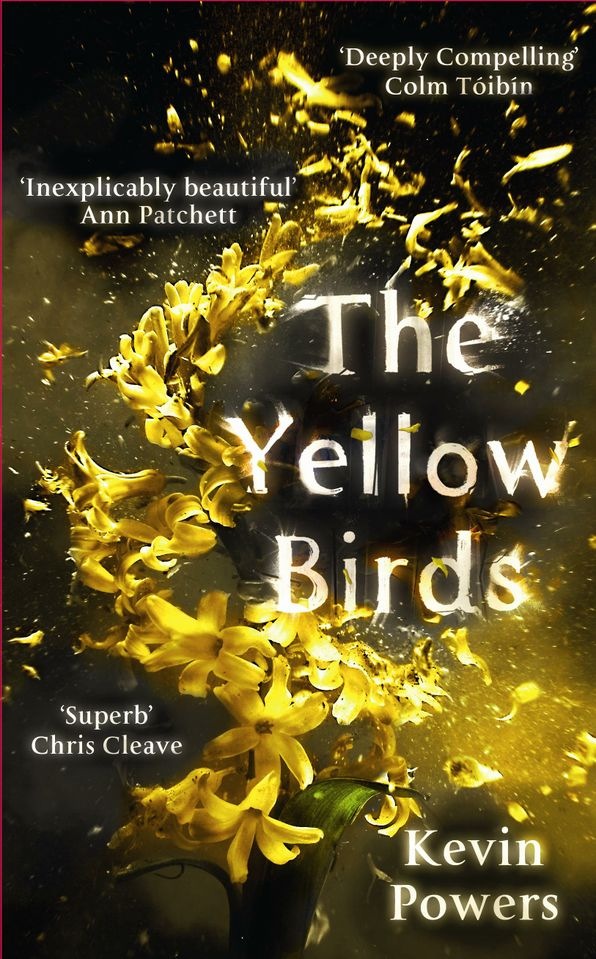
Kevin Powers: The Yellow Birds (2012) Literature and War Readalong January 2013

Kevin Power’s book The Yellow Birds is oddly lyrical and beautiful. Why oddly? Because it is a book about war, about killing people, about young recruits facing their own and their country’s demons, about torture and killing of innocent people, old men, women and children, animals, a book about a young man losing his best friend, about guilt, mistakes and trauma but still it is lyrical and beautiful and that is odd.

The Yellow Birds is a first person narrative. Private Bartle tells his story in chapters alternating between 2004, Al Tafar, Iraq and 2005, Richmond, Virginia, interrupted by the one or the other chapter set in other places in 2003, 2005 and 2009.

The 21 year-old Bartle joins up in 2003. He meets Murph who is only 18 then. They are trained and led by the hardened tough-guy Sgt Sterling. In 2004 they are shipped to Al Tafar, Iraq. The two young men, become attached to each other from the beginning, and once they are in Iraq, that friendship intensifies.

At the beginning of the story, the young Privates are detached. They kill because they have to kill. They are constantly under attack but that’s how it is. The heat bothers them more than the killing as such. However, the longer they stay, the more the war gets to them and finally a tragedy happens.

We know from the beginning that Murph dies but we don’t know how, we only know the circumstances must have been terrible and that Bartle feels guilty. The truth is unveiled slowly.

There is a lot I liked in this novel and a lot I didn’t. The descriptions are wonderful; we are there and see the landscape, we feel what it must have been like to fight in this terrain, the dry orchards, the city, a place swarming with soldiers and civilians, being attacked constantly without ever knowing where the enemy will come from. The horror of killing civilians and animals. I thought Powers captured this very well.

There are lyrical scenes like this

I try so hard now to remember if I saw hint of what was coming, if there was some shadow over him, some way I could have known he was so close to being killed. In  my memory of those days on the rooftop, he is half a ghost. But I didn’t see it then, and couldn’t. No one can see that, I guess I’m glad I didn’t k now, because we were happy that morning in Al Tafar, in September. Our relief was coming. The day was full of light and warm. We slept. (p. 24/25)

I had a problem with the fact that the book was much more about a friendship than about the war as such. Bartle returns traumatized. It could appear that what is traumatizing about a war is that you lose your best friends. That’s a crude simplification. It certainly makes matters worse but it’s not the only reason for PTSD.

I’ve read a lot of articles about the high suicide rates among US troops and veterans of this war, much higher, it seems, than in any other war. I would have wished that this was addressed. I would also have liked that we learned more about the war in Iraq. Surely it’s not only the terrain that makes this war different from others.

Despite my reservations, this is a beautiful book, with a surprisingly gentle atmosphere, pervaded by a floating mood. There are graphic scenes and they are hard to stomach. Each country has a predilection for certain types of torture and unfortunately we get a descriptive sample of what that is in this region.

All in all I would say, this novel is far more a moving, even heart-breaking story of a friendship under exceptional circumstances – namely during a war – than a novel about the war in Iraq. If you come to the book with these expectations, you will find a well crafted novel with many beautiful scenes and a powerful story about loss.

Other reviews

A Fiction Habit

Danielle – A Work in Progress

Exurbanis

Judith – Reader in the Wilderness

Uncertain Somewhere

Savvy Verse and Wit

TBM (50 Year Project)

Tony’s Book World

*******

The Yellow Birds was the first book in the Literature and War Readalong 2013. The next is The Flowers of War aka Jingling Shisan Chai by Chinsese writer Geling Yan. Discussion starts on Thursday 28 February, 2013. Further information on the Literature and War Readalong, including the book blurbs can be found here.

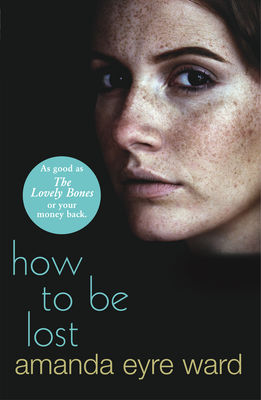
Amanda Eyre Ward: How to be Lost (2005)

How to be Lost

How do you cope when someone gets lost?  How much time must go by until you allow yourself to move on? Does your life come to a standstill after the loss? How many possibilities are there in one life? These are some of the questions Amanda Eyre Ward explores masterfully in her lovely first novel How to be Lost.

The Winters are a dysfunctional family, rich and apparently happy, but there are some dark secrets hidden beneath the surface. The parents are heavy drinkers and their three daughters are often scared by their fights and excesses. One day the youngest, Ellie, disappears and the family breaks apart.

The novel starts fifteen years later with the oldest daughter Caroline working as a cocktail waitress in New Orleans. She’s left suburban New York shortly after the disappearance of her baby sister. Like her parents, she is a heavy drinker. She is not unhappy, her life isn’t what it could have been, she’s all but forgotten about her talent as a pianist, but this provisional life of drifting and temporary jobs suits her.

When her mother sees a picture in a newspaper, showing a young woman who looks exactly like the lost sister, all their lives are set in motion. Caroline will go on a trip and look for the young woman. The outcome of her search will free them one way or the other. Maybe it is Ellie and they finally find out what has happened or if it isn’t, they will be able to declare her dead.

What I liked a lot about Eyre Ward’s novel was how it manged to tell a riveting story in a suspenseful way but still captured the interior lives of the characters and did unfold the back story in a captivating way. It’s a book that asks a lot of questions and answers many of them.

One of the most interesting ideas is the theory of the split lives which is presented towards the end. The idea is that every time you make a decision, your life splits and someone else, somewhere, lives the life that you could have had.

The exploration of how many different lives we could have lived if at one given time something particular hadn’t happened or if, at another time, we would have made a different decision, fascinates me. Looking back at my own life so far, I see such a lot of “split moments”, moments where I could have done something different and would now be living a completely different life. Capturing this premise masterfully, is one of the strength’s of this novel.

Often when I read about a dysfunctional family I feel it is done in a much too biased way. With her gentle tone and the transformative ending, Ward creates a much more nuanced portrayal. There can still be a lot of love and deep and even healthy feelings underneath the dysfunction. And there is hope and the possibility of a new life for many children coming from families which seemed rotten inside.

How to be Lost is one of those novels I liked a lot while I was reading it but, unlike many others, after putting it away, it still haunts me.

James Lincoln Collier & Christopher Collier: My Brother Sam Is Dead (1974)

My Brother Sam is Dead is a historical children’s book set during the American Revolutionary War. I didn’t really want to read a children’s book but it seems there are a great deal of novels for children and young adults on this period and hardly any literary fiction at all (Please, correct me if I’m wrong). I thought I had found a few literary novels but every time I looked at a book more closely it turned out to be a novel on the Civil War.

The Colliers are brothers and have written quite a lot of books for children together. While Christopher does the research and writes down the structure of the books, James writes the novels.

It’s a well written book but very clearly for children and meant to teach history. It’s quite educational and very anti-war, something which, oddly enough, has been criticized. American patriots, to this day, seem to think that it’s ok to go to war as long as the goal is freedom. Freedom is certainly worth fighting for but, as the Colliers exemplify, it will always be better to see if there are no other options.

In order to show the different positions, they created a conflict inside of one family. The Meekers own a tavern in Redding, a Tory town. The older son, Sam, is about 16 and in college, the younger, Tim, is only 10 at the beginning of the novel. When the novel opens, Sam and his father get into a fight because Sam joins the Patriot troops and wants to fight the “lobsterbacks” – the English. Sam’s father is against this. He doesn’t see why they should fight the King and his troops. Young Timmy is somewhere in-between. He admires his brother but he also loves his father and respects his opinion.

The main reason for the outbreak of the war, as presented in the novel, is that the colonials feel it is unjust that they have to pay such high taxes to England. They want this to stop and become free.

After his dispute with his father, Sam runs away and joins the troops. The novel then focusses on the remaining Meekers and shows how difficult it was for families to survive and to stay out of the conflict. The war soon invades everything. They were attacked by Patriots, British troops got all their food. Staying neutral was suspicious.

I don’t want to tell too much of the story as it’s a short book and there are a few tragic events which shouldn’t be revealed here. Obviously the title contains a spoiler but it will still be surprising to find out how Sam died.

I liked reading this, it’s quite atmospherical and think captures well what it must have been like for families to live during that time. The Collier’s position, which becomes clear when you read the book and which is shown in some quite ironic moments, is that they are not sure whether the war was really needed. They seem to think that there might have been other solutions for the colony to become independent.

The book contains background information on the story and the characters, some events and people were real, some were not. It also contains an interview with one of the brothers. All this together makes this an interesting book, not a literary gem but nicely executed and informative. In some ways you could even call it a cautionary tale.

I’d like to end the review with a  quote taken from the interview with Charles Collier.

I want a reader to understand the complicatedness of the Revolutionary War. Maybe there was as much bad as good that came of it, especially if one considers the Meekers. I think any book that deals honestly with war will be antiwar, because any book that glorifies war isn’t telling the truth.

The review is a contribution to Anna’s and Serena’s American Revolution Reading Challenge. Please visit their site for other reviews or if you’d like to join  as well.

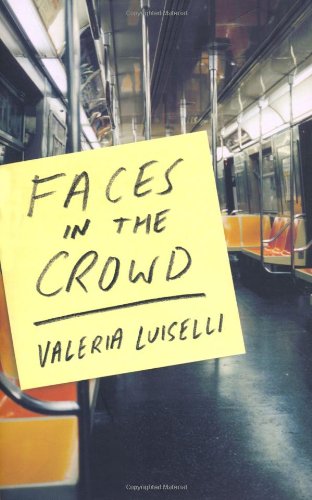
Valeria Luiselli: Faces in the Crowd – Los ingrávidos (2011)

Faces in the Crowd

I discovered Valeria Luiselli’s Faces in the Crowd – Los ingrávidos on Stu’s best of list last year. Somehow I had missed his review (here). The book sounded really interesting and since I was in the mood for some unconventional writing, this was just the book to match the mood. Valeria Luiselli is a Mexican writer and has published essays and short pieces. Faces in the Crowd is her first novel.

The narrator of  Faces in the Crowd is a young married woman.  She lives with her husband and two kids in Mexico City and leads a life which is far from fulfilling. She decides to write a novel about her time in New York where she worked for an editor and met a lot of colorful people. Writing the novel isn’t easy. Her life isn’t her life, her children claim a large part. Her writing isn’t her writing, as her husband reads it and gets jealous.

The book has an interesting structure. It consist of small and very small paragraphs and episodes, some are up to two pages long, many not much longer than a sentence or two. In the beginning the narrative jumps from the present to the past but in the middle of the novel the narrative voices start to multiply.

Leave a life. Blow everything up. No, not everything: blow up the square meter you occupy among people. Or better still: leave empty chairs at the table you once shared with your friends, not metaphorically, but really, leave a chair, become a gap for your friends, allow the circle of silence around you to swell and fill with speculation. What few people understand is that you leave one life to start another.

The narrator is very interested in the poems of Gilberto Owen, an Mexican poet who lived in New York. His voice will be one of the most important ones towards the end of the book and we are led to believe that it’s not the young woman anymore who writes about a writer but the writer who writes about the young woman.

This may sound quite confusing but it’s not, it is always clear whether we are in New York or Mexico City and who is telling the story. It’s a unusual book and I was reminded of Bolaño’s The Savage Detectives more than once. Faces in the Crowd may very well be a novel but it has a lot of non-fiction elements. Many poets and writers like Ezra Pound, Gilberto Owen, Federico García Lorca, Nella Larsen are present. Many of the sequences circle around topics like reality and imagination, the boundaries between the two, illusions and inventions. Many symbols and stories echo and multiply throughout the novel. Early on there is the story of Ezra Pound who believes he has seen the face of  a dead friend who had been killed in the trenches on the subway. This is a recurring element. The young woman believes she has seen Gilberto Owen’s face on the subway, although he is long-dead and later, when he tells the story, he believes to see hers. The book is populated by real and imaginary people and their ghosts.

I’m glad I’ve read Faces in the Crowd, it’s very different. It’s a book to read again, slowly. Some of the paragraphs and sequences even work on their own and they are all very different in tone and style.  Some contain small stories, some are thoughts, philosophical reflections, meditations, some are like small poems. There is a reason for this structure as the narrator tells us in the beginning:

Novels need a sustained breath. That’s what novelists want. No one knows exactly what it means but they all say: a sustained breath. I have a baby and a boy. They don’t let me breathe. Everything i write is – has to be – in short bursts. I’m short of breath.

The only reservation I had,  was the woman’s voice and the lack of atmosphere. I thought she was a very cold and distant character and not likable at all, especially in the parts set in the present. It’s as if she is dead inside. A ghost. Which she probably is.

The narrator of the novel should be like an Emily Dickinson. A woman who remains eternally locked up in her house, or in a subway carriage, it makes no difference which, talking with her ghosts and trying to piece together a series of broken thoughts.

If you like unusual books or are a fan of Bolaño’s writing, you should give it a try. It’s rare that I pick up a book after having finished it and re-read passages, and find they have even more meaning read out of context.